 By admin
 INTRODUCTION:
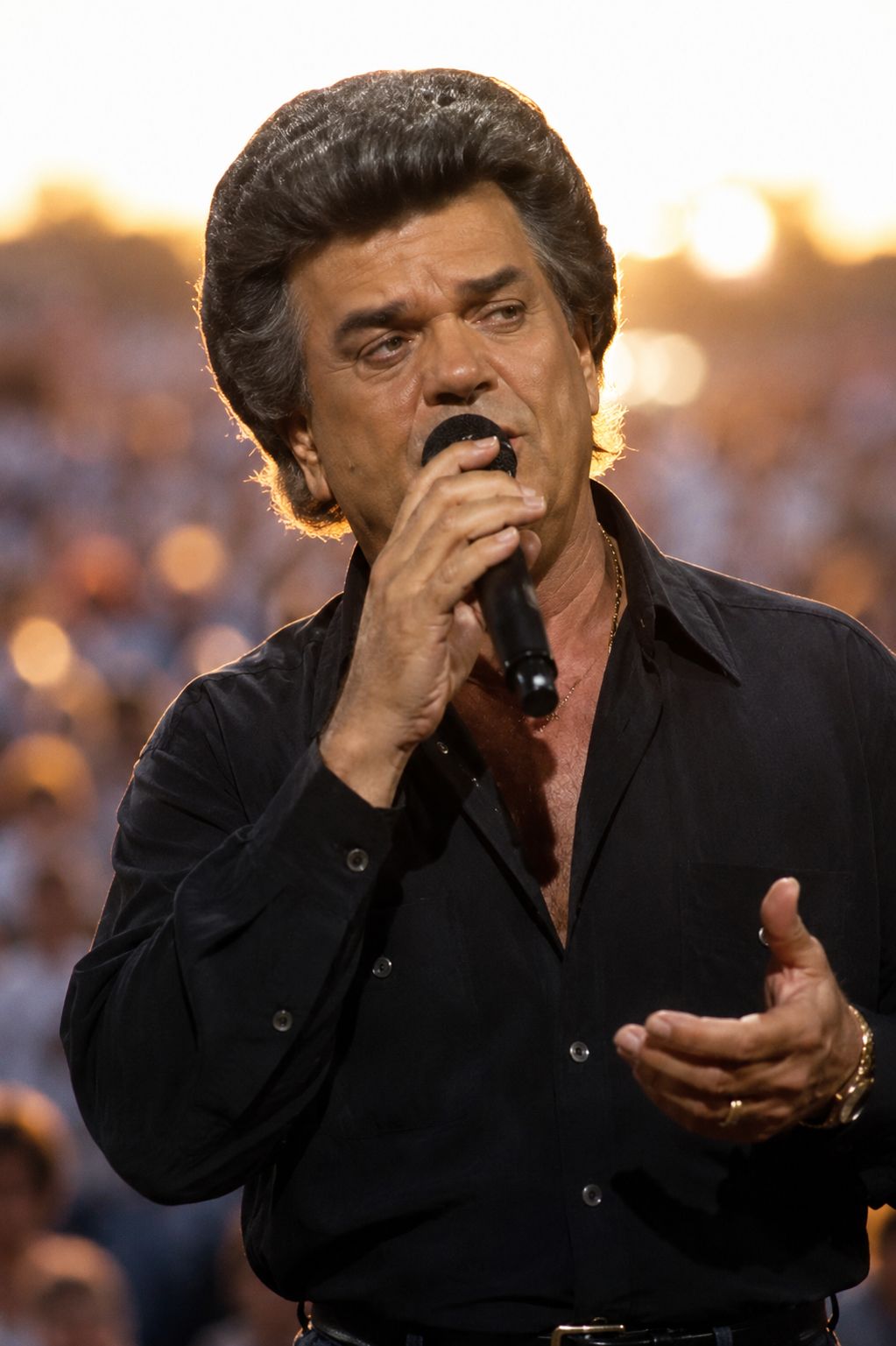
There are country singers who become famous, and then there are artists who seem to become part of the emotional language of an entire generation.
Conway Twitty belonged to the second category.
For decades, his unmistakable voice carried stories of desire, heartbreak, regret, devotion, temptation, and second chances. Songs such as “Hello Darlin’,” “Linda on My Mind,” “You’ve Never Been This Far Before,” and “I’d Love to Lay You Down” made him one of the defining voices of country music. Yet the man behind that legendary name had a life far more complicated—and fascinating—than many fans realize.
Born Harold Lloyd Jenkins in Friars Point, Mississippi, on September 1, 1933, Twitty ultimately built a career spanning rock ’n’ roll, country, songwriting, business, baseball, television, and live entertainment. The Country Music Hall of Fame notes that his stardom survived five decades of changing musical fashions and that he had more country No. 1 records than any country artist had achieved at the time.
But numbers only tell part of the story.
Here are seven remarkable facts that help explain why Conway Twitty remains such an enduring figure.
1. Before Country Music, Conway Twitty Was a Rock ’n’ Roll Superstar
Today, it is difficult to imagine Conway Twitty as anything other than a country legend.
But before Nashville embraced him, he was chasing the sound of early rock ’n’ roll.
Twitty recorded for Sun Records in Memphis, during the same revolutionary period that produced some of the most important rock ’n’ roll music in American history. His early recordings were influenced heavily by Elvis Presley, whose music convinced the young musician that he could compete in rock ’n’ roll even if he was intimidated by the country legends he admired.
Then came “It’s Only Make Believe.”
Released in 1958, the song became a massive international success, turning Twitty into a teen idol and pop star. According to his official biography, the song eventually sold millions of copies and reached No. 1 in numerous countries.
He even appeared in movies during this period.
Yet something inside him remained unsatisfied.
He loved country music.
And eventually, he decided to go home.
2. His Stage Name Was Almost a Musical Geography Lesson
“Conway Twitty” sounds like a name that was destined to belong to a country singer.
But it wasn’t his birth name.
He was born Harold Lloyd Jenkins.
The stage name was created by combining two place names: Conway, Arkansas, and Twitty, Texas. The result was one of the most recognizable names in American music history.
It is almost poetic that a man born Harold Lloyd Jenkins would eventually become “Conway Twitty”—a name that sounded less like an ordinary person and more like a character already waiting inside a country song.
But behind the stage name was a remarkably grounded man.
His official biography describes him as someone who worked hard, cared deeply about his family, and never took his abilities for granted.
That contrast became central to his appeal.
Onstage, he could sound like the world’s most confident man.
Offstage, he was intensely disciplined.
3. Baseball Nearly Became His Career
Before the records, sold-out concerts, and Country Music Hall of Fame induction, Conway Twitty had another dream: professional baseball.
And he was good enough to attract serious attention.
Twitty was scouted by the Philadelphia Phillies after high school, and a professional baseball career appeared possible. But before that dream could become reality, he was drafted into military service during the Korean War era.
Then music pulled him back.
After returning home, Twitty heard Elvis Presley and became convinced that music was the path he should pursue. One account of his life captures the decision almost like a movie scene: he had to choose between the baseball bat and the guitar.
He chose the guitar.
That decision changed country music history.
And it also became one of the great “what if?” moments in entertainment history.
What if Conway Twitty had become a professional baseball player?
We might never have heard “Hello Darlin’.”
4. He Was Already Performing on Radio as a Child
Twitty’s musical story didn’t begin with a record contract.
It began when he was a boy.
According to the Country Music Hall of Fame, he was taught guitar by his grandfather and a neighborhood blues musician, and by the age of 12, he was already broadcasting over radio station KFFA in Helena, Arkansas.
His official biography goes even further, noting that he received his first guitar at only four years old and formed his first band, the Phillips County Ramblers, at age 10.
Think about that for a moment.
While most children were still discovering what they liked, Harold Jenkins was already developing the skills that would eventually define Conway Twitty.
And his influences were wonderfully diverse.
He absorbed country music, blues, gospel, and later rock ’n’ roll. That mixture helped create the distinctive emotional quality that became his trademark.
He didn’t simply sing country songs.
He understood how different musical traditions could make a listener feel something.
5. His Partnership With Loretta Lynn Became Country Music History
If Conway Twitty had never recorded with Loretta Lynn, his legacy would still be enormous.
But together, they created something extraordinary.
Twitty and Lynn became one of the most successful male-female partnerships in country music, recording classics including “After the Fire Is Gone,” “Louisiana Woman, Mississippi Man,” and “Feelin’s.” Their work earned a Grammy and multiple CMA awards.
Their appeal came from chemistry.
They sounded like two people having a conversation that perhaps they shouldn’t be having.
There was tension.
There was vulnerability.
There was humor.
And there was unmistakable emotional electricity.
Their voices seemed to understand each other.
That is difficult to manufacture—and impossible to fake.
“After the Fire Is Gone” wasn’t simply a duet. It sounded like two complicated lives colliding inside one song.
Their recordings remain a reminder of an era when country duets weren’t merely collaborations. They were miniature dramas.
6. He Was Known as “The High Priest of Country Music”
Conway Twitty didn’t perform like everyone else.
He cultivated mystery.
For years, his concerts were famous for their minimalist presentation. He often avoided extensive stage banter, interviews, music-business parties, and the traditional celebrity routine. Instead, he let the songs do the talking.
His intensely devoted audiences helped inspire the nickname “The High Priest of Country Music.”
It was an extraordinary description—but somehow fitting.
Twitty understood something fundamental about performance:
Sometimes saying less makes people listen harder.
His official biography quotes his explanation for his famously restrained concerts:
“I do talk, but the communication is through my music.”
That philosophy tells us a great deal about him.
He wasn’t interested in becoming bigger than the songs.
The songs were the point.
7. His Legacy Was Much Bigger Than His Hit Records
The easiest way to remember Conway Twitty is through statistics.
Forty No. 1 Billboard country hits during his career is an astonishing achievement, according to the Country Music Hall of Fame. Eleven of those No. 1s were songs he wrote himself.
But his influence extended beyond the recording studio.
Twitty established Twitty City, a Nashville-area entertainment and tourism complex, and became involved in baseball ownership and other business ventures. He also supported younger artists and earned a reputation among Nashville songwriters as “the best friend a song ever had.”
Artists including Vince Gill, Kathy Mattea, Naomi Judd, and Reba McEntire were among those whose careers received support from Twitty’s influence and generosity.
That may be one of the most important parts of his legacy.
He wasn’t simply trying to build Conway Twitty.
He was helping build country music.
The Tragic Ending That Made His Legacy Even More Bittersweet
Conway Twitty’s story ended far too soon.
He died on June 5, 1993, at just 59 years old, after suffering a stomach aneurysm while traveling from a performance in Branson, Missouri, toward Nashville.
The timing was painfully cruel.
He was still recording.
Still performing.
Still producing music.
Still finding new ways to connect with audiences.
His final recording session included a collaboration with Sam Moore on “Rainy Night in Georgia,” and an album titled Final Touches was released after his death.
Six years after his death, the ultimate recognition arrived.
In 1999, Conway Twitty was inducted into the Country Music Hall of Fame.
And perhaps that is where the story comes full circle.
The boy from Mississippi.
The baseball hopeful.
The rock ’n’ roll heartthrob.
The country superstar.
The songwriter.
The businessman.
The duet partner.
The mysterious performer who believed the music should speak for itself.
All of them were the same man.
Why Conway Twitty Still Matters
Conway Twitty’s greatest achievement wasn’t simply collecting No. 1 records.
It was reinvention.
He entered music as Harold Lloyd Jenkins, became a rock ’n’ roll sensation as Conway Twitty, and then reinvented himself again as one of country music’s most emotionally powerful performers.
He refused to let the success of one era determine the limits of the next.
That may be why his music continues to resonate.
Because beneath the polished records were very human emotions.
Love.
Jealousy.
Regret.
Longing.
Fear.
Hope.
The things that never go out of style.
Conway Twitty didn’t just sing about heartbreak. He understood why people keep listening to heartbreak songs long after the person who broke their heart is gone.
His career lasted nearly four decades, his influence crossed genres, and his recordings became part of the permanent soundtrack of country music.
But perhaps his most enduring legacy is simpler.
He understood that a great country song doesn’t need to explain everything.
Sometimes it only needs to say the thing that someone sitting alone in the dark desperately needed to hear.
And Conway Twitty had a remarkable gift for doing exactly that.
VIDEO: