 By admin
 INTRODUCTION:
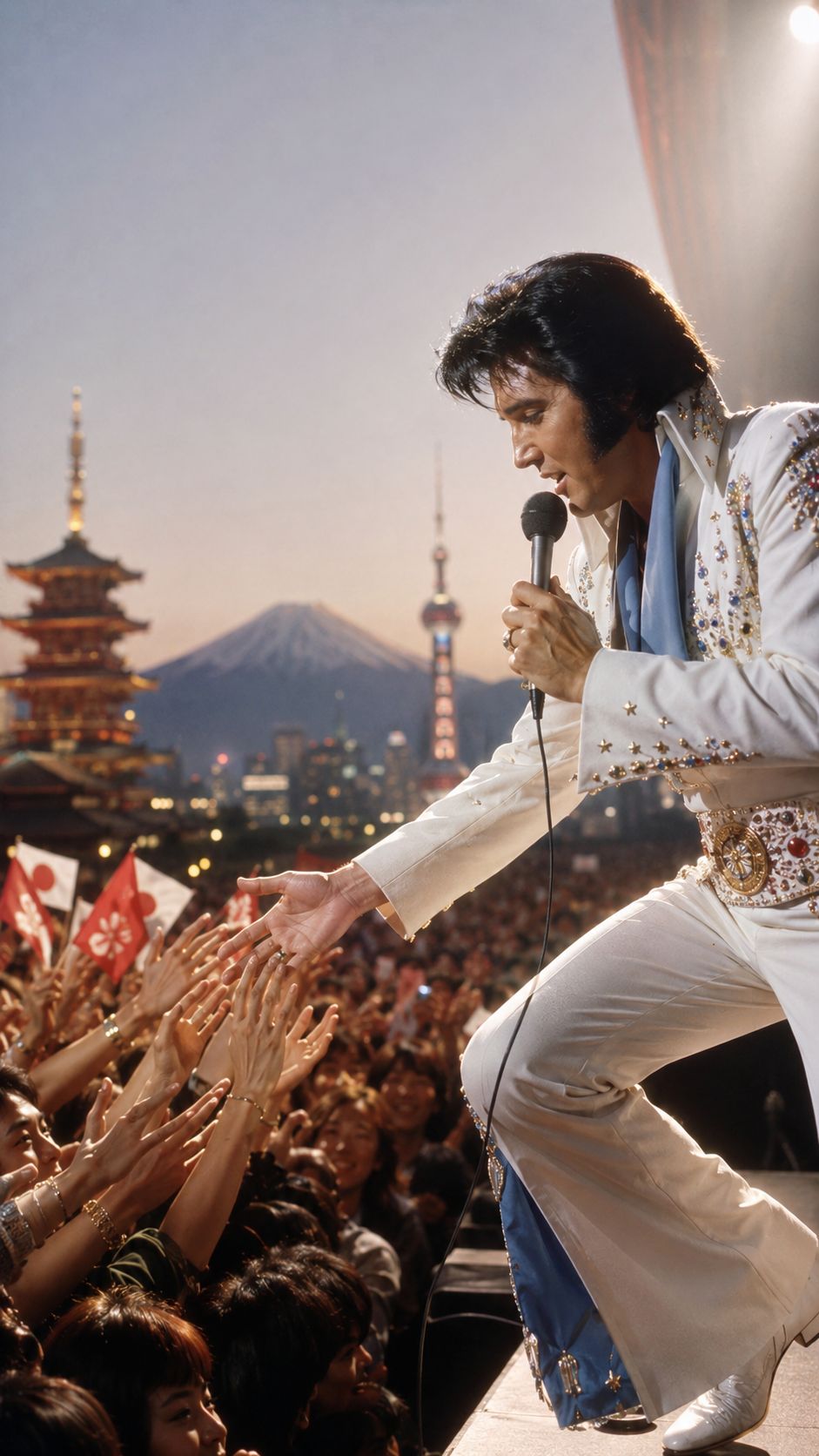
There are many tragedies woven into the legend of Elvis Presley, but one of the most heartbreaking remains surprisingly overlooked. While the world remembers the dazzling jumpsuits, the sold-out theaters, the screaming fans, and the unmatched cultural impact of the King of Rock and Roll, few fully understand the dream that haunted him during the final years of his life: the desire to perform for his millions of loyal fans across Europe and Asia.
For fans in countries thousands of miles away from America, Elvis Presley was not merely an entertainer. He was a symbol of freedom, rebellion, hope, and modern music itself. His records crossed oceans, his movies reached foreign cinemas, and his influence transformed generations of musicians. Yet despite his global fame, countless admirers never had the chance to see him perform live.
As the 1970s unfolded, Elvis reportedly expressed growing frustration about being confined to a relentless cycle of performances in Las Vegas and domestic tours across the United States. The world was calling for him. International promoters were eager. Fans in Japan, Australia, Germany, England, and throughout Asia dreamed of welcoming the biggest star on Earth.
But the tours never happened.
Instead, the singer found himself trapped inside a demanding machine that prioritized short-term profits over long-term fulfillment. What followed became one of the most painful “what if” stories in music history—an untold chapter filled with ambition, exhaustion, and a dream that remained forever out of reach.
The Global Superstar Who Rarely Left America
By the early 1970s, Elvis Presley had become one of the most recognized figures on the planet. His influence extended far beyond the borders of the United States. His recordings sold in massive numbers throughout Europe and Asia, while fan clubs flourished in countries where he had never set foot.
The irony was striking.
Few artists possessed a larger international audience, yet few major stars traveled less extensively overseas. Aside from military service in Germany during the late 1950s and a handful of performances outside the continental United States, Elvis never embarked on the kind of global touring schedule that later became standard for international superstars.
Many historians point to the enormous control exercised by his longtime manager, Colonel Tom Parker.
The relationship between Elvis Presley and Colonel Tom Parker remains one of the most analyzed partnerships in entertainment history. Parker helped transform a young singer from Memphis into a worldwide sensation. Yet critics argue that his management style increasingly prioritized predictable revenue streams over artistic freedom.
The world wanted Elvis. Elvis wanted the world. But somewhere in between stood a gatekeeper who never opened the door.
Why Europe and Asia Never Got Their Elvis Tour
For years, promoters across Europe attempted to bring Elvis Presley overseas. The financial opportunities were staggering. Stadiums could have sold out instantly. Television specials would have generated enormous publicity. Fans were ready.
Yet proposal after proposal failed to materialize.
One commonly cited factor involved Parker’s personal circumstances. Because of questions surrounding his citizenship and legal status, many researchers believe he was reluctant to travel internationally. Since Parker insisted on maintaining complete control over Elvis’s business affairs, international touring became increasingly complicated.
The result was a devastating missed opportunity.
While contemporaries expanded their global reach, Elvis Presley remained largely confined to American stages. Fans in London, Tokyo, Hong Kong, Singapore, Manila, and countless other cities continued waiting for a concert that never came.
For Asian audiences especially, the disappointment was profound. The influence of Rock and Roll had spread rapidly throughout the region. Young musicians learned songs inspired by Elvis, copied his style, and embraced his revolutionary approach to performance. Yet the artist who inspired them remained physically distant.
Many longtime fans still describe this absence as one of the greatest disappointments in music history.
The Las Vegas Cycle
The centerpiece of Elvis’s later career became Las Vegas.
His comeback performances in 1969 were a sensation. Audiences flocked to see him. Critics praised his renewed energy. The residency initially represented artistic rebirth.
However, what began as a triumphant return gradually evolved into an exhausting routine.
Year after year, Elvis Presley returned to the same city, performing hundreds of shows under immense pressure. The schedule was relentless. Residencies generated substantial income, making them attractive from a business perspective. Yet the physical and emotional demands were immense.
The excitement of exploring new countries, connecting with unfamiliar audiences, and experiencing different cultures was replaced by repetition.
Many observers believe that international touring could have revitalized him creatively.
Imagine Elvis standing before 50,000 fans in Tokyo.
Imagine him performing Suspicious Minds, Can’t Help Falling in Love, and Burning Love in packed arenas across Europe.
Imagine the emotional energy generated by audiences who had waited decades to see him.
Instead, he remained caught in a cycle that seemed increasingly disconnected from his personal aspirations.
The Human Cost
As the years progressed, the demands of constant performances began taking a visible toll.
Health issues mounted. Fatigue became increasingly apparent. The pressure to maintain an exhausting schedule never truly disappeared.
Friends, associates, and biographers have often described a man who felt trapped between public expectations and private desires.
He had conquered the world through records, movies, and television, yet he could not freely travel the world that loved him.
This contradiction became one of the great emotional burdens of his later years.
For someone who thrived on audience connection, the inability to meet international fans carried genuine emotional weight. Reports from people close to Elvis Presley suggest he remained curious about foreign audiences and aware of his enormous popularity overseas.
Asia, in particular, represented an unrealized chapter.
Countries throughout the region had embraced American popular culture, and Elvis stood at the center of that movement. The possibility of performing in major Asian cities represented more than a business venture—it was an opportunity to complete a relationship that had existed for decades through records alone.
The Regret That Never Went Away
Every legendary artist leaves behind unfinished dreams.
For Elvis Presley, one of the most poignant appears to have been the inability to fully embrace his international audience.
His legacy remains untouchable. His music continues to inspire new generations. Songs like Heartbreak Hotel, Jailhouse Rock, Love Me Tender, Suspicious Minds, and Can’t Help Falling in Love remain timeless pillars of popular music.
Yet there remains a lingering sadness in the story.
The fans who waited in Europe never saw him.
The admirers throughout Asia never welcomed him onto their stages.
The global celebration that seemed inevitable never arrived.
History remembers Elvis Presley as a man who changed music forever. But behind the legend stood a performer who reportedly longed to reach the people who had supported him from afar.
And perhaps that is why this chapter continues to resonate so deeply.
Not because of what happened.
But because of what never had the chance to happen.
Somewhere across Europe and Asia, millions of fans kept waiting for Elvis to arrive. The tragedy is that he wanted to come, too.