 By admin
 INTRODUCTION:
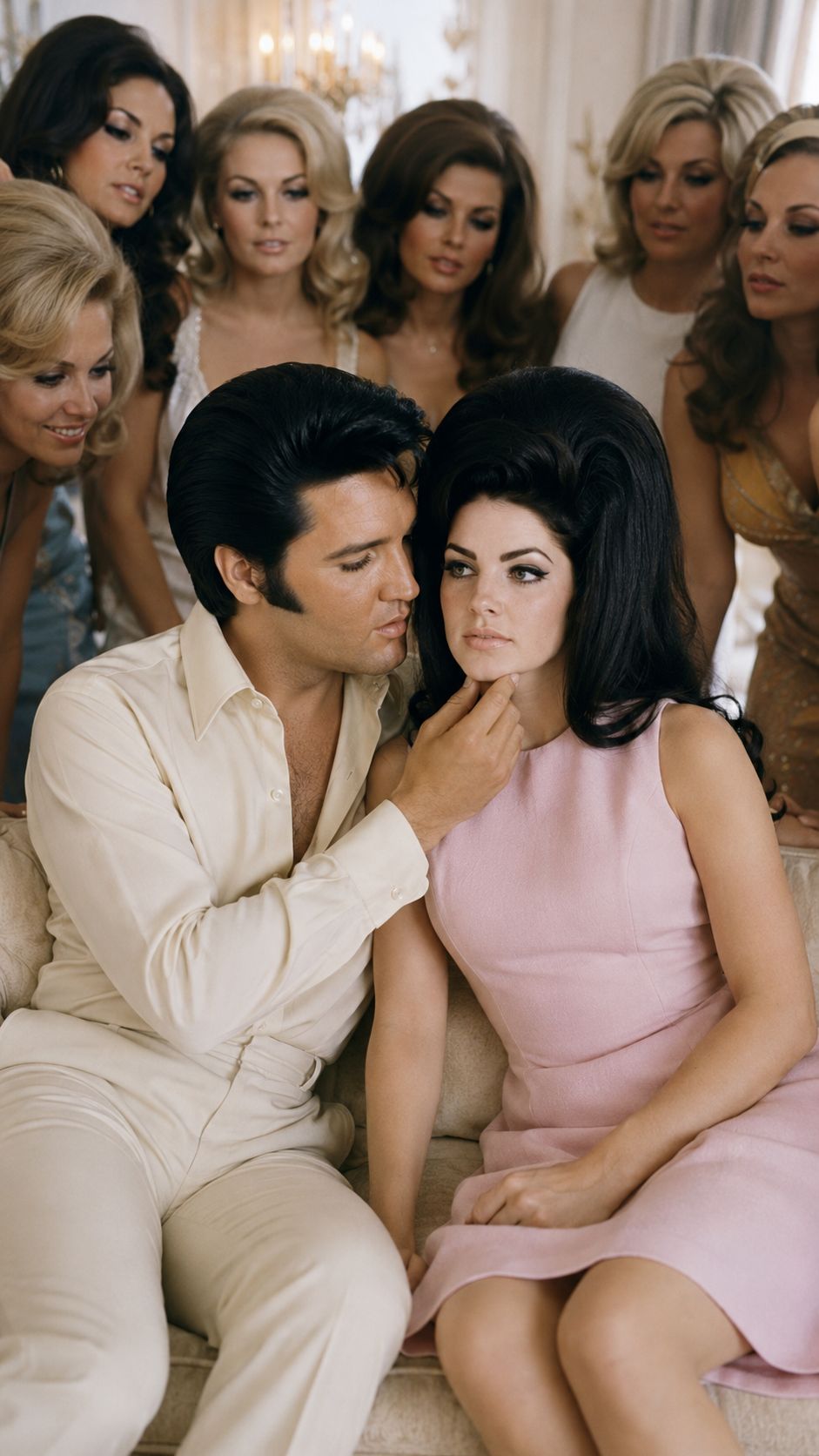
Few love stories in American pop culture have generated as much fascination, controversy, and heartbreak as the relationship between Elvis Presley and Priscilla Presley. To the world, they appeared to embody a fairy-tale romance: the King of Rock and Roll and the beautiful young woman who stood faithfully beside him. Their photographs became iconic, their wedding became international news, and their names became forever intertwined in the mythology of American celebrity.
Yet behind the glamorous images existed a far more complicated reality.
The story of Elvis Presley and Priscilla Presley was not merely a love story. It was a story about power, control, expectations, and contradiction. It revealed the enormous pressures of fame and the deeply traditional beliefs that shaped many relationships during the mid-twentieth century. While Elvis adored Priscilla in many ways, he also sought to mold her into an idealized vision of womanhood that existed largely in his imagination.
At the same time, a painful paradox sat at the center of their marriage. The woman he loved was expected to remain pure, loyal, and carefully controlled, while he moved through a world filled with movie stars, admirers, backup singers, and endless temptation.
The greatest tragedy of their relationship may not have been that they loved each other too little—but that they loved each other according to rules that were never equal.
Understanding that contradiction helps explain why one of America’s most famous romances ultimately could not survive.
The Making of an Ideal Woman
When Elvis Presley first met Priscilla Presley in Germany in 1959, the age difference and imbalance of life experience were impossible to ignore. Elvis was already one of the most famous entertainers on Earth. Priscilla was still a teenager trying to understand the extraordinary world into which she had suddenly been invited.
From the beginning, many accounts suggest that Elvis took a highly active role in shaping Priscilla’s appearance and behavior. He reportedly influenced everything from her hairstyle to her makeup choices. The dark hair, dramatic eye makeup, elegant wardrobe, and polished image that later became synonymous with Priscilla were heavily influenced by Elvis’s personal preferences.
To Elvis, image mattered enormously.
As the face of the emerging Rock and Roll revolution, he understood the power of visual presentation better than almost anyone in entertainment. But his desire for control extended beyond stagecraft and celebrity branding. It also entered the most intimate areas of his personal life.
Priscilla often described learning how Elvis wanted her to dress, how he preferred her to carry herself, and even how he wanted conversations to unfold. In many ways, she became the living embodiment of his idealized feminine image.
Elvis didn’t simply fall in love with Priscilla. He helped create the version of Priscilla he wanted to love.
This dynamic reflected broader cultural expectations during the late 1950s and 1960s. Men were frequently expected to lead relationships, while women were encouraged to adapt themselves to male expectations. Yet in the case of Elvis Presley, those tendencies were amplified by unprecedented fame, wealth, and influence.
The Madonna Ideal
One of the most discussed aspects of Elvis’s personal life was his complicated relationship with sexuality and intimacy.
Biographers have long noted that Elvis often divided women into categories. Some were viewed as respectable and pure, while others occupied a more openly sexual role. This psychological pattern created enormous challenges within his marriage.
Priscilla increasingly represented the image of the ideal wife and mother. After the birth of their daughter, Lisa Marie Presley, that perception reportedly intensified.
For Elvis, purity carried immense symbolic importance.
Yet the very qualities he admired sometimes made true emotional intimacy difficult. The woman placed upon a pedestal became difficult to see as a fully independent individual with her own desires, ambitions, and evolving identity.
The contradiction was painful.
The more Priscilla fulfilled the role Elvis envisioned, the further she risked losing the freedom to define herself.
Being someone’s dream can become a prison when you’re no longer allowed to be yourself.
A World Filled With Temptation
While Priscilla lived within the expectations of domestic life, Elvis occupied a vastly different reality.
Throughout the height of his fame, Elvis Presley was constantly surrounded by beautiful women. During his years in Hollywood, he worked alongside some of the most admired actresses of the era. Films such as Blue Hawaii, Viva Las Vegas, and numerous other productions placed him in close proximity to glamorous co-stars.


The entertainment industry of the 1960s created an environment where celebrity, admiration, and temptation existed everywhere.
In addition to actresses, Elvis was frequently accompanied by members of his entourage, singers, dancers, and fans eager to gain access to his world. Stories about romantic relationships and affairs followed him throughout much of his adult life.
What made this especially difficult was the apparent double standard.
The freedoms available to Elvis were not equally available to Priscilla. Society often excused male celebrity behavior while demanding unwavering loyalty from women.
This imbalance reflected a broader cultural reality of the era, but it became particularly visible because of Elvis’s immense fame.
The Price of Control
Control can create stability in the short term, but it often produces resentment over time.
As Priscilla matured, she began to develop a stronger sense of independence. The young girl who had entered Elvis’s world eventually became a woman seeking her own identity.
That evolution was inevitable.
No person can permanently remain frozen inside another person’s fantasy.
Priscilla later spoke openly about how difficult it was to discover who she truly was outside of Elvis’s influence. Many of the choices she made for years had been filtered through his expectations.
The challenge wasn’t simply that Elvis controlled aspects of her appearance. It was that his vision often left little room for personal growth.
Meanwhile, Elvis himself struggled with pressures few people could comprehend. Global fame, relentless public attention, career demands, and personal insecurities created emotional burdens that frequently surfaced in his relationships.
The result was a marriage increasingly strained by competing realities.
One partner sought freedom.
The other sought permanence.
One was trying to discover herself.
The other was trying to preserve an ideal.
Why Their Story Still Resonates
More than half a century later, the relationship between Elvis Presley and Priscilla Presley continues to captivate audiences because it reflects universal human questions.
How much influence should one partner have over another?
Can love survive when expectations become more important than individuality?
What happens when admiration transforms into control?
The story also exposes the gender dynamics that defined much of the mid-century entertainment world. The standards applied to powerful men often differed dramatically from those imposed on women.
Today, many viewers examine their relationship through a modern lens and see warning signs that earlier generations may have overlooked. Others see two flawed people doing their best within the cultural framework of their time.
Perhaps both perspectives contain truth.
What remains undeniable is that Elvis Presley and Priscilla Presley shared a bond that was profound, complicated, and ultimately unsustainable.
Their relationship was built on genuine affection, but affection alone could not overcome inequality.
In the end, the tragedy was not merely that their marriage ended. It was that the dream each carried into the relationship was fundamentally different.
Elvis searched for an ideal woman.
Priscilla searched for the freedom to become her own.
And somewhere between those two desires, one of the most famous love stories in entertainment history quietly unraveled.