 By admin
 INTRODUCTION:
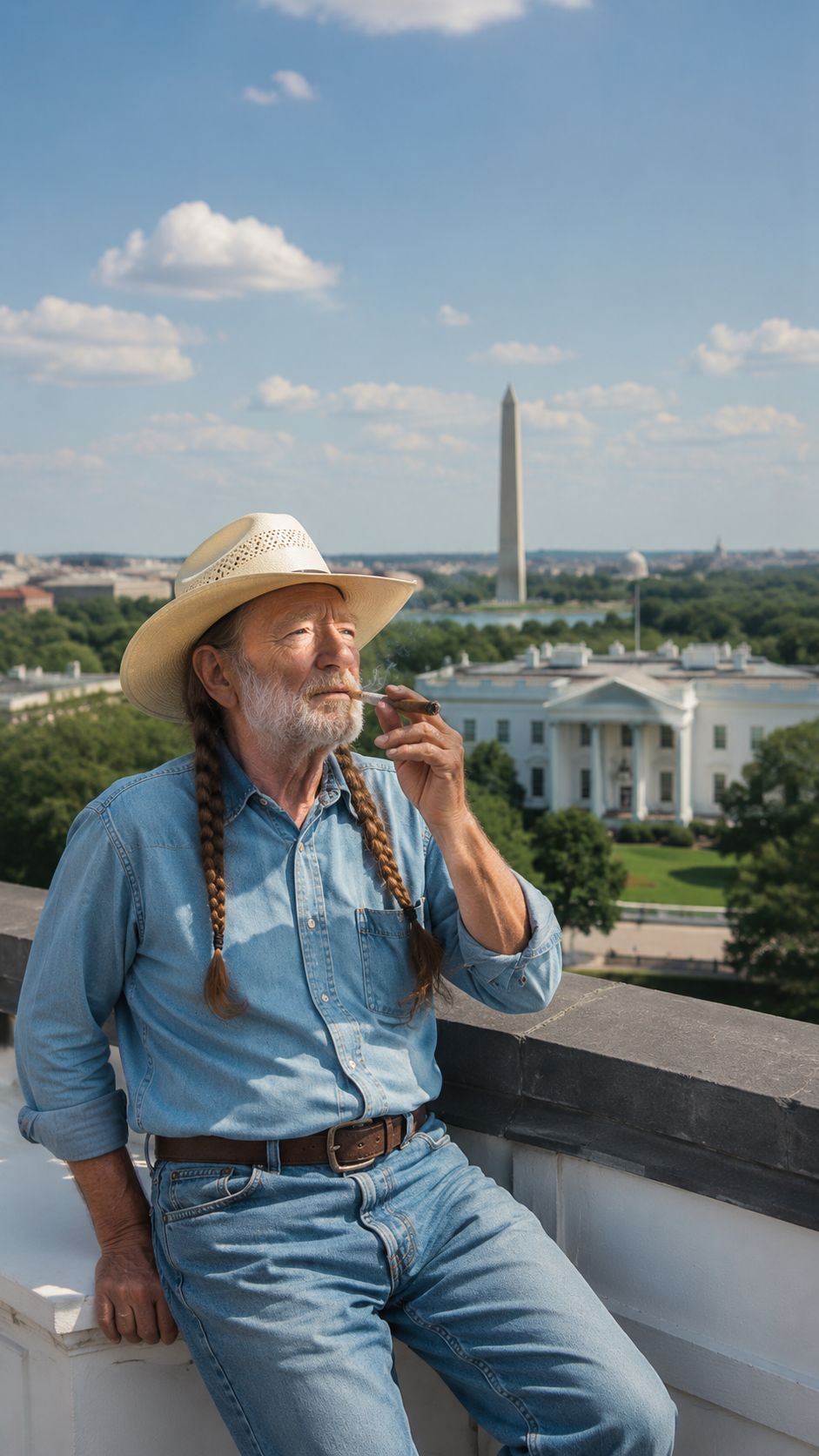
There are stories in Country Music that feel larger than life—moments so improbable, so perfectly aligned with an artist’s spirit, that they transcend fact and become folklore. Few tales fit that description better than the legendary night when Willie Nelson, visiting the White House as a guest of President Jimmy Carter, quietly slipped away, climbed to the roof, and smoked a joint while gazing across the Washington skyline.
It sounds like something straight out of a movie. The White House, the most powerful residence in America. The nation’s capital stretched beneath the stars. And standing above it all was Willie Nelson, a musician whose career had already become synonymous with freedom, rebellion, and authenticity.
For decades, fans have repeated the story with a mixture of disbelief and admiration. It captures everything that made Willie Nelson unique: his refusal to conform, his effortless cool, and his ability to remain completely himself regardless of where he was. Whether performing in small Texas dance halls or walking the halls of political power, Willie carried the same spirit.
More than a funny anecdote, the White House rooftop story reveals something profound about both the artist and the era. It symbolizes a collision between establishment America and the outlaw soul of Country Music—a moment when the boundaries between power and freedom briefly disappeared beneath the stars.
The Most Willie Nelson Story Ever Told
Among all the legends surrounding Willie Nelson, this one stands apart because it feels almost impossible to invent. During a visit to the White House in the late 1970s, when President Jimmy Carter occupied the Oval Office, Willie attended an event as an honored guest.
Most visitors would have been overwhelmed by the significance of the moment. They might have admired the architecture, shaken hands with dignitaries, and carefully followed protocol.
Not Willie.
Instead, according to the story later confirmed and discussed over the years, he found his way onto the White House roof. There, looking out over Washington, D.C., he smoked a joint while taking in one of the most iconic views in America.
“It was probably one of the best joints I ever smoked.”
That quote would become part of Country Music mythology, perfectly reflecting the humor and honesty that made Willie beloved by millions.
The image itself is unforgettable. The White House represents authority, tradition, and governmental power. Willie Nelson represented independence, creativity, and resistance to convention.
For one remarkable evening, those two worlds occupied the same rooftop.
The Outlaw Country Spirit
To understand why this story resonates so deeply, it is important to understand Willie’s place in the history of Outlaw Country.
During the 1970s, Outlaw Country emerged as a reaction against the polished, heavily controlled Nashville Sound. Artists wanted greater creative freedom and sought to reconnect with authentic storytelling.
Figures like Willie Nelson, Waylon Jennings, Kris Kristofferson, and Johnny Cash became symbols of artistic independence.
Albums such as Red Headed Stranger transformed Willie from a respected songwriter into a cultural phenomenon. His music spoke to outsiders, dreamers, drifters, and anyone who felt constrained by expectations.
The White House rooftop story perfectly encapsulates that identity.
Even inside the most prestigious building in America, Willie remained Willie.
He did not change for the institution. The institution became part of the story.
That distinction explains why the anecdote continues to fascinate fans decades later.
Jimmy Carter and an Unusual Friendship
The story also reveals something important about President Jimmy Carter and the cultural climate of the era.
Unlike many political leaders, Carter openly appreciated artists and musicians. He developed friendships with figures from across the entertainment world and often embraced people who existed outside traditional political circles.
The relationship between Jimmy Carter and Willie Nelson reflected a uniquely American dynamic. They came from different worlds but shared a deep appreciation for honesty, humility, and human connection.
The late 1970s were a period of social transition. America was redefining itself after the turbulence of the 1960s and the scandals of the 1970s. Music increasingly served as a bridge between political institutions and everyday citizens.
Willie’s White House visit symbolized that bridge.
Rather than representing conflict between government and counterculture, the moment suggested coexistence. An outlaw musician could be welcomed into the nation’s most important residence without abandoning his identity.
Why Fans Love the Story
Many celebrity stories fade because they feel manufactured. This one survives because it feels undeniably authentic.
Everything about it aligns with the public image Willie Nelson spent decades building.
Fans never viewed Willie as a carefully constructed celebrity brand. They saw him as genuine. His songs, interviews, and public appearances projected consistency.
Whether singing classics like Blue Eyes Crying in the Rain, Always on My Mind, or On the Road Again, Willie communicated the same values: freedom, honesty, and living life on one’s own terms.
The White House story reinforces those values.
Standing above Washington, Willie wasn’t trying to make a statement. He was simply being himself.
That authenticity is increasingly rare in modern celebrity culture, which helps explain why the anecdote remains so compelling.
A Perfect Symbol of Country Music’s Evolution
The story also reflects a broader transformation within Country Music itself.
For much of its history, country artists were often portrayed through narrow stereotypes. The rise of Outlaw Country challenged those assumptions by introducing more complex personalities and perspectives.
Willie Nelson became one of the movement’s most recognizable ambassadors.
His music blended traditional country roots with influences from jazz, folk, western swing, and popular music. He appealed to rural audiences and urban listeners alike.
The White House rooftop moment symbolizes that evolution.
An artist once considered a rebel was now invited into the highest levels of American society. Yet rather than losing his edge, he brought his individuality with him.
In that sense, the story represents more than personal rebellion.
It represents cultural acceptance.
The outlaw had not been tamed. He had become a national treasure.
The Enduring Legacy of the Rooftop Joint
Decades later, the image continues to capture imaginations because it feels uniquely American.
Only in America could a musician become an icon by challenging convention. Only in America could that same musician eventually find himself standing atop the White House.
The tale survives because it combines humor, symbolism, and authenticity into a single unforgettable moment.
For fans of Country Music, it serves as a reminder that the genre’s greatest artists often succeed not by fitting expectations but by refusing to fit them.
For admirers of Willie Nelson, it confirms everything they already believed about him.
He was fearless.
He was authentic.
And whether he was performing before thousands of fans or looking out across Washington from the White House roof, he remained unmistakably, unapologetically Willie.
Long after political administrations have changed and generations have passed, the image remains: Willie Nelson, under the night sky, above the nation’s capital, embodying the restless spirit of freedom that made him one of the most beloved figures in the history of Country Music.