 By admin
 INTRODUCTION:
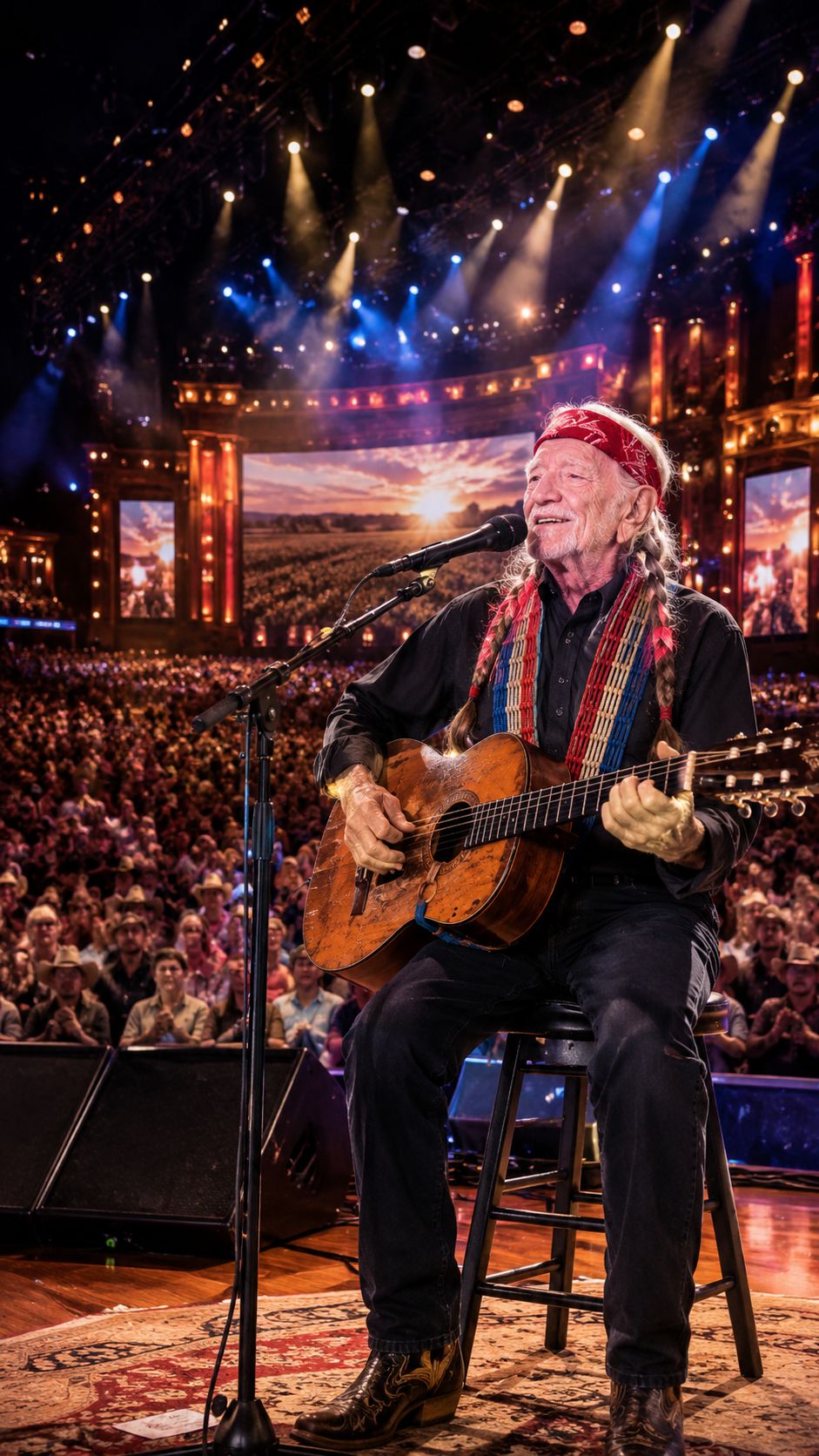
There are legends, there are icons, and then there is Willie Nelson—a man who somehow transcends both labels. With his weathered face, unmistakable twin braids, and the battered guitar known as Trigger, he often appears less like a global superstar and more like a wise traveler who wandered in from another century. His smile is warm. His voice is gentle. His presence feels peaceful.
But that image tells only part of the story.
Behind those braids lies one of the toughest survivors in the history of country music. Few artists have endured as many personal, professional, financial, and cultural battles as Willie Nelson. He has watched entire eras rise and fall. He has outlived trends, critics, record executives, and countless predictions that his career was finished. Time and again, the industry changed around him, yet he remained standing.
His journey is not simply a story about success. It is a story about resilience. It is about refusing to fit into someone else’s mold. It is about losing everything and rebuilding from nothing. Most importantly, it is about staying true to yourself even when the world insists you change.
For more than six decades, Willie Nelson has embodied the spirit of survival. And that may be the greatest achievement in all of country music.
The Man Who Never Fit Nashville’s Rules
When Willie Nelson first arrived in Nashville during the early 1960s, he did not look or sound like a future star. The dominant image of country music at the time favored polished performers with smooth voices and carefully crafted appearances.
Willie Nelson was different.
His singing style bent melodies in unconventional ways. His phrasing often seemed to float behind the beat. Record executives struggled to understand him. Many believed he was better suited to writing songs than performing them.
Ironically, those same qualities would eventually make him unforgettable.
Before becoming a superstar, he established himself as one of the most gifted songwriters in America. Classics such as “Crazy”, immortalized by Patsy Cline, and “Hello Walls”, recorded by Faron Young, proved that his songwriting genius could not be ignored.
Yet even while other artists turned his songs into hits, Willie Nelson remained on the outside looking in.
“The world loved his songs long before it fully understood the man who wrote them.”
That disconnect would become one of the defining struggles of his career.
The Birth of the Outlaw Revolution
Everything changed during the 1970s.
Frustrated with the rigid expectations of the Nashville Sound, Willie Nelson returned to Texas and embraced creative freedom. His hair grew longer. His image became more rebellious. Most importantly, he began making music on his own terms.
This movement would become known as Outlaw Country.
Alongside fellow rebels like Waylon Jennings, Willie Nelson challenged the traditional power structure of country music. Instead of allowing producers and executives to dictate every detail, artists demanded control over their sound and identity.
Albums like “Shotgun Willie”, “Phases and Stages”, and especially “Red Headed Stranger” transformed him into a cultural force.
Many industry insiders initially considered “Red Headed Stranger” too sparse and unconventional. Yet the album became a masterpiece and one of the most influential records in country music history.
The lesson was simple:
Willie Nelson succeeded not because he adapted to the industry—but because he forced the industry to adapt to him.
Trigger: The Guitar That Refused to Die
Every great survivor has a symbol.
For Willie Nelson, that symbol is Trigger.
The famous acoustic guitar has accompanied him for decades, accumulating scars, scratches, and a massive hole worn into its body by years of relentless playing. Most musicians would have replaced it long ago.
Not Willie.
The guitar’s condition mirrors its owner’s journey. Both have been battered by time. Both show every mile traveled. And both continue to perform despite the damage.
To many fans, Trigger represents authenticity in an era increasingly dominated by image and marketing.
“The hole in Trigger isn’t damage. It’s a record of survival.”
Each mark tells a story. Every scratch represents another concert, another city, another year spent refusing to quit.
The Tax Nightmare That Nearly Destroyed Him
Perhaps the greatest test of Willie Nelson’s resilience arrived in the early 1990s.
The Internal Revenue Service (IRS) claimed he owed millions of dollars in unpaid taxes. The debt became one of the most public financial disasters ever faced by a major entertainer.
His assets were seized.
His properties were taken.
Many observers believed the situation would permanently destroy his career.
Instead, Willie Nelson did what survivors do.
He kept working.
He toured relentlessly, recorded music, and found creative ways to repay the debt. Rather than disappearing in shame, he confronted the crisis openly.
The result became one of the most remarkable comeback stories in entertainment history.
While many celebrities have seen financial scandals define their legacy, Willie Nelson transformed adversity into another chapter of perseverance.
Crossing Generations Without Losing Himself
One reason Willie Nelson remains relevant is his remarkable ability to connect with multiple generations.
Unlike artists who constantly chase trends, he never abandoned his identity. Instead, younger audiences came to him.
From collaborations with Johnny Cash and Merle Haggard to projects involving artists from rock, folk, Americana, and even modern popular music, he became a bridge between eras.
His influence extends far beyond country music.
Artists admire his songwriting. Musicians respect his independence. Fans trust his authenticity.
That trust has become increasingly valuable in a world where celebrity images often feel manufactured.
When people listen to Willie Nelson, they believe they are hearing the real person.
And they are.
The Secret Behind His Longevity
Many artists achieve fame.
Very few achieve endurance.
The secret behind Willie Nelson’s extraordinary longevity is not talent alone. Plenty of talented performers disappear. It is not luck. Luck fades.
His true strength is adaptability without compromise.
He evolved while remaining unmistakably himself.
As country music moved from the era of vinyl records to streaming platforms, from honky-tonks to stadiums, Willie Nelson continued forward. He never chased youth. He never pretended to be something he was not.
Instead, he embraced age with dignity.
The result is rare: an artist whose credibility grows stronger with time.
“Most stars spend their careers trying to stay relevant. Willie Nelson became timeless.”
The Ultimate Survivor
Today, Willie Nelson stands as one of the last living connections to multiple generations of country music history.
He survived rejection.
He survived industry politics.
He survived financial ruin.
He survived changing musical fashions.
He survived the countless moments when others assumed his story was over.
Yet every time the final chapter seemed near, another chapter appeared.
That is why his legacy extends beyond awards, chart positions, or record sales.
His greatest achievement is endurance.
The sight of Willie Nelson holding Trigger is more than an image of a musician. It is a reminder that authenticity can outlast trends, that resilience can overcome failure, and that true artistry cannot be manufactured.
Beneath the smile of the peaceful old man is a fighter who spent a lifetime proving that survival is its own form of greatness.
And in the long history of country music, no one has survived quite like Willie Nelson.