 By admin
 INTRODUCTION:
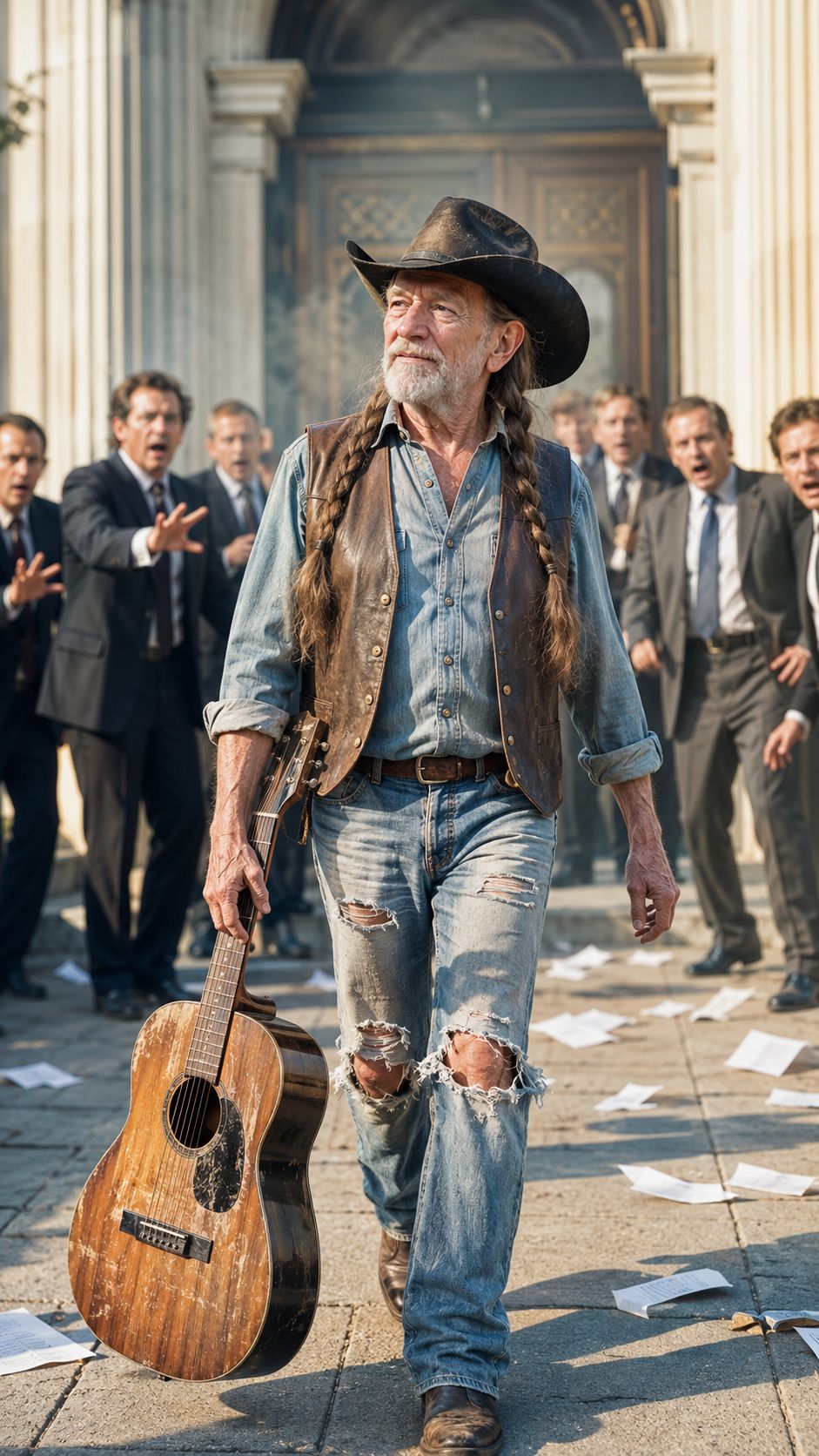
In the history of Country Music, there are moments that feel less like career decisions and more like acts of rebellion. Few artists embodied that spirit more completely than Willie Nelson. Long before he became a cultural icon, a symbol of artistic freedom, and one of the most recognizable voices in American music, Nelson found himself trapped inside a system that demanded conformity.
The 1970s were a defining era for Nashville. The music establishment had perfected a formula. Artists were expected to look polished, speak carefully, wear tailored suits, and fit neatly into the industry’s vision of marketable country stars. Success often depended as much on appearance and obedience as it did on talent.
Yet at the height of his growing fame, Willie Nelson made a decision that stunned executives, producers, and industry insiders alike. He abandoned the clean-cut image that Nashville expected. He grew his hair long. He let his beard flourish. He traded polished stagewear for ripped jeans and casual clothes. Most importantly, he walked away from the rigid rules that governed the business.
What followed was not career suicide, as many predicted. It became one of the most important artistic revolutions in the history of Country Music, transforming Nelson from a respected songwriter into a legendary cultural force whose influence still echoes decades later.
The Nashville Machine of the Early 1970s
To understand the significance of Willie Nelson’s transformation, it is necessary to understand the world he was rejecting.
During the late 1960s and early 1970s, Nashville operated with remarkable control over the careers of country artists. Producers often dictated song selections, studio arrangements, public appearances, and even personal style. The famous “Nashville Sound” had become commercially successful by blending country roots with polished pop production.
Artists were expected to fit a specific image. Clean-shaven faces, carefully combed hair, expensive suits, and predictable performances were part of the package.
For many musicians, the formula worked.
For Willie Nelson, it became a prison.
Despite being recognized as a brilliant songwriter behind classics such as “Crazy”, famously recorded by Patsy Cline, Nelson increasingly felt disconnected from the version of himself being presented to the public.
His creativity was constrained.
His individuality was muted.
His authentic voice was struggling to breathe.
“The greatest artists rarely change the world by fitting in. They change it by refusing to.”
The Turning Point
The turning point came when Willie Nelson returned to Texas, reconnecting with the culture that had shaped him long before Nashville attempted to refine him.
Texas offered something the industry could not:
Freedom.
The music scene there was vibrant, unpredictable, and deeply authentic. Audiences cared less about polished appearances and more about honest performances. Musicians blended genres without asking permission. Country mixed with rock. Folk mixed with blues. Boundaries became irrelevant.
For Nelson, it felt like coming home.
Instead of fighting to fit into Nashville’s expectations, he embraced the version of himself he had always been.
His hair grew longer.
His beard became legendary.
His wardrobe became intentionally casual.
The transformation was more than cosmetic. It represented a philosophical declaration of independence.
He was no longer willing to allow executives to determine his artistic identity.
The Birth of the Outlaw Movement
What seemed radical at the time soon evolved into something much larger.
Willie Nelson, alongside artists such as Waylon Jennings, became central figures in what would later be known as Outlaw Country.
Unlike traditional Country Music, Outlaw Country rejected corporate control and creative restrictions. Artists demanded ownership of their recordings, greater control over production, and the freedom to write and perform music that reflected their real lives.
The movement resonated because it mirrored broader cultural changes happening throughout America during the 1970s.
People were questioning authority.
Institutions were losing their unquestioned power.
Authenticity was becoming more valuable than perfection.
Nelson’s appearance became a visual symbol of this movement.
The beard wasn’t merely facial hair.
The ripped jeans weren’t merely fashion.
They became statements.
They communicated that an artist could be successful without surrendering individuality.
“Every strand of hair and every worn thread of denim represented freedom from a system designed to create uniformity.”
Red Headed Stranger: The Gamble That Changed Everything
The ultimate test of Nelson’s newfound independence came with “Red Headed Stranger” in 1975.
From a commercial perspective, the album appeared risky.
The production was sparse.
The arrangements were minimal.
The storytelling was unconventional.
Many industry executives believed the record sounded unfinished.
Some feared it would damage Nelson’s career.
Instead, it became a masterpiece.
“Red Headed Stranger” achieved massive commercial success while earning critical acclaim. Songs like “Blue Eyes Crying in the Rain” proved that audiences were hungry for authenticity.
The album’s success sent shockwaves throughout Nashville.
The establishment had assumed that strict control was necessary to produce hits.
Nelson demonstrated the opposite.
Artists could trust their instincts.
Audiences could appreciate simplicity.
Creative freedom could be profitable.
Why His Look Mattered More Than People Realized
Critics sometimes reduce Nelson’s transformation to a fashion statement.
That interpretation misses the deeper truth.
Throughout entertainment history, appearance has often served as a tool of institutional control. Industries create visual standards because they help maintain predictable brands.
When Willie Nelson rejected those standards, he challenged the underlying power structure itself.
His image became inseparable from his message.
Fans saw someone who appeared exactly as he wished.
There was no corporate filter.
No manufactured persona.
No artificial polish.
In an era increasingly dominated by commercial interests, Nelson represented something rare: authenticity.
That authenticity created trust.
And trust created loyalty.
The bond between Willie Nelson and his audience became far stronger than any marketing campaign could manufacture.
“People weren’t just listening to Willie Nelson’s music. They were witnessing a man live according to his own principles.”
The Long-Term Impact on Country Music
The ripple effects of Nelson’s rebellion extended far beyond his own career.
Modern artists enjoy creative freedoms that were far less common before the rise of Outlaw Country.
The idea that country musicians can write their own material, challenge genre boundaries, control production decisions, and cultivate unique personal styles owes much to pioneers like Willie Nelson.
His influence can be seen across generations.
Artists who prioritize authenticity over image continue to follow a path that Nelson helped carve.
His success proved that individuality was not a liability.
It was an asset.
More importantly, he redefined what a country star could be.
Not a polished corporate product.
Not a carefully managed celebrity.
But a genuine artist.
A Legacy Built on Defiance
Looking back, the most remarkable aspect of Willie Nelson’s decision is how risky it truly was.
Today, his braided hair, iconic beard, and relaxed style seem inseparable from his identity. They feel inevitable.
But in the early 1970s, nothing about that transformation was guaranteed to succeed.
He risked alienating executives.
He risked losing commercial opportunities.
He risked becoming an outsider.
Instead, he became a legend.
The music industry expected compliance.
Willie Nelson chose authenticity.
The establishment demanded conformity.
He chose freedom.
And in doing so, he didn’t just reinvent his career.
He helped reinvent Country Music itself.