 By admin
 INTRODUCTION:
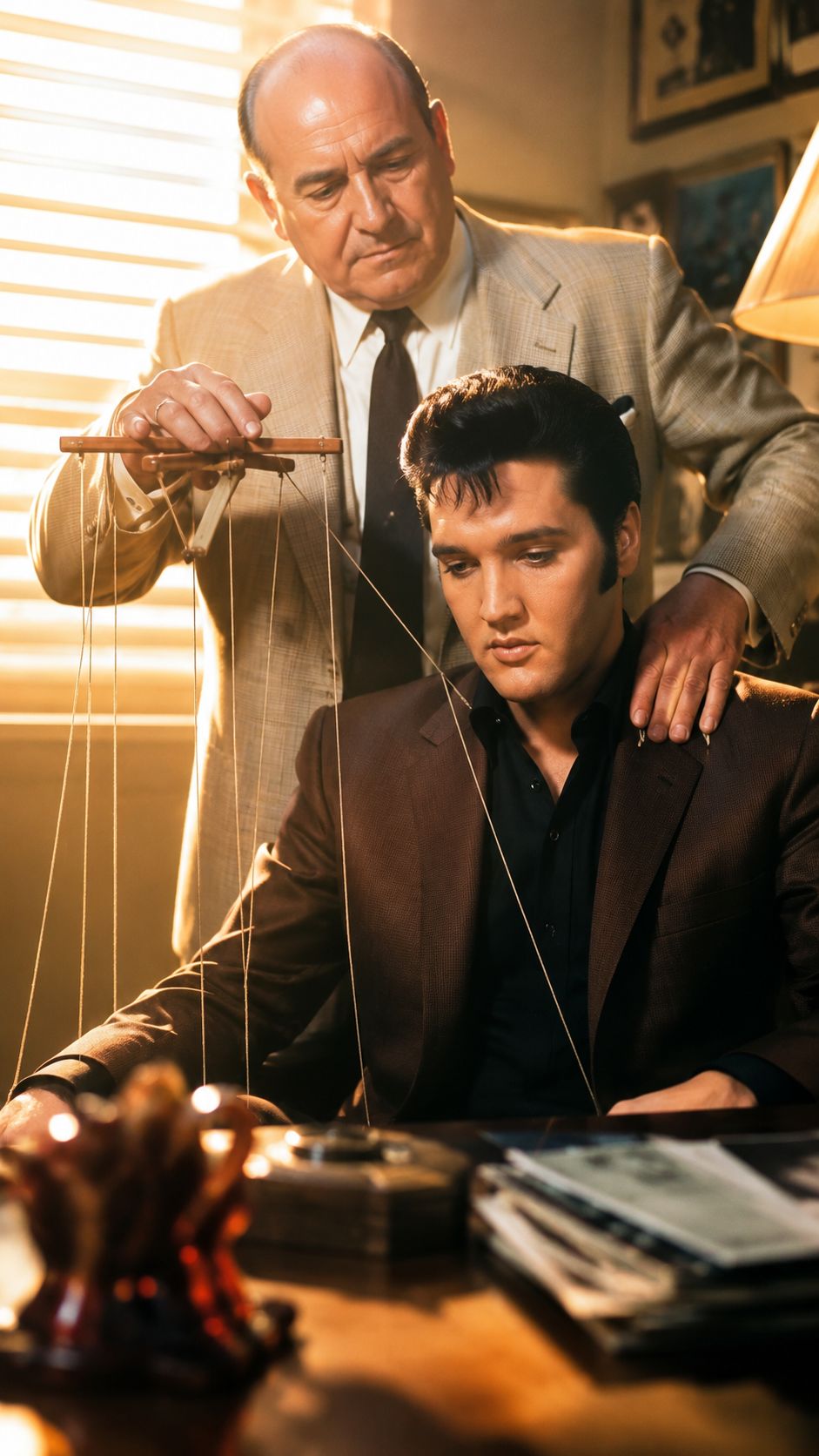
There are villains in music history.
Then there is Colonel Tom Parker.
To millions around the world, Elvis Presley was more than a singer. He was a revolution wrapped in rhinestones. He was youth, rebellion, desire, vulnerability, and American culture itself. His voice could shake stadiums, stop traffic, and leave audiences in tears.
But behind the dazzling jumpsuits, sold-out arenas, and screaming fans stood one man whose shadow stretched across every chapter of Elvis’s life.
A man many now call the greatest manager in entertainment history.
And others call something far darker.
For over two decades, Colonel Tom Parker controlled nearly every aspect of Elvis’s career. He negotiated the contracts. Chose the films. Approved appearances. Managed the money. Controlled access. Even family members often found themselves pushed aside.
The question that still haunts music historians is chilling:
Did Colonel Parker make Elvis Presley a global icon—or slowly destroy him?
The Mysterious Man Who Wasn’t Even A Colonel
Long before he became the cigar-smoking mastermind behind The King of Rock and Roll, Colonel Tom Parker was hiding secrets.
His real name wasn’t Tom Parker.
He wasn’t born in America.
And he wasn’t a colonel.
Born Andreas Cornelis van Kuijk in the Netherlands, Parker immigrated illegally to the United States in the 1920s under circumstances that remain controversial to this day. Historians still debate exactly what he left behind in Europe and why he never returned.
The title “Colonel” wasn’t military at all. It was an honorary title bestowed by Louisiana Governor Jimmie Davis.
Yet Parker understood something few people ever truly master:
Image is power.
He created the Colonel persona with absolute precision—white suit, cigar, carnival-barker charisma, booming voice.
And perhaps no one bought into the illusion more completely than young Elvis Presley.
Discovering Gold In Memphis
When Parker first encountered Elvis in the mid-1950s, the young singer from Tupelo possessed a raw energy unlike anything America had ever seen.
Elvis didn’t just sing.
He ignited.
Television audiences gasped. Parents panicked. Teenagers lost their minds.
Parker recognized instantly what others only sensed.
Elvis wasn’t simply an artist.
He was a phenomenon.
In 1955, Parker secured management control and quickly engineered a groundbreaking deal with RCA Records.
Almost overnight, Elvis became America’s brightest new star.
There is no denying Parker’s brilliance.
Without him, it’s entirely possible the world never would have witnessed the meteoric rise of Elvis Presley.
“Colonel Parker didn’t create Elvis’s talent. But he knew exactly how to package lightning and sell it to the world.”
For a time, the partnership seemed unstoppable.
Money poured in.
Records shattered.
History was being written.
But success came with a price.
The Cage Behind Graceland
As Elvis’s fame exploded, Parker tightened his grip.
Every major decision flowed through him.
Concert schedules.
Film roles.
Television appearances.
Business ventures.
Friends, associates, and insiders increasingly described an environment where access to Elvis often required going through the Colonel first.
Some believed Parker intentionally isolated his superstar.
Others argue he simply protected his most valuable asset.
Either way, Elvis became increasingly dependent.
The relationship resembled more than manager and client.
It began to look like control.
“Elvis trusted people deeply. Colonel Parker understood that trust—and built an empire around it.”
Perhaps nowhere was this more evident than in Hollywood.
Hollywood’s Golden Prison
During the 1960s, Elvis starred in more than thirty films.
Many were commercially successful.
Few were artistically fulfilling.
Movies like Harum Scarum, Paradise, Hawaiian Style, and Clambake generated revenue but often frustrated Elvis creatively.
The singer longed to evolve.
He admired dramatic actors.
He dreamed of challenging roles.
He wanted artistic respect.
Yet Parker prioritized guaranteed profits.
Formula films meant predictable income.
Risk was unnecessary.
As years passed, Elvis increasingly felt trapped.
Friends later recalled his growing dissatisfaction.
The creative fire that had once changed popular music seemed buried beneath repetitive scripts and soundtrack albums.
Critics have long argued that Parker sacrificed Elvis the artist to preserve Elvis the brand.
And Elvis knew it.
The World Tour That Never Happened
Perhaps the greatest controversy surrounding Colonel Parker concerns something that never happened.
Elvis Presley never performed a true international concert tour.
Think about that.
The most famous entertainer on Earth never toured Europe.
Never toured Japan.
Never toured Australia.
Never performed major concerts across South America.
Why?
Many historians believe the answer lies with Parker himself.
Because Parker’s immigration status remained deeply suspicious, some speculate he feared leaving the United States and being unable to re-enter.
Whether entirely true or partially exaggerated, Parker consistently steered Elvis away from overseas touring opportunities.
The result?
Millions of fans around the globe never had the opportunity to see Elvis perform live.
“The world wanted Elvis. The Colonel kept him home.”
Some historians consider this one of the greatest missed opportunities in entertainment history.
Others see it as evidence that Parker’s interests increasingly came before Elvis’s.
The Financial Empire—and The Exploitation Claims
Parker’s financial arrangements remain staggering even by modern standards.
Managers traditionally earned around 15 percent.
Parker reportedly took 25 percent—and sometimes even more through various business structures.
Critics accused him of treating Elvis less like a client and more like a personal corporation.
By the 1970s, despite earning enormous sums, Elvis’s finances had become increasingly complicated.
Lavish spending certainly played a role.
So did Graceland’s enormous expenses.
Yet many observers questioned whether Parker’s business decisions always benefited Elvis equally.
Years after Elvis’s death, legal investigations conducted on behalf of the Presley estate scrutinized numerous Parker agreements.
Some arrangements were eventually deemed unethical.
Questions linger to this day.
Did Parker merely negotiate aggressively?
Or did he exploit a trusting superstar?
The answer depends largely on whom you ask.
The Las Vegas Years: Salvation Or Decline?
When Parker secured Elvis’s residency in Las Vegas in 1969, the move initially appeared brilliant.
Elvis was reborn.
The performances were electric.
The voice was extraordinary.
The charisma remained unmatched.
The legendary comeback captivated audiences.
Yet over time, Vegas became relentless.
Hundreds of performances.
Exhausting schedules.
Endless pressure.
Elvis increasingly relied on prescription medications to cope with physical pain, insomnia, anxiety, and exhaustion.
Some critics argue Parker enabled this punishing pace because it generated enormous revenue.
Others insist Elvis himself chose to continue.
Reality likely lies somewhere in between.
But the tragic outcome is impossible to ignore.
As Elvis’s health deteriorated, the machine kept moving.
Concert after concert.
Year after year.
The show had to go on.
August 16, 1977: The End Of The King
When Elvis Presley died at Graceland at just 42 years old, the world mourned.
Millions grieved as though they had lost family.
And almost immediately, scrutiny turned toward Colonel Parker.
Could anyone have saved Elvis?
Should the people closest to him have intervened sooner?
Was Parker protector, opportunist, loyal friend, manipulator—or some complicated mixture of all four?
Even now, decades later, historians remain divided.
What is undeniable is this:
Colonel Tom Parker changed entertainment forever.
Without him, Elvis Presley may never have become a global phenomenon.
But without him, Elvis may also have lived a very different life.
Perhaps a freer one.
Perhaps a happier one.
Perhaps a longer one.
And that is the tragedy that continues to haunt music history.
Because in the story of Elvis Presley, the greatest mystery isn’t how The King became famous.
It’s whether the man who built the throne also built the cage.
VIDEO: