 By admin
 INTRODUCTION:
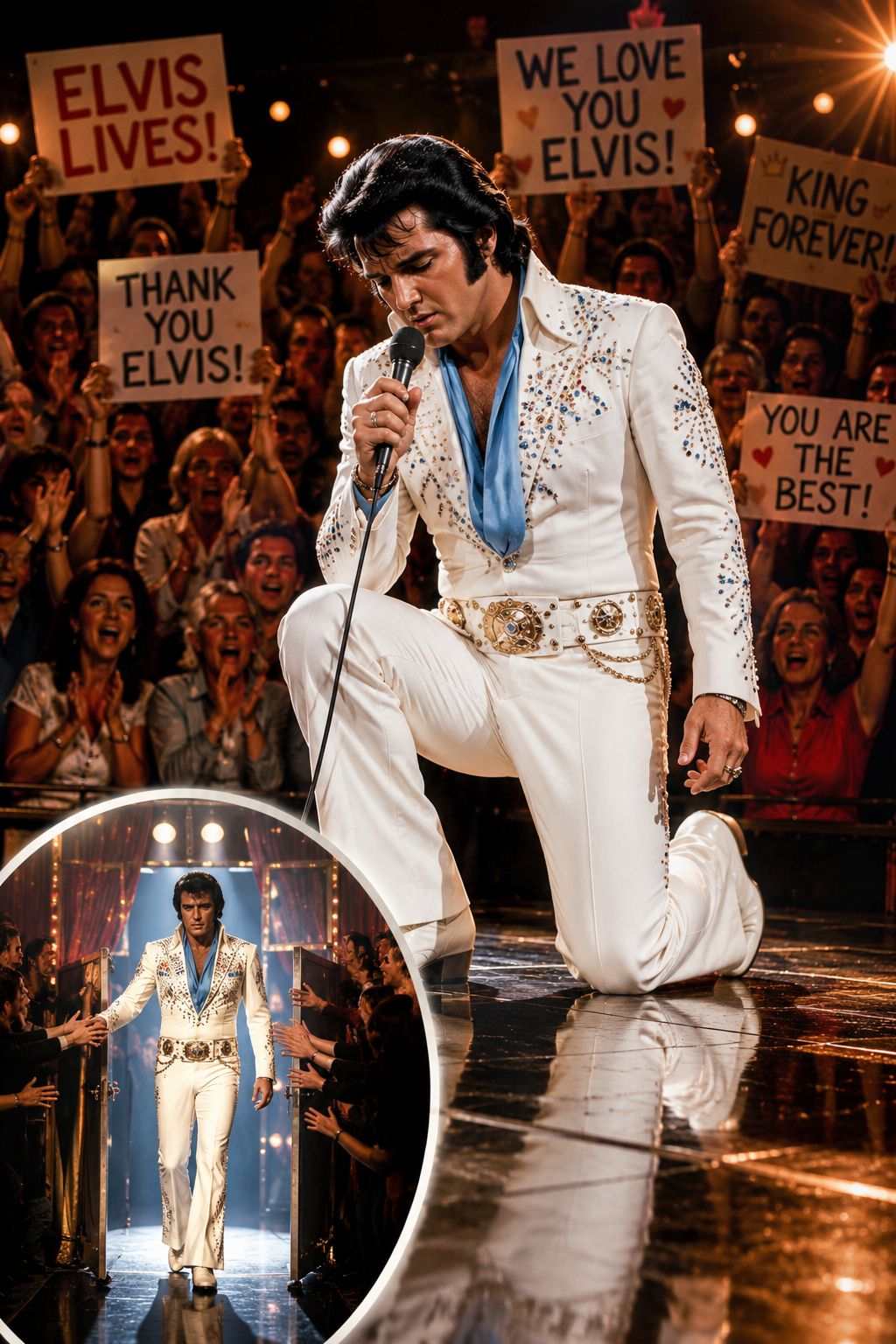
There are performances that entertain.
There are performances that make history.
And then there are performances so emotionally overwhelming that they seem to transcend music itself, becoming something far greater than a song.
For Elvis Presley, “If I Can Dream” was exactly that.
What was originally intended as the closing number for the legendary 1968 Comeback Special evolved into one of the most powerful moments not only in Elvis’s career, but in the entire history of popular music. It was a performance born from grief, social turmoil, personal frustration, and a desperate longing for hope. And when Elvis stood beneath those blazing red letters spelling out “ELVIS” and delivered the final line, something extraordinary happened inside that studio.
The room fell silent.
No one moved.
No one quite knew what to say.
Because they had just witnessed something far bigger than entertainment.
They had witnessed Elvis Presley reclaim his soul.
The King Had Lost His Crown
By 1968, the story of Elvis Presley appeared to be heading toward a sad conclusion.
Only a decade earlier, he had revolutionized music. He was the young rebel who shook America to its core. Girls screamed. Parents panicked. Television executives worried that his dancing alone might corrupt an entire generation.
But as the 1960s progressed, the musical landscape changed.
The British Invasion had arrived. Rock music had evolved. Artists like The Beatles, Bob Dylan, and The Rolling Stones were reshaping popular culture. Meanwhile, Elvis found himself trapped in a cycle of increasingly forgettable Hollywood films and formulaic soundtrack albums.
Many critics openly wondered if the King had become irrelevant.
Behind the scenes, Elvis himself knew something was wrong.
He was frustrated.
Exhausted.
Restless.
For years, he had wanted to return to live performance and reconnect with audiences through real music rather than lightweight movie songs.
The planned NBC television special was initially conceived as little more than a Christmas program.
Elvis hated the idea.
Producer Steve Binder quickly sensed that this wasn’t merely a singer preparing for another television appearance. This was a man fighting for artistic survival.
And then tragedy struck America.
A Nation in Pain
On April 4, 1968, Dr. Martin Luther King Jr. was assassinated.
The nation plunged into grief and unrest.
Riots erupted across American cities. Hope seemed distant. Division appeared everywhere.
Elvis was deeply affected.
Though often politically private, he had long admired King’s message of peace and human dignity. The atmosphere surrounding America weighed heavily on him.
As rehearsals for the NBC special continued, Binder proposed abandoning the planned Christmas finale entirely.
Instead, songwriter Walter Earl Brown was commissioned to create something new—something meaningful.
What emerged was “If I Can Dream.”
Inspired by King’s famous speeches, the lyrics spoke not of romance, but of faith, unity, and hope amid darkness.
When Elvis first heard the song, he immediately understood its significance.
“I’m never going to sing another song I don’t believe in.”
Those words reportedly became a defining declaration.
This was no ordinary closing number.
This was personal.
The Night Everything Changed
The recording session took place on June 23, 1968.
By then, the informal “sit-down sessions” had already electrified everyone involved. Elvis looked revitalized. Dressed in black leather, laughing with old bandmates, and singing with ferocious energy, he seemed reborn.
But “If I Can Dream” demanded something entirely different.
No playful banter.
No rock-and-roll swagger.
Only truth.
As the cameras rolled, Elvis stood alone.
Behind him glowed giant red letters spelling “ELVIS,” almost like a beacon burning through darkness.
The opening notes began.
Immediately, the atmosphere inside the studio shifted.
Witnesses later recalled that Elvis approached the song with astonishing intensity. Every lyric appeared to come from somewhere deep within him.
“There must be lights burning brighter somewhere…”
His voice trembled—not from weakness, but from conviction.
As the song built, so did the emotion.
The audience remained completely silent.
Crew members stopped working.
Even hardened television professionals reportedly found themselves transfixed.
Elvis wasn’t simply performing.
He was pleading.
Pleading for hope.
Pleading for understanding.
Perhaps even pleading for himself.
The Final Line That Stunned Everyone
As the orchestra swelled, Elvis delivered the song’s unforgettable climax:
“If I can dream of a better land, where all my brothers walk hand in hand…”
His face glistened with sweat.
His eyes burned with emotion.
Then came the final words:
“Right now.”
He didn’t merely sing them.
He almost cried them.
The last note rang out.
Silence.
Not polite television silence.
Real silence.
For several seconds, the studio remained motionless.
According to numerous accounts, many present were visibly emotional. Some applauded instantly. Others simply sat in stunned disbelief.
Steve Binder later described the performance as one of the most emotionally charged moments he had ever witnessed in television production.
Elvis himself appeared physically drained.
He had left everything on that stage.
Absolutely everything.
More Than a Comeback
When the NBC special aired on December 3, 1968, America responded immediately.
More than 40 percent of the viewing audience tuned in.
Critics who had dismissed Elvis suddenly reversed course.
The King was back.
But calling it merely a “comeback” almost understates what occurred.
“If I Can Dream” represented liberation.
For years, Elvis had been creatively confined by Hollywood formulas and managerial decisions that often prioritized profit over artistry.
This performance shattered those boundaries.
Viewers saw an artist rediscovering purpose.
They saw vulnerability.
They saw passion.
Most importantly, they saw authenticity.
For perhaps the first time in years, Elvis wasn’t playing a movie character.
He was simply Elvis Presley.
And audiences recognized the difference instantly.
Why The Performance Still Resonates Today
Nearly six decades later, “If I Can Dream” continues to move listeners because its message remains painfully relevant.
The world still struggles with division.
People still search for hope.
Dreams of peace and understanding remain unfinished.
Elvis captured that universal longing in a way that feels timeless.
Modern performances often rely on spectacle—massive staging, visual effects, elaborate choreography.
Yet “If I Can Dream” proves that genuine emotion remains the most powerful force in music.
No pyrotechnics.
No dancers.
No distractions.
Just one man standing beneath bright lights, singing with every ounce of his heart.
And somehow, that was enough.
More than enough.
The Night Elvis Saved Himself
Many historians argue that the 1968 Comeback Special saved Elvis’s career.
Perhaps.
But “If I Can Dream” may have done something even greater.
It saved his belief in himself.
Because in those final moments, Elvis wasn’t merely reclaiming his place in popular culture.
He was reclaiming his identity as an artist.
And audiences could feel it.
That is why the performance still leaves people breathless.
That is why millions continue to revisit it.
And that is why, long after the lights dimmed and the applause faded, “If I Can Dream” remains far more than a finale.
It became a declaration.
A prayer.
A promise.
And for one unforgettable night in 1968, Elvis Presley reminded the world that dreams—no matter how fragile—still matter.
VIDEO: