 By admin
 INTRODUCTION:
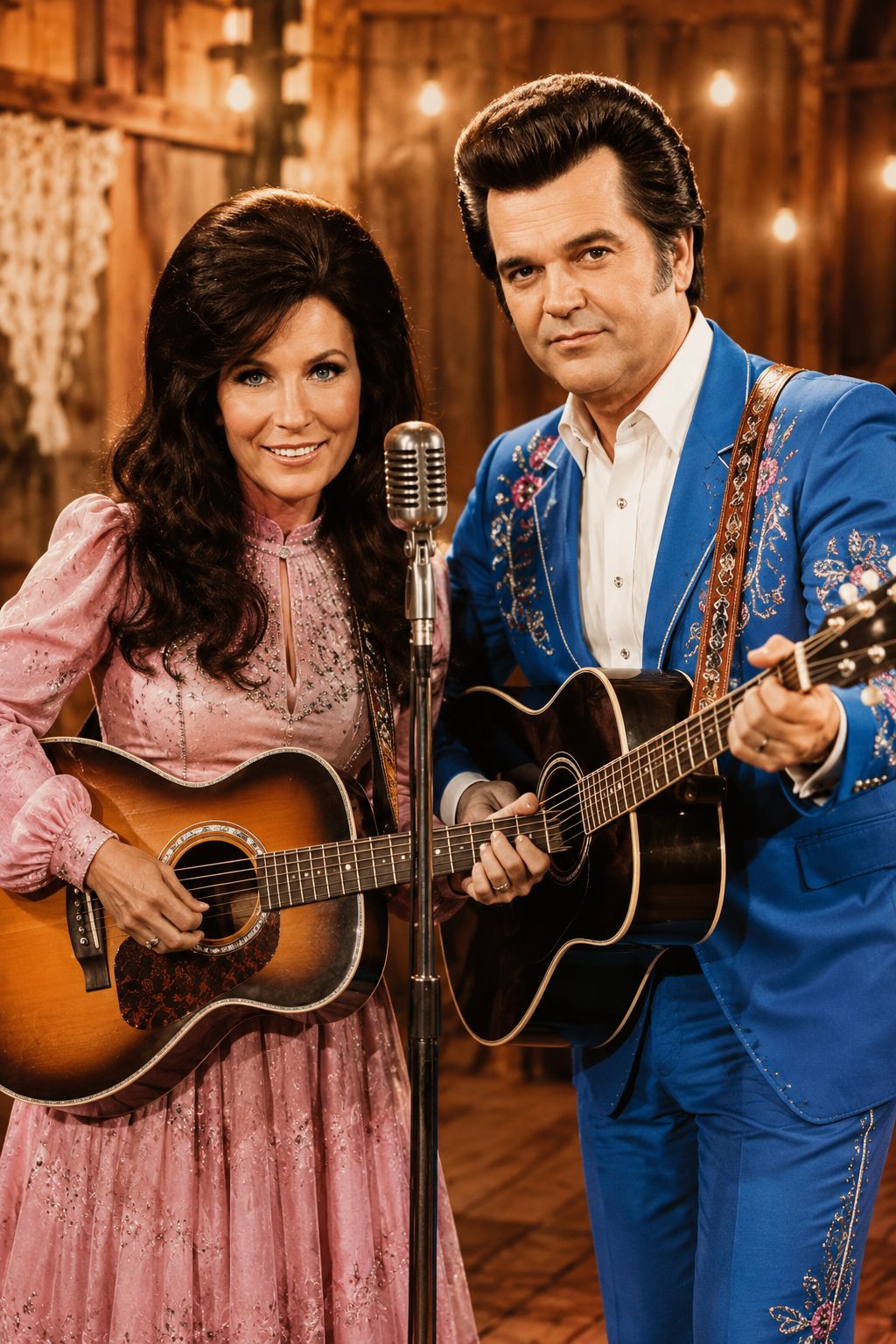
There are country songs that become hits.
And then there are country songs that seem to carry an entire era inside them.
When Conway Twitty and Loretta Lynn recorded “Louisiana Woman, Mississippi Man,” they weren’t simply putting another duet onto a record. They were creating a little piece of country music theater—one filled with longing, teasing, distance, determination, and the unmistakable chemistry of two voices that seemed to know exactly where the other one was going.
Released in 1973 as the title track and first single from their album of the same name, the song eventually climbed to No. 1 on the Billboard country chart on August 18, 1973. It became the duo’s third No. 1 country single together and spent 13 weeks on the chart.
More than five decades later, it is easy to hear the opening exchange and immediately understand why audiences fell in love.
“Louisiana woman!”
“Mississippi man!”
Those words sound almost playful today.
But in 1973, they represented something bigger: two of country music’s most distinctive personalities discovering that when their voices collided, something special happened.
The Magic Was Never Just in the Song
By the time “Louisiana Woman, Mississippi Man” arrived, Conway Twitty and Loretta Lynn had already established themselves as one of country music’s most compelling partnerships.
Their story began years earlier, when both were already successful solo artists. Twitty had transformed himself from a rock-and-roll star into one of country music’s most reliable hitmakers, while Lynn had become one of Nashville’s most important female voices.
Their duet partnership began in earnest in 1971.
And almost immediately, listeners noticed something unusual.
Their voices didn’t sound alike.
That was precisely the point.
Conway’s smooth, rich delivery gave the songs a masculine confidence, while Loretta’s unmistakable Appalachian-influenced voice brought warmth, grit, and emotional honesty.
Together, they created tension.
Not conflict.
Tension.
The kind that makes a listener lean closer.
PBS’s American Masters notes that Lynn and Twitty ultimately made 11 studio albums together between 1971 and 1988, while winning the CMA Award for Vocal Duo of the Year four consecutive times from 1972 through 1975.
That wasn’t an accident.
The chemistry was real—but it was musical chemistry.
A River Became the Perfect Metaphor
“Louisiana Woman, Mississippi Man” is built around a wonderfully simple idea.
A man lives on one side of the Mississippi River.
A woman lives on the other.
The river is enormous.
The distance is inconvenient.
There are even alligators waiting nearby.
But none of it matters.
Because they are in love.
The song turns geography into romance.
The Mississippi River isn’t merely water separating two people. It becomes the obstacle standing between them and the person they desperately want to see.
And the answer to that obstacle is wonderfully old-fashioned:
They’ll cross it anyway.
The songwriters, Jim Owen and Becki Bluefield, gave Conway and Loretta a premise that perfectly matched their personalities. The track was produced by legendary Nashville producer Owen Bradley and recorded at Bradley’s Barn in Mount Juliet, Tennessee.
The musical arrangement gave the story even more personality, blending country instrumentation with a lively Cajun flavor. Contemporary reviews praised its upbeat sound and the way the duo’s voices worked together.
It wasn’t a sad ballad.
It was a celebration.
The characters weren’t surrendering to distance.
They were laughing at it.
“The Mississippi River can’t keep us apart.”
That idea is the beating heart of the entire song.
Behind the Hit Was a Simple Gamble
One of the most fascinating parts of the story is how the song found its way to the duo.
Loretta Lynn’s husband, Doolittle “Mooney” Lynn, reportedly came across the song and recognized its potential for his wife and Conway. PBS recounts Lynn explaining that her husband found the song for the pair.
Sometimes music history changes because somebody in a Nashville office hears a demo and thinks:
This is the one.
That was essentially what happened.
The song didn’t need complicated production or elaborate storytelling.
It needed the right singers.
And it had them.
When Conway and Loretta stepped into the studio, they understood that the song worked because of its personality.
Conway didn’t need to overpower Loretta.
Loretta didn’t need to overpower Conway.
They bounced off each other.
He called out.
She answered.
He pushed forward.
She pushed back.
Then they came together.
That conversational quality became one of the defining characteristics of their partnership.
And Then Came No. 1
On August 18, 1973, the song reached the summit of the Billboard country chart. It stayed at No. 1 for one week and remained on the country chart for 13 weeks overall.
For a song about crossing a river to find someone you love, there was something almost poetic about its own journey.
It crossed from the recording studio to country radio.
From radio into people’s homes.
From homes into memories.
And eventually, into country music history.
But the success didn’t stop with the single.
The album Louisiana Woman, Mississippi Man also became a major milestone for the duo. It reached No. 1 on the U.S. Billboard Hot Country LPs chart, becoming their first collaborative album to top the country albums chart.
Loretta Lynn’s official discography likewise identifies the 1973 album as the pair’s first No. 1 album together.
That is important because the song wasn’t simply an isolated success.
It represented the growing power of the Conway-and-Loretta brand.
Fans Wanted to Believe the Chemistry Was Real
There was another element to their success that no record executive could manufacture.
People believed them.
Audiences sometimes wondered whether Conway and Loretta had a romantic relationship beyond the stage because their performances felt so natural.
But Loretta herself pushed back against that idea.
In the PBS American Masters material, Lynn explained that she loved Conway as a friend and emphasized that the supposed romance was not real.
And perhaps that’s what made their partnership even more fascinating.
They didn’t have to be lovers to sing like lovers.
They understood the emotional language of country music.
They knew how to tell a story with a glance, a pause, a harmony, or a change in vocal tone.
They knew that sometimes the space between two singers can be just as powerful as the notes themselves.
They didn’t need a real-life romance to create a believable musical one.
That distinction matters.
Because the magic of Conway and Loretta wasn’t built on scandal.
It was built on performance.
Why the Song Still Feels Alive
Listen to “Louisiana Woman, Mississippi Man” today, and something becomes immediately clear.
The song doesn’t feel trapped in 1973.
The production is unmistakably from its era.
The instrumentation carries the fingerprints of classic Nashville.
But the emotional premise is timeless.
Distance.
Longing.
Determination.
Two people refusing to let circumstances decide their future.
That’s something every generation understands.
And perhaps that’s why the song continues to resonate with classic-country listeners.
Country music has always been fascinated by impossible distances.
A highway between two lovers.
A train carrying someone away.
A telephone that can’t quite replace human touch.
A river separating two people who simply want to be together.
In this case, the river became the character.
It was the villain.
And Conway and Loretta refused to let it win.
More Than a Hit—A Snapshot of Country Music’s Golden Era
The early 1970s were a remarkable period for country music.
Traditional sounds were still firmly established, but production was evolving. Artists were becoming larger personalities. Country songs were reaching wider audiences.
And in the middle of that transformation stood Conway Twitty and Loretta Lynn.
They represented something wonderfully old-fashioned while simultaneously sounding fresh.
Their partnership eventually produced 11 studio albums, numerous major hits, and five No. 1 singles together according to PBS’s account of their career.
But statistics can only explain so much.
Numbers tell us that the records sold.
Charts tell us that listeners tuned in.
Awards tell us that the industry noticed.
They don’t tell us why someone decades later can hear two voices trading lines and suddenly remember sitting beside a parent, grandparent, spouse, or friend while an old country station played in the background.
That’s the real legacy.
The River Still Runs
Conway Twitty died in 1993.
Loretta Lynn died in 2022.
The people who created the song are gone now.
But the river they sang about is still there.
And so is the song.
Every time Conway calls out to the Louisiana woman, and Loretta answers as the Mississippi man, the old story comes alive again.
A man wants to cross the water.
A woman is waiting on the other side.
And neither is willing to accept that distance should have the final word.
That may be why “Louisiana Woman, Mississippi Man” remains more than a nostalgic country hit.
It is a reminder of what classic country music did so brilliantly: take an ordinary problem and turn it into an unforgettable story.
No complicated metaphor was required.
No studio trick was necessary.
Just two extraordinary voices, a clever song, and a river standing between them.
Sometimes the greatest country songs aren’t about perfect love. They’re about love that refuses to give up.
And that’s exactly what Conway Twitty and Loretta Lynn gave us in 1973.
They gave us a song about crossing the impossible.
They gave us laughter in the middle of longing.
They gave us two voices that could flirt, argue, tease, and embrace without ever needing to explain themselves.
And when “Louisiana Woman, Mississippi Man” reached No. 1, country music gave its answer.
The river hadn’t won.
Conway and Loretta had.
More than 50 years later, the song still feels like an open invitation to remember what made classic country so powerful: stories that sounded simple, voices that sounded human, and emotions that never needed an expiration date.
So the next time that familiar opening rings out—
“Louisiana woman!”
“Mississippi man!”
—don’t just hear an old No. 1 hit.
Hear an entire era calling back.
And ask yourself:
Do you still remember the first time you heard Conway Twitty and Loretta Lynn sing it?
VIDEO: