 By admin
 INTRODUCTION:
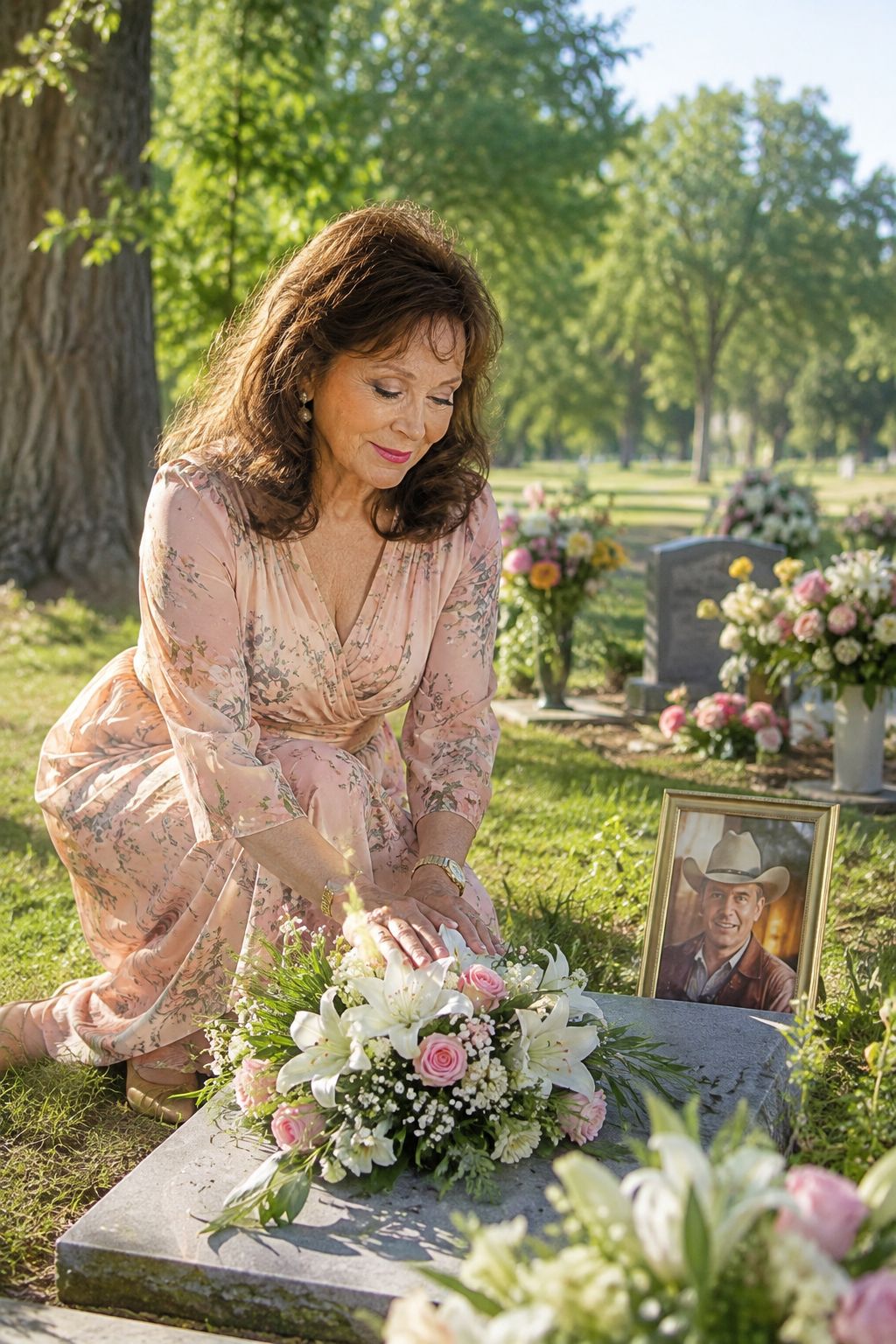
There was no roaring crowd.
No grand Nashville spectacle.
No wall of cameras surrounding the final goodbye.
Instead, on a quiet Friday morning in October 2022, Loretta Lynn was carried away from the beloved Hurricane Mills property that had been her home, her refuge, and one of the most important places in her extraordinary life.
Just days earlier, the world had learned that the “Coal Miner’s Daughter” had died peacefully in her sleep at the age of 90. Her family announced that she had passed on October 4 at her ranch in Hurricane Mills, Tennessee, asking for privacy as they grieved.
Then came a detail that seemed almost poetic.
Loretta was buried quietly, privately, on the same property she had shared with her family for decades—beside her husband, Oliver “Doolittle” “Mooney” Lynn, the man with whom she had spent nearly half a century.
The ceremony was intimate, with roughly 100 people reported to have attended. The family cemetery was not a public spectacle. It was a place reserved for those closest to her.
And somehow, that quiet goodbye seemed fitting for a woman whose greatest stories were never really about fame.
They were about home.
Family.
Hardship.
Love.
And survival.
“She wasn’t simply returning to the place where she lived. She was returning to the place where so much of her life had happened.”
A Love Story That Was Never Simple
To understand why Loretta was laid to rest beside Mooney, you have to understand that their marriage was anything but a fairy tale.
Loretta Webb married Oliver “Mooney” Lynn in 1948 when she was just 15 years old. Their marriage lasted until his death in 1996—approximately 48 years. Together they raised six children, endured financial struggles, moved across the country, and eventually watched Loretta become one of the most influential women in country music.
Their relationship was complicated.
There was love, but there was also pain.
There were arguments, separations, infidelity and difficult years. Loretta herself spoke openly about the troubled side of their marriage rather than pretending their story had been perfect.
That honesty became part of her artistry.
She didn’t write about a polished version of life.
She wrote about the life people actually lived.
The lonely wives.
The working husbands.
The mothers trying to hold families together.
The arguments behind closed doors.
The jealousy.
The forgiveness.
The heartbreak.
And the complicated love that can exist between two people who have spent decades growing up together.
That was one reason Loretta’s songs felt different.
She wasn’t singing from a distance.
She was singing from experience.
Then Came Hurricane Mills
In 1966, Loretta and Mooney discovered the historic property at Hurricane Mills, Tennessee. According to Loretta Lynn’s official ranch history, the couple found the property while looking for a quiet place to raise their family. What began as a home eventually became a sprawling destination connected forever with Loretta’s name.
The ranch became much more than an address.
It became part of the mythology of Loretta Lynn.
The historic home.
The rolling Tennessee landscape.
The creek.
The old mill.
The family memories.
The concerts.
The museum.
The fans arriving from across the country.
Over time, Hurricane Mills became a physical representation of everything Loretta had built.
A girl from Butcher Hollow had become a country music legend—and yet she had created a place where the world of her childhood could still be felt.
It was only natural, then, that the ranch would eventually become her final home.
And, finally, her final resting place.
The Quiet Funeral That Followed a Giant Life
Loretta died on October 4, 2022.
For a woman whose career had filled concert halls and television screens for generations, her final farewell was remarkably private.
A public memorial was planned separately, but the family first chose to gather privately.
On October 7, Loretta was transported from the ranch toward the family cemetery. Reports described a black hearse, a procession led by the Humphreys County sheriff, and loved ones following behind.
Fans who happened to be nearby could only watch from outside.
They could not walk into the family cemetery.
They could not turn the moment into a public event.
They could only stand at a distance and say goodbye.
That privacy was important.
Because this wasn’t the closing scene of a concert.
It was a family saying goodbye to their mother, grandmother and matriarch.
And waiting in that cemetery was someone Loretta had known longer than almost anyone else.
Mooney.
Nearly Fifty Years Apart—and Then Together Again
Mooney Lynn had died in 1996.
Loretta had lived another 26 years without him.
Twenty-six years of recording.
Twenty-six years of performances.
Twenty-six years of awards, family milestones, health challenges, triumphs and losses.
She became even more of an icon during those years.
But when she died, she was placed beside him.
The contrast is haunting.
For more than two decades, their graves were separated by time.
Then, suddenly, they were together again.
The symbolism is difficult to miss.
“For 26 years, Loretta carried on without Mooney. In the end, she returned to the place where he had been waiting.”
Their marriage had lasted nearly half a century.
His death ended their life together in the ordinary sense.
But their shared history never disappeared.
It remained in Loretta’s songs.
It remained in photographs.
It remained in their children.
And it remained in the land they had built together.
Not a Perfect Marriage—A Real One
Perhaps the most important thing about Loretta and Mooney’s story is that it doesn’t need to be romanticized.
Their marriage wasn’t perfect.
It wasn’t always peaceful.
It wasn’t the kind of relationship that belongs in a fairy tale.
But it was real.
And Loretta’s willingness to tell the truth about that reality made her extraordinary.
She understood something that many artists never learn: people don’t connect with perfection.
They connect with truth.
A woman listening to Loretta sing about marriage could recognize herself.
A husband could hear his own struggles.
A mother could hear the exhaustion and determination of trying to keep a family together.
A young girl could hear a future she hadn’t yet lived.
And an older listener could hear memories she had almost forgotten.
That was Loretta’s gift.
She turned ordinary pain into extraordinary music.
The Meaning of That Final Resting Place
There is something profoundly moving about Loretta being buried at Hurricane Mills.
She wasn’t taken to some distant cemetery far away from the world she knew.
She was laid to rest on the property that had become part of her identity.
The ranch’s official history describes Hurricane Mills as a place where Loretta’s music, history and spirit continue to come together.
And her grave remains private.
That matters.
Because Loretta spent much of her adult life giving herself to the public.
She gave interviews.
She gave performances.
She gave songs.
She gave pieces of her personal story.
But in death, her family protected one final piece of her life.
Her resting place became a family space.
Not a tourist attraction.
Not a stage.
Not a photo opportunity.
Just a quiet corner of Tennessee where the woman behind the legend could finally rest.
The Queen of Country Music Finally Came Home
There is an almost cinematic quality to the story.
A young girl from Kentucky marries young.
She leaves home.
She becomes a wife and mother.
She struggles.
She writes songs.
She finds her voice.
She becomes famous.
She builds a home.
She loses people she loves.
She outlives her husband.
She continues performing.
She becomes a symbol of American country music.
And then, at 90, she dies peacefully at the ranch she loved.
Days later, she is carried to a private family cemetery.
And there, beside the man with whom she spent nearly 48 years of marriage, she is laid to rest.
No stadium.
No flashing lights.
No standing ovation.
Just family.
Earth.
Tennessee hills.
And silence.
“The woman who spent a lifetime singing about home finally found her way home for the last time.”
What Loretta Lynn Left Behind
The greatest tribute to Loretta isn’t a monument.
It isn’t an award.
It isn’t even a record collection.
It’s the fact that people still hear themselves in her music.
Decades after she first stepped onto the country music stage, songs connected to her life continue to tell stories about marriage, motherhood, independence, heartbreak and resilience.
She proved that a woman didn’t have to come from privilege to become powerful.
She didn’t need to hide her scars.
She didn’t need to pretend her life was perfect.
She simply needed to tell the truth.
And Loretta told it.
Again and again.
Until her voice became part of American history.
Now, at Hurricane Mills, the world still remembers the woman who transformed a difficult life into unforgettable songs.
But somewhere beyond the public spaces, behind the privacy of the Lynn family cemetery, there is a quieter story.
Loretta rests beside Mooney.
The two people who shared nearly five decades of life together are once again side by side.
Their story was complicated.
Their marriage was imperfect.
Their lives were full of hardship and triumph.
But perhaps that is exactly why the final image feels so powerful.
Because Loretta Lynn never promised her audience a perfect life.
She gave them a real one.
And in the end, she chose to rest in the place where that real life had unfolded—with her family nearby, her beloved Tennessee ranch surrounding her, and the memory of the husband who had been part of her story for nearly half a century.
The Queen of Country Music had taken her final bow.
And this time, there was no encore.
Only home.
VIDEO: