 By admin
 INTRODUCTION:
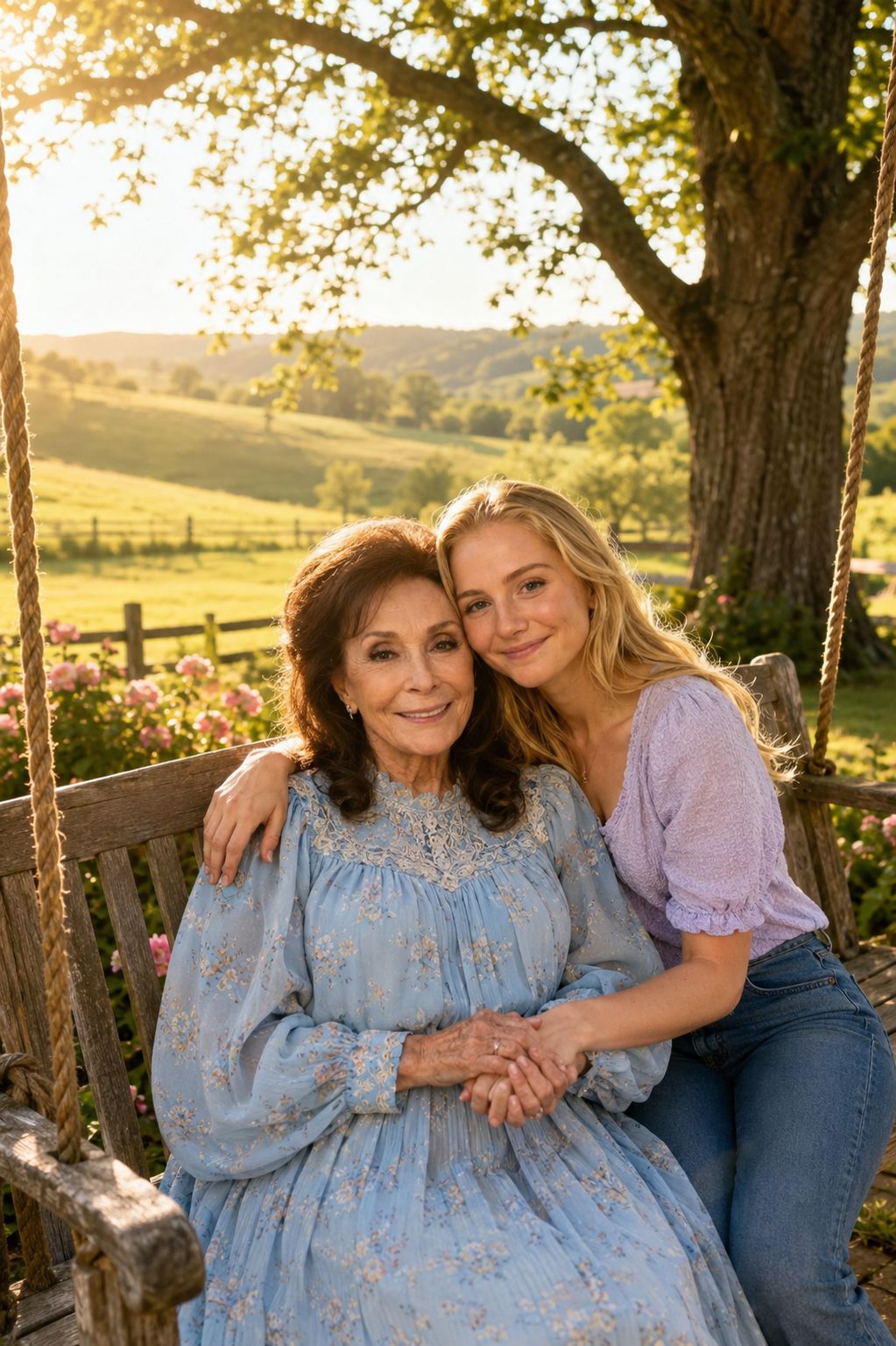
Four years after Loretta Lynn died peacefully at her beloved home in Hurricane Mills, Tennessee, on October 4, 2022, one question still lingers for country music fans: What did the “Coal Miner’s Daughter” really leave behind?
The obvious answers are everywhere.
There are awards. Gold records. No. 1 songs. Historic performances. A legendary ranch. A best-selling autobiography. A celebrated film. Hall of Fame honors. And a catalog of music that helped redefine what a woman could say in a country song.
But those things, as important as they are, may not be Loretta Lynn’s greatest inheritance.
Because Loretta left something much harder to measure.
She left courage.
She left honesty.
She left a voice for people who had spent years believing their stories were too ordinary, too painful, or too complicated to sing about.
And four years after her passing, that may be the part of her legacy that matters most.
THE WOMAN WHO NEVER NEEDED TO PRETEND
Loretta Lynn’s story was extraordinary precisely because she never presented herself as extraordinary.
She came from Butcher Holler, Kentucky, one of eight children raised in a poor coal-mining family. Her father worked in the mines and farmed, while her mother cared for the growing family. Loretta later transformed those childhood memories into the foundation of her most famous song, “Coal Miner’s Daughter.”
She didn’t arrive in Nashville carrying a carefully manufactured image.
She arrived carrying her life.
And that distinction changed country music.
Loretta Lynn didn’t have to invent a character for her songs. She simply had to tell the truth about the woman she already was.
That honesty became her superpower.
She sang about marriage, motherhood, jealousy, poverty, heartbreak, temptation, independence, family and the complicated realities of being a woman.
Songs such as “You Ain’t Woman Enough,” “Fist City,” “Don’t Come Home A-Drinkin’” and “The Pill” were not designed to make everyone comfortable.
They were designed to say what many women were already thinking.
And that was revolutionary.
HER GREATEST GIFT WAS PERMISSION
For decades, country music had been filled with stories of working people.
But Loretta gave women something especially powerful: permission to speak in their own voices.
She didn’t always make her characters perfect.
Sometimes they were angry.
Sometimes they were hurt.
Sometimes they were jealous.
Sometimes they were stubborn.
Sometimes they were afraid.
And sometimes they simply wanted to be heard.
That honesty helped create a new space for female artists who came after her.
The Country Music Hall of Fame describes Lynn as a groundbreaking figure who broke new ground for women in country music, while PBS emphasizes how her honesty, working-class identity and perspective on womanhood helped transform the genre.
That is an inheritance no lawyer could calculate.
A songwriter can inherit a publishing catalog.
A singer can inherit a stage.
A family can inherit property.
But an entire generation of artists can inherit permission.
And Loretta gave them plenty.
THE RANCH BECAME MORE THAN A HOME
There is another part of Loretta’s legacy that makes her story especially emotional: Hurricane Mills.
The ranch was discovered by Loretta and her husband, Oliver “Doolittle” Lynn, in 1966 while they were looking for a quiet place to raise their family. Over the years, the property grew into far more than a private home. It became a gathering place for fans, concerts, festivals, trail rides and country music history.
Today, the ranch includes the Coal Miner’s Daughter Museum, Loretta’s historic home and other attractions dedicated to preserving her story.
Think about that for a moment.
The girl who once came from a tiny Kentucky coal-mining community eventually created a place where strangers from across the country could walk into her world.
They could see the house.
They could learn the story.
They could stand where she had stood.
They could hear the music.
They could remember.
And perhaps that is why the ranch feels so important to her legacy.
It doesn’t simply preserve artifacts.
It preserves atmosphere.
SHE LEFT MUSIC THAT REFUSED TO AGE
Loretta’s career lasted roughly six decades.
Her official biography credits her with more than 60 years of recording and touring, 16 No. 1 country singles, more than 45 million records sold worldwide and numerous major honors, including the Presidential Medal of Freedom, Kennedy Center Honors, four Grammy Awards and induction into the Country Music Hall of Fame and Songwriters Hall of Fame.
Yet statistics don’t fully explain why people still care.
Numbers can tell us how successful Loretta was.
They cannot tell us why her songs still feel personal.
That’s the magic.
A woman who heard “Coal Miner’s Daughter” decades ago may hear it today and suddenly remember her parents.
A man who grew up listening to Loretta may hear the opening of one of her old records and be transported back to a kitchen, a truck, a porch or a Saturday night.
A younger songwriter may discover one of her songs and realize that the subject matter she thought was “too honest” had already been written about by Loretta Lynn generations earlier.
That is what timeless music does.
It doesn’t stay in its original decade.
It follows people through their lives.
HER FAMILY WAS PART OF THE STORY, TOO
Loretta’s legacy was never only about the stage.
Family was woven into the story from the beginning.
She became a mother while still very young and ultimately raised a large family while building one of the most demanding careers in American music. Her children and grandchildren became part of the continuing story of the Lynn family, while some family members also participated in her later musical work.
Her daughter Patsy Lynn Russell, in particular, became involved in her mother’s later recordings. The 2016 album Full Circle and subsequent projects were part of a late-career period in which Loretta continued creating music even after most artists would have retired.
Then came Still Woman Enough in 2021.
That title now carries an almost haunting significance.
At an age when the music industry could easily have treated her as a historical figure rather than a living artist, Loretta was still making her voice heard.
Still writing.
Still singing.
Still telling women that their stories mattered.
THE FINAL CHAPTER DIDN’T ERASE THE PREVIOUS SIX DECADES
Loretta Lynn passed away at 90.
Her family announced that she died peacefully in her sleep at home at the ranch she loved.
There was no need for a manufactured final spectacle.
Her life had already been the spectacle.
A poor Kentucky girl became one of country music’s most important women.
A young mother became a songwriter.
A songwriter became a superstar.
A superstar became an institution.
And the institution became something even bigger: a symbol of authenticity.
That is why her death felt different to so many fans.
They weren’t simply saying goodbye to a singer.
They were saying goodbye to someone whose voice had accompanied entire generations.
When Loretta Lynn died, country music didn’t lose its history. It lost one of the people who had personally lived it.
FOUR YEARS LATER, THE REAL INHERITANCE IS STILL GROWING
This is where the title of Loretta Lynn’s legacy becomes especially powerful.
Her greatest inheritance wasn’t necessarily something that could be divided among heirs or listed line by line on a legal document.
It was already scattered everywhere.
It was inside the songs.
Inside the stories.
Inside the women who found courage in her lyrics.
Inside the artists who learned that country music could be both traditional and fearless.
Inside the fans who still play her records when they miss someone.
Inside the ranch that continues to tell her story.
Inside the phrase “Coal Miner’s Daughter,” which became much more than a song.
It became an identity.
A reminder that where you come from does not determine how far your voice can travel.
Loretta never stopped being proud of Butcher Holler.
She never needed to hide the poverty, hardship or struggles that shaped her.
Instead, she turned them into art.
And perhaps that is the most beautiful lesson she left behind.
She didn’t inherit a kingdom. She came from a place where there was almost nothing — and built a legacy that millions now feel belongs to them, too.
THE LEGACY THAT CANNOT BE BURIED
Four years can pass quickly.
Music changes.
Artists come and go.
Radio formats evolve.
New stars take the stage.
But some voices refuse to disappear.
Loretta Lynn is one of them.
Her songs continue to tell uncomfortable truths.
Her story continues to inspire.
Her ranch continues to preserve memories.
And her influence continues to appear whenever a country artist chooses honesty over image.
That may be why Loretta’s legacy feels so different from a simple collection of awards.
Awards sit behind glass.
Records sit on shelves.
Buildings can be preserved.
But influence lives in people.
And Loretta Lynn influenced generations.
She showed country music that a woman’s experience was not a side story.
It could be the main story.
She showed young songwriters that ordinary lives could produce extraordinary songs.
She showed millions of fans that strength didn’t always look polished.
Sometimes strength sounded like a Kentucky woman standing at a microphone and telling the truth.
So four years after Loretta Lynn passed away, perhaps the question isn’t what she left behind.
Perhaps the better question is:
What did she leave inside us?
For some, it is a favorite song.
For others, a childhood memory.
For another generation, it is the courage to write something honest.
And for country music itself, it is a standard that may never be duplicated.
Loretta Lynn once built a career by turning her own life into songs.
Now, long after her final performance, those songs are turning themselves into memories for everyone else.
And that may be the inheritance that no will could ever contain.
A voice that refused to disappear.
A story that refused to be forgotten.
And a legacy that still belongs to anyone who has ever heard Loretta Lynn sing and thought, “That sounds like my life.”
VIDEO: