 By admin
 INTRODUCTION:
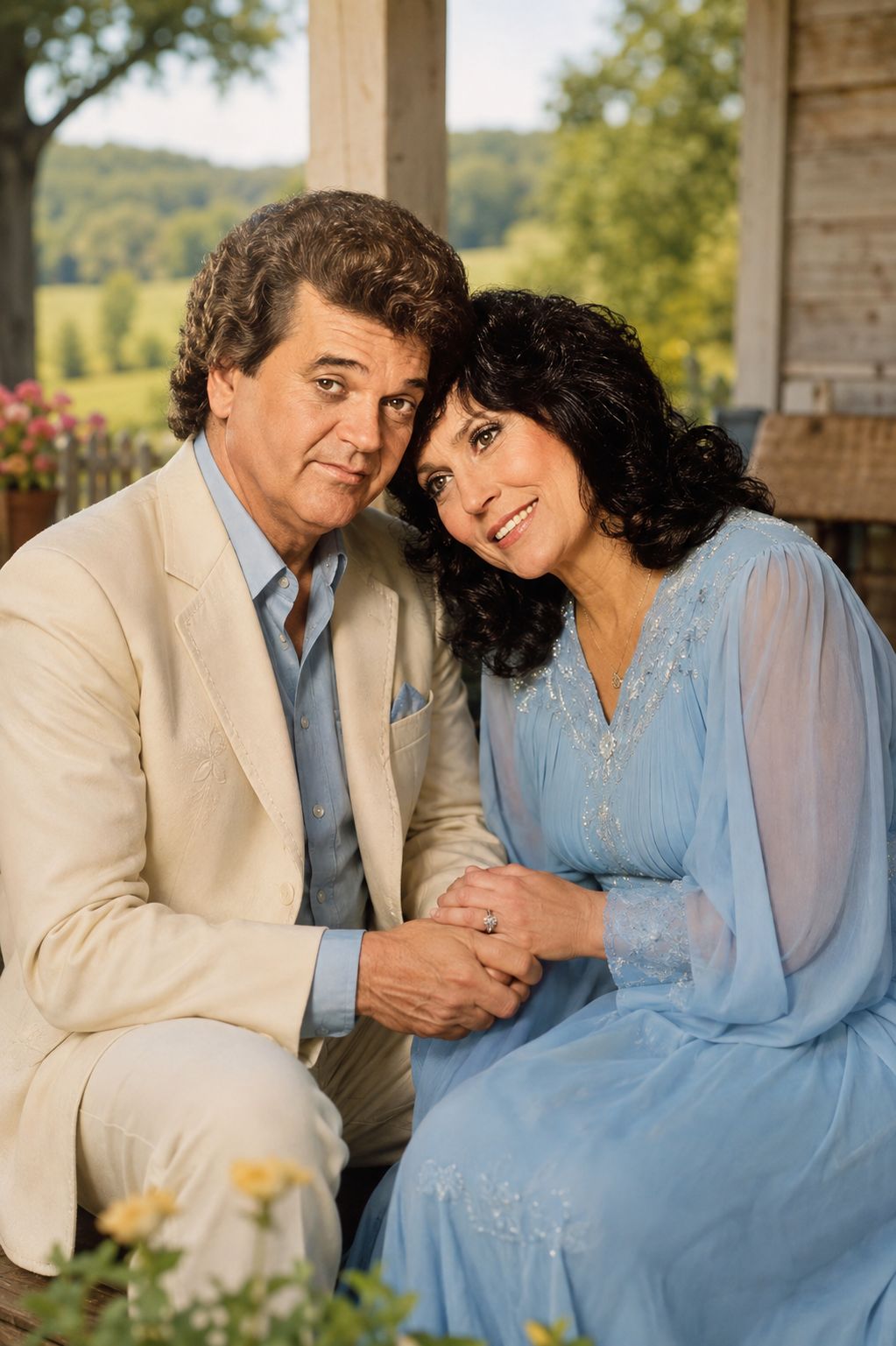
There are country duos whose harmonies sound good together.
And then there are duos whose voices make you wonder whether you are overhearing something you were never supposed to hear.
Conway Twitty and Loretta Lynn belonged to the second category.
For years, their songs made millions of listeners believe they were hearing more than music. The glances, the teasing exchanges, the aching pauses, the stories about forbidden love and marriages falling apart—all of it felt almost too convincing to be acting.
Yet the remarkable truth is that one of country music’s most believable romantic partnerships was not, in fact, a real-life love affair.
It was something arguably more difficult to create: a friendship and musical partnership powerful enough to make an entire audience believe in a fictional romance.
And that may be the real secret behind the enduring magic of Conway Twitty and Loretta Lynn.
Two Stars Who Didn’t Need Each Other—Until They Did
When Twitty and Lynn began recording together in the early 1970s, neither was an unknown hoping for a career breakthrough.
Loretta Lynn had already established herself as one of country music’s most important female voices. Her songs were direct, funny, fearless and deeply rooted in the lives of ordinary women. Her rise from rural Kentucky to country superstardom had already made her a cultural force.
Conway Twitty’s journey was completely different.
He had first conquered the pop world, scoring a No. 1 hit with “It’s Only Make Believe” in 1958, before reinventing himself as a country superstar. By the late 1960s and early 1970s, he had become one of Nashville’s most reliable hitmakers.
Then came the pairing.
Their producer, Owen Bradley, helped bring the two artists together. Initially, the idea of combining two established solo stars was not universally obvious. But once their voices met, something happened that could not be explained simply by marketing.
Their voices argued.
They flirted.
They challenged each other.
They sounded wounded.
And sometimes, they sounded like two people who had loved each other for years.
That illusion became one of country music’s greatest performances.
“After the Fire Is Gone” Changed Everything
In 1971, Twitty and Lynn released “After the Fire Is Gone.”
The premise was explosive: two married people trapped in unhappy relationships find comfort in one another.
It wasn’t innocent.
It wasn’t sentimental.
It was complicated, morally messy and intensely human—the exact territory where country music has always been strongest.
The song became their first No. 1 hit together and won the Grammy for Best Country Vocal Performance by a Duo or Group.
But something else happened.
Listeners began asking the question that would follow the pair for years:
Were Conway and Loretta secretly in love?
It wasn’t difficult to understand why people wondered.
Their chemistry was extraordinary.
Their songs were often about affairs, temptation, broken marriages and forbidden desire. Their performances didn’t feel like two singers standing beside one another. They felt like characters caught in the middle of an emotional crisis.
But Loretta Lynn eventually made her position clear.
“Everybody thought me and Conway had a thing going. And that’s the farthest from the truth.”
She described Twitty as a friend and emphasized that her husband, Oliver “Doolittle” Lynn, also cared deeply about him.
That statement is crucial because it changes how we should hear their music.
The romance was in the songs.
The trust was in the relationship.
And the difference between those two things is what made the partnership work.
They Didn’t Have to Be Lovers to Sound Like Lovers
This is where Twitty and Lynn demonstrated something few singers ever master.
Great acting requires distance.
So does great singing.
If an artist is too emotionally close to the material, the performance can become uncontrolled. But if the performer understands the character, the emotion can be shaped, sharpened and delivered exactly where it hurts.
Twitty and Lynn understood this instinctively.
When they sang about forbidden desire, they weren’t confessing their private lives.
They were inhabiting someone else’s.
That distinction allowed them to go further.
They could sing about infidelity without actually being unfaithful to their spouses. They could play jealous lovers, desperate partners and people contemplating impossible choices without having to live those stories themselves.
And because both singers were exceptional storytellers, the fiction felt real.
The Magic Was in the Contrast
Part of their appeal came from the contrast between them.
Twitty possessed a smooth, deep voice that could sound intimate without becoming fragile. His delivery often suggested a man trying to hide his emotions until the final possible second.
Lynn was different.
Her voice carried grit, humor and unmistakable personality. She could sound vulnerable one moment and completely in control the next.
Put those voices together and the emotional mathematics became almost irresistible.
His restraint met her fire.
His darkness met her sharpness.
His smoothness met her rough edges.
The result wasn’t perfection.
It was tension.
And tension is what makes a love song believable.
Then Came “Louisiana Woman, Mississippi Man”
If “After the Fire Is Gone” introduced listeners to the duo’s emotional danger, “Louisiana Woman, Mississippi Man” showed how much fun they could have with it.
The song became another No. 1 hit and eventually one of the defining recordings of their partnership. PBS notes that the title track topped the country chart, while the album itself also reached No. 1.
The concept was playful: geography becomes part of the romantic conflict.
Instead of simply singing about love, Twitty and Lynn turned the song into a conversation.
He pushed.
She pushed back.
They teased.
They competed.
And somehow, beneath all that humor, the listener could still feel genuine affection.
That ability to move effortlessly between comedy and heartbreak was one of their greatest strengths.
The Songs Became Little Dramas
Their catalog wasn’t simply a collection of duets.
It was almost a theater.
“Lead Me On” explored temptation.
“Feelins’” examined emotional distance and the complicated aftermath of intimacy.
“As Soon as I Hang Up the Phone” pushed theatrical storytelling even further, with Lynn singing while Twitty delivered spoken passages. The recording itself used a telephone-style setup, creating the impression that listeners were eavesdropping on a private conversation.
This was not accidental.
Twitty and Lynn understood that a duet could function like a miniature movie.
Each song had characters.
Each had conflict.
Each had emotional stakes.
And the audience became the witness.
The Awards Proved It Was More Than a Gimmick
Their success wasn’t just based on gossip.
It was measurable.
Between 1971 and 1988, Lynn and Twitty recorded 11 studio albums together, while their partnership produced multiple major hits. PBS reports that they scored five No. 1 songs from five different collaborative albums and won the Country Music Association’s Vocal Duo of the Year award four consecutive times, from 1972 through 1975.
The Country Music Hall of Fame likewise recognizes their 1971 breakthrough and their extraordinary run as a duo.
That longevity matters.
A publicity stunt might create curiosity.
It cannot easily sustain two decades of music.
What sustained Conway and Loretta was chemistry—not romantic chemistry, but creative chemistry.
Perhaps the Most Beautiful Part Was the Friendship
There is something almost bittersweet about realizing that the relationship fans imagined wasn’t the relationship that actually mattered.
The real story may be better.
They didn’t need to be secretly in love.
They needed to trust each other.
They needed to know that the other singer would understand the emotional direction of a song.
They needed to be comfortable enough to tease one another, challenge one another and expose vulnerability through music.
And that trust was visible.
Loretta Lynn’s own words make clear that she regarded Twitty as a genuine friend. PBS also describes how Lynn’s husband, Doo, cared about Twitty and supported the partnership.
That changes the meaning of all those old performances.
The smiles weren’t necessarily romantic secrets.
The glances weren’t evidence of an affair.
They were the gestures of two performers who knew exactly how to tell a story together.
Why People Still Believe the Romance
Because great country music makes fiction feel like memory.
That’s the trick.
A listener doesn’t necessarily hear “After the Fire Is Gone” and think, This is a fictional character.
They think, I’ve known someone like this.
They remember a marriage that failed.
A relationship that almost happened.
A temptation they resisted—or didn’t.
A person they loved at the wrong time.
That’s why Twitty and Lynn’s music continues to feel personal.
The songs aren’t really about Conway and Loretta.
They’re about us.
“The romance was part of the performance—but the connection between the performers was real.”
That distinction may be the most important lesson of their story.
A Partnership That Outlived the Rumors
Twitty and Lynn’s full-time touring partnership eventually ended in 1981, although their recording legacy continued. Twitty died in 1993, while Lynn died in 2022.
But their voices remain locked together in country music history.
Decades later, new generations still discover the same strange magic.
They hear the opening notes.
They hear Twitty’s voice.
Then Lynn answers.
And suddenly, the room feels smaller.
The distance between performer and listener disappears.
For a few minutes, it sounds as though two people are telling us something deeply private.
Maybe that’s why the rumors never completely disappeared.
People wanted the chemistry to have a secret explanation.
But perhaps there was never a secret.
Perhaps the explanation was simply talent.
Conway Twitty and Loretta Lynn didn’t have to fall in love to convince the world they had.
They only had to sing like they did.
And that is arguably an even more extraordinary achievement.
Their greatest love story was never between Conway and Loretta.
It was between the song and the listener.
Every time their voices meet, that story begins again.
And every time it does, country music reminds us of one of its oldest truths:
Sometimes the most convincing heartbreak is the one you never personally lived.
VIDEO: