 By admin
 INTRODUCTION:
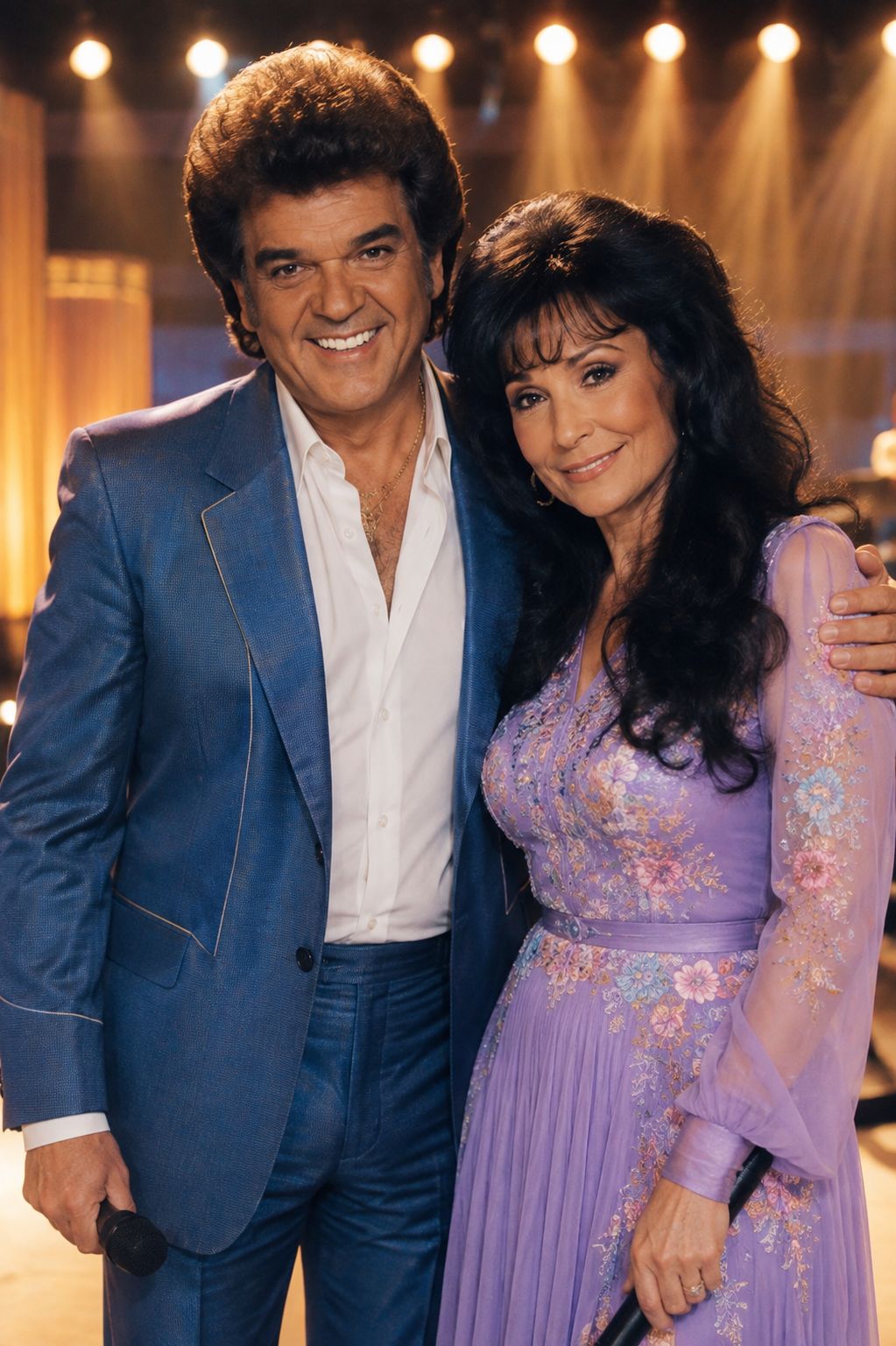
There are country music partnerships built on business. There are others built on chemistry. And then there are the rare ones that seem to exist because two voices were simply meant to find each other.
Conway Twitty and Loretta Lynn belonged to that last category.
When their voices collided in the early 1970s, something happened that neither solo career could have created alone. His smooth, dramatic baritone met her unmistakable Kentucky twang, and suddenly songs about heartbreak, temptation, distance, marriage, regret, and desire sounded less like performances and more like private conversations accidentally overheard.
For years, fans wondered whether the connection went beyond music.
The answer, according to Loretta herself, was much simpler—and perhaps more beautiful.
It was friendship.
And that friendship became one of the most successful partnerships country music has ever known.
Before They Became “Conway and Loretta”
Long before they became a legendary duet, Conway Twitty and Loretta Lynn had already established themselves as formidable solo artists.
Twitty had taken a remarkable journey from rock ‘n’ roll to country music. After his 1958 smash “It’s Only Make Believe,” he eventually found his true artistic home in Nashville. By the late 1960s and early 1970s, songs such as “Hello Darlin’” had transformed him into one of country music’s most powerful hitmakers. The Country Music Hall of Fame credits him with 40 No. 1 Billboard country hits.
Lynn, meanwhile, had become the voice of working-class women in country music. Her songs could be funny, rebellious, vulnerable, controversial, and painfully honest. “Coal Miner’s Daughter” wasn’t simply a hit—it became the musical autobiography of an artist who had turned ordinary life into extraordinary storytelling.
So when the two began recording together, nobody was bringing an unknown artist into the spotlight.
They were putting two established stars in the same room.
And that could have gone very differently.
The First Spark
Their first meeting happened through legendary Nashville producer Owen Bradley.
Lynn already knew Twitty’s work. In fact, she had admired him long before they became partners. Their eventual introduction at Bradley’s studio became the beginning of a relationship that would change both of their careers.
But the idea of pairing two major solo stars wasn’t immediately embraced by everyone around them.
There were concerns about egos. Concerns about record companies. Concerns about whether two artists with strong identities could successfully share the spotlight.
Twitty and Lynn weren’t interested in those doubts.
As Twitty later recalled, the idea made sense to him, Lynn, and her husband, Oliver “Doolittle” Lynn—even though others resisted it.
That determination became the first part of their unbreakable pact:
Trust the music.
They did.
And country music was never quite the same afterward.
“After the Fire Is Gone” Changed Everything
Their partnership officially exploded in 1971 with “After the Fire Is Gone.”
The song wasn’t sweet or innocent. It was complicated.
It explored emotional emptiness, temptation, and the uncomfortable spaces between love and loneliness. Twitty sounded wounded and restrained. Lynn sounded conflicted but fearless.
Together, they created tension.
Not manufactured tension.
Real emotional tension.
The recording became their first No. 1 duet and won them a Grammy. The Country Music Hall of Fame recognizes it as the song that launched one of country music’s most successful duet teams.
And suddenly, the audience understood what their producers had heard.
Their voices didn’t compete.
They completed each other.
“When these two voices hit, it creates this dimension that you can’t get singular—one without the other.”
That observation, shared by Garth Brooks in the PBS American Masters story on Lynn, explains their magic better than almost any statistic can.
The Rumors Were Inevitable
But their chemistry created another problem.
People believed them.
Not just as singers.
As a couple.
Their songs were filled with romance, arguments, forbidden attraction, longing, and emotional intimacy. Onstage, they could make a fictional relationship feel completely real.
Fans began imagining a relationship between them.
Loretta eventually addressed the rumors directly.
“Everybody thought me and Conway had a thing going. And that’s the farthest from the truth.”
Then she explained what the relationship actually meant to her.
She loved Conway as a friend.
And importantly, she emphasized that her husband loved him too.
That distinction is at the heart of their story.
Their closeness didn’t need to become a romance to be powerful.
In some ways, it was stronger because it didn’t.
The Unbreakable Pact Was Never About Romance
Country music has always understood complicated relationships.
But Lynn and Twitty demonstrated something different: two people could create breathtaking emotional intimacy in a song without destroying the boundaries of their real lives.
They trusted one another.
They understood one another’s strengths.
And they knew how to leave the ego outside the recording booth.
That was the real pact.
I will make you sound better. You will make me sound better. And neither of us has to become less of ourselves to make it work.
That principle is deceptively simple.
It’s also incredibly rare.
Then Came “Louisiana Woman, Mississippi Man”
By 1973, the partnership had become unstoppable.
“Louisiana Woman, Mississippi Man” gave them one of their most recognizable recordings. Oliver Lynn reportedly found the song and believed it was perfect for the pair. When he presented it to Loretta and Conway, they immediately recognized its potential.
The result?
Another No. 1.
The album Louisiana Woman, Mississippi Man also reached No. 1 on the country album chart.
The song worked because it sounded like the two artists were talking directly to one another.
Geography became metaphor.
The Mississippi River became a symbol of separation.
And their voices became the bridge.
They Didn’t Just Have Hits—They Had a Language
Listen closely to their recordings and you’ll hear why the partnership lasted.
Twitty often brought restraint.
Lynn brought immediacy.
He could sound like a man hiding something.
She could sound like a woman who already knew.
He leaned into the drama.
She punctured it with emotional honesty.
That contrast created a musical language uniquely theirs.
“Lead Me On.”
“Louisiana Woman, Mississippi Man.”
“As Soon as I Hang Up the Phone.”
“Feelins’.”
These weren’t merely songs sung by two famous people.
They were miniature dramas.
Each recording had characters, conflict, temptation, vulnerability, and resolution—or sometimes no resolution at all.
And listeners came back because they wanted to know what happened next.
The Awards Proved What the Audience Already Knew
The industry eventually had no choice but to recognize what fans had discovered.
Twitty and Lynn won the CMA Vocal Duo of the Year four consecutive times, from 1972 through 1975. They also won a Grammy for “After the Fire Is Gone.”
Their partnership produced 11 studio albums together between 1971 and 1988, according to PBS, with five No. 1 songs highlighted among their achievements.
Those numbers are extraordinary.
But statistics don’t explain why people still remember them.
For that, you have to listen.
The Greatest Duets Often Hide a Conversation
The secret of Conway and Loretta wasn’t simply their voices.
It was their willingness to listen.
In a great duet, one singer doesn’t simply wait for their turn.
They react.
They answer.
They challenge.
They surrender.
They leave space.
Twitty and Lynn understood that instinctively.
You can hear it in the way one voice enters after the other. You can hear the tension before their harmonies arrive. You can hear two personalities negotiating the emotional meaning of a lyric.
That is why their recordings still feel alive decades later.
They weren’t just singing together.
They were communicating.
When the Partnership Ended, the Legacy Didn’t
Their professional partnership eventually ended, but the music remained.
Twitty died in 1993 at the age of 59. Lynn died in 2022 at the age of 90.
Nearly three decades separated their deaths.
Yet the duet they created still feels strangely complete.
Perhaps that’s because the story was never really about how long they remained together.
It was about what they accomplished while they did.
They showed country music that two enormous personalities could share the spotlight without diminishing one another.
They showed that friendship could produce artistic intimacy without becoming scandal.
They showed that chemistry didn’t have to mean romance.
And they showed that sometimes the most enduring love story in music is the one that never needed to be a love affair.
Two Legends. One Legacy.
Conway Twitty and Loretta Lynn entered the studio as two country stars.
They left it as something bigger.
They became a musical institution.
Their partnership helped define the golden age of country duets and influenced generations of singers who discovered that the strongest duet isn’t necessarily two voices singing beautifully.
It’s two voices telling the truth together.
That is why their music refuses to disappear.
The records still play.
The stories still circulate.
The rumors still fascinate people.
And the voices still sound like they are speaking directly to each other.
But perhaps the most important lesson of their story is the one Loretta gave us herself.
They didn’t need to be lovers to create something unforgettable.
They needed trust.
They needed respect.
They needed friendship.
And above all, they needed the music.
“It isn’t taking anything away from the singular artist, but it’s just something different. There’s an energy there.”
That energy was Conway Twitty and Loretta Lynn.
Two legends.
Two lives.
Two unmistakable voices.
One extraordinary legacy.
And a friendship that proved, once and for all, that sometimes the strongest pact in country music is simply this:
I hear you. You hear me. Now let’s make something neither of us could have made alone.
VIDEO: