 By admin
 INTRODUCTION:
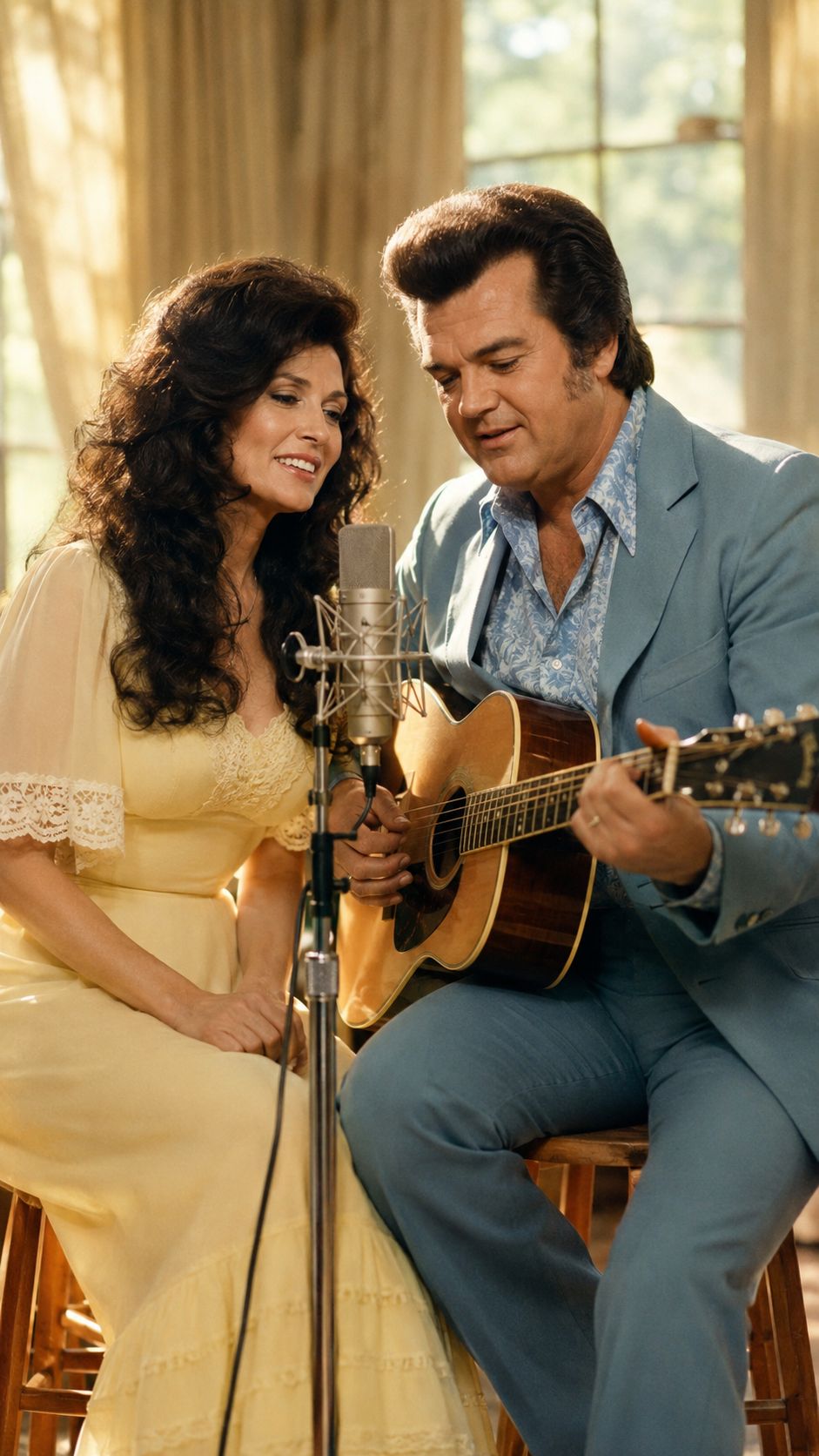
There are country music partnerships that succeed because two voices sound good together.
And then there are partnerships that feel almost impossible to explain.
Loretta Lynn and Conway Twitty belonged to the second category.
When their voices met, something happened that was bigger than harmony. Their songs sounded like conversations between two people who understood heartbreak, temptation, humor, loneliness, marriage, and complicated love. They could sing about a troubled relationship and make millions of listeners believe they were overhearing something intensely private.
Yet behind the chemistry was a relationship far less scandalous—and perhaps far more meaningful—than the rumors suggested.
Loretta Lynn repeatedly insisted that she and Conway Twitty were close friends, not secret lovers. In fact, she described their bond as one built on affection, trust, humor, and genuine respect.
And that distinction matters.
Because the story of Loretta and Conway was never really about romance.
It was about musical trust.
The Meeting That Started It All
Long before they became one of country music’s most celebrated duos, Loretta Lynn was already a major admirer of Conway Twitty.
Twitty, born Harold Lloyd Jenkins, had first become famous as a rock-and-roll performer before reinventing himself as a country singer. By the late 1960s, he was building the legendary country career that would eventually produce an extraordinary run of No. 1 hits.
Lynn had admired him long before she ever recorded beside him.
According to a 1978 Billboard account, Lynn had been a fan of Twitty’s music since hearing “It’s Only Make Believe.” She even reportedly had a Conway Twitty poster in her home before she became a major recording artist herself.
Then came the meeting.
At producer Owen Bradley’s studio, Lynn was finishing a recording session when Bradley told her that Conway Twitty was nearby.
The revelation reportedly left her stunned.
She had been hoping to meet the man whose voice she admired.
Suddenly, he was standing behind her.
It was the beginning of something neither singer could have fully predicted.
“It was a mutual admiration society.”
That description, attributed to the two singers in their recollections of the meeting, may actually be the simplest explanation for why their partnership worked so beautifully.
They didn’t begin with manufactured chemistry.
They began with admiration.
The Dressing Room Where the Magic Began
The real beginning of the partnership happened away from the spotlight.
Lynn and Twitty traveled overseas with a group of performers. Between appearances, they found themselves singing together in dressing rooms.
No elaborate production.
No hit record waiting to happen.
Just two singers discovering what happened when their voices met.
Lynn later explained that they started singing together backstage and decided to return home and see what producer Owen Bradley thought about the idea of recording as a duo.
That detail is important because it reveals something about their relationship.
Their partnership wasn’t simply created by record executives looking for a profitable male-female pairing.
The singers themselves discovered the chemistry first.
And once Nashville heard it, there was no going back.
“After the Fire Is Gone” Changed Everything
In 1971, Loretta Lynn and Conway Twitty released “After the Fire Is Gone.”
The song wasn’t sweet.
It wasn’t innocent.
It dealt with the emotional emptiness that can exist inside a relationship after passion disappears.
And that was exactly why the two voices worked.
Twitty brought his smooth, restrained intensity.
Lynn answered with a voice that could sound vulnerable and defiant in the same breath.
Together, they didn’t sound like two singers performing a duet.
They sounded like two people trapped inside the same emotional situation.
“After the Fire Is Gone” became their first No. 1 country single and won the Grammy Award for Best Country Performance by a Duo or Group with Vocal.
Suddenly, the experiment had become history.
And the audience wanted more.
Then Came “Louisiana Woman, Mississippi Man”
If “After the Fire Is Gone” established the partnership, “Louisiana Woman, Mississippi Man” proved how much fun they could have together.
The song was playful, energetic, and filled with regional imagery.
Instead of sounding like two people carefully sharing a microphone, Lynn and Twitty sounded like characters who couldn’t wait to answer each other.
The song became a No. 1 country hit, and the album of the same name also reached No. 1 on the country album chart.
Their formula was becoming unmistakable:
Conflict. Humor. Passion. Vulnerability.
And above all, believable chemistry.
Why Did Everyone Think They Were in Love?
This may be the most fascinating part of the story.
Audiences didn’t simply enjoy Loretta Lynn and Conway Twitty.
They believed them.
Their songs often sounded so intimate that listeners naturally began wondering whether something more was happening behind the scenes.
Lynn eventually addressed the speculation directly.
“Everybody thought me and Conway had a thing going. And that’s the farthest from the truth.”
Then she explained what their relationship actually meant.
“I loved Conway as a friend, and my husband loved him.”
That statement changes the way their entire partnership can be understood.
The intensity audiences heard wasn’t necessarily romantic tension between the performers.
It was professional intimacy—the rare ability to completely trust another singer with an emotional song.
And perhaps that is even more remarkable.
Conway Was More Than a Duet Partner
For Lynn, Conway wasn’t simply the man standing beside her at the microphone.
He became a trusted friend.
Her husband, Oliver “Doolittle” Lynn, also developed a close friendship with Twitty. Lynn recalled that Conway was essentially the only artist in the country music business her husband genuinely cared about.
There was humor in that friendship, too.
Lynn remembered Doolittle telling Conway stories—many of them exaggerated—and hearing Conway laughing.
“Most of them lies.”
The laughter became part of the memory.
That detail is easy to overlook, but it says something powerful about the relationship.
Behind the glamorous costumes, hit records, sold-out concerts, and television appearances were simply people who enjoyed one another’s company.
They Became Country Music’s Golden Duet
From 1971 through the late 1970s, Lynn and Twitty became one of the most successful male-female partnerships in country music.
PBS notes that they recorded 11 studio albums between 1971 and 1988 and produced five No. 1 singles from five different albums. They also won the CMA Vocal Duo of the Year award every year from 1972 through 1975.
Their catalog included songs such as:
- “After the Fire Is Gone”
- “Lead Me On”
- “Louisiana Woman, Mississippi Man”
- “You’re the Reason Our Kids Are Ugly”
- “I Still Believe in Waltzes”
- “Making Believe”
Their music could be heartbreaking one moment and hilarious the next.
That range was part of their genius.
They didn’t pretend love was simple.
They understood that relationships could be messy, funny, passionate, painful, and deeply human.
That was country music at its most honest.
The Partnership Eventually Changed
By 1981, Lynn and Twitty had largely stopped touring together full-time.
Their individual careers had become enormous, and sustaining both solo careers and the duet partnership became increasingly difficult. They continued to record together occasionally, including the 1988 single “Making Believe.”
But stopping regular performances did not mean the friendship disappeared.
That distinction is crucial.
The microphones became quieter.
The friendship did not.
And then, in 1993, something happened that turned their entire history into something almost unbearably poignant.
Their Final Goodbye Wasn’t Planned
Conway Twitty died on June 5, 1993, after becoming ill while on tour.
By an extraordinary twist of fate, Loretta Lynn was already at Cox Medical Center in Springfield, Missouri, where her husband Doolittle was receiving treatment.
Twitty was brought to the same hospital.
Lynn later recalled seeing his bus arrive and realizing something was wrong. She went downstairs as Conway was being brought in.
It would become their final encounter.
There was no grand stage.
No television cameras.
No carefully planned reunion.
No final duet under concert lights.
Just two old friends brought together by circumstance at the end of Twitty’s life.
And perhaps that makes the moment even more powerful.
Their last meeting wasn’t about country music.
It was about friendship.
The Tragedy of What Might Have Been
There is another emotional layer to the story.
Loretta Lynn lived for decades after Conway Twitty’s death. She continued performing, recording, telling stories, and representing a generation of country music that had helped redefine the genre.
But Twitty was gone.
And fans were left wondering what might have happened if he had lived.
Would they have reunited?
Would they have recorded another album?
Would an older Loretta and Conway have created an entirely different kind of music together?
Nobody can know.
Loretta’s family and others involved in preserving their legacy have suggested that a second chapter might have been possible. Her official site notes that the duo had stopped touring together full-time in 1981, while Twitty died in 1993.
That unrealized future is part of what makes their story so bittersweet.
Their music ended before their friendship had to.
What Made Loretta and Conway Different?
Country music has produced countless duets.
But Loretta Lynn and Conway Twitty possessed something rare.
They trusted each other.
They listened to each other.
They understood how to leave space for the other voice.
And most importantly, they weren’t afraid of emotional contradiction.
Loretta could sound wounded without sounding weak.
Conway could sound passionate without becoming theatrical.
Together, they created characters who felt real because the singers themselves understood real life.
Their performances were convincing precisely because they weren’t pretending to be perfect.
They were singing about people who made mistakes.
People who loved the wrong person.
People who stayed too long.
People who laughed through difficult moments.
People who discovered that sometimes the person standing beside you can understand your heart without knowing every detail of your life.
That was the secret.
Not romance.
Recognition.
The Legacy Lives On
Decades after Conway Twitty’s death, the sound of Loretta Lynn and Conway Twitty continues to influence artists and audiences.
Their songs are still performed.
Their voices are still studied.
And their partnership remains one of the defining examples of what a country duet can accomplish.
The Country Music Hall of Fame recognizes Lynn’s historic achievements, including her 1972 CMA Vocal Duo of the Year award with Twitty.
But statistics only tell part of the story.
The real legacy lives in the feeling.
Play “After the Fire Is Gone” today, and the voices still sound remarkably alive.
Play “Louisiana Woman, Mississippi Man,” and the playful electricity is still there.
Listen closely, and you can hear why audiences once wondered if their chemistry was something more.
But perhaps the truth is better than the rumor.
They didn’t need to be lovers to create something unforgettable.
They needed to be friends who trusted each other enough to tell difficult stories through song.
And when Conway Twitty’s life ended in that Missouri hospital in 1993, Loretta Lynn didn’t lose merely a singing partner.
She lost someone she had known, laughed with, traveled with, recorded with, and trusted.
Their final goodbye was not performed beneath stage lights.
There was no orchestra.
No applause.
No encore.
Just two people whose voices had once filled arenas finding themselves together one last time.
And perhaps that is why their music has endured.
Because underneath all the awards, chart records, costumes, and rumors was something far simpler:
Two extraordinary country singers who found something rare in each other—and made music that still sounds like two hearts talking
VIDEO: