 By admin
 INTRODUCTION:
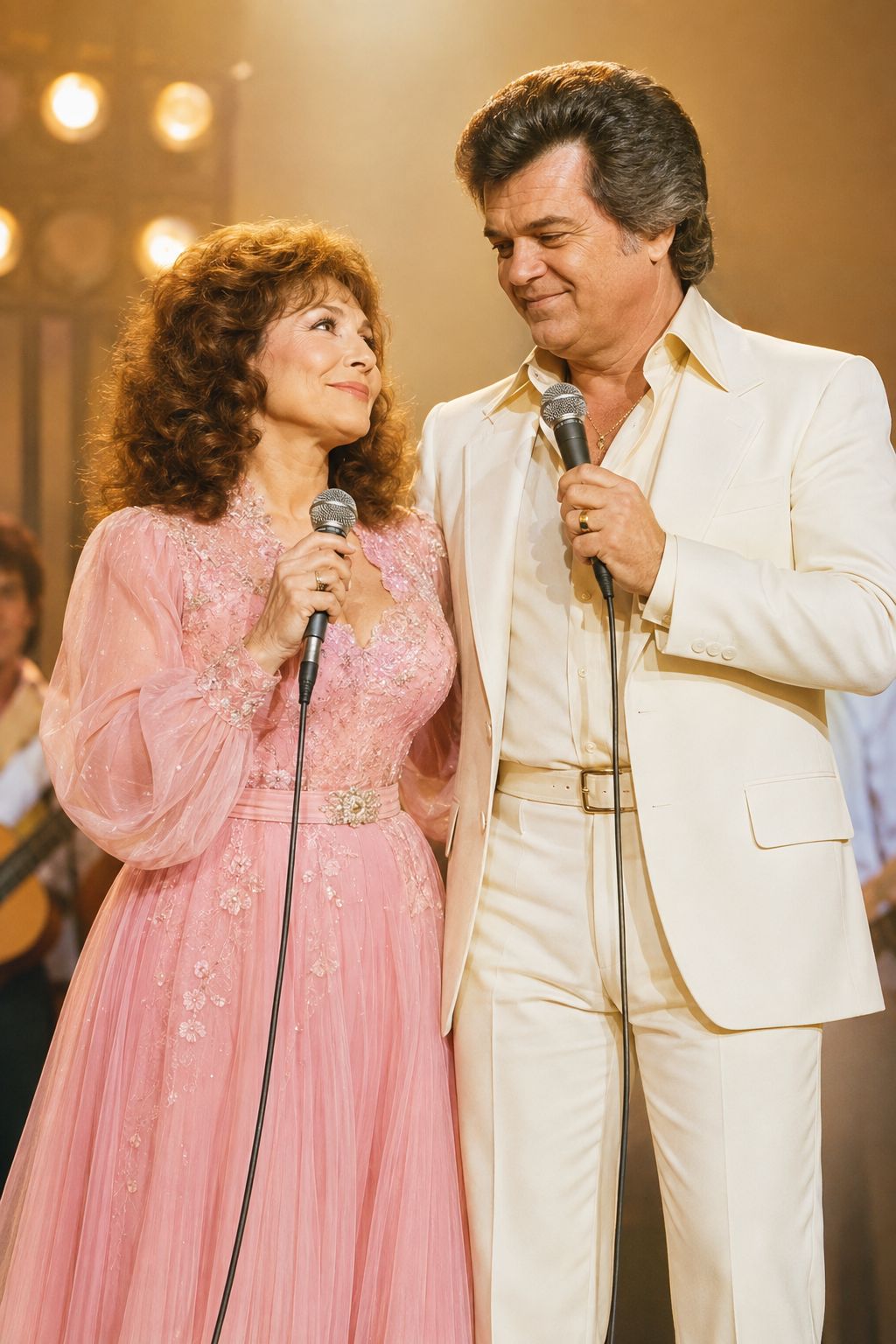
There are successful duets, and then there are musical partnerships that seem to create their own gravitational pull.
Conway Twitty and Loretta Lynn belonged to the second category.
When their voices first came together in the early 1970s, nobody could have known just how extraordinary the partnership would become. Twitty already had an enormous solo career behind him, while Lynn had established herself as one of country music’s most fearless and authentic female voices. Yet something happened when the two stood behind the same microphone.
Their voices didn’t simply blend.
They created tension.
They created vulnerability.
They created the feeling that listeners were overhearing a private conversation between two people who had far more to say than they were willing to admit.
And that may have been the secret behind their astonishing run of success.
Their first major duet, “After the Fire Is Gone,” reached No. 1 on the country chart in 1971 and became the launchpad for one of the most celebrated male-female partnerships in country music history. The pair eventually produced five consecutive No. 1 country singles during the early 1970s, including “Lead Me On,” “Louisiana Woman, Mississippi Man,” “As Soon as I Hang Up the Phone,” and “Feelins’.”
But the numbers only tell part of the story.
The real magic was happening underneath them.
Two Completely Different Artists — One Perfect Musical Equation
Conway Twitty and Loretta Lynn were not obvious clones of one another.
That was precisely why they worked.
Twitty brought an intensely controlled, masculine vocal presence. His voice could sound confident one moment and wounded the next. The Country Music Hall of Fame describes his singing as intensely emotional, with a dramatic style that helped define his career.
Lynn brought something different.
Her voice carried the authority of someone who had lived the stories she sang.
She had built her career around songs that confronted marriage, jealousy, betrayal, motherhood, independence and the complicated realities of women’s lives. Her songwriting was unusually autobiographical and direct for the era.
Put them together and something fascinating happened.
Twitty could represent temptation.
Lynn could represent consequence.
Twitty could sound like the person trying to justify a decision.
Lynn could sound like the person demanding the truth.
That contrast gave their songs a dramatic quality that many conventional love duets simply didn’t have.
“The secret wasn’t that they sounded alike. It was that they sounded like two people who needed each other to finish the story.”
That distinction is critical.
Their records weren’t merely vocal exercises.
They were miniature dramas.
The Chemistry Was Built on Conflict
One of the most important ingredients in their success was emotional conflict.
Country music has always understood that happiness alone doesn’t make the most compelling story.
Heartbreak does.
Temptation does.
Regret does.
And Conway and Loretta repeatedly found material that placed those emotions at the center of their performances.
Consider the emotional territory of “After the Fire Is Gone.”
The song isn’t about a perfect relationship.
It’s about what happens when the excitement disappears and people find themselves confronting the uncomfortable reality of a fading romance.
That was dangerous territory for mainstream country music—but it was also incredibly relatable.
When the song reached No. 1 in 1971, it immediately established the formula: adult themes, complicated relationships and two voices that sounded emotionally invested in every line. The song also earned them a Grammy, adding industry recognition to their commercial success.
And then they did something even harder.
They repeated the magic.
Again.
And again.
And again.
They Didn’t Try to Outshine Each Other
This may be the most underrated part of their partnership.
Both artists were powerful enough to dominate a recording by themselves.
But they didn’t need to.
Twitty’s great strength was often restraint. His stage persona was famously understated, and his official biography notes that he preferred communicating through music rather than excessive stage banter.
Lynn, meanwhile, possessed an unmistakable personality and emotional directness.
Instead of competing, they created space.
One singer would lead.
The other would respond.
One would sound vulnerable.
The other would challenge that vulnerability.
The result felt conversational.
Almost cinematic.
You weren’t simply listening to Conway Twitty and Loretta Lynn sing.
You were watching two characters negotiate love.
That distinction gave their music longevity.
The “Louisiana Woman, Mississippi Man” Formula
By 1973, their partnership had become almost unstoppable.
“Louisiana Woman, Mississippi Man” became another No. 1 hit, while the album of the same name also reached No. 1 on the country album chart.
The title itself reveals something about their appeal.
It wasn’t polished suburban fantasy.
It was regional.
It was colorful.
It had personality.
It sounded like a story before the record even began.
And that’s exactly what country music does at its best: it takes ordinary human experiences and turns them into unforgettable characters.
Loretta wasn’t simply “the woman.”
Conway wasn’t simply “the man.”
They were personalities.
They had accents, attitudes, flaws, pride and desire.
That made the songs feel lived-in rather than manufactured.
Their Secret Weapon: Believability
The audience had to believe them.
That sounds obvious.
It isn’t.
Many technically brilliant duets fail because the singers sound like they’re performing a duet.
Twitty and Lynn frequently sounded as though they were having a conversation.
That difference is enormous.
Listen closely to the architecture of their recordings and you’ll often hear a question-and-answer dynamic.
One voice establishes the emotional situation.
The other reacts.
The first pushes harder.
The second pulls away.
Then the voices meet.
It’s almost like watching a relationship unfold in real time.
“Their greatest special effect was chemistry.”
No elaborate production trick could manufacture that.
It came from the combination of their vocal personalities.
And because the emotions were complicated, listeners could project their own experiences onto the songs.
A married couple could hear one thing.
Someone going through heartbreak could hear another.
A young listener could hear a forbidden romance.
An older listener might hear regret.
That universality helped make the records endure.
The Awards Proved It Wasn’t Just Hype
The industry noticed.
The Country Music Association named Conway Twitty and Loretta Lynn Vocal Duo of the Year four consecutive times, from 1972 through 1975.
That is important because their success wasn’t simply the result of one breakout single.
It was sustained.
Their collaboration generated a remarkable body of work. Sources differ slightly in how they count their releases and hits depending on whether compilations and chart categories are included, but their partnership clearly produced a long series of successful recordings, including multiple No. 1s and numerous Top 10 hits.
And perhaps most impressively, their duet success existed alongside thriving solo careers.
Loretta continued scoring major hits of her own.
Conway continued his extraordinary solo run.
Neither artist needed the other to remain relevant.
That may actually be why the partnership worked so well.
They came together because they wanted to, not because either career depended upon the other.
The Deeper Reason Fans Couldn’t Look Away
There was another ingredient that can’t be measured by chart statistics.
Mystery.
Conway Twitty cultivated an aura of distance and restraint. Loretta Lynn, by contrast, was known for an openness that made audiences feel as though she were telling them the truth directly.
That contrast created intrigue.
He didn’t give everything away.
She often did.
He could hide behind a phrase.
She could expose the emotion behind it.
And somewhere between those two approaches was the magic.
It created a feeling that there was always something happening beneath the lyrics.
Something unsaid.
Something unresolved.
That is one reason their recordings still feel emotionally charged decades later.
They Turned a Duet Into a Storytelling Machine
The greatest lesson from Conway Twitty and Loretta Lynn isn’t simply that two talented singers can make beautiful music together.
It’s that contrast creates drama.
Their voices were different.
Their personas were different.
Their emotional perspectives were different.
Yet those differences fit together.
That’s the formula.
Strength + vulnerability.
Temptation + consequence.
Confidence + doubt.
Male perspective + female perspective.
Silence + confrontation.
Every great duet needs some form of tension.
Conway and Loretta understood that instinctively.
They didn’t erase their differences.
They weaponized them.
Why Their Partnership Still Matters
More than half a century after “After the Fire Is Gone” reached the top of the charts, the Conway Twitty–Loretta Lynn partnership remains a blueprint for country duets.
Their music demonstrates something modern producers sometimes forget:
You don’t need more effects.
You need more emotion.
You don’t need two voices that sound identical.
You need two voices that need each other.
The Country Music Hall of Fame still describes their first collaboration as the beginning of one of the most successful duet teams in country music history.
And perhaps that’s the simplest explanation for their enduring appeal.
They made the audience believe that something was happening between the lines.
Something fragile.
Something dangerous.
Something human.
When Conway Twitty sang, you could hear the confidence of a man who knew exactly what he wanted.
When Loretta Lynn answered, you could hear a woman who wasn’t necessarily going to let him have it.
And when their voices finally met, the listener became the third person in the room.
That was the secret.
Not perfection.
Not publicity.
Not coincidence.
Chemistry.
The kind that can’t be manufactured, can’t be taught and can’t be duplicated simply by putting two famous names on an album cover.
Conway Twitty and Loretta Lynn didn’t just record country songs together.
They created emotional theater inside three minutes of music.
And that’s why, decades later, their partnership still feels less like a chapter in country music history—and more like a conversation that never really ended.
VIDEO: