 By admin
 INTRODUCTION:
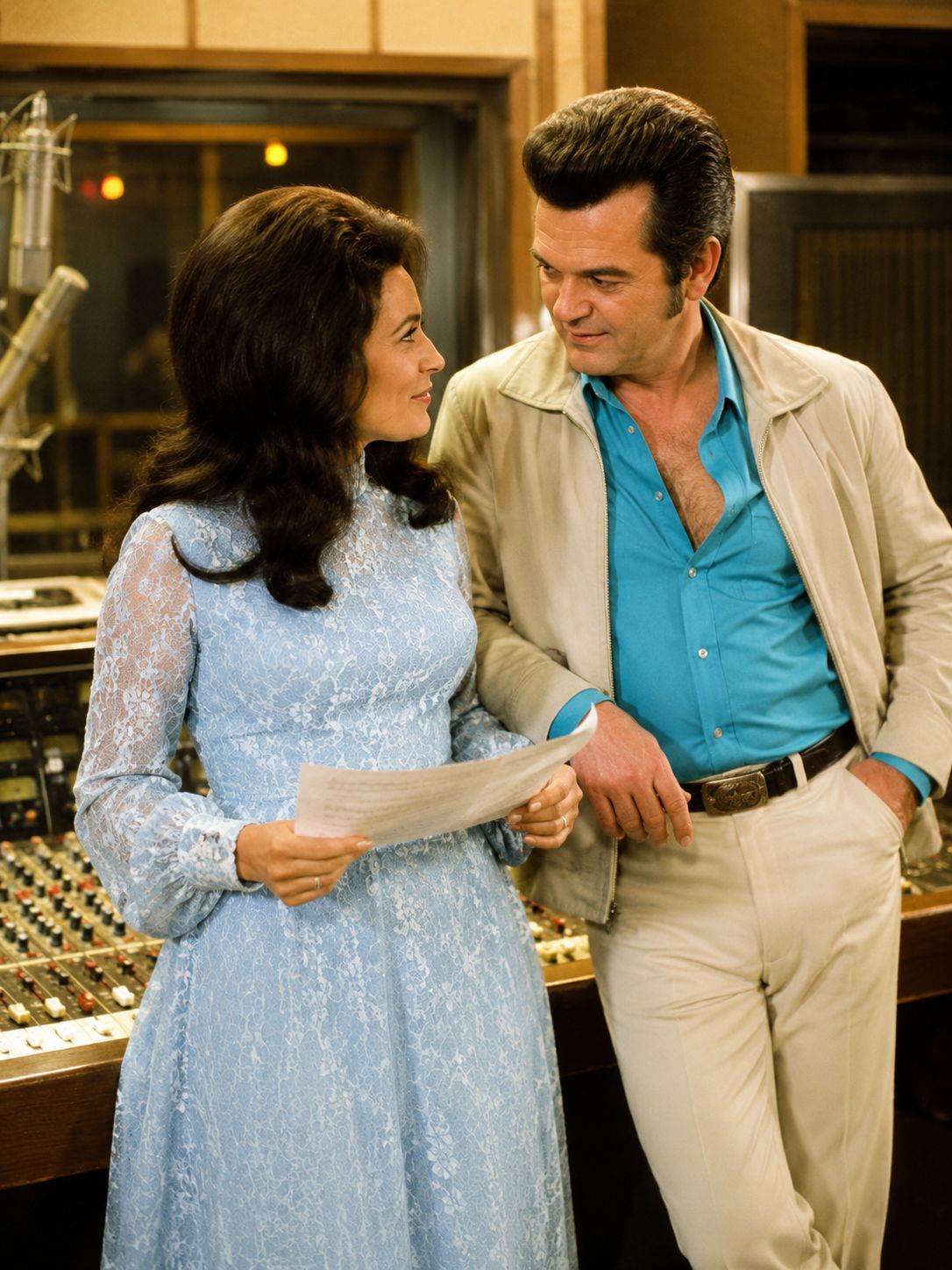
There are country duos that sound good together.
Then there are duos that sound as if they were destined to collide.
Conway Twitty and Loretta Lynn belonged to the second category.
When their voices met in the early 1970s, something unusual happened. Twitty brought a deep, seductive, almost conversational delivery. Lynn answered with a voice that could sound tender one second and fiercely confrontational the next. On paper, they were different personalities. In the recording studio, that difference became their greatest weapon.
Their partnership ultimately produced five consecutive No. 1 country singles, multiple Top 10 hits, a Grammy, and four consecutive CMA Vocal Duo of the Year awards from 1972 through 1975.
But the real story isn’t simply about statistics.
It is about tension.
It is about two powerful performers learning how to turn contrast into chemistry.
And it is about why audiences believed every word they sang.
The Meeting of Two Completely Different Country Stars
By the time Conway Twitty began working with Loretta Lynn, neither artist needed another superstar to establish a career.
Twitty had already transformed himself from a rock-and-roll performer into one of country music’s most formidable hitmakers. His country career would eventually produce a remarkable 40 Billboard No. 1 country hits.
Lynn had already become one of Nashville’s most important female voices, with songs that reflected marriage, betrayal, motherhood, independence, jealousy, and the complicated realities of working-class life.
That difference mattered.
Twitty often approached a song from the perspective of the emotionally complicated man—the character who wanted something, regretted something, or was trying to justify something.
Lynn could answer him.
And she wasn’t going to simply agree.
That created the dramatic engine behind their duets.
He could make a confession sound irresistible. She could make the consequences impossible to ignore.
That was the magic.
“After the Fire Is Gone” Changed Everything
Their first major duet, “After the Fire Is Gone,” arrived in 1971.
It was not merely successful.
It went to No. 1 on the country chart and established the template for what followed. The Country Music Hall of Fame describes it as the song that launched one of country music’s most successful duet partnerships.
AllMusic notes that the song also crossed over onto the pop charts, helping inaugurate a professional association that would generate more than a decade of hits.
Listen to the premise and the reason becomes obvious.
The song is about two people trapped in a relationship that has lost its passion, finding emotional heat somewhere they shouldn’t.
It is morally complicated.
It is uncomfortable.
And it is incredibly human.
That was exactly where Twitty and Lynn were strongest.
They weren’t singing like two people politely performing a love song.
They sounded like two people having a conversation neither one could afford to have.
The “Clashes” Were Part of the Magic
Stories about great musical partnerships often become exaggerated over time.
There is a temptation to imagine that every legendary duo was secretly fighting backstage, throwing microphones across recording studios, or barely tolerating one another.
The documented record gives us something more interesting.
There is no need to invent dramatic studio fights to explain their chemistry.
The creative tension is already in the music.
Twitty had an extraordinarily controlled vocal style. Lynn’s delivery was more direct, earthy, and emotionally exposed. Their voices did not blend because they were identical.
They blended because they were different.
That distinction is crucial.
The secret wasn’t that Conway and Loretta sounded alike. The secret was that they sounded impossible to ignore when placed side by side.
When Twitty lowered his voice, Lynn could push back.
When Lynn became emotional, Twitty could steady the conversation.
When one singer sounded vulnerable, the other could sound skeptical.
It created a miniature drama inside every song.
Then Came “Lead Me On”
Their second No. 1 hit, “Lead Me On,” proved that “After the Fire Is Gone” wasn’t a fluke.
Released in 1971, the song became the second No. 1 hit from the partnership. AllMusic describes the duo as seemingly “invincible” as they continued reaching the top of the charts.
And that is when Nashville had a serious problem to solve:
What do you do when lightning strikes twice?
The answer was simple.
Record again.
And again.
And again.
Their early success quickly became a pattern.
The Formula Wasn’t Romance — It Was Conflict
This is perhaps the most fascinating part of their story.
Many male-female country duos depended heavily on the audience believing the singers were romantically involved.
Twitty and Lynn didn’t need that.
In fact, AllMusic specifically notes that the two were never romantically linked despite becoming one of the most commercially successful male-female country partnerships in music history.
That separation between performance and real life may actually have made the music more convincing.
They could play characters without audiences needing to believe Conway and Loretta themselves were secretly together.
The drama belonged to the songs.
And those songs were often built around temptation, disagreement, loneliness, desire, marriage, and regret.
That gave them an enormous emotional playground.
“Louisiana Woman, Mississippi Man” Took the Formula Somewhere Bigger
By 1973, the partnership had become a country institution.
Then came “Louisiana Woman, Mississippi Man.”
The title itself sounds like a movie.
Two people from different places.
Two personalities.
Two voices.
One relationship.
The song became another No. 1 hit, reinforcing the remarkable run that had begun two years earlier.
But underneath the catchy premise was the same fundamental trick:
Let the singers disagree.
Country music has always understood that conflict creates storytelling.
Twitty and Lynn simply turned that principle into a vocal art form.
Instead of presenting perfect romance, they gave listeners relationships with friction.
And listeners recognized themselves in that friction.
“As Soon as I Hang Up the Phone” and “Feelins’”
The streak continued.
“As Soon as I Hang Up the Phone” became another No. 1 in 1974.
Then came “Feelins’,” another chart-topper in the same era. Together, those songs completed a remarkable run of five consecutive No. 1 country singles between 1971 and 1975.
And their success wasn’t limited to singles.
Their discography expanded rapidly, with albums including We Only Make Believe, Lead Me On, Louisiana Woman, Mississippi Man, Country Partners, Feelins’, United Talent, Dynamic Duo, Honky Tonk Heroes, Diamond Duet, and others.
AllMusic’s overview of their work lists 12 Top 10 country duets on one compilation, including all five No. 1s.
This wasn’t a one-hit partnership.
It was a system.
Why Their Voices Worked So Well
Imagine trying to manufacture their chemistry today.
A producer could bring in two great singers.
They could hire the best Nashville musicians.
They could spend weeks adjusting harmonies.
But something would still be missing.
Because Twitty and Lynn brought something technology couldn’t create:
personality.
Twitty’s voice had weight.
Lynn’s voice had bite.
He could sound like the man who had already made a bad decision.
She could sound like the woman who knew exactly what that decision would cost.
That is why their duets frequently feel less like songs and more like scenes from a country drama.
They weren’t simply harmonizing. They were arguing, flirting, forgiving, accusing, remembering, and surrendering—all within three or four minutes.
That is an extraordinarily difficult thing to fake.
The Awards Confirmed What Listeners Already Knew
The industry noticed.
Twitty and Lynn won the CMA Vocal Duo of the Year award four consecutive times, from 1972 through 1975. They also won a Grammy for their work together, including recognition for “After the Fire Is Gone.”
Those awards matter because they demonstrate that the partnership wasn’t simply a fan phenomenon.
Musicians, critics, and industry voters recognized the quality of what they were doing.
Lynn’s own legacy was simultaneously expanding. She had already broken ground for women in country music, while Twitty was becoming one of the defining male voices of the era.
Together, they became something larger than either solo identity.
The Most Important Secret Was Trust
There is another reason their partnership lasted.
You cannot sing emotionally vulnerable material with another person unless you trust them.
A duet requires surrender.
One singer has to leave room for the other.
One has to know when not to dominate.
One has to recognize when the other voice needs to become the emotional center of the song.
Twitty and Lynn understood that instinctively.
Their voices constantly passed the spotlight back and forth.
That is why their recordings still feel alive.
They don’t sound like two stars trying to prove who is better.
They sound like two characters trying to win an argument.
And that difference is everything.
What Made Conway and Loretta Truly Unstoppable?
Perhaps the simplest answer is this:
They understood human relationships.
They understood that love isn’t always sweet.
Marriage isn’t always peaceful.
Desire isn’t always convenient.
And forgiveness doesn’t always arrive at the right moment.
Their greatest songs lived inside those uncomfortable spaces.
That made them relatable.
It also made them timeless.
More than a decade of recordings followed their initial partnership, and their legacy continued through compilations and reissues long after their peak years.
The remarkable thing is that the music doesn’t require listeners to know every detail about their personal lives.
The songs work because the emotions are recognizable.
The Legacy That Still Feels Dangerous
Conway Twitty died in 1993.
Loretta Lynn died in 2022.
Yet when their voices meet on an old recording, the years seem to disappear.
There is still that tension.
That pause.
That sense that one singer is about to say something the other doesn’t want to hear.
And perhaps that’s why their music continues to fascinate country fans.
Their success wasn’t built on pretending relationships were perfect.
It was built on showing that they weren’t.
Conway Twitty and Loretta Lynn didn’t become legendary because they eliminated the tension between two voices. They became legendary because they turned that tension into music.
That was their secret formula.
Not romance.
Not manufactured drama.
Not simply two famous names sharing a microphone.
It was contrast, trust, character, chemistry, and emotional honesty.
And once those ingredients came together, the charts had almost no choice but to listen.
That is why, decades later, Conway Twitty and Loretta Lynn remain more than a celebrated country duo.
They remain a lesson in what happens when two completely different artists stop trying to sound alike—and discover that their differences are exactly what makes them unforgettable.
VIDEO: