 By admin
 INTRODUCTION:
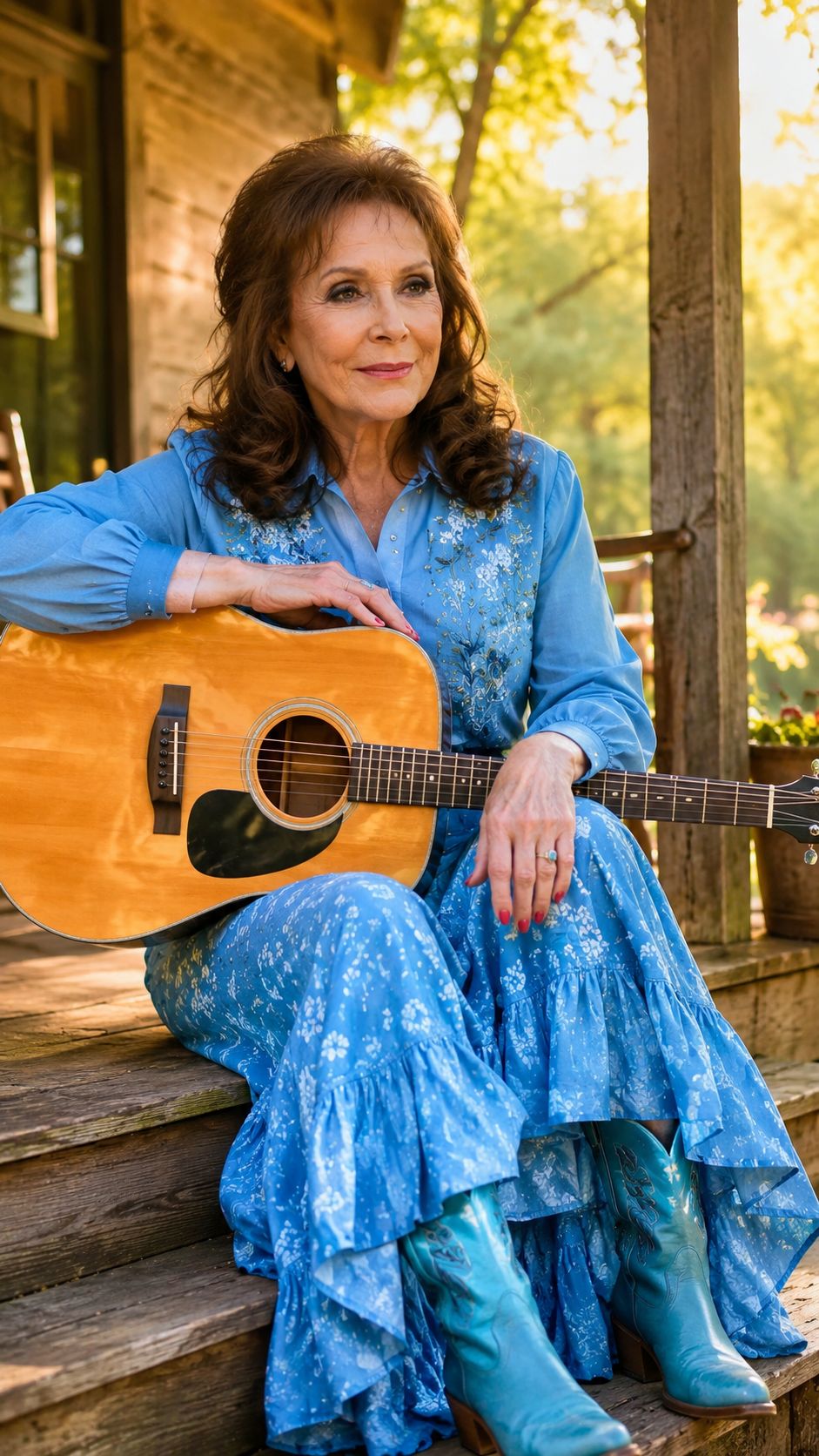
There are country stars who become famous because they have extraordinary voices. There are others who become legends because they write extraordinary songs.
Then there was Loretta Lynn.
Her story was different from the beginning.
Born in the poverty of Butcher Hollow, Kentucky, Lynn grew up in a one-room log cabin as the second of eight children. Her father worked as a coal miner, while her mother cared for a large family with very little money. Yet from those difficult beginnings came one of the most influential women country music has ever known.
Lynn died on October 4, 2022, at age 90, but the story she left behind is far more complicated than the familiar image of the smiling “Coal Miner’s Daughter.”
Behind the rhinestones, hit records and awards was a woman who experienced poverty, teenage marriage, motherhood, complicated relationships, controversy, grief and extraordinary success.
And perhaps the most remarkable truth of all is that she turned almost every painful chapter of her life into music.
She Didn’t Come From Nashville — She Came From Almost Nowhere
Today, it’s easy to look at Loretta Lynn’s career and imagine that she was destined for Nashville.
She wasn’t.
There was no prestigious music school. No wealthy family. No powerful record executive waiting in the wings.
There was simply a girl from Appalachia who loved country music.
Lynn was born Loretta Webb in Butcher Hollow, Kentucky. Her family lived in circumstances so difficult that her later song “Coal Miner’s Daughter” became more than a hit—it became a musical autobiography of an entire way of life.
She eventually married Oliver “Doolittle” Lynn, known as “Mooney,” while still a teenager. The couple moved to Washington State in search of better opportunities, and motherhood quickly became the center of Lynn’s young life. By the time she was 22, she had four children.
It would have been easy for her story to end there.
Instead, something unexpected happened.
Her husband bought her a guitar.
The instrument cost only $17.
That inexpensive guitar became the beginning of a career that would eventually make Lynn one of the most important women in American music.
“Her first guitar cost $17, and with it this coal miner’s daughter gave voice to a generation.”
That description, offered by President Barack Obama when Lynn received the Presidential Medal of Freedom, captures something essential about her career.
She didn’t wait for permission.
She learned.
She sang.
And eventually, she wrote.
Loretta Lynn Didn’t Just Sing About Women’s Lives — She Exposed Them
This is perhaps the most important part of Lynn’s legacy.
Before Loretta Lynn, women in country music certainly had voices. But Lynn pushed the genre into territory that many artists—and radio programmers—were uncomfortable entering.
She wrote about husbands who drank.
She wrote about cheating.
She wrote about divorce.
She wrote about sexuality.
She wrote about pregnancy and birth control.
And she frequently told those stories from the woman’s point of view.
The Songwriters Hall of Fame notes that Lynn’s work confronted major social issues of her era and addressed subjects that were rarely explored so openly by female country performers.
Her songs weren’t political speeches.
They were stories.
That’s what made them powerful.
When Lynn sang about a woman’s anger, loneliness or frustration, listeners didn’t hear an abstract social issue. They heard a woman talking about her life.
Lynn herself once explained the philosophy behind her songwriting: she wrote about what she knew—and what she knew often involved something that someone had done to her.
That honesty became her greatest weapon.
“Fist City” Wasn’t Just a Song
Few songs demonstrate Lynn’s personality better than “Fist City.”
The song was inspired by rumors involving her husband and another woman. Rather than quietly ignoring the situation, Lynn turned her anger into a hit record. According to the Smithsonian, she reportedly wrote the lyrics after driving home from Nashville while thinking through the confrontation.
The result was unmistakably Loretta.
Bold.
Funny.
Threatening.
And completely unapologetic.
The song reached No. 1 on the country chart in 1968.
But underneath the humor was something deeper.
Lynn was giving women permission to be angry.
For generations, women were often expected to endure betrayal quietly. Lynn’s songs suggested something different:
You can speak.
You can fight back.
You can tell your story.
That attitude became one of the defining characteristics of her career.
Then Came “The Pill” — And the Controversy Exploded
If “Fist City” showed Lynn’s willingness to confront infidelity, “The Pill” showed just how far she was willing to go.
Released in 1975, the song addressed birth control at a time when the subject remained deeply controversial. Some radio stations refused to play it.
Yet Lynn didn’t retreat.
That was her pattern.
When a subject made people uncomfortable, she often walked directly toward it.
“The Pill” wasn’t simply provocative for the sake of being provocative. It reflected a larger transformation happening in American society, particularly for women.
And Lynn understood something many people in the music business didn’t:
Ordinary women wanted to hear their lives reflected in songs.
She didn’t necessarily write for critics.
She wrote for the woman listening to the radio while washing dishes, raising children, working, worrying about money or trying to understand a difficult marriage.
That’s why her songs traveled so far.
Her Marriage Was Far More Complicated Than the Public Image
Perhaps the most uncomfortable part of Loretta Lynn’s story is her relationship with Mooney.
Their marriage lasted for nearly five decades, but it was far from a fairy tale.
Lynn’s autobiography, Coal Miner’s Daughter, openly discussed the difficult aspects of their relationship, including struggles involving drinking and marital conflict. The 1980 film adaptation brought those experiences to an even larger audience.
That honesty mattered.
Lynn didn’t present herself as someone who had escaped every hardship.
Instead, she acknowledged that success did not magically erase pain.
She could become a superstar and still carry the emotional scars of the woman she had been before the fame.
That contradiction is one reason her music remains so compelling.
Patsy Cline Was More Than a Musical Influence
Another important chapter in Lynn’s life involved her friendship with Patsy Cline.
Cline became one of Lynn’s earliest supporters and an important influence during the younger singer’s rise. Lynn’s connection to Cline became part of the mythology surrounding her career, but it was also deeply personal.
When Cline died in a plane crash in 1963, Lynn lost someone she considered a friend and mentor.
That loss stayed with her.
Country music has always been built around relationships—between artists, writers, musicians and audiences.
For Lynn, those relationships could be intensely emotional.
She didn’t simply collect famous names around her.
She remembered the people who helped her become Loretta Lynn.
Conway Twitty Became One of Her Greatest Musical Partners
Then came another defining relationship: Conway Twitty.
Together, Lynn and Twitty became one of the most successful country duos of their generation. They won the CMA Vocal Duo of the Year award repeatedly in the early 1970s, and their recordings became country standards.
Their chemistry was undeniable.
They could sound playful one moment, romantic the next, and emotionally wounded after that.
But their success wasn’t accidental.
Both artists understood storytelling.
And Lynn knew how to make a duet feel like a conversation between two people who had history.
That became one of the trademarks of their recordings.
“Coal Miner’s Daughter” Changed Everything
In 1970, Lynn released “Coal Miner’s Daughter.”
The song transformed her personal history into one of country music’s most recognizable narratives.
It wasn’t a glamorous story.
There were no mansions.
No Hollywood fantasies.
Instead, there was a family struggling to survive, a hardworking father, a devoted mother and a daughter who remembered where she came from.
The song reached No. 1 and eventually became the title of Lynn’s bestselling autobiography. That book later inspired the Oscar-winning 1980 film starring Sissy Spacek and Tommy Lee Jones.
Suddenly, the woman from Butcher Hollow wasn’t simply a country singer.
She was an American cultural figure.
Her life had become part of the country’s mythology.
But Success Never Completely Changed Her
Perhaps the most touching aspect of Loretta Lynn’s story is that extraordinary success never erased her connection to her roots.
She became a Country Music Hall of Fame member in 1988. She became the first woman to win the CMA Entertainer of the Year award in 1972. She earned numerous major honors, including the Presidential Medal of Freedom in 2013.
She could have reinvented herself completely.
Instead, she kept returning to the same themes:
Family.
Hard work.
Love.
Heartbreak.
Kentucky.
Women.
And the complicated business of being human.
Even decades into her career, Lynn continued recording. Her 2004 album Van Lear Rose, produced by Jack White, introduced her music to another generation and won the Grammy for Best Country Album.
Think about that for a moment.
A woman who began singing with a $17 guitar eventually released a Grammy-winning album more than four decades after her first hit.
That’s not merely longevity.
That’s cultural endurance.
The Real Untold Truth Is That Loretta Lynn Never Pretended Her Life Was Perfect
That’s ultimately what made her different.
Loretta Lynn’s life wasn’t “unusual” simply because she became famous.
It was unusual because she took experiences that could have remained private and transformed them into songs that millions of people recognized as their own.
She didn’t hide the contradictions.
She could be vulnerable and fierce.
Traditional and rebellious.
Funny and heartbreaking.
A devoted mother and an ambitious performer.
A woman deeply connected to her past while constantly breaking new ground.
The Country Music Hall of Fame describes her legacy as one built from telling her own truth in a voice unlike any other.
And perhaps that is the most fitting way to remember her.
Loretta Lynn didn’t become a legend because she had an extraordinary life. She became a legend because she had the courage to tell the truth about an ordinary life—and make the world listen.
Her father was a coal miner.
Her first guitar cost $17.
She became a mother while still a teenager.
She faced marital struggles.
She lost friends.
She endured controversy.
She challenged radio stations.
She wrote about subjects people preferred women not to discuss.
And somehow, through all of it, she kept singing.
That is why “Coal Miner’s Daughter” still carries such emotional weight.
It isn’t just about Loretta Lynn.
It’s about anyone who came from somewhere small and difficult and wondered whether life could become something bigger.
Loretta Lynn proved that it could.
And when she finally left this world at 90, she didn’t leave behind merely a catalog of hits.
She left behind a door that she had kicked open for generations of women who came after her.
That may be the greatest untold truth of Loretta Lynn’s life: she didn’t simply survive her story. She turned it into a voice for millions
VIDEO: