 By admin
 INTRODUCTION:
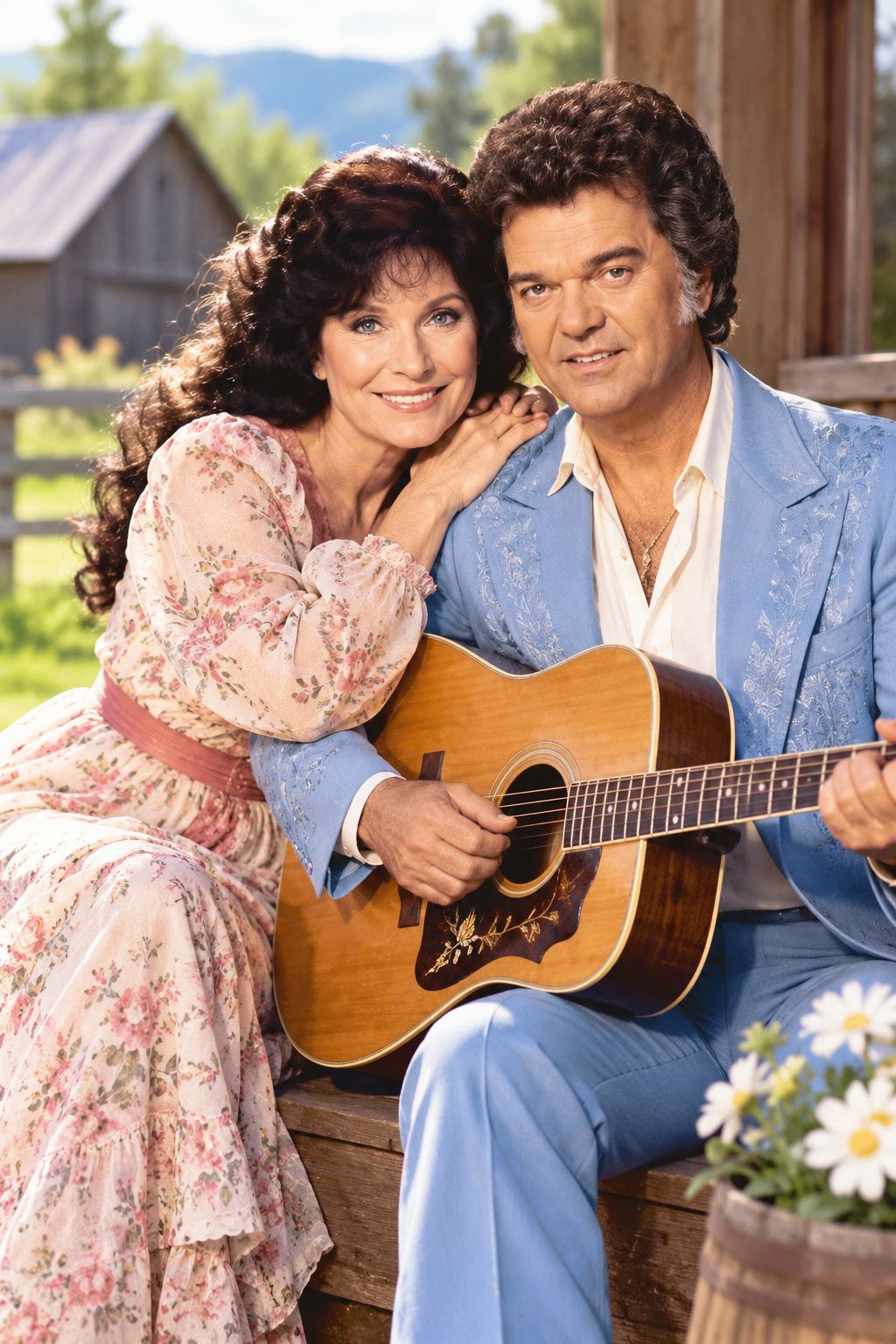
There are country music duos people remember because they had a few successful songs together.
And then there are duos whose voices seem to belong together—as if the songs were waiting for them.
Conway Twitty and Loretta Lynn were that kind of duo.
When their voices met in the early 1970s, something happened that neither artist could quite reproduce alone. Twitty brought his deep, intimate, almost conversational delivery. Lynn answered with a voice filled with grit, vulnerability, humor, and unmistakable Kentucky strength.
Together, they didn’t simply sing about love.
They sang about marriage, temptation, loneliness, regret, jealousy, desire, and the complicated choices people make when their hearts refuse to behave.
Their partnership eventually produced 11 studio albums, five No. 1 country singles, and four consecutive CMA Vocal Duo of the Year awards from 1972 through 1975.
But the most fascinating part of their story isn’t the trophies.
It’s why their partnership worked so extraordinarily well.
Two Completely Different Stars
Before Conway Twitty became one half of country music’s most famous male-female partnerships, his career had already taken an extraordinary path.
Born Harold Lloyd Jenkins in Mississippi, Twitty initially became a rock ‘n’ roll star. His 1958 hit “It’s Only Make Believe” made him a million-selling sensation before he eventually reinvented himself as a country artist.
By the time he entered the country world, Twitty had developed the dramatic, emotionally restrained style that would become his trademark. Eventually, he accumulated 40 No. 1 Billboard country hits.
Loretta Lynn’s journey was almost the opposite.
She came from the coal-mining hills of Kentucky, grew up in a large family, married young, became a mother while still a teenager, and eventually transformed her life experiences into some of country music’s most direct and fearless songs.
The Country Music Hall of Fame describes her career as one in which she insisted on sharing her own truth rather than hiding behind fantasy.
And perhaps that’s exactly why Conway and Loretta worked.
He was restraint. She was fire.
He could make a line sound like a secret whispered across a barroom table.
She could make the same line sound like a confession—or a warning.
Then Came “After the Fire Is Gone”
Their partnership truly changed country music in 1971.
Their first major duet together, “After the Fire Is Gone,” reached No. 1 on the country charts and immediately established them as a formidable team.
The song wasn’t a simple love story.
It was uncomfortable.
It dealt with two people whose relationship had lost its emotional warmth, creating the temptation to find something elsewhere.
That was precisely the kind of emotional territory where Twitty and Lynn excelled.
Neither singer tried to make the characters appear perfect.
Instead, they sounded human.
“Their greatest strength was that they never made complicated relationships sound simple.”
That quality gave their music a rare authenticity.
You could hear the hesitation in Twitty’s voice.
You could hear Lynn’s emotional resistance.
And somewhere between those two voices was the tension that made the song unforgettable.
The recording went on to win a Grammy, confirming that this wasn’t merely a successful pairing—it was something special.
The Secret Was in the Contrast
One of the reasons their recordings remain so memorable is that their voices were not identical.
That might sound obvious, but it mattered.
Great duets don’t always come from two singers who sound alike. Sometimes they come from two singers who sound completely different but understand exactly how to leave space for one another.
Twitty’s voice could be smooth, low, and seductive.
Lynn’s could be sharp, expressive, and emotionally explosive.
When he leaned into a phrase, she could pull back.
When she pushed emotionally, he could answer with understatement.
It created a musical conversation.
And listeners weren’t merely hearing two singers.
They were hearing two people negotiating an emotional relationship in real time.
That is a major reason songs like “Lead Me On,” “Louisiana Woman, Mississippi Man,” and “Feelin’s” remain associated so strongly with both artists. The Country Music Hall of Fame identifies their partnership as one of the most successful duet teams in country music history.
“Louisiana Woman, Mississippi Man” Took It Even Further
If “After the Fire Is Gone” established their chemistry, “Louisiana Woman, Mississippi Man” showed just how much fun they could have with it.
The song turned their partnership into a playful musical tug-of-war.
Instead of simply singing together, Conway and Loretta seemed to flirt, challenge, tease, and compete with one another.
It felt spontaneous.
It felt personal.
And it became another No. 1 hit.
Their 1973 album of the same name also reached No. 1 on the country album chart. PBS’s American Masters notes that Loretta later explained that her husband-manager, Doo Lynn, had found the song for the duo.
That detail is easy to overlook.
Behind one of country music’s most recognizable partnerships was a larger team of people who understood what made the pairing special.
But once Conway and Loretta stood behind the microphones, the magic belonged to them.
They Weren’t Just a Recording Partnership
Their success wasn’t limited to records.
The duo became a major presence in country music’s awards landscape.
From 1972 through 1975, they won the CMA Vocal Duo of the Year award four years in a row.
Think about what that means.
Country music in that era was filled with legendary voices.
Yet year after year, audiences and industry voters kept returning to the same combination.
Conway and Loretta.
Their partnership had become bigger than any individual song.
It had become an identity.
And Yet, Their Music Never Felt Perfectly Polished
Perhaps the most beautiful thing about their recordings is that they often don’t sound like two superstars trying to impress you.
They sound like people trying to understand each other.
That’s particularly important because both artists had enormous individual careers.
Loretta was already an established superstar, with songs such as “Coal Miner’s Daughter,” “You Ain’t Woman Enough,” and “Fist City” helping redefine what women could say in country music. The Songwriters Hall of Fame credits Lynn with 11 solo No. 1 country hits and five additional No. 1s with Twitty.
Twitty, meanwhile, had one of the most successful country careers of his generation.
Neither needed the other to become famous.
That may be the secret.
They weren’t trying to use the partnership to rescue their careers.
They were already stars.
They came together because something happened when they sang.
The Emotional Illusion They Created
There was another fascinating dimension to their music.
Listeners could easily believe they were hearing a real romantic relationship unfolding.
But that was the power of performance.
The chemistry was convincing because they understood storytelling.
They knew that country music isn’t always about happy endings.
Sometimes the most powerful country songs live in the gray areas:
The marriage that is breaking.
The love that shouldn’t happen.
The person who knows better but can’t walk away.
The memory that refuses to disappear.
Conway and Loretta inhabited those stories without needing to explain them.
“They didn’t sing at the listener. They pulled the listener into the room.”
That distinction is enormous.
And it’s why decades later, their recordings can still feel surprisingly intimate.
A Partnership That Outlived the Moment
Conway Twitty died suddenly in 1993 after suffering a stomach aneurysm while traveling from a performance in Branson, Missouri, toward Nashville. He was only 59.
Loretta Lynn continued her extraordinary career for decades afterward. She died in 2022 at age 90.
Their lives ultimately took separate paths.
But their recorded partnership remained frozen in time.
That’s one of the strange gifts of music.
People disappear.
Careers end.
Stages go dark.
But a recording can preserve a moment forever.
Every time “After the Fire Is Gone” plays, Conway is still there.
Loretta is still there.
And for a few minutes, the two voices meet again.
The Legacy Is Bigger Than the Hits
It’s tempting to measure Conway Twitty and Loretta Lynn’s partnership by numbers.
Five No. 1 duets.
Eleven studio albums.
Four consecutive CMA Duo awards.
A Grammy.
Those accomplishments are remarkable.
But statistics don’t explain why people still remember them.
The real legacy is chemistry.
They demonstrated that a duet could be dramatic without becoming theatrical, romantic without becoming sentimental, and vulnerable without becoming weak.
They understood something fundamental about country music:
The truth is often most powerful when it hurts a little.
And Conway and Loretta weren’t afraid of that pain.
They sang about it.
They argued through it.
They laughed through it.
They sometimes sounded like they were falling apart—and somehow made beautiful music while doing so.
The Final Truth About Conway and Loretta
Perhaps the biggest misconception is that their partnership was simply another successful pairing created by Nashville.
It wasn’t.
Nashville could put two singers in a studio.
It couldn’t manufacture what happened between Conway Twitty and Loretta Lynn.
That required two extraordinary performers, two completely different voices, and two artists willing to surrender enough of their individuality to create something bigger together.
Conway had the mystery. Loretta had the fire.
And when those qualities collided, country music got one of its most unforgettable partnerships.
Their songs remain because they weren’t really about Conway and Loretta.
They were about us.
Our mistakes.
Our marriages.
Our regrets.
Our impossible choices.
Our memories of people we couldn’t quite forget.
And perhaps that’s why, all these years later, their voices still sound as if they’re speaking directly to someone sitting alone in the dark.
“Some partnerships make great music. Conway Twitty and Loretta Lynn made emotional history.”
Their story wasn’t simply about two country stars singing together.
It was about what happens when two voices find the exact emotional space where neither one can completely stand alone.
And once they found that space, country music was never quite the same.