 By admin
 INTRODUCTION:
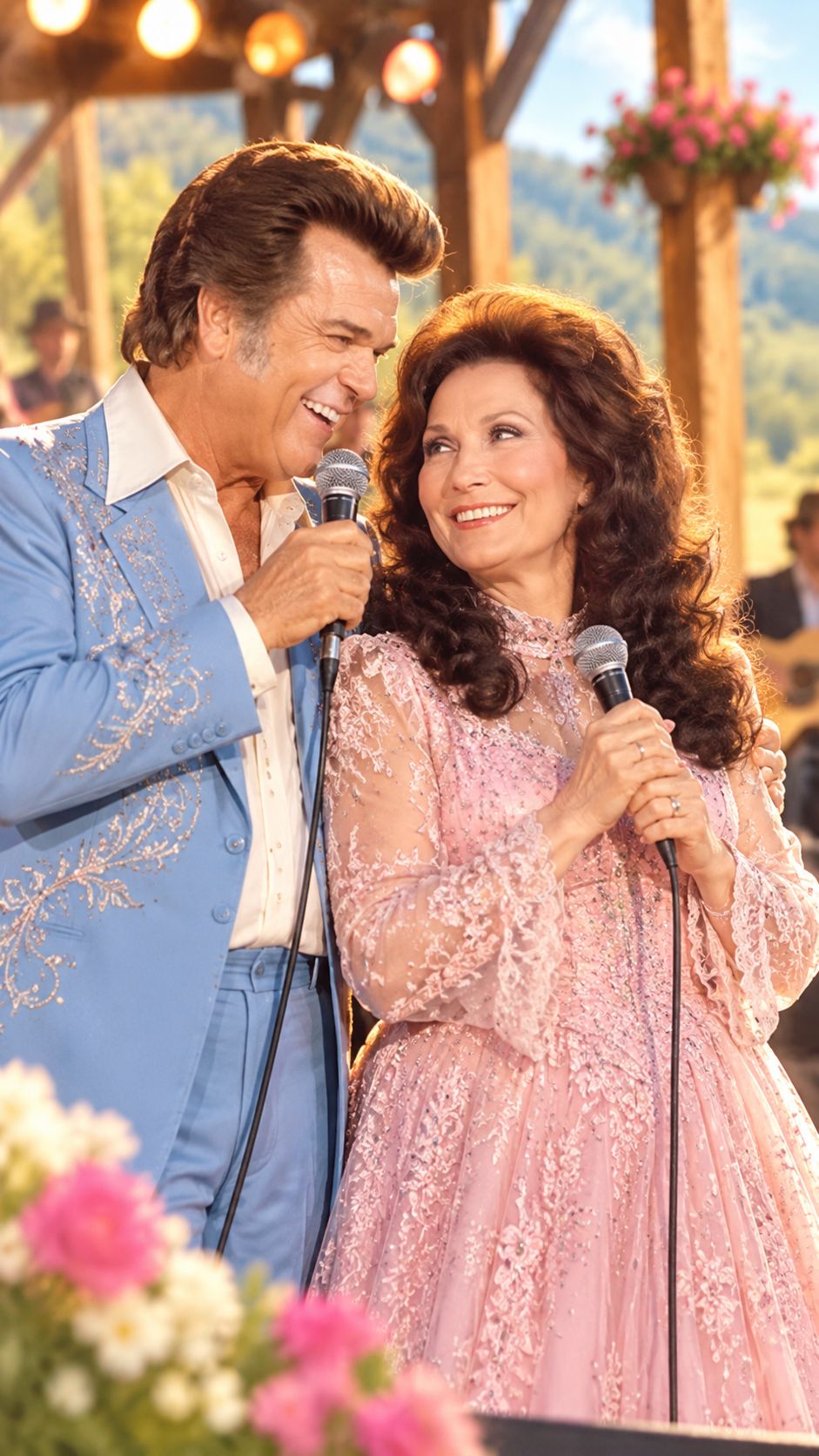
There are country duos that sound good together.
And then there are duos that seem to become something entirely different when they share a microphone.
Conway Twitty and Loretta Lynn belonged to the second category.
From the moment their voices met, audiences heard something that felt almost too natural to be manufactured. His deep, intimate delivery. Her unmistakable Kentucky edge. His restraint. Her emotional directness. Together, they could make a simple country lyric feel like a private conversation between two people who had known each other forever.
For years, fans wondered whether there was something more behind that connection.
Loretta eventually had a simple answer.
“Everybody thought me and Conway had a thing going.”
But then came the part that mattered most:
“And that’s the farthest from the truth.”
According to Lynn, the bond was friendship, musical trust, and a remarkable creative connection—not a secret romance.
And perhaps that is what made their story even more fascinating.
Because whatever happened between them musically was real enough to make millions of people believe they were witnessing something impossible to explain.
The First Time Their Voices Found Each Other
By the early 1970s, both artists were already stars in their own right.
Loretta Lynn had built a reputation as one of country music’s most honest and fearless storytellers. Conway Twitty had transformed himself from a rock-and-roll performer into one of country music’s most powerful hitmakers.
Then, in 1971, their paths came together professionally.
Their first major No. 1 duet, “After the Fire Is Gone,” immediately demonstrated that this wasn’t going to be an ordinary collaboration. The song became a Grammy-winning recording and launched one of the most successful male-female partnerships country music had ever seen.
Something clicked.
Not because their voices were similar.
They weren’t.
That was precisely the point.
Twitty’s voice carried weight, darkness and controlled sensuality. Lynn’s voice could sound vulnerable one second and defiant the next. Instead of competing, those differences created tension.
And tension is often where great country music lives.
When Conway sang, Loretta sounded like she was answering him.
When Loretta sang, Conway sounded as though he was listening.
That illusion of conversation became one of their greatest strengths.
The Chemistry Was So Convincing That Fans Started Believing the Rumors
Their records often dealt with complicated relationships—love, temptation, distance, regret and desire.
That made their performances feel intensely personal.
It also caused audiences to wonder what was happening offstage.
PBS’s American Masters later described how their easy chemistry and the nature of their lyrics led some audiences to puzzle over their relationship. Lynn herself pushed back against the rumors and emphasized the friendship between them.
And there was another important person in the story: Loretta’s husband, Mooney Lynn.
According to Loretta, Mooney respected Conway and considered him a close friend.
That detail changes the way we should look at the partnership.
The magic wasn’t dependent on a forbidden romance.
It was dependent on trust.
Trust between two performers.
Trust between friends.
Trust between two people who understood exactly how much space the other needed to make a song work.
Then Came “Louisiana Woman, Mississippi Man”
If “After the Fire Is Gone” introduced the world to their chemistry, “Louisiana Woman, Mississippi Man” turned it into a phenomenon.
The song arrived in 1973 and became another No. 1 hit. Their album of the same name also reached No. 1 on the country chart.
The premise itself was irresistible: two people separated by geography but pulled together by something stronger.
And when Twitty and Lynn sang it, they didn’t sound like two singers reading lines from a script.
They sounded like two characters living inside the story.
That distinction mattered.
Country music depends on believability. A singer can have perfect technique and still fail to make a lyric feel lived-in.
Conway and Loretta rarely had that problem.
They understood that the secret wasn’t simply singing together.
It was reacting to each other.
That is why their performances could feel spontaneous even when every note had been rehearsed.
The Moment That Changed Everything
But perhaps the most important “moment” wasn’t one dramatic backstage confession or secret revelation.
It was the moment the music itself proved what the partnership could become.
After their first success, the industry didn’t simply move on.
It doubled down.
The pair recorded album after album, eventually making 11 studio albums together between 1971 and 1988. They produced five No. 1 songs from five different albums, according to PBS.
And then came the awards.
From 1972 through 1975, Conway Twitty and Loretta Lynn were named the CMA’s Vocal Duo of the Year four consecutive times.
That wasn’t a novelty.
It wasn’t a one-hit accident.
It was a sustained musical partnership.
The Country Music Hall of Fame describes their first No. 1 duet as the beginning of one of the most successful duet teams in country music history.
In other words, the industry eventually stopped asking whether their chemistry was real.
The awards, records and audiences had already answered the question.
Why Did They Work So Well?
The answer may be found in what they didn’t try to do.
They didn’t try to make their voices identical.
They didn’t erase their personalities.
They didn’t turn every duet into a competition.
Instead, they created contrast.
Conway could be cool and controlled.
Loretta could be fiery and emotionally exposed.
He could leave space between phrases.
She could fill that space with feeling.
It was almost like watching two actors who understood that the most powerful scene isn’t always the one where both characters are talking.
Sometimes it’s the pause.
Sometimes it’s the look.
Sometimes it’s the breath before the next line.
That quality became particularly powerful in their live performances.
Garth Brooks later described the effect of their voices as creating something that doesn’t exist when either artist performs alone. Trisha Yearwood similarly pointed to the energy created when two voices connect.
That’s the real secret behind great duets.
One plus one doesn’t equal two.
Sometimes, musically, it equals something entirely new.
“Feelins’” and the Matured Sound of the Partnership
By the middle of the 1970s, the duo wasn’t simply repeating the formula.
They were refining it.
Songs such as “Feelins’” demonstrated how naturally they could inhabit emotionally complicated material. Conway’s ability to convey restrained longing complemented Loretta’s more conversational emotional honesty.
Their partnership had matured.
The early surprise had become confidence.
They knew where the other singer was going.
And perhaps more importantly, they knew when not to get in the way.
That kind of chemistry cannot simply be taught in a recording studio.
It develops through repetition, trust and shared experience.
Their decades-long professional relationship gave them all three.
The Tragedy of Losing Conway
Then, in 1993, everything changed again.
Conway Twitty died at age 59 following complications after surgery.
The man who had spent years letting his music speak for him was suddenly gone.
For Loretta, the loss was personal.
She didn’t describe him merely as a former duet partner.
She described him as a friend.
A congressional record published after Twitty’s death quoted Lynn saying that she had lost not only a great singing partner but also a great friend.
And that is perhaps the most emotional chapter of their story.
Because after years of fans wondering about their supposed secret relationship, Loretta’s words revealed what mattered far more.
There had been no need for a scandal.
No secret affair was necessary to explain their connection.
They had something rarer.
They genuinely trusted one another.
Why Their Story Still Resonates
Country music has changed dramatically since Conway Twitty and Loretta Lynn stood together in the spotlight.
Production styles changed.
Radio changed.
The definition of a country star changed.
But their duets remain memorable because the emotional language never became outdated.
Love still feels complicated.
Distance still hurts.
Temptation still exists.
Regret still sounds familiar.
And when two singers can make listeners believe they are experiencing those emotions in real time, decades suddenly disappear.
That’s what Conway and Loretta accomplished.
Their chemistry wasn’t mysterious because there was some hidden romance waiting to be uncovered.
It was mysterious because great musical chemistry is difficult to explain in the first place.
You can analyze the arrangements.
You can study the melodies.
You can compare vocal ranges.
You can examine the production.
But none of those things fully explains why two voices suddenly feel like one emotional story.
And maybe that is why their partnership remains so powerful.
“When these two voices hit, it creates this dimension that you can’t get singular—one without the other.”
That observation, from Garth Brooks in PBS’s American Masters, captures what generations of country fans heard for themselves.
Conway Twitty and Loretta Lynn didn’t need a secret to make their story extraordinary.
Their secret was the music.
Two completely different voices.
Two very different personalities.
One extraordinary trust.
And every time those voices met, country music fans heard something that could never quite be recreated again.
That is why, decades later, the Conway Twitty and Loretta Lynn duets still don’t simply sound like old country music.
They sound like two people who knew exactly how to make each other better.
VIDEO: