 By admin
 INTRODUCTION:
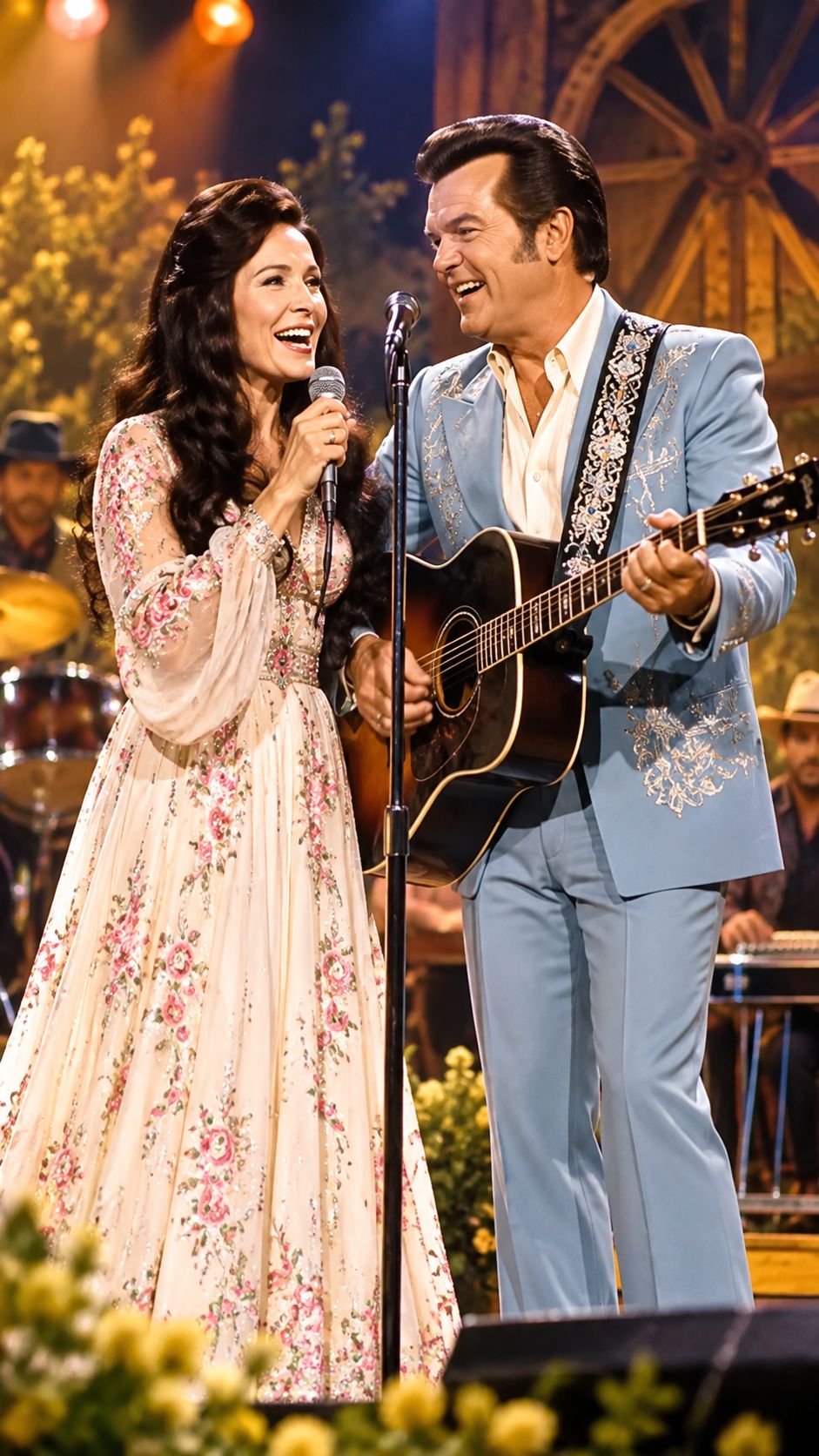
There are country music performances that entertain you.
And then there are performances that make you forget you are watching a performance at all.
Whenever Conway Twitty and Loretta Lynn stood side by side beneath the stage lights, something seemed to change. Their voices did not simply blend. They collided, challenged one another, flirted, argued, softened, and ultimately found their way back together.
For generations of country fans, that chemistry created one persistent question:
What was really happening between Conway Twitty and Loretta Lynn when they stepped onto the stage together?
The answer is less scandalous—and in many ways more remarkable—than the rumors.
It was the result of two extraordinarily different artists discovering exactly how to make each other better.
And the secret was hidden in the music itself.
The Moment Everything Changed
Loretta Lynn was already a major country star when her musical path crossed with Conway Twitty’s. She had built her reputation on songs that felt intensely personal, drawing from the experiences, frustrations, humor, and heartbreak of ordinary life.
Twitty, meanwhile, had reinvented himself after an earlier rock-and-roll career and become one of Nashville’s most successful male vocalists.
According to the Country Music Hall of Fame, their first major duet was “After the Fire Is Gone,” released in 1971. The song reached No. 1 and launched one of country music’s most successful male-female partnerships.
That first hit revealed something neither artist could completely create alone.
Twitty brought the smooth, controlled intensity.
Lynn brought the raw, conversational honesty.
Together, they sounded like two people caught in the middle of an emotional conversation.
“The magic wasn’t that they sounded alike. The magic was that they sounded completely different—and somehow belonged in the same song.”
That distinction is crucial.
They weren’t trying to become one voice.
They were creating tension between two voices.
And country music thrives on tension.
The “Secret” Was Their Ability to Make a Song Feel Real
Listen carefully to a Twitty-Lynn duet and something becomes obvious.
They rarely sound as though they are simply singing at an audience.
They sound as though they are singing to each other.
A line from Conway can feel like a challenge.
Loretta answers it with attitude.
He pushes.
She pushes back.
Then one of them softens.
That emotional back-and-forth became the signature of their partnership.
Their catalog included songs such as “Lead Me On,” “Louisiana Woman, Mississippi Man,” “As Soon as I Hang Up the Phone,” and “Feelins’.” The pair ultimately recorded numerous albums together, with PBS noting that they made 11 studio albums between 1971 and 1988.
But the statistics only tell half the story.
The other half happened onstage.
When They Walked Toward Each Other, the Audience Knew Something Was Coming
Imagine a packed country-music theater.
The band begins the familiar introduction.
The crowd recognizes the song before the first words are sung.
Then Conway steps forward.
A moment later, Loretta joins him.
There is no need for a long explanation.
No elaborate speech.
No dramatic announcement.
The audience already understands.
They are about to watch two performers who know exactly how to play off one another.
Twitty was famous for his controlled stage persona. The Country Music Hall of Fame describes his concert style as dramatic and minimalist, noting that for years he avoided extensive onstage conversation and relied heavily on his music to communicate.
That made his interactions with Lynn even more noticeable.
When Conway gave Loretta a look, it could feel like part of the song.
When Loretta responded with a smile or a teasing expression, the audience reacted immediately.
Nothing needed to be explained.
The chemistry was the explanation.
“Louisiana Woman, Mississippi Man” Turned Their Differences Into Magic
Few songs demonstrate the formula better than “Louisiana Woman, Mississippi Man.”
Released in 1973, the song became one of their signature recordings. It was written by Becki Bluefield and Jim Owen, with producer Owen Bradley guiding the recording.
The premise itself is almost tailor-made for their personalities.
A Louisiana woman.
A Mississippi man.
Two strong personalities.
Two different perspectives.
And one undeniable attraction.
The song doesn’t require them to sound identical.
Quite the opposite.
Their differences are the point.
Loretta’s voice carries a directness that makes her sound fearless.
Conway answers with that deep, confident baritone.
It feels less like two singers sharing a microphone and more like two characters having a conversation.
That was their great trick.
They made the audience believe the song was happening right there.
The Rumors Were Inevitable
And this is where the story becomes complicated.
Because when two performers create that much believable romantic tension, audiences naturally start wondering whether the chemistry extends beyond the stage.
For decades, fans have speculated about the relationship between Lynn and Twitty.
Were they secretly attracted to one another?
Was there something happening backstage?
Did their performances reveal feelings they never openly discussed?
These questions have become part of the mythology surrounding the duo.
But mythology should not be confused with fact.
There is no reliable evidence establishing that Lynn and Twitty carried on a secret romantic relationship.
What is documented is their extraordinary professional partnership and the awards it produced.
They won the CMA Vocal Duo of the Year four consecutive times, from 1972 through 1975. They also won a Grammy for their duet work.
In other words, the evidence points toward something powerful enough without needing a hidden romance:
They understood each other as performers.
The Real Secret May Have Been Trust
Great duets require trust.
One singer has to know when to step forward.
The other has to know when to back away.
A vocalist has to leave space for the other person’s emotion.
Twitty and Lynn seemed to understand that instinctively.
Neither tried to dominate every moment.
Instead, they allowed the emotional balance of the song to determine who should lead.
That’s why their duets remain so convincing decades later.
They weren’t merely matching notes.
They were responding to one another.
“Conway gave Loretta something to push against. Loretta gave Conway something to answer.”
That is the foundation of great dramatic singing.
And perhaps nobody in country music mastered it quite like they did.
They Were Also Completely Different People
Another reason their partnership worked was that they came from very different artistic worlds.
Twitty had started his career in rock and roll before becoming a country superstar. His official biography describes a remarkable transformation that ultimately led to one of the greatest careers in country music.
Lynn’s identity was deeply rooted in country storytelling.
She wrote and sang from the perspective of a woman navigating marriage, family, work, social expectations, heartbreak, and independence.
Their differences created an emotional balance.
Conway could sound restrained.
Loretta could sound explosive.
He could suggest.
She could confront.
He could whisper emotion.
She could put it right in your face.
And when those qualities met, the result was unmistakable.
The Awards Proved It Was More Than a Gimmick
Sometimes successful pairings are created by record-company strategy.
A singer has a hit, another singer joins the project, and the collaboration disappears after one or two records.
That wasn’t what happened here.
The partnership lasted for years.
The Country Music Hall of Fame identifies their run of classic recordings—including “After the Fire Is Gone,” “Louisiana Woman, Mississippi Man,” and “Feelins’”—as one of the defining duet partnerships in country music.
PBS similarly notes that their albums produced five No. 1 songs and that the duo won the CMA Vocal Duo award every year from 1972 through 1975.
That kind of consistency doesn’t happen by accident.
They had discovered a musical language that audiences understood immediately.
And Then There Was the Silence Between the Words
Perhaps the most underrated part of their performances was what happened between the lyrics.
A pause.
A glance.
A breath.
A smile.
A moment when one singer waited for the other.
Those tiny details could communicate as much as an entire verse.
This is why old footage of Twitty and Lynn can still feel strangely intimate today.
The technology is old.
The clothing is unmistakably from another era.
The production may look dated.
But the emotions don’t.
Heartbreak still sounds like heartbreak.
Longing still sounds like longing.
Two people trying to convince each other still sounds exactly the same.
Their Partnership Eventually Became Country Music History
The years changed.
Music changed.
Audiences changed.
But the recordings remained.
Lynn and Twitty eventually became one of the most celebrated duet teams in country history. Their influence can still be felt in later generations of country singers who understand that a great duet isn’t simply two voices singing simultaneously.
It’s a relationship.
And that may be the biggest secret behind what happened whenever they stepped onto the stage together.
They didn’t just perform a love song. They created a believable relationship inside the song.
That is why fans still talk about them.
That is why a familiar introduction can instantly transport listeners back decades.
And that is why their performances continue to feel more personal than many modern productions.
The Legacy That Refuses to Disappear
Conway Twitty died in 1993, but the musical partnership he built with Loretta Lynn never truly disappeared.
Even today, their families continue celebrating the music.
Tre Twitty, Conway’s grandson, and Tayla Lynn, Loretta’s granddaughter, perform as Twitty & Lynn, keeping the grandparents’ songs alive for new audiences. Loretta Lynn’s official site describes their show as a celebration of the pair’s music and the tradition of country duet singing.
Their story has therefore become bigger than two singers.
It has become part of a musical inheritance.
A reminder that country music has always been at its most powerful when it feels human.
So what really happened when Conway Twitty and Loretta Lynn stepped onto the stage together?
Maybe there was no secret scandal.
Maybe there was no hidden romance waiting to be exposed.
Maybe the real secret was much simpler—and much harder to reproduce.
They trusted each other.
They knew how to listen.
They knew how to leave space.
They knew how to turn a lyric into a conversation.
And most importantly, they knew how to make millions of people believe, for three or four minutes, that they were witnessing something private.
That was the magic.
And decades later, it still works.
Because when Conway Twitty’s voice met Loretta Lynn’s, country music didn’t just hear a duet.
It heard a story.