 By admin
INTRODUCTION:
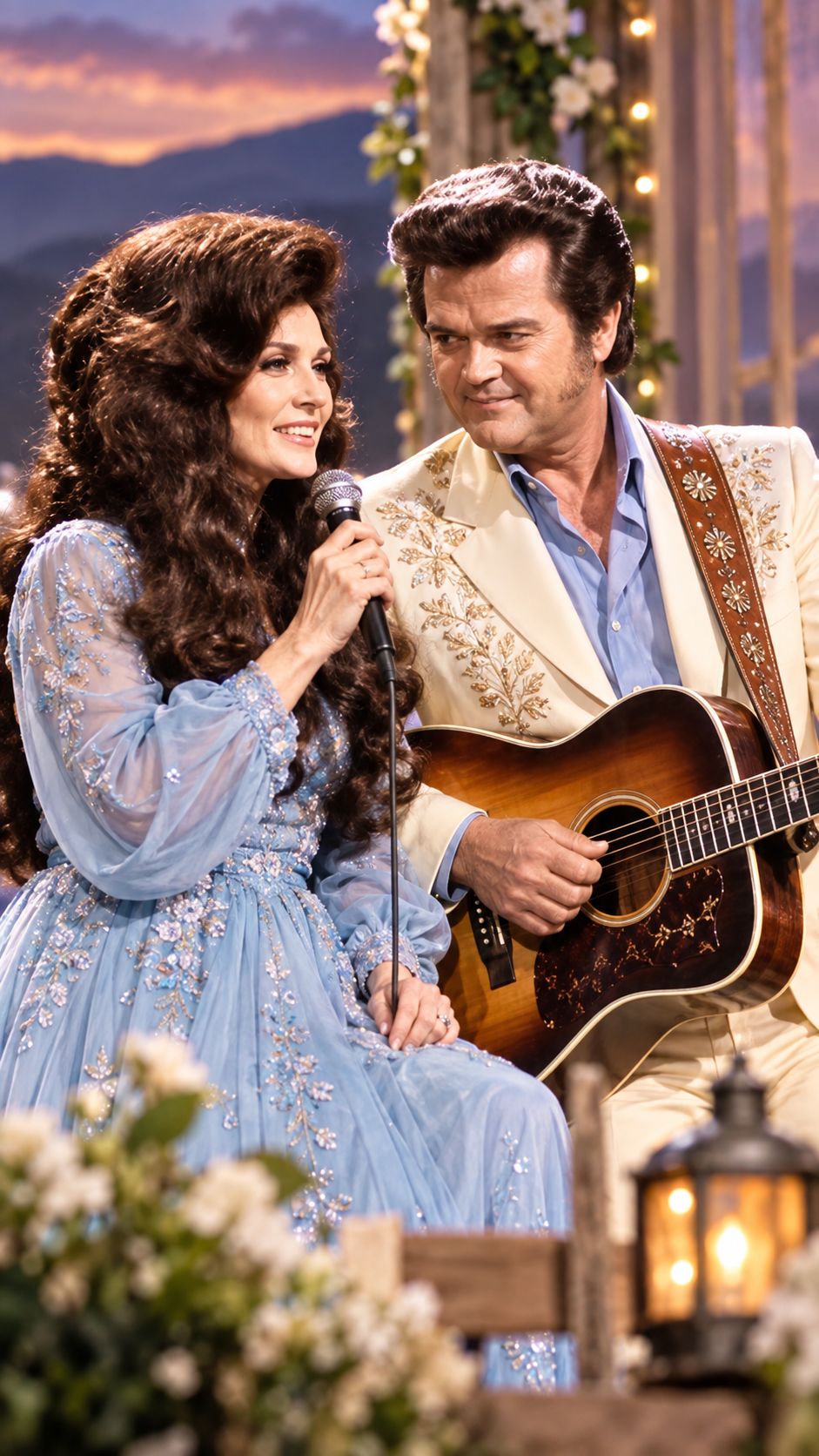
There are country-music partnerships that sound good together.
And then there are partnerships that make listeners wonder whether they are hearing a song—or accidentally overhearing something deeply personal.
Conway Twitty and Loretta Lynn belonged to that second category.
For nearly two decades, their voices carried an almost unsettling intimacy. They flirted, argued, laughed, challenged each other and sang about complicated relationships with such conviction that millions of listeners became convinced there had to be something more behind the microphones.
But here is where the story gets more interesting.
The greatest “secret” between Conway and Loretta may not have been a forbidden romance at all.
It may have been how completely they trusted each other to make audiences believe one existed.
And somewhere along the way, that remarkable friendship and artistic partnership became buried beneath decades of rumors, exaggerated stories and the mythology surrounding two of country music’s most recognizable stars.
The documented history tells a different story.
The First Spark Was Musical—Not Romantic
Conway Twitty and Loretta Lynn did not begin as some mysterious Nashville couple hiding a secret relationship.
Their professional connection grew out of mutual admiration.
According to archival material from UNLV, the two first sang together for fun in 1969 while touring Europe as part of a country-music package show. Twitty later recalled that he discovered Lynn had been a fan of his since 1958—and he was already a fan of hers.
That detail matters.
Because before the hits, before the rumors and before audiences started treating every glance between them as evidence of something forbidden, there was something much simpler:
respect.
They understood each other’s instincts.
They knew how to leave space for the other singer.
And they quickly discovered something that Nashville producers dream about but cannot manufacture:
chemistry.
Their first major duet, “After the Fire Is Gone,” arrived in 1971 and became a No. 1 country hit. The partnership eventually produced 11 studio albums and five No. 1 singles.
The Country Music Association recognized them as Vocal Duo of the Year four consecutive times, from 1972 through 1975.
That wasn’t a brief experiment.
It was a musical partnership that defined an era.
Then America Started Believing the Songs Were Real
This is where the supposed “secret” begins.
Twitty and Lynn didn’t merely sing romantic songs.
They acted them.
A pause from Lynn could sound like suspicion.
A grin from Twitty could sound like guilt.
A glance could make a three-minute country song feel like a private conversation between two people who had known each other for years.
Their performances were so convincing that audiences naturally began asking the question:
Were Conway and Loretta secretly in love?
Loretta eventually addressed those rumors herself.
In the PBS American Masters documentary, she made it clear that the rumors were wrong, saying that she loved Conway as a friend and that her husband, Oliver “Doolittle” Lynn, also cared deeply about him.
And Conway himself reportedly described Loretta as one of his best friends in the music business, explicitly denying that anything romantic had happened between them.
That is an important piece of the story that often gets lost.
The legend is seductive.
The evidence is considerably more ordinary—and perhaps more beautiful.
They were friends.
And they were extraordinarily good at their jobs.
The Man Behind the “Secret” Was Actually Doolittle Lynn
One of the most overlooked parts of their story involves Loretta’s husband.
Oliver “Doolittle” Lynn was not simply standing somewhere in the background while his wife and Conway created country history.
He was involved in their musical journey.
PBS records Loretta explaining that Doolittle was particularly fond of Conway. She recalled the two men joking together and laughing, with Conway becoming one of the few people in the music business with whom her husband genuinely connected.
And in 1973, Doolittle helped find the song that became “Louisiana Woman, Mississippi Man.”
That song became another No. 1 hit and one of the defining recordings of their partnership.
Think about how extraordinary that is.
The supposed romantic triangle imagined by generations of fans doesn’t line up with the documented relationship.
Instead, the real story involves a husband who respected Conway, a wife who treasured Conway’s friendship, and two performers who knew how to turn emotional storytelling into unforgettable records.
The “Secret” Was Their Ability to Tell Dangerous Stories Safely
This is perhaps the most fascinating part.
Conway Twitty built an enormous career around emotionally complicated songs—regret, temptation, infidelity, desire and reconciliation. The Country Music Hall of Fame notes that many of his signature songs embodied his familiar combination of infidelity and guilt.
Put Loretta Lynn beside him, and the emotional voltage increased.
Their songs frequently placed two people in situations that were morally complicated.
And they performed those situations without sounding embarrassed.
That’s why listeners believed them.
The songs weren’t necessarily confessions.
They were stories performed with such emotional precision that listeners forgot they were stories.
“When Conway and Loretta, that … energy… All of a sudden, man, it just crawls all over you.”
That sentiment, expressed by Garth Brooks when discussing their performances in the PBS documentary, captures what made the duo so difficult to replicate.
They didn’t sound like two singers harmonizing.
They sounded like two characters living inside the same story.
The 20-Year Timeline Tells a Very Different Story
The idea of a single hidden secret surviving for 20 years is irresistible because it fits the mythology of Nashville.
But the historical record shows something more complicated.
Their partnership began around 1970–71 and continued through the 1980s. PBS records that their collaboration lasted until 1988, producing 11 albums and five No. 1 songs.
They continued building careers separately while maintaining their extraordinary duet partnership.
That balance was intentional.
Archival material indicates that the pair and their teams understood that recording together too frequently could interfere with their individual careers, so the concept was to make roughly one duet album a year while continuing their solo work.
That was smart business.
And it worked.
They became one of the most successful male-female partnerships in country music history without allowing the duet identity to completely consume either artist’s solo career.
Then the Partnership Changed
The sadness in this story comes later.
Conway and Loretta eventually stopped touring together full-time in 1981.
But that does not establish the existence of a secret fight, affair or dramatic betrayal.
There are modern stories that attempt to fill that gap with sensational explanations.
Some claim there was a devastating confrontation.
Others suggest jealousy.
Others imply that something deeply personal happened behind the scenes.
But there is a crucial distinction between a compelling story and documented history.
There is no reliable evidence establishing one explosive secret incident as the reason their partnership changed.
And that’s precisely where responsible country-music history has to resist the temptation to turn uncertainty into fact.
What America May Have “Forgotten”
Perhaps the real tragedy isn’t that the music industry intentionally erased some scandalous secret.
Perhaps it’s that the real story is less sensational—and therefore easier to overlook.
Conway Twitty and Loretta Lynn proved that two people could create extraordinary emotional intimacy without being lovers.
They proved that trust could sound like romance.
They proved that friendship could create chemistry powerful enough to fool an entire audience.
And they proved that country music didn’t need a real-life scandal to create an unforgettable story.
Their voices did that all by themselves.
Loretta’s sharp, unmistakable delivery met Conway’s smooth, aching baritone, and something happened between those sounds that neither could have created alone.
That’s the part worth remembering.
Conway Left Too Soon
Conway Twitty died in 1993 at only 59 years old.
His absence transformed the meaning of those old recordings.
Suddenly, songs that once sounded playful became historical documents.
Every laugh.
Every harmony.
Every teasing exchange.
Every moment when Conway’s voice answered Loretta’s.
They were no longer simply pieces of a successful catalog.
They were fragments of a partnership that could never be recreated in exactly the same way.
The Country Music Hall of Fame credits Twitty with 40 No. 1 Billboard country hits, while his work with Lynn produced some of the most celebrated duets in country history.
And Loretta continued carrying the memory of that partnership long after Conway was gone.
Later generations have even taken their songs back to the Grand Ole Opry stage. In 2022, Twitty & Lynn—relatives of the two stars—performed “Louisiana Woman, Mississippi Man” at the Opry, celebrating the legacy of their famous family names.
That is the real inheritance.
Not a scandal.
Not a forbidden romance.
Not an imaginary secret.
A sound.
The Secret Was Never What Fans Thought
For decades, audiences searched Conway Twitty and Loretta Lynn’s music for clues.
They wondered whether the chemistry was too intense to be innocent.
They wondered whether the songs were autobiographical.
They wondered what happened when the cameras stopped rolling.
But perhaps we’ve been asking the wrong question.
The better question is:
How did two friends create performances that made millions of people believe they were hearing something private?
The answer is talent.
Trust.
Timing.
And the rare ability to disappear completely into a song.
“I loved Conway as a friend.”
Loretta’s words may be the simplest—and most powerful—way to understand the entire story.
Because sometimes the greatest secret in country music isn’t the scandal everyone imagined.
Sometimes it’s the friendship everyone underestimated.
And that’s why, decades later, when Conway Twitty’s voice rises beside Loretta Lynn’s, something still happens.
For a few minutes, the years disappear.
The stage disappears.
The rumors disappear.
And two old friends are simply singing again.
That may be the part of their story the music industry didn’t intentionally erase—but history came dangerously close to forgetting.
VIDEO: