 By admin
INTRODUCTION:
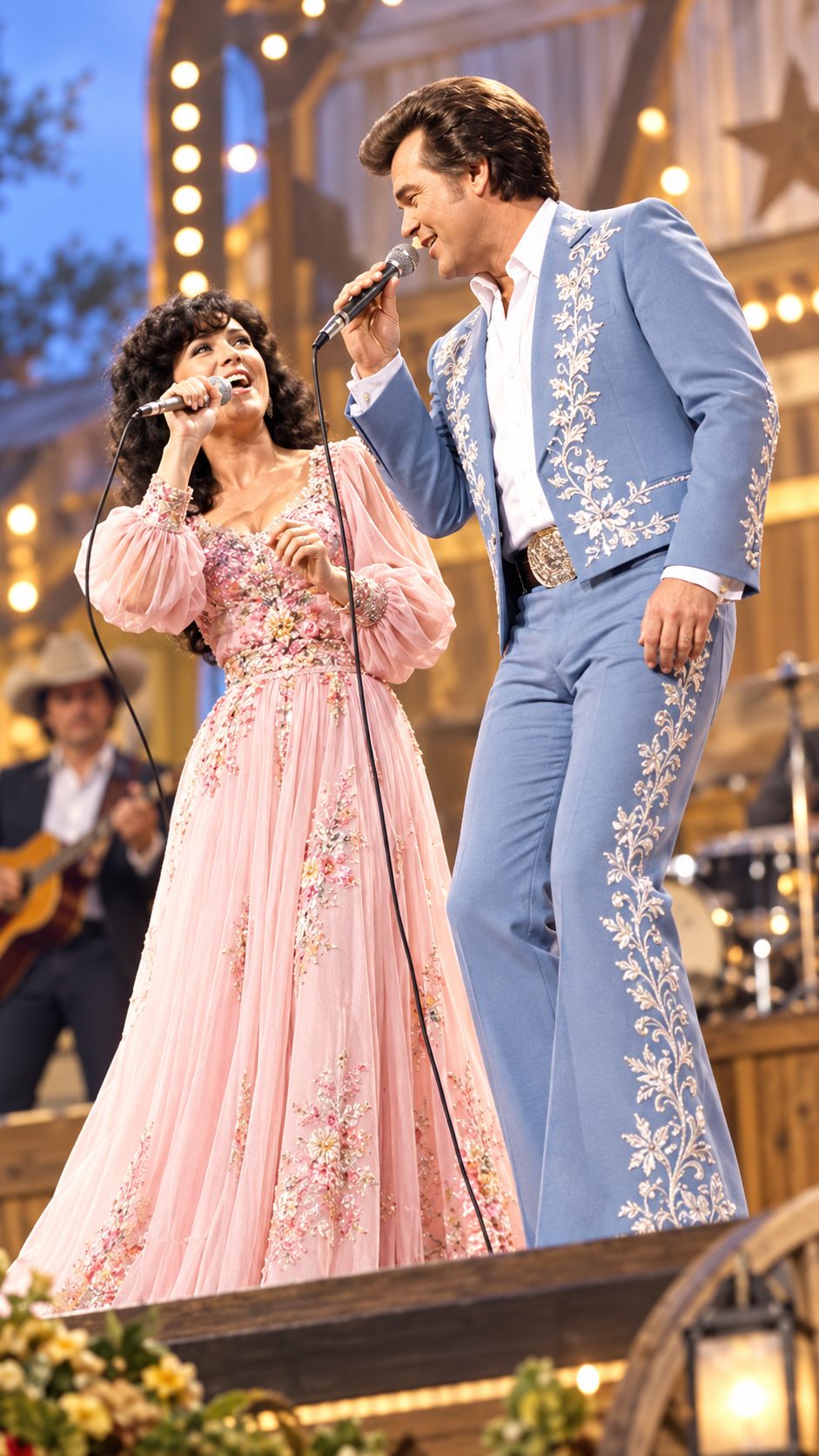
There are partnerships in country music that seem inevitable in hindsight.
Then there are partnerships that, when they first happen, look like a gamble.
Conway Twitty and Loretta Lynn belonged to the second category.
When the two country superstars began recording together around 1971, nobody could have known that the experiment would become one of the defining male-female partnerships in country music history. Twitty already had an extraordinary career behind him, while Lynn had established herself as one of Nashville’s most powerful female voices. Putting them together meant risking two enormous personalities on the same microphone.
The gamble worked.
And it worked in a way that changed what a country duet could be.
The story wasn’t simply about two famous singers harmonizing. It was about two voices creating an entire emotional world—sometimes romantic, sometimes confrontational, sometimes funny, and often painfully believable.
The Country Music Hall of Fame describes their first major duet, “After the Fire Is Gone,” as the beginning of one of the most successful duet partnerships in country music history. The song reached No. 1 in 1971 and helped launch a remarkable run that would reshape the country-duet tradition.
The Risk Was Bigger Than It Looked
Conway Twitty wasn’t originally a country singer in the way history remembers him.
Before becoming one of Nashville’s most successful stars, he had experienced life in rock and roll. His career eventually moved toward country music, where his emotional delivery and carefully selected material transformed him into one of the genre’s biggest stars.
By the time Loretta Lynn entered the picture, Twitty had already developed a recognizable identity.
Lynn had one too.
She wasn’t simply another female vocalist. She was the woman behind songs that spoke openly about marriage, motherhood, poverty, temptation, independence and the complicated realities of working-class life.
Putting them together could easily have produced something forgettable.
Instead, it produced tension.
And tension is exactly what made the records unforgettable.
Their voices didn’t merely blend.
They answered each other.
One would make a statement. The other would challenge it. One would sound vulnerable. The other would sound defensive. Suddenly, the listener wasn’t hearing two singers.
They were hearing two characters.
“When Conway and Loretta sang together, the song often felt less like a performance and more like a conversation nobody was supposed to overhear.”
That illusion became their secret weapon.
“After the Fire Is Gone” Changed Everything
The first major breakthrough came with “After the Fire Is Gone.”
It wasn’t simply successful—it became a Grammy-winning recording and the first of five consecutive No. 1 country hits the pair achieved between 1971 and 1975. Their run included “Lead Me On,” “Louisiana Woman, Mississippi Man,” “As Soon as I Hang Up the Phone,” and “Feelins’.”
That kind of consistency is extraordinary.
But the deeper significance was cultural.
Before Twitty and Lynn, male-female country duets certainly existed. Yet Conway and Loretta demonstrated how powerful a duet could become when the two performers were treated almost like dramatic characters.
Their songs weren’t just about love.
They were about complicated love.
There were disagreements.
Temptations.
Regrets.
Promises.
Mistakes.
And occasionally, humor.
That emotional complexity helped make their recordings feel remarkably contemporary even decades later.
The Chemistry Was So Convincing That Fans Started Wondering
Eventually, the performance became so believable that audiences began asking an uncomfortable question:
Was there something happening between them offstage?
The speculation was understandable.
They sang about romantic situations with such conviction that listeners sometimes forgot they were listening to professional performers.
But Loretta Lynn herself rejected the idea that the chemistry reflected a secret romance.
In an American Masters interview, Lynn explained that she loved Conway as a friend and emphasized that her husband also cared deeply about him.
That distinction actually makes their partnership more fascinating.
The magic didn’t require a secret affair.
It required trust.
They could perform emotional material without allowing the fictional world of the song to destroy the real friendship behind it.
That is much harder than it sounds.
They Turned Arguments Into Art
Perhaps the most revolutionary part of the Twitty-Lynn partnership was the way they used conflict.
Country music has always understood heartbreak.
But Conway and Loretta understood something else:
people in love don’t always agree.
That became one of the defining characteristics of their recordings.
Listen to songs such as “Louisiana Woman, Mississippi Man.”
The premise itself creates distance.
He’s from Mississippi.
She’s from Louisiana.
And yet the song turns geography into romantic tension.
The famous recording became another No. 1 hit, reinforcing the idea that a duet could tell a story rather than simply showcase two voices.
The result was almost cinematic.
Two people.
Two perspectives.
One relationship.
And millions of listeners sitting in the middle.
Nashville Took Notice
The awards followed.
Twitty and Lynn were named the Country Music Association’s Vocal Duo of the Year for four consecutive years, from 1972 through 1975.
Their success wasn’t a brief novelty.
They continued recording together throughout the 1970s, releasing album after album and producing numerous Top 10 singles. AllMusic records that the pair ultimately accumulated 14 Top 10 hits and multiple major industry honors, including a Grammy for “After the Fire Is Gone.”
That longevity mattered.
It demonstrated that the partnership wasn’t simply a successful pairing of two stars.
It had become its own musical identity.
There was Conway Twitty.
There was Loretta Lynn.
And then there was Conway and Loretta.
That distinction is crucial.
They Also Took Risks With Their Sound
Another reason the partnership mattered was that they didn’t remain trapped inside one formula.
Their catalog moved through traditional country, romantic ballads, dramatic spoken performances and songs with a more playful edge.
“The Letter,” for example, was structured almost entirely around spoken exchanges between the two singers. Released in 1976, it reached No. 3 on the Billboard Hot Country Singles chart.
That’s an unusual choice for major country stars.
But it worked because their strength was storytelling.
They didn’t always need soaring vocal arrangements.
Sometimes, all they needed was a microphone and a believable conversation.
The Partnership Became Bigger Than the Records
By the late 1970s, the Conway-Loretta phenomenon had become firmly established.
Their 1979 album Diamond Duet even marked roughly a decade of making records together, demonstrating just how enduring the experiment had become.
And their influence wasn’t limited to chart statistics.
They helped establish an expectation for country duets that remains important today:
Chemistry matters.
Not manufactured chemistry.
Not celebrity chemistry.
Emotional chemistry.
The audience has to believe that the two voices need each other.
That’s what Conway and Loretta understood.
When Twitty sang alone, he could make heartbreak sound personal.
When Lynn sang alone, she could turn real-life struggle into a story.
Together, they could create an entire relationship inside three minutes.
And Then the Story Changed
Their full-time touring partnership eventually ended in 1981.
That ending is one of the saddest parts of the story because the partnership had become so synonymous with country music that it was difficult to imagine one without the other.
But history didn’t give them decades more.
Conway Twitty died in 1993 at just 59.
The news stunned Nashville.
Congressional records from the time noted his extraordinary career, including his 50 No. 1 country hits and his four consecutive CMA Vocal Duo of the Year awards with Loretta Lynn.
His death meant something more than the loss of a legendary solo performer.
It closed the door on the possibility of another chapter with Loretta.
And perhaps that’s why their recordings continue to feel so emotionally charged.
There is an unfinished quality to them.
A sense that the conversation could have continued.
The Real Legacy of the Risk
Today, it’s easy to look backward and assume Conway Twitty and Loretta Lynn were destined to become a legendary duo.
They weren’t.
They were two established artists taking a professional risk.
The reward was enormous.
They created five consecutive No. 1 country singles, numerous Top 10 hits, award-winning recordings and a catalog that remains one of the strongest examples of male-female duet storytelling in American country music.
But statistics don’t fully explain their legacy.
The numbers tell us how successful they were.
The recordings tell us why.
When Conway’s voice entered after Loretta’s, something changed.
When Loretta answered him, the story became larger.
And when they sang together, the boundary between performance and emotion seemed to disappear.
“Their greatest achievement wasn’t convincing America that Conway and Loretta were in love. It was convincing America that, for the length of a song, these two people were living the story they were singing.”
That may be the real reason their partnership changed country music forever.
They proved that a duet doesn’t have to be two stars sharing a song.
It can be a relationship.
It can be a conversation.
It can be an argument.
It can be a confession.
And, when the chemistry is extraordinary enough, it can become history.
Conway Twitty and Loretta Lynn took that risk more than half a century ago.
Country music has been living with the consequences ever since.
VIDEO: