 By admin
INTRODUCTION:
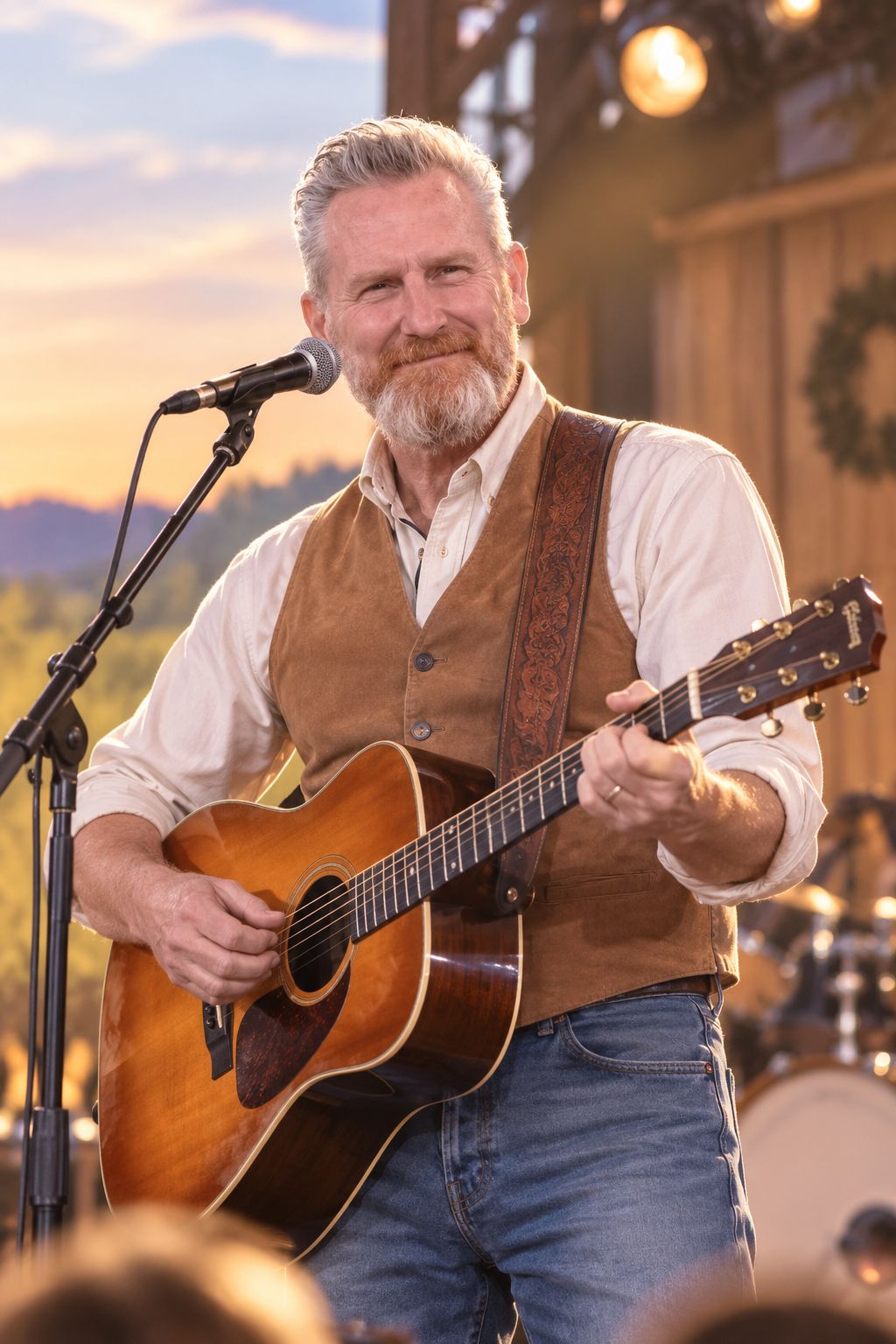
For years, the idea of Rory Feek standing onstage without Joey seemed almost impossible.
The microphone was still there. The guitar was still there. The songs were still there.
But the woman who had made those songs feel alive was gone.
When Joey Feek died in 2016 after her battle with cancer, Rory didn’t simply lose a musical partner. He lost the person with whom he had built a marriage, a family, a creative identity, and a life that millions of country fans had watched unfold. In the aftermath, he openly said he did not want to make music without her.
And perhaps that is why his eventual return to the stage feels so much bigger than a comeback.
It is a story about grief.
It is a story about memory.
But most importantly, it is a story about discovering that moving forward does not necessarily mean leaving someone behind.
For a Long Time, Rory Couldn’t Imagine Singing Without Joey
To understand the emotional weight of Rory’s return, you have to go back to the silence that followed Joey’s death.
Rory and Joey had become one of country music’s most beloved duos, performing together as Joey + Rory. Their music was intimate, traditional and deeply personal. But their story became even more powerful as Joey’s illness progressed.
When she died, the stage suddenly became a place filled with absence.
Rory wasn’t simply asking himself whether he wanted to perform again.
He was asking something much harder:
Could music still mean the same thing when Joey wasn’t standing beside him?
In a 2016 interview with CBS Sunday Morning, Rory explained that he didn’t want to go onstage without her, while leaving open the possibility that time might change how he felt.
That hesitation mattered.
Because grief doesn’t operate according to a schedule.
There is no moment when someone simply wakes up and announces, I’m healed now.
Healing is usually quieter.
It begins with being able to remember without collapsing.
It begins with being able to smile at a memory that once only caused pain.
And eventually, sometimes, it means picking up the instrument again.
Then Something Changed
Rory’s return didn’t arrive as some massive industry-driven comeback campaign.
Instead, it emerged gradually—and in deeply personal places.
His official concert listings now include intimate home concerts at his Tennessee homestead, describing the evenings as opportunities to share “stories & songs.” His 2026 schedule includes multiple performances throughout the year.
That detail says a lot.
He isn’t returning to music simply because the industry needs another performer.
He is returning because music has become part of the next chapter of his life.
And that distinction is everything.
In one of Rory’s most revealing reflections about returning to the stage, he explained that he didn’t necessarily want to perform without Joey—but increasingly felt that he was supposed to.
He connected that realization to watching musicians perform at his church and, especially, to seeing his daughter Indiana’s love for music.
Then came words from Joey’s father that helped change his perspective.
Jack Feek reminded Rory that singing and playing guitar was who Rory had been when Joey first met him.
And Rory came to believe that Joey would want him to perform.
That realization transformed the question.
It was no longer:
“How can I perform without Joey?”
It became:
“How can I carry what Joey and I built into the life that remains?”
The Stage Became a Place of Healing
This is where Rory’s story becomes bigger than country music.
Because returning to the stage after devastating loss can be an act of healing.
Not because the music erases grief.
It doesn’t.
Instead, music gives grief somewhere to go.
A song can hold memories that ordinary conversation can’t.
A melody can bring someone back for three minutes.
A familiar guitar can make an empty room feel occupied.
And a voice can say the things the heart still struggles to explain.
That may be why Rory’s recent performances feel less like traditional concerts and more like gatherings.
His home concerts emphasize stories and songs, creating an atmosphere where the audience isn’t simply watching an entertainer. They are being invited into a chapter of his life.
And that is something country music has always done exceptionally well.
The greatest country songs rarely pretend life is perfect.
They tell us about the kitchen table.
The empty chair.
The old photograph.
The person we still miss.
The road we don’t know how to travel.
Rory’s music now exists inside that same tradition.
“A New Song” for a New Chapter
Perhaps the clearest window into Rory’s transformation came when he described his return as the beginning of a new song.
He wrote that he didn’t know what the song would be or how the story would unfold.
But he knew the opening line.
That metaphor is extraordinarily powerful.
Because grief often feels like a song that ended too soon.
You know the verses that came before.
You remember the chorus.
But suddenly, there is no next line.
Rory’s decision to perform again suggests that he is allowing himself to write another one.
Not a replacement for Joey and not a rejection of their story.
A continuation.
“This moment is probably the first line of a new story in our lives.”
That is the heart of his return.
He isn’t rewriting the past.
He’s refusing to let the past prevent the future from existing.
“Once Upon A Farm”
One of the most moving examples came when Rory announced performances called “Once Upon A Farm.”
The concerts were planned at the barn on his property, with proceeds benefiting Music Health Alliance, an organization that had helped his family.
Even the setting mattered.
The farm wasn’t merely a venue.
It was part of the story.
It was where Rory and Joey built memories.
It was where their family grew.
It was where their dreams lived.
And now it could become the place where Rory began creating new ones.
That is a remarkably country-music kind of healing: not escaping the old home, but filling it with new music.
The Most Powerful Message: You Can Move Forward Without Moving On
There is an important distinction between those two ideas.
People often say someone must “move on” after loss.
But for someone like Rory, perhaps the healthier idea is to move forward while carrying the person you loved with you.
Joey doesn’t have to disappear from his story for Rory to have another chapter.
Her memory can remain.
Her songs can remain.
Their daughter can grow up knowing who her mother was.
And Rory can still pick up a guitar.
That isn’t betrayal.
It is continuation.
In fact, Rory’s own writing repeatedly frames his recent life as a story still unfolding. In 2026, he reflected on more than a decade of sharing his life publicly, describing the journey as containing both extraordinarily beautiful moments and deeply heartbreaking ones while emphasizing his faith through both.
That perspective helps explain why his performances resonate.
The audience isn’t simply hearing songs.
They’re witnessing someone discover how to live after the story changed.
And Then There Was the Night That Felt Like Something More
In late 2025, Rory described an extraordinary experience at Homestead Heritage in Texas.
He had been invited not simply to sing, but to host concerts and help connect the music with the larger story of the community.
He admitted he was nervous.
He wondered whether he belonged.
He even questioned whether he had made the right decision after the first night.
Then came the second night.
Rory described thousands of people singing, raising their hands and crying together. He said the experience felt bigger than a concert—something he described as a revival.
And his response afterward may reveal more about his transformation than any performance ever could.
Instead of trying to control the moment, he let go.
He stopped trying to figure everything out.
He simply decided to be present.
That may be the final lesson of Rory Feek’s return.
Healing isn’t always about understanding why something happened.
Sometimes healing means accepting that you don’t understand—and still taking the next step.
The Guitar Doesn’t Mean the Grief Is Gone
This is perhaps the most important thing fans should remember.
Seeing Rory perform again doesn’t mean he has forgotten Joey.
It doesn’t mean the pain disappeared.
And it certainly doesn’t mean the years of grief were somehow unnecessary.
Quite the opposite.
His return carries meaning precisely because of what came before it.
The silence mattered.
The hesitation mattered.
The years away mattered.
The memories mattered.
And now, the music matters again.
Because the guitar that once represented a life Rory shared with Joey can also become an instrument through which he honors that life.
That’s not forgetting.
That’s remembering differently.
A Different Kind of Comeback
Country music has produced countless comeback stories.
Artists recover from addiction.
They return after career failures.
They overcome changing musical trends.
They reinvent themselves.
But Rory Feek’s story is different.
His comeback isn’t primarily about charts, awards or radio.
It is about permission.
Permission to laugh again.
Permission to sing again.
Permission to build again.
Permission to imagine a future without feeling guilty for having one.
And perhaps that is why his return carries such emotional force.
Because millions of people have experienced some version of what Rory has experienced.
They have lost someone.
They have wondered whether joy was still allowed.
They have looked at something they once loved and wondered if they could ever touch it again.
Rory’s answer, slowly and imperfectly, seems to be:
Yes.
Not because the loss wasn’t real.
But because love doesn’t require a person to stop living.
You can miss someone deeply and still make room for tomorrow.
That may ultimately be the most powerful healing message behind Rory Feek’s return to the musical stage.
He isn’t stepping back into the spotlight to prove that he’s over Joey.
He’s stepping into it because their story gave him something worth carrying forward.
And somewhere beneath the lights, behind the guitar and between the songs, there is still the same love.
Only now, instead of ending with goodbye, it has become part of the next verse.
VIDEO: