 By admin
INTRODUCTION:
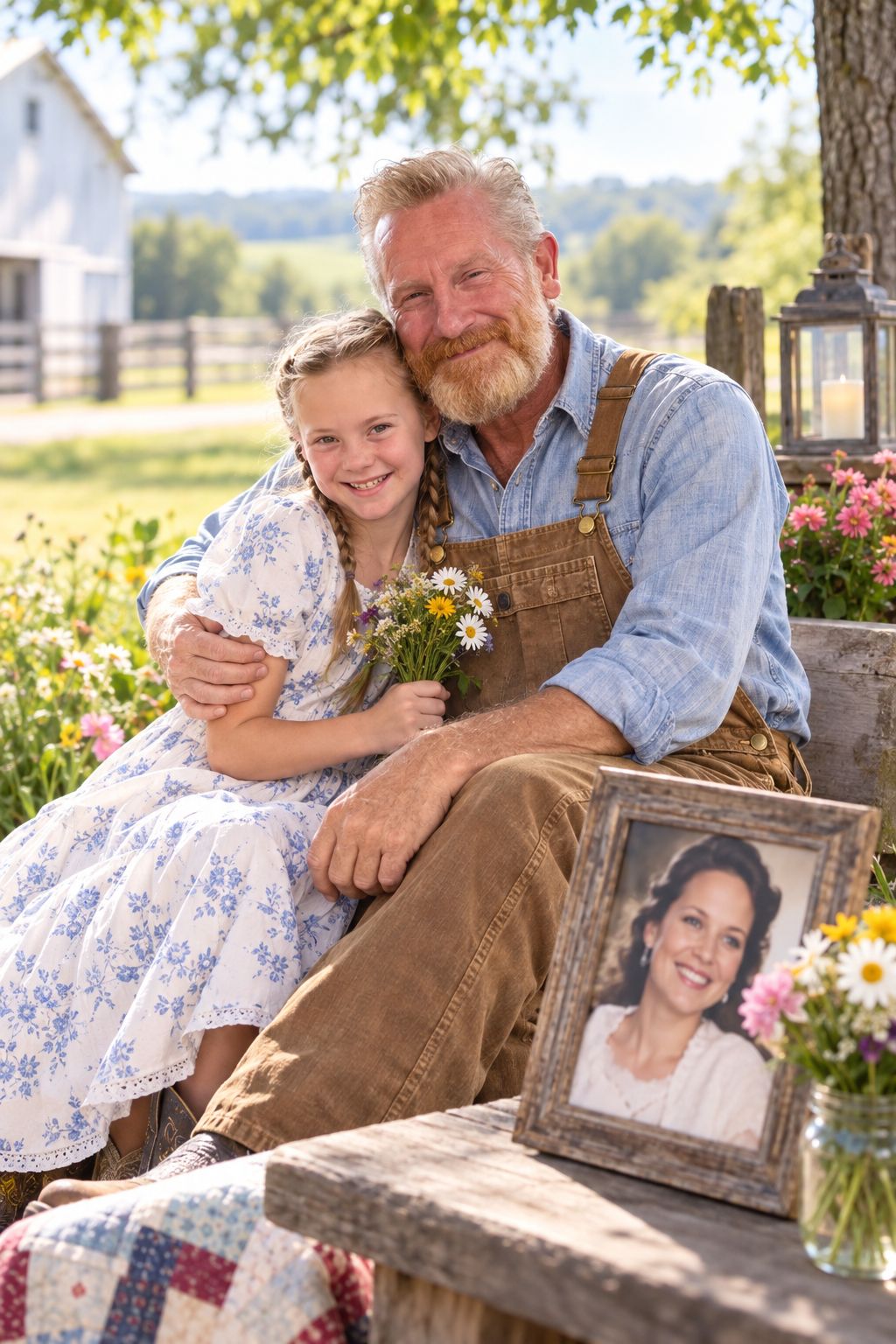
There are some love stories that do not end when the final chapter is written.
They simply change form.
For Rory Feek, the love story he shared with Joey has lived on in a thousand ordinary moments: a song playing on the radio, an old photograph tucked away in a drawer, the familiar sound of laughter from a video recorded years ago—and, most profoundly, in their daughter, Indiana.
Joey Martin Feek died on March 4, 2016, at just 40 years old after a battle with cervical cancer. Their daughter, Indiana, was only two. A decade later, Rory continues to speak about Joey not as someone erased by time, but as someone whose presence remains woven into the family’s everyday life.
And perhaps that is the most moving part of Rory’s story.
He has never treated remembering Joey as something that belongs only to anniversaries.
He has made remembering her part of living.
“Indy is just an amazing love letter from her mama that talks to me all the time.”
Those words, shared by Rory in an interview, reveal the heart of his journey. To him, Indiana is not simply the child he and Joey brought into the world. She is a living connection to the woman he loved, a reminder that Joey’s influence did not disappear when her life ended.
The Little Girl Joey Had Waited For
Joey became a mother later in life, welcoming Indiana in February 2014. By all accounts, motherhood was something she embraced completely.
Friends have recalled how deeply Joey loved Indiana and how strong their bond was, even though their time together was tragically short. One friend remembered Joey caring for her daughter while simultaneously doing everyday farm work—an image that captures something essential about Joey: motherhood was not separate from life on the farm. It was life.
Joey and Rory had imagined a quieter future.
They wanted to step away from some of the demands of entertainment and spend more time at home. Rory later wrote that they had planned to homestead and tell the story of their growing family.
Instead, their lives took an unimaginable turn.
Joey was diagnosed with cancer only months after Indiana was born.
The couple faced the diagnosis publicly, but what emerged from those difficult years was not merely a story about illness. It was a story about faith, marriage, parenthood and the decision to treasure ordinary days.
And when Joey was gone, Rory was left with something no father can ever truly prepare for:
a little girl who would grow up knowing her mother largely through stories, photographs, recordings and memories.
So Rory made a choice.
He would make sure Indiana never had to wonder who her mother was.
Turning Memories Into a Childhood
One of the most extraordinary things about Rory’s approach has been his willingness to preserve the past while allowing Indiana to build her own future.
He didn’t simply put Joey’s belongings away and close the door.
He kept telling the story.
Rory’s long-running This Life I Live blog became a place where memories could be preserved, examined and shared. He has described writing as a way not only to capture important moments but also to understand them.
That distinction matters.
Because grief can make memories feel fragile.
A photograph can fade. A voice recording can sit unheard. A child can grow older and begin wondering about the parent she barely remembers.
But stories can be retold.
Again and again.
And Rory has retold them.
He has shared footage of Joey laughing, singing, cooking and simply being herself. The couple had documented so much of their life that Rory eventually recognized the extraordinary gift hidden inside all those old recordings.
Joey was still there.
Not physically.
But in her voice.
In her smile.
In the way she moved through their home.
In the memories that Indiana could one day inherit.
Rory once explained that because so much of the couple’s professional life had been filmed, Indiana could encounter her mother in countless ways.
“Her mama lives on in a million ways.”
That may be one of the most powerful descriptions of legacy in modern country music.
A Schoolhouse Built Around a Mother’s Dream
Perhaps nowhere is Joey’s influence more visible than in the way Rory approached Indiana’s education.
Before Joey died, she had wanted to homeschool their daughter.
After her death, Rory faced the painful reality that the plan was no longer possible.
But instead of simply abandoning the dream, he asked a different question:
What if he could build something that reflected the kind of childhood Joey had imagined?
That thinking helped inspire the schoolhouse on the family property.
Rory later explained that he wanted a school where learning differently would not be treated as a limitation. The school became part of the larger community surrounding their farm, incorporating not only traditional educators but people with practical skills and experiences.
It was an extraordinary response to an ordinary tragedy.
A mother had a dream for her daughter.
Cancer took the mother away.
But the dream didn’t have to die with her.
Rory carried it forward.
That is what makes the Indiana story so emotionally powerful. It isn’t about trying to recreate Joey. It is about allowing the values Joey cared about to continue influencing the life of the child she left behind.
The Farm Became a Living Memory
Rory’s Tennessee farm has also become part home, part school, part community and part memorial.
A particularly poignant description of the property once noted that Rory could look out from his home and see two powerful symbols: Joey’s memorial cross on one side and the schoolhouse built for Indiana on the other.
Think about what that means.
On one side is the woman who is gone.
On the other is the child she left behind.
And between them stands Rory.
Still telling the story.
Still raising their daughter.
Still trying to turn grief into something constructive.
The farm therefore isn’t simply scenery in the Feek story. It has become a kind of living scrapbook.
The schoolhouse represents the future.
The memorial represents the past.
Indiana represents the bridge between them.
Indiana Doesn’t Have to Know Joey Only Through Grief
This may be Rory’s greatest gift to his daughter.
He has not allowed Joey’s memory to become synonymous only with cancer or death.
There is much more to remember.
There was Joey the singer.
Joey the wife.
Joey the baker.
Joey the farmer.
Joey the woman who laughed.
Joey the woman who loved her family.
Joey the woman who dreamed about raising her little girl.
And that matters enormously.
A child who loses a parent very young can easily inherit the tragedy before inheriting the person.
Rory has worked to reverse that.
He has given Indiana stories about her mother that contain joy.
He has preserved footage where Joey is alive and vibrant.
He has allowed her music to remain part of their world.
When Indiana hears her mother’s voice on the radio, Rory has said she recognizes it.
Imagine the power of that moment.
A song begins.
A familiar voice fills the car.
And for a few minutes, the past and present occupy the same space.
Ten Years Later, The Love Has Changed—but It Hasn’t Disappeared
In 2026, a decade has passed since Joey’s death.
Rory recently marked the tenth anniversary by reflecting on the enormous impact Joey continued to have long after her passing. He described her as the bravest person he had ever known and emphasized that her influence only seemed to grow with time.
That is perhaps the strange mathematics of certain lives.
Joey lived only 40 years.
But the love she created continues multiplying.
It lives in Indiana.
It lives in Rory.
It lives in Joey’s music.
It lives in the people who watched their story unfold.
It lives in the old videos.
It lives in the songs.
It lives in the farm.
It lives in the schoolhouse.
And it lives in the stories Rory continues to tell.
There is something profoundly country about that kind of remembrance.
Country music has always understood the power of ordinary things—a front porch, a family photograph, an old song, a kitchen table, a field at sunset.
Rory’s story fits naturally into that tradition.
He hasn’t tried to make grief glamorous.
He has simply tried to make love durable.
A Mother’s Love That Still Has Somewhere to Go
The most beautiful part of Joey’s legacy may not be the awards or recordings.
It may be Indiana.
Joey never got to watch her daughter grow up.
She never got to see the person Indiana would become.
She never got to experience the teenage years, the questions, the milestones, the little victories or the ordinary mornings.
But through Rory’s memories, Indiana can still encounter pieces of her mother.
She can hear her.
See her.
Learn about her.
And understand that she was deeply, completely loved.
That is the gift Rory has spent years protecting.
Not an illusion that Joey is still physically present.
Something more honest.
The knowledge that love does not require physical presence to remain real.
A mother can leave this world, but the love she poured into her child can keep traveling forward.
And perhaps that is what Rory has been doing all these years.
He has been helping Joey’s love travel.
From a mother to a daughter.
From one generation to the next.
From yesterday into tomorrow.
The country music world may remember Joey Feek for her beautiful voice and the music she created with Rory. Fans may remember the courage she showed during her final years.
But Indiana can remember something even more personal.
She can know her mother as a woman who loved her fiercely.
And every time Rory tells another story, plays another recording, walks across that farm, or watches his daughter grow into the person Joey once dreamed she would become, that love gets another chance to speak.
Joey’s life ended.
Her motherhood did not.
Because in Indiana, the little girl she loved so completely, a piece of Joey’s heart keeps moving forward.
And that may be the most enduring song Rory Feek will ever sing.
VIDEO: