 By admin
INTRDUCTION:
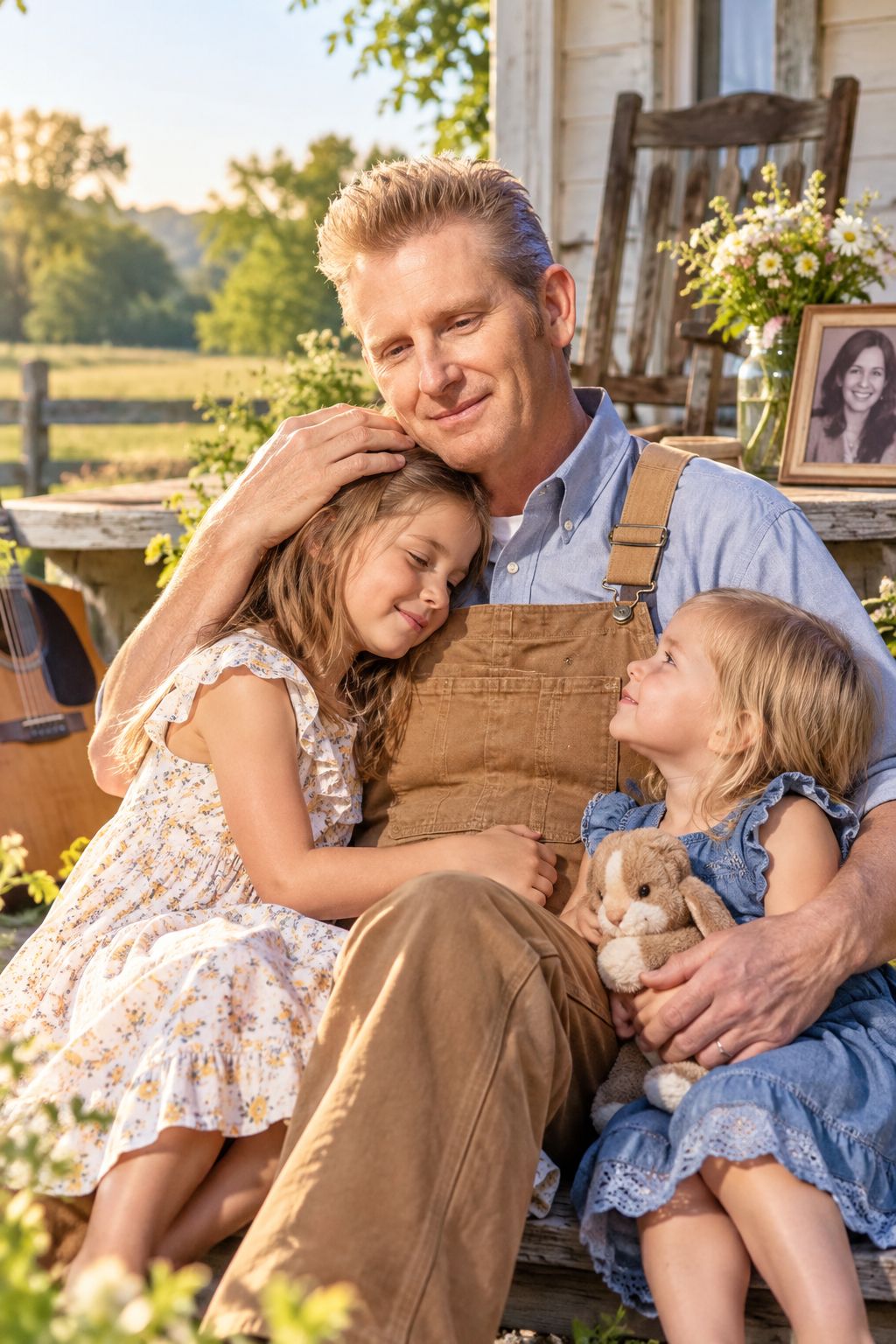
There are some kinds of grief that arrive with a funeral.
And then there is the kind that follows you into the kitchen the next morning.
It wakes up when your child wakes up. It sits beside you at breakfast. It rides with you in the car. It waits quietly at bedtime.
For country singer-songwriter Rory Feek, the death of his wife and musical partner, Joey Feek, in March 2016 was not simply the loss of the woman he loved. It meant suddenly becoming the parent responsible for raising their two-year-old daughter, Indiana, without the mother who had been at the center of their family.
Joey was only 40 when she died from cervical cancer.
Rory was left with a little girl who was too young to fully understand what had happened—and a lifetime of memories that could never be recreated.
What followed was not a glamorous country-music comeback story. It was something much quieter: a father learning how to keep going.
The Moment the Music Stopped
For years, Rory and Joey had been known as the beloved country duo Joey+Rory.
Their relationship had become part of their music. Their marriage, faith, family life and struggles were intertwined with the songs they performed.
Then cancer changed everything.
During Joey’s final months, Rory documented much of their journey, including the heartbreaking reality that their daughter Indiana might grow up without her mother.
In his own writing, Rory recalled how Joey’s greatest concern after receiving her diagnosis was not herself—but Indiana.
That detail says almost everything about Joey as a mother.
She knew she was fighting for her life, but her heart was already focused on the little girl who might have to live without her.
And eventually, that fear became reality.
Rory later described the strange cruelty of returning home after Joey’s funeral: the farmhouse was still there, the fields were still there, the cemetery was just beyond the house—but Joey wasn’t.
“Everyone except Joey.”
Those words from Rory’s account of returning home after Joey’s death capture the emptiness better than any dramatic speech could.
The house had not changed.
The family had.
Indiana Was Two Years Old
Perhaps the most painful part of Rory’s new reality was Indiana’s age.
She was just two years old when Joey died.
She couldn’t possibly understand cancer, death, funerals or why her mother would not walk through the farmhouse door again.
Rory, however, understood all of it.
And he had to carry that knowledge while trying to give his daughter a childhood.
That meant something extraordinary: he had to grieve and parent at the same time.
There was no opportunity to simply disappear into sorrow.
There was a child who needed breakfast.
A child who needed comfort.
A child who needed someone to answer her questions.
A child who still needed her father to smile.
Rory once described Indiana as the joy in a family that should have been filled with sadness.
That became one of the central themes of his life after Joey.
Indiana did not erase the grief.
She gave him a reason to walk through it.
“She Is the Smile on the Face of a Father Who Should Be Crying”
One of the most moving aspects of Rory’s story is that he never portrayed fatherhood as a replacement for Joey.
Instead, Indiana became a living connection to her mother.
Every milestone became bittersweet.
Her first days at school.
Her growing personality.
Her changing voice.
The little expressions that reminded Rory of Joey.
Years later, Rory wrote about working on the farm with Indiana when he suddenly noticed something familiar in her face.
“Sometimes you just look like your Mama.”
He admitted that moments like that could stop him in his tracks, making him imagine what life might have been like if Joey were still there to share those ordinary moments.
That is the kind of grief people rarely see.
It isn’t always dramatic.
Sometimes it is simply seeing your daughter laugh in a particular way and realizing exactly who she inherited it from.
Raising a Daughter While Carrying a Mother’s Memory
Rory’s challenge wasn’t only keeping Indiana safe and cared for.
He also wanted her to know the mother she was too young to fully remember.
That meant preserving stories.
Photographs.
Songs.
Videos.
Family traditions.
Memories of Joey’s voice.
In a sense, Rory became both father and storyteller.
He had to tell Indiana about the woman who had loved her before she was old enough to remember being loved by her.
That is an enormous responsibility.
And Rory’s decision to document Joey’s life became especially meaningful.
The documentary To Joey, With Love grew out of footage from their life together, capturing not only Joey’s illness but the woman she had been before cancer dominated the story. Rory explained that he wanted people to see Joey live—not only watch her die.
That distinction matters.
For Rory, Joey’s legacy was never supposed to be defined by her final months.
She was a wife.
A mother.
A singer.
A friend.
A woman who laughed, dreamed, worked and loved.
And Indiana deserved to know all of that.
The Empty Chair
One of the most haunting symbols in Rory’s story is the empty space Joey left behind.
Before her illness, Rory and Joey had shared stages.
They had traveled together.
They had written and performed together.
Their voices had become inseparable.
After Joey died, Rory had to discover who he was without the person standing beside him.
At one point, even the idea of performing again felt almost impossible.
Joey’s father, Jack, eventually encouraged Rory to return to music, reminding him that singing and playing guitar was part of who he had been when Joey first fell in love with him.
It was a powerful reminder.
Rory didn’t have to abandon everything that reminded him of Joey.
He could carry her forward.
But there was another reason to keep going.
Indiana.
Grief Doesn’t Follow a Schedule
Rory’s story also challenges the popular idea that grief eventually disappears.
It doesn’t.
It changes.
In the beginning, the pain can be overwhelming.
Later, it can hide inside memories.
A song.
A photograph.
A familiar place.
A birthday.
A child’s face.
Years after Joey’s death, Rory was still visiting her grave with Indiana. On the ninth anniversary of Joey’s passing, he shared a moment of Indiana visiting her mother’s grave with flowers.
That image carries a profound message.
Indiana is growing up.
But Joey remains part of her story.
The daughter who once needed her father to explain why Mama wasn’t coming home eventually became old enough to participate in remembering her.
The grief changed shape.
The love didn’t.
The Hardest Part: Moving Forward Without Moving On
Perhaps the greatest misconception about Rory’s journey is that “moving forward” means leaving Joey behind.
It doesn’t.
For him, moving forward appears to have meant learning how to build a life in which Joey’s absence and Joey’s presence could somehow coexist.
The cemetery remained.
The songs remained.
The memories remained.
And Indiana grew.
Rory once wrote about the strange experience of watching old footage of his family while already knowing how the story would end. He described seeing Joey alive, vibrant and full of light—and then realizing that the story didn’t truly end with her death.
It continued through Indiana.
Through him.
Through every person Joey had touched.
That may be the deepest lesson in Rory’s story.
“Life goes on as it must.”
Rory wrote those words while reflecting on Joey’s death and the changes that followed.
It is not a statement of forgetting.
It is an acceptance of responsibility.
The world keeps moving even when your heart desperately wants it to stop.
The Father Behind the Country Star
It is easy to look at Rory Feek through the lens of country music.
The songs.
The awards.
The stages.
The television appearances.
The story of Joey+Rory.
But after Joey died, perhaps the most important role Rory played was not musician.
It was Dad.
He had to become the person who could make breakfast when he was hurting.
The person who could answer questions when he didn’t have answers.
The person who could celebrate Indiana’s victories even when he wished desperately that Joey could see them.
And he had to do all of that while carrying his own private grief.
That is what makes the story so emotionally powerful.
There was no magical recovery.
No moment when the sadness simply disappeared.
There was only one ordinary day after another.
And another.
And another.
Until years had passed.
A Legacy Bigger Than a Song
Joey Feek’s legacy is often discussed through music.
But her greatest legacy may be the daughter she left behind.
Indiana was born into a family surrounded by music, faith and love. She lost her mother before she was old enough to understand the magnitude of that loss.
Yet Rory spent years making sure Joey remained part of the story.
He didn’t simply tell Indiana that her mother had been a singer.
He showed her who Joey was.
A woman who loved her deeply.
A woman who fought to stay with her.
A woman whose greatest fear during cancer was leaving her little girl.
And perhaps that is why Rory’s story resonates so strongly with country-music fans.
Because underneath the celebrity, the records and the headlines is something painfully ordinary:
A father missed his wife.
A daughter missed her mother.
And somehow, they had to keep living.
Years later, Rory can still look at Indiana and see Joey.
Sometimes that vision probably hurts.
Sometimes it probably feels like a gift.
But perhaps that is what love becomes after loss.
It doesn’t disappear.
It becomes memory.
It becomes responsibility.
It becomes a photograph kept close.
It becomes a song you can barely sing.
And sometimes, it becomes a little girl standing beside her father on a Tennessee farm—growing older, laughing, living, and carrying a piece of her mother into the future.
That may be the real emotional reality of Rory Feek’s journey.
He didn’t simply raise his daughter after Joey’s death.
He spent years learning how to raise her while keeping the memory of Joey alive.
And in doing so, he discovered one of the hardest truths grief can teach:
You don’t have to stop missing someone to keep living.
Sometimes, you live because you loved them so much.
VIDEO: