 By admin
INTRODUCTION:
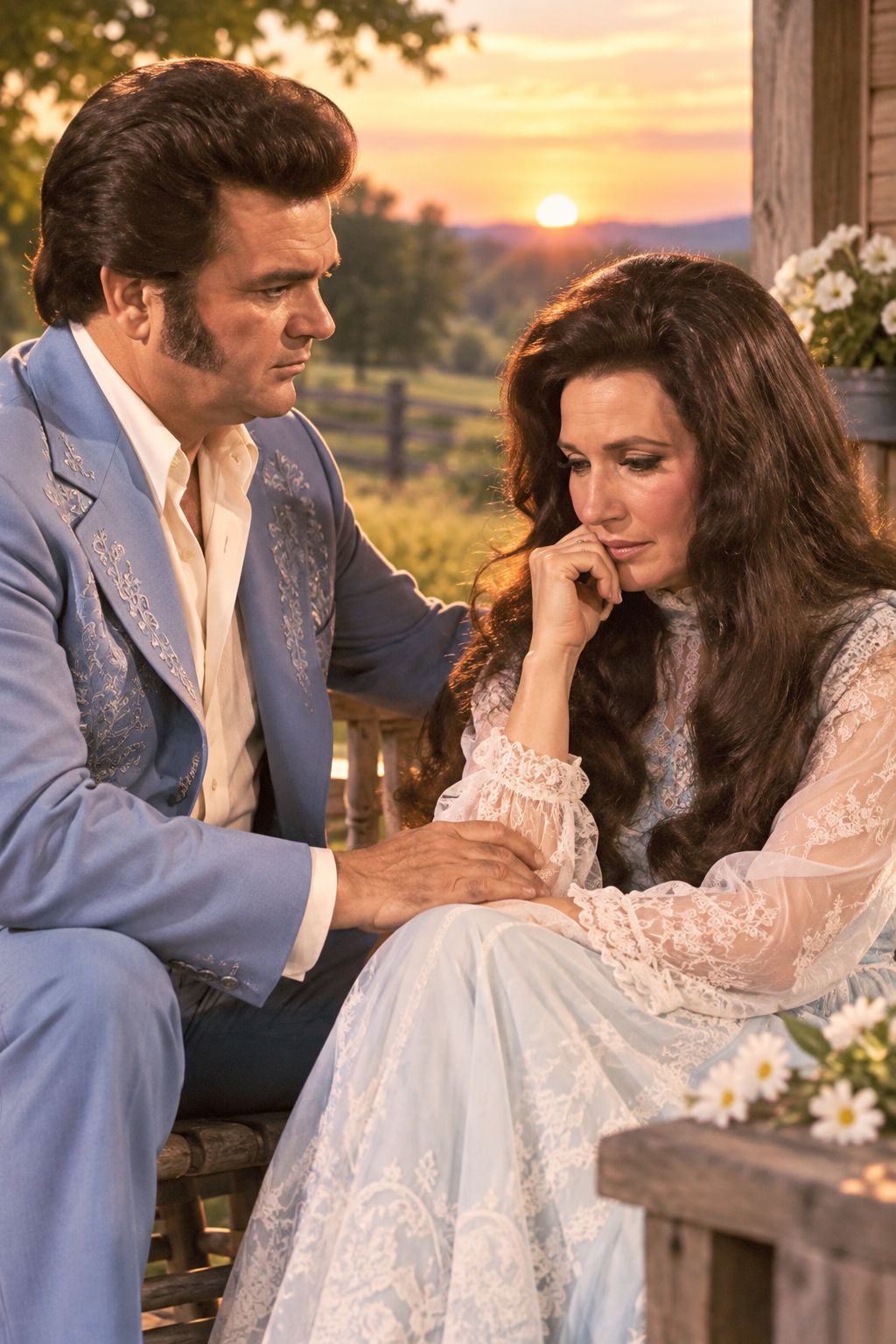
There are some country music partnerships so convincing that audiences eventually stop believing they are watching a performance.
Loretta Lynn and Conway Twitty were one of them.
For more than a decade, their voices created the illusion of two people caught in a secret relationship—sometimes tempted, sometimes guilty, sometimes desperate, and always dangerously close to crossing a line.
Their songs sounded intimate enough to make millions of listeners wonder:
Was there really something between Loretta Lynn and Conway Twitty that they refused to admit?
The answer, however, is more complicated—and perhaps more moving—than the romantic rumor that has survived for generations.
Because Loretta did talk about Conway.
She remembered him warmly. She admired him enormously. She called him a close friend. And she repeatedly rejected the idea that they were lovers.
In a PBS American Masters interview, Lynn addressed the rumors directly:
“Everybody thought me and Conway had a thing going.”
Then she made her position unmistakable:
“And that’s the farthest from the truth.”
Yet that denial never completely ended the speculation.
And perhaps the reason is hiding in the music itself.
The chemistry was real—just not necessarily romantic
To understand why people believed Loretta and Conway were secretly in love, you have to listen to the records without thinking about their personal lives.
Their voices simply sounded too believable.
The partnership began almost accidentally. Lynn and Twitty were performing overseas as part of a larger country music package in the late 1960s. They began singing together backstage and discovered that their voices fit naturally. When they returned home, they brought the idea to producer Owen Bradley. He liked what he heard, and the partnership became official.
Their first major duet, “After the Fire Is Gone,” became a No. 1 country hit.
Then came more.
“Lead Me On.”
“Louisiana Woman, Mississippi Man.”
“As Soon as I Hang Up the Phone.”
“Feelins’.”
They weren’t simply successful. They became one of the most celebrated male-female duos in country music history, collecting major awards and multiple No. 1 hits.
But the subject matter was explosive.
They sang about temptation.
Infidelity.
Desire.
Marriage problems.
Forbidden attraction.
Regret.
Their characters often sounded like two people who wanted each other but knew they shouldn’t.
That was the magic—and the source of the rumors.
Loretta understood exactly what people were hearing
One of the most revealing interviews came years later when Terry Gross asked Lynn about those songs.
Gross pointed out that many of their duets portrayed two people who were attracted to each other even though the relationship was wrong.
Lynn laughed.
Then came the question everyone wanted answered.
Were the songs reflecting something real?
Lynn’s response was simple:
“Me and Conway were friends. We wasn’t lovers.”
That statement matters because it came directly from Lynn herself, rather than from a biographer, fan, or later internet storyteller.
And it changes the question.
Maybe the mystery isn’t why Loretta wouldn’t admit she loved Conway romantically.
Maybe the more interesting question is:
Why did people need her to?
Because their performances felt like confessions
There is an important distinction between feeling something and being in love.
Lynn clearly felt something powerful for Twitty.
But powerful doesn’t automatically mean romantic.
She admired him professionally. She trusted him musically. She considered him a close friend. And she had enormous respect for the way he worked.
In a 1978 Billboard interview, Lynn described Twitty as one of the greatest performers she knew and recalled that she had been a major fan of his long before they became recording partners. Twitty likewise described Lynn as one of his best friends in the business.
That’s an important piece of the puzzle.
They didn’t need a secret affair to create chemistry.
They had something else: trust.
Two performers who trusted each other could step into a song about betrayal without actually betraying anyone.
They could sing a forbidden-love lyric and make an audience believe it because they understood how to inhabit the emotions.
That is acting.
That is musicianship.
And in their case, it was extraordinarily convincing.
Loretta’s marriage made the rumors even more complicated
There was another reason Lynn had little incentive to encourage romantic speculation.
Her husband, Oliver “Doolittle” Lynn, was deeply intertwined with her life and career.
And Conway wasn’t some secret enemy lurking outside that marriage.
He was actually a friend of Doolittle’s.
Lynn repeatedly emphasized this point.
She once explained that Doolittle particularly liked Conway and considered him the one country artist he genuinely cared about. She remembered Conway laughing at her husband’s stories during trips and recalled those memories affectionately.
That detail is almost the opposite of the scandalous story fans sometimes imagine.
Rather than Conway being a hidden threat to her marriage, he was welcomed into their circle.
That doesn’t make the partnership less emotional.
If anything, it makes it more fascinating.
The songs were allowed to say what real life couldn’t
Country music has always understood something about human nature:
People sometimes sing about emotions they would never act upon.
A performer can step inside a character’s heartbreak without personally experiencing the exact situation.
Lynn and Twitty mastered that distinction.
Listen to “After the Fire Is Gone.”
The song describes two people whose marriages have lost their emotional spark and who find themselves drawn toward one another.
It’s uncomfortable.
It’s intimate.
And because Lynn and Twitty sing it with such restraint, the story sounds almost like a private conversation.
The audience wasn’t hearing two singers simply hitting their marks.
They were hearing two characters making a dangerous decision.
That distinction is crucial.
The intimacy was real. The romance was the story.
And perhaps Loretta’s greatest achievement was convincing listeners of the story without allowing the story to consume her real life.
There was also something deeply personal about her admiration
Lynn wasn’t indifferent to Conway.
Quite the opposite.
She had admired him since she was young, long before they became a famous duo. She recalled being stunned when she first met him because she had been such a fan of his earlier work.
That kind of admiration can become part of a lifelong friendship.
Imagine meeting someone whose music you loved when you were younger—and then discovering that, years later, you could stand beside that person in a recording studio and create history together.
That’s an extraordinary emotional bond.
But again, it doesn’t require a secret romance.
Sometimes admiration becomes friendship.
Friendship becomes trust.
Trust becomes artistic intimacy.
And artistic intimacy can look remarkably similar to love when two gifted performers stand behind the same microphone.
Why the rumor refuses to die
The rumors survive because the recordings are timeless.
Every new generation hears the same songs and reaches the same conclusion:
“They sound like they really loved each other.”
And emotionally, perhaps they did.
But love has more than one language.
There is romantic love.
There is friendship.
There is artistic devotion.
There is admiration.
There is the love between people who have survived long careers together and understand one another without having to explain every emotion.
Lynn and Twitty appeared to have that kind of connection.
And their history provides little reason to replace Lynn’s own explanation with a more sensational one.
Twitty himself reportedly described Lynn as one of his best friends in the business and explicitly rejected the idea that there had been a romantic relationship between them.
So perhaps the real secret wasn’t that Loretta Lynn was hiding her love for Conway Twitty.
Perhaps the secret was that the two of them knew how to make friendship sound like forbidden love.
The heartbreaking truth came later
When Conway died in 1993, Lynn was dealing with a deeply personal loss of her own family life at the time. She remembered that Conway had been especially close to Doolittle and described the friendship between the two men with warmth and humor.
She didn’t describe losing a secret lover.
She described losing a friend.
And sometimes that is even more powerful.
Because the temptation to turn every extraordinary connection into a romance says something about us as audiences. We are fascinated by hidden love stories. We want the chemistry onstage to have an explanation offstage.
But maybe there doesn’t need to be one.
Maybe two people can create something breathtaking together without secretly belonging to one another.
Maybe Conway Twitty was important to Loretta Lynn precisely because he occupied a different place in her life—a trusted friend, musical partner, admirer, and fellow performer who understood exactly how to bring out the emotional truth in a song.
The real reason Loretta never “confessed”
So, was Loretta Lynn secretly in love with Conway Twitty?
There is no solid evidence that she was, and Lynn herself repeatedly denied that they were lovers. The strongest documented record points instead toward a remarkably close friendship and an extraordinary professional partnership.
The real reason she never publicly admitted to romantic feelings may therefore be much simpler:
Because she said there weren’t any romantic feelings to admit.
What she did have was something country music rarely produces—a musical partnership so emotionally authentic that millions of people mistook performance for confession.
And perhaps that’s the greatest compliment their music could ever receive.
They didn’t have to be lovers.
They only had to sound like they were.
And for Conway Twitty and Loretta Lynn, that was enough to make country music history.