 By admin
INTRODUCTION:
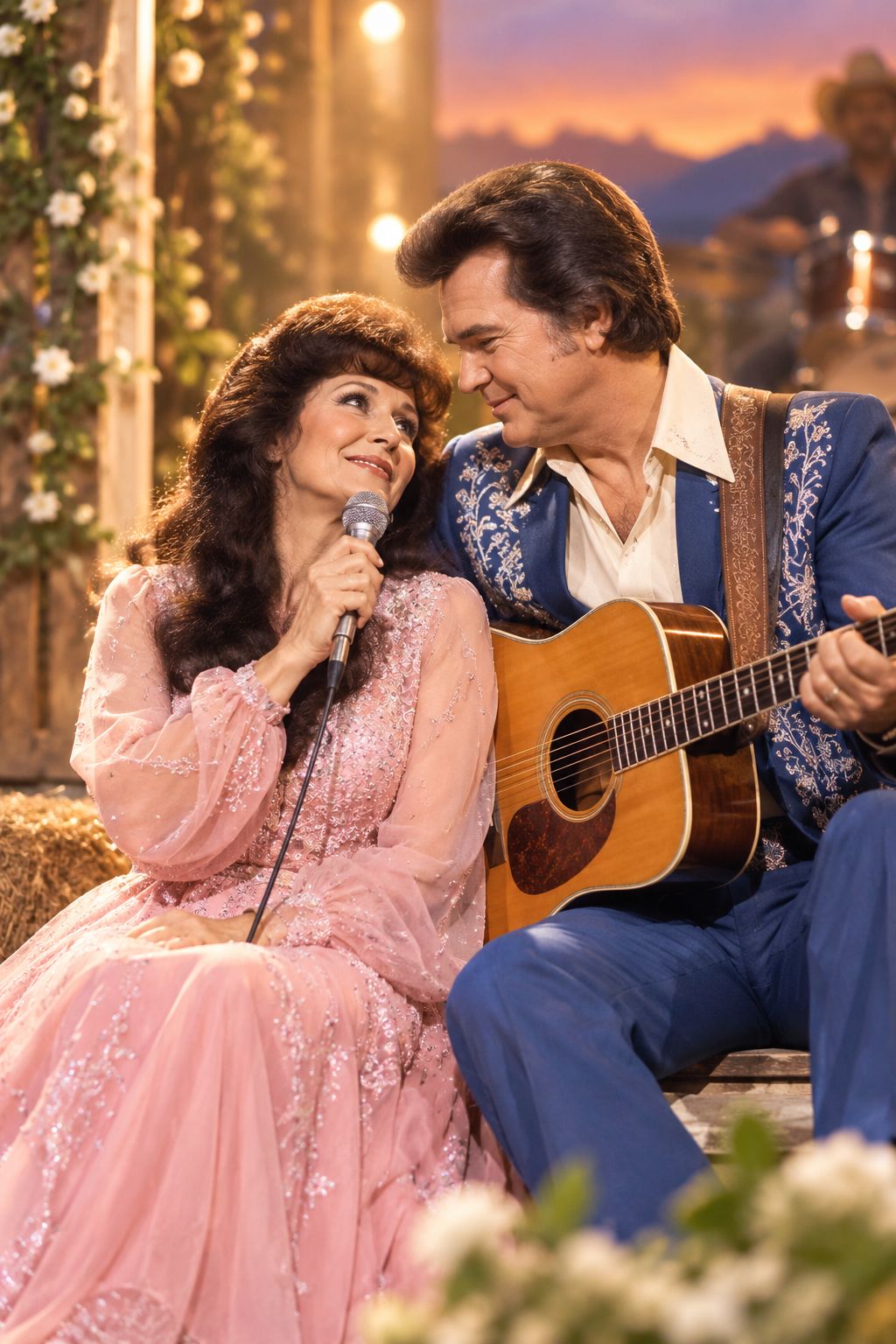
For decades, country music fans have asked the same irresistible question: What was really happening between Conway Twitty and Loretta Lynn?
They stood shoulder to shoulder under the spotlight, singing about forbidden attraction, lonely marriages, temptation, jealousy, and the kind of desire that could tear a family apart.
And they didn’t merely sing those emotions.
They made audiences believe them.
From the first notes of “After the Fire Is Gone” to the fiery exchanges of “Louisiana Woman, Mississippi Man,” Conway and Loretta created something so convincing that fans often wondered whether the music was simply acting—or whether they were hearing something much more personal.
But after decades of speculation, interviews and firsthand accounts paint a fascinating picture.
The answer is less scandalous than the rumor—and, in many ways, much more beautiful.
The Chemistry That Started the Rumors
Conway Twitty and Loretta Lynn weren’t originally assembled as some carefully manufactured romantic duo.
Their partnership grew naturally.
In 1969, the two were traveling overseas as part of a country music package. Lynn already admired Twitty’s music, while Twitty had long admired her talent. According to accounts from both singers, they began singing together backstage and in dressing rooms.
Something clicked.
When they returned home, they took the idea to producer Owen Bradley.
Bradley loved what he heard.
That decision changed country music.
Their first major collaboration, “After the Fire Is Gone,” became a No. 1 country hit in 1971 and eventually earned them a Grammy. They followed it with hit after hit, including “Lead Me On,” “Louisiana Woman, Mississippi Man,” “As Soon as I Hang Up the Phone,” and “Feelins’.”
But there was a problem.
Their songs sounded dangerously real.
“Everybody thought me and Conway had a thing going.”
That wasn’t a modern internet rumor.
Loretta herself acknowledged that people genuinely believed they were having an affair.
Why?
Listen to the stories inside the songs.
“After the Fire Is Gone” isn’t a sweet love song about two innocent people finding happiness together. It’s about two people who know they shouldn’t be together but can’t ignore the attraction.
“Lead Me On” plays with emotional temptation.
“Louisiana Woman, Mississippi Man” turns separation itself into romantic tension.
And “Feelins’” pushes even deeper into intimate territory.
For listeners in the 1970s, the line between performance and reality could feel incredibly thin.
But Loretta Lynn Gave a Very Different Answer
The most important evidence isn’t a rumor from a tabloid.
It’s Loretta Lynn’s own words.
In an interview with Terry Gross, Lynn was directly asked about the persistent belief that she and Conway were lovers.
Her response was remarkably clear:
“But me and Conway were friends. We wasn’t lovers.”
That statement matters.
Lynn didn’t describe their relationship as a secret romance.
She described it as friendship.
And according to her, her husband, Oliver “Doolittle” Lynn—often called Mooney—was also fond of Conway.
In fact, Loretta recalled that Conway was essentially the only person in the music business her husband genuinely enjoyed talking with.
That detail completely changes the emotional picture.
Instead of a hidden affair taking place behind a suspicious husband’s back, the surviving firsthand account describes something far more complicated—and perhaps more remarkable:
three people who understood the unusual bond created by music.
Conway Twitty Said the Same Thing
Conway wasn’t exactly shy about the rumors either.
In an interview preserved in the UNLV Special Collections, Twitty described Loretta as one of his closest friends in the business.
And he directly rejected the idea that something romantic had happened between them.
“She’s one of the best friends I’ve got in this business. But there’s nothing like that ever gone on between us.”
That’s about as straightforward as it gets.
Yet the rumors never disappeared.
Why?
Because Conway and Loretta had something that couldn’t easily be explained by friendship alone—not because there was necessarily a secret affair, but because their musical intimacy was extraordinary.
The Strange Magic of Two Voices
This is where the story becomes more interesting.
Great duet partners don’t simply sing simultaneously.
They react to each other.
They leave space.
They anticipate.
They breathe together.
They understand when to push a line and when to pull back.
Conway’s smooth, controlled baritone could sound almost conversational. Loretta’s voice carried vulnerability, toughness, and emotional honesty.
Put them together, and the result felt like a private conversation overheard through a studio wall.
Garth Brooks later described the effect of their voices as creating an energy that neither artist could create alone. Trisha Yearwood similarly pointed to the special energy generated when two singers become something greater together.
That may be the real “secret” behind the rumors.
They didn’t need to be lovers to sound like lovers.
They needed to believe the story.
And they did.
Their Songs Were Almost Designed to Confuse Reality
There’s another reason fans became suspicious.
The songs weren’t cautious.
They weren’t always respectable.
They often dealt with subjects country radio audiences understood intimately but didn’t necessarily discuss openly.
Married people falling out of love.
Two people discovering attraction outside their relationships.
Loneliness inside marriage.
The dangerous excitement of forbidden affection.
For Conway and Loretta, those themes became their artistic playground.
And they were extraordinarily good at it.
Loretta later laughed when discussing the rumors, acknowledging that audiences assumed the songs reflected their private lives.
But perhaps that’s precisely what made the partnership work.
They understood that country music isn’t merely about telling the truth.
Sometimes it’s about making a fictional truth feel real enough to hurt.
Their Success Wasn’t a One-Hit Accident
If the chemistry had been manufactured, it should have faded.
It didn’t.
Conway and Loretta recorded 11 studio albums together between 1971 and 1988, with five No. 1 country songs and an extraordinary run of awards. They won the CMA Vocal Duo of the Year award four consecutive times from 1972 through 1975.
Their professional relationship lasted for years.
They weren’t simply two stars thrown together for one romantic duet.
They became a genuine creative partnership.
Conway’s official biography even describes Loretta as his duet partner and highlights songs such as “After the Fire Is Gone,” “Lead Me On,” and “Louisiana Woman, Mississippi Man.”
And there was another important layer.
They were business partners as well as musical partners.
Conway recalled that they helped build United Talent together with Loretta and Mooney. He spoke warmly of both of them, describing Mooney affectionately and emphasizing the friendship between them.
That is hardly the picture of two secret lovers desperately hiding a forbidden relationship.
So Why Did It Feel So Real?
Maybe because both singers understood something that many performers never master:
emotional truth doesn’t require literal truth.
A country singer can sing about heartbreak without being heartbroken that morning.
An actor can cry without losing someone.
And Conway Twitty and Loretta Lynn could sing about forbidden love without secretly living it.
But there was something real between them.
It was trust.
It was admiration.
It was friendship.
It was years of performing together until each knew exactly how the other would phrase a lyric, where the other would breathe, and when to step closer emotionally.
That kind of connection can look remarkably like romance from the outside.
Especially when you’re singing:
“Love is where you find it…”
and the entire audience believes you.
The Most Emotional Part of the Story
Conway died in 1993.
Loretta continued her career for decades afterward, carrying memories of their partnership with her.
The musical relationship that had once seemed almost endless suddenly belonged to history.
And perhaps that’s why the old rumors remain so powerful.
People aren’t necessarily obsessed with proving that Conway and Loretta were secretly lovers.
They’re fascinated because their connection felt too powerful to be ordinary.
Fans saw two people who could finish each other’s musical sentences.
They saw playful teasing.
They saw eye contact.
They heard longing in the vocals.
They heard heartbreak.
They heard desire.
And they naturally wondered:
Could two people really sound this close without being in love?
The evidence says yes.
But there’s an important distinction.
They may not have been secret lovers.
They were something that, in its own way, can be just as rare:
creative soulmates.
The Verdict: Secret Lovers or Something Else?
After looking at the strongest available evidence, the secret-lover theory simply doesn’t have solid firsthand support.
Both Conway and Loretta publicly described their relationship as friendship. Loretta specifically denied that they were lovers, while Conway likewise rejected the idea of a romantic relationship.
What is undeniable is their extraordinary musical chemistry.
They understood one another.
They trusted one another.
And they knew how to transform a song about forbidden love into something that sounded almost painfully personal.
That may actually be the greater achievement.
Because anyone can create a scandal.
But very few artists can create a musical relationship so convincing that generations of listeners still wonder where the performance ended and reality began.
Conway and Loretta didn’t need a secret affair to make country music history.
They already had something more enduring:
two voices, two personalities, one unforgettable musical connection.
And perhaps the greatest mystery was never whether they were secretly in love.
Perhaps it was how two friends managed to make millions of people feel like they were listening to two lovers confessing something they weren’t supposed to say.
VIDEO: