 By admin
INTRODUCTION:
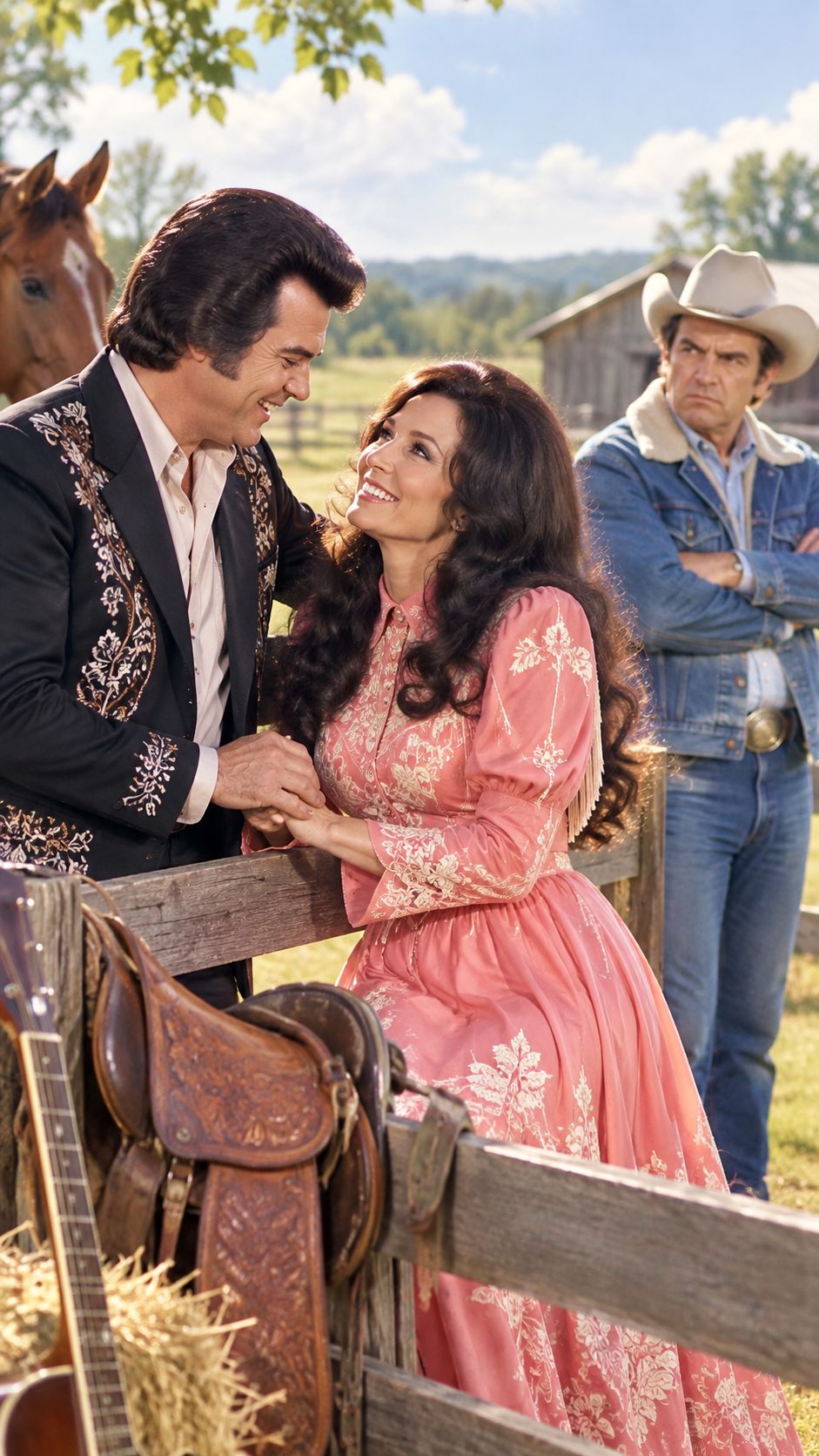
There are some country music partnerships that sound good together. Then there are partnerships that make people believe the story is real.
Loretta Lynn and Conway Twitty belonged to the second category.
From their earliest recordings together, their voices seemed to move beyond ordinary harmony. They teased, challenged, interrupted, softened and answered one another as if they were having a private conversation in front of thousands of people. Their songs were often about temptation, forbidden love, heartbreak and complicated relationships—and their performances were so convincing that audiences sometimes forgot they were watching two professional singers.
That realism created a question that followed the pair for decades:
Did Loretta Lynn’s husband, Oliver “Mooney” Lynn, ever feel threatened by Conway Twitty?
The answer is more complicated—and more interesting—than the viral version of the story suggests.
There is evidence that Mooney understood exactly how powerful the Lynn-Twitty partnership was. There are also reports that jealousy existed around their closeness. But the idea that he was literally “terrified” of Conway is stronger than what the historical record can firmly establish.
And ironically, one of the most important facts is that Mooney himself helped make the partnership happen.
The Chemistry That Fooled Millions
When Loretta Lynn and Conway Twitty began recording together, their chemistry was almost impossible to ignore.
Their first major collaborative success, “After the Fire Is Gone,” arrived in 1971. The song told the story of two people trapped in relationships where the passion had disappeared—and finding emotional comfort somewhere else.
It was exactly the sort of material that could blur the line between performance and reality.
The song became a No. 1 country hit and eventually won the pair a Grammy. Over the next several years, they built one of the most successful duet partnerships in country music.
But the lyrics created a problem.
People didn’t simply hear two singers performing a song.
They saw Loretta and Conway.
And when the two looked at each other onstage, traded lines and leaned into emotionally charged lyrics, some listeners began assuming the relationship had to be more personal than professional.
PBS’s American Masters later noted that the lyrics and Lynn and Twitty’s easy chemistry made their relationship a puzzle to audiences.
Loretta herself rejected the romantic interpretation.
“Everybody thought me and Conway had a thing going. And that’s the farthest from the truth.”
That statement matters.
Because the mythology surrounding the duo has sometimes become bigger than the documented history.
But What About Mooney?
This is where the story gets fascinating.
Oliver “Mooney” Lynn was not an outsider watching his wife suddenly develop a friendship with another man.
He knew Conway.
In fact, Conway later spoke warmly about Mooney, describing him as a friend and emphasizing how much they respected one another. A 1978 Billboard feature described the relationship between Conway, Loretta and Mooney as one built around mutual admiration and business as well as music.
Even more surprising, historical accounts indicate that Mooney was supportive of the partnership.
According to later reporting, when the song “Louisiana Woman, Mississippi Man” came to his attention, Mooney liked the song and helped push the idea of Conway and Loretta recording it.
Think about that for a moment.
The man supposedly “terrified” by Conway’s chemistry with his wife was also involved in encouraging the musical partnership that produced some of their biggest records.
That doesn’t exactly fit the dramatic legend.
But it does reveal something much more human.
Jealousy May Have Been Part of the Picture
Mooney and Loretta’s marriage was complicated long before Conway Twitty entered the story.
Their relationship included love, children, career struggles, infidelity, drinking and serious conflict. Loretta herself openly wrote and spoke about the difficult parts of the marriage.
That history matters because it changes how we should interpret stories about jealousy.
A 2000-era Nashville Scene profile noted that rumors about Conway and Loretta had existed for years and specifically described the pair as close friends whose relationship could sometimes prompt jealousy from Mooney.
But there is a crucial distinction:
Reported jealousy is not the same thing as proven fear.
And jealousy is not evidence of an affair.
The historical record doesn’t establish that Loretta and Conway secretly carried on a romantic relationship. In fact, Loretta repeatedly described Conway as a friend, and Conway’s relationship with Mooney was publicly characterized as friendly and respectful.
Why Their Performances Could Have Been Difficult to Watch
Even if Mooney trusted both of them, imagine watching your wife perform a song like “Lead Me On.”
This wasn’t an ordinary duet.
The song was built around emotional restraint collapsing under temptation. Loretta and Conway didn’t sing it like two people reading lines from a page.
They sounded like two people trying desperately not to cross a boundary.
A Nashville Scene review described the performance in intensely dramatic terms, emphasizing the way the arrangement and vocal exchanges created the sensation of mounting desire and emotional tension.
That’s precisely what made their partnership extraordinary.
And precisely what could make the mythology so powerful.
They didn’t have to be lovers to sound like people who were dangerously close to becoming lovers.
That was the artistry.
Loretta Was Already a Master of Emotional Storytelling
There is another reason audiences became convinced.
Loretta Lynn had built her career by turning uncomfortable domestic realities into songs.
She wrote about jealousy.
She wrote about infidelity.
She wrote about marriage.
She wrote about women defending themselves.
She wrote about husbands coming home drunk.
And she did it with an extraordinary ability to make listeners feel as if they were standing inside the room.
Songs such as “Fist City” and “Don’t Come Home A-Drinkin’ (With Lovin’ on Your Mind)” drew heavily from the emotional realities surrounding marriage and relationships.
So when Loretta sang opposite Conway, she already knew how to make fictional characters feel real.
Conway possessed a similar gift.
His smooth baritone could make even a simple line sound intimate.
Together, they created an illusion powerful enough to generate decades of speculation.
The Twist: Mooney and Conway Actually Had Respect for Each Other
Perhaps the biggest contradiction to the “terrified husband” narrative is Conway’s own description of Mooney.
In a 1978 Billboard account, Conway spoke positively about Loretta’s husband and referred to him affectionately. The article also described the three-way relationship surrounding their musical enterprise, including their business partnership.
That doesn’t mean Mooney never felt jealousy.
People can simultaneously trust someone and feel uncomfortable with a situation.
They can admire a friend and still dislike how emotionally convincing that friend’s performances are with their spouse.
Human relationships rarely fit neatly into a headline.
And that may be the real story here.
The Most Powerful Evidence May Be Loretta’s Own Words
Years later, Loretta continued to describe Conway in affectionate but platonic terms.
In a 2016 interview, she remembered him warmly and said that Conway loved her husband. She also spoke about Conway’s character and noted that he never drank.
That recollection complicates the idea that Conway was some dangerous rival secretly circling her marriage.
Instead, the available evidence paints a different picture:
Conway was a close friend.
Mooney knew him.
Mooney could appreciate his talent.
And Loretta and Conway possessed a professional chemistry that was so convincing that audiences repeatedly mistook artistic intimacy for romantic intimacy.
Why the Rumor Refuses to Die
Because the music still sounds personal.
That’s the secret.
Listen to “After the Fire Is Gone.”
Listen to “Lead Me On.”
Listen to “Louisiana Woman, Mississippi Man.”
The voices don’t simply harmonize.
They react.
Loretta’s sharp, emotionally direct delivery pushes against Conway’s smoother style. He responds. She challenges him. He answers. Their timing creates the sensation of two personalities negotiating something complicated.
That’s why their performances remain compelling decades later.
The audience isn’t merely hearing a song.
They’re witnessing a relationship.
And when the performers are married to other people in real life, the illusion becomes even more powerful.
The Tragedy of Turning a Complicated Marriage Into a Simple Rumor
There is a temptation to turn the entire story into one dramatic sentence:
“Mooney was terrified that Loretta would fall for Conway.”
It’s catchy.
It’s emotional.
But history is rarely that simple.
Loretta’s marriage to Mooney contained genuine affection alongside serious conflict. Her partnership with Conway contained genuine friendship alongside extraordinary artistic intimacy.
Both things can be true.
Mooney could have experienced jealousy without being “terrified.”
Loretta could have loved Conway deeply as a friend without having a romantic relationship with him.
And Conway could have created astonishing chemistry with Loretta without crossing the boundary their audiences imagined.
That complexity is actually more fascinating than the rumor.
The Legacy That Outlived the Rumor
Conway Twitty died in 1993, and Loretta publicly mourned him not only as a legendary singing partner but as a close friend. Their partnership had earned multiple CMA Vocal Duo of the Year awards and a Grammy, leaving behind a catalog that remains central to classic country music.
Mooney died in 1996 after nearly five decades of marriage to Loretta. Their relationship, like Loretta’s music, contained contradictions that could never be reduced to a single label.
And perhaps that’s why the story continues to fascinate country fans.
Because behind the rumors was something much more extraordinary:
Three people who helped create one of country music’s most unforgettable partnerships.
Mooney wasn’t simply the jealous husband standing in the shadows.
Conway wasn’t simply the handsome rival.
And Loretta wasn’t simply the woman caught between two men.
She was an artist who understood exactly how to turn emotional tension into music.
The chemistry between Loretta Lynn and Conway Twitty didn’t need to be an affair to feel dangerous. It only needed to sound real.
And that’s precisely why, more than half a century later, people are still talking about it.
VIDEO: