 By admin
INTRODUCTION:
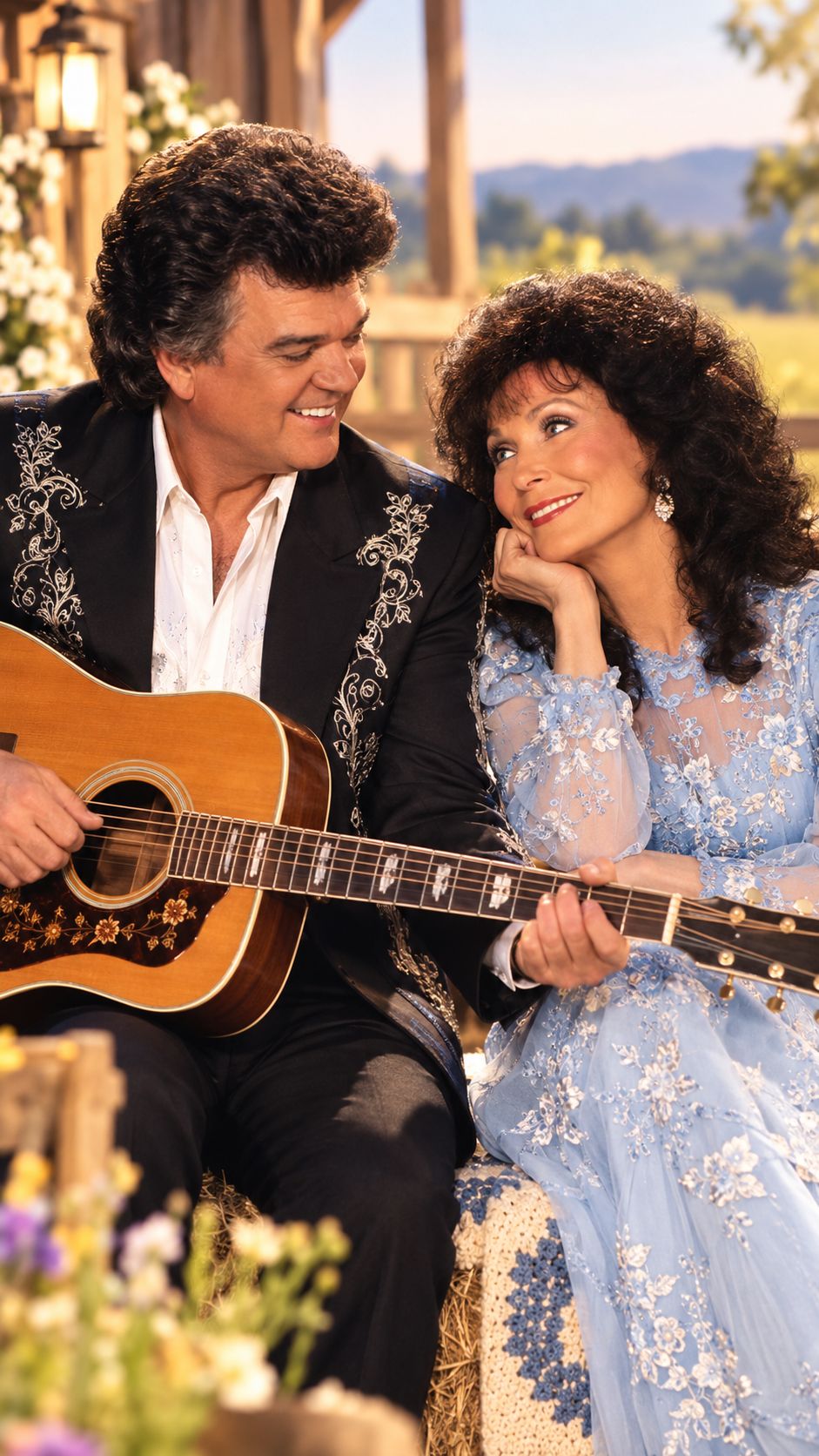
There are country music partnerships that succeed because the artists have great voices. Then there are partnerships that seem to create an entirely different world whenever the two singers stand beside each other.
Conway Twitty and Loretta Lynn belonged to the second category.
For years, audiences watched them sing about forbidden love, jealousy, temptation, marriage, heartbreak, arguments, and reconciliation. Their performances could sound so emotionally convincing that listeners began asking a question that has followed their legacy for decades:
Were Conway Twitty and Loretta Lynn really that close—or was there something more behind the music?
The documented story is both less scandalous and, in some ways, more moving. Their connection was built on professional trust, musical chemistry, friendship, and an extraordinary ability to make fictional songs feel painfully real. Loretta herself later pushed back against the idea that the two were romantically involved, describing Conway as a friend and emphasizing that her husband, O.V. “Doolittle” Lynn, also cared about him.
And perhaps that is what made their partnership so remarkable.
They did not need a secret romance to create the illusion of one.
They only needed two voices that understood exactly how to tell a story.
The Beginning Was More Than Just Another Recording Session
By the early 1970s, Loretta Lynn was already one of country music’s most important female stars. She had built her career by turning personal experiences, family life, marriage, conflict, and the realities of working-class women into songs that millions could recognize.
Conway Twitty, meanwhile, had already traveled a remarkably unusual musical road. Before becoming one of country music’s defining voices, he had found success in rock and roll. Eventually, country music became the center of his career.
When their professional partnership began in 1971, neither artist needed the other to establish a career.
That matters.
This was not a situation where one unknown singer was being rescued by a superstar. Both already had identities, audiences, and careers of their own.
Then they stepped behind the same microphone.
Their first major duet, “After the Fire Is Gone,” became a No. 1 country hit and won them a Grammy. According to the Country Music Hall of Fame, that recording launched one of the most successful duet partnerships in country music history.
Suddenly, country music had a new musical couple.
But there was a problem.
The audience couldn’t always tell where the performance ended and the relationship began.
Why Did Their Chemistry Feel So Real?
Listen closely to the great Conway Twitty and Loretta Lynn duets and something becomes obvious.
They weren’t simply singing at each other.
They were reacting to each other.
A line from Conway could sound like a challenge. Loretta’s response could sound like an accusation. A pause could suddenly feel like an argument between two people who had known each other for years.
That quality was central to their appeal.
Songs such as “Lead Me On,” “Louisiana Woman, Mississippi Man,” “As Soon as I Hang Up the Phone,” and “Feelins’” weren’t merely collections of beautiful melodies. They were miniature dramas.
The singers became characters.
The audience became the witness.
The magic was not necessarily in what was happening between Conway and Loretta offstage. It was in how convincingly they could make something happen inside a song.
PBS notes that their easy chemistry and emotionally charged lyrics caused audiences to wonder about the nature of their relationship. Yet Loretta directly rejected the romantic interpretation, saying people assumed they “had a thing” when, according to her, that was not the truth.
That distinction is important.
Their chemistry was real.
The supposed affair was not established by the evidence.
Eleven Albums. Five No. 1 Hits. Years of Trust.
The numbers alone tell part of the story.
Conway Twitty and Loretta Lynn made 11 studio albums together between 1971 and 1988, according to PBS. Their collaboration produced five No. 1 country singles, while their first major hit, “After the Fire Is Gone,” earned a Grammy.
They also dominated the CMA Vocal Duo of the Year category from 1972 through 1975.
But statistics cannot explain why the partnership lasted.
For that, you have to understand trust.
A duet is unusually intimate.
Two solo performers can hide behind production, arrangements, musicians, and staging. But when two voices are trading lines, every hesitation becomes noticeable. Every breath matters. Every change in tone becomes part of the story.
Conway and Loretta seemed to know instinctively when to push and when to pull back.
That musical understanding became their secret weapon.
The Songs Created a Story Bigger Than Reality
Perhaps the most fascinating thing about their partnership is how often the songs created an alternate reality.
On record, they could be lovers.
They could be spouses.
They could be two people fighting.
They could be two people trying desperately not to admit what they felt.
But outside the songs, the documented picture was considerably more grounded.
Loretta described Conway as a friend, and she specifically remembered that her husband also liked him.
That makes the mythology even more interesting.
The public didn’t fall in love with a secret relationship.
They fell in love with the illusion created by two extraordinarily gifted performers.
They made fiction sound like confession.
That is one of the rarest abilities a country singer can possess.
“Louisiana Woman, Mississippi Man” Changed Everything Again
Few songs better demonstrate the Conway-Loretta phenomenon than “Louisiana Woman, Mississippi Man.”
The title itself sounds like the beginning of a Southern romance.
Then the voices arrive.
Loretta’s delivery brings toughness and independence. Conway answers with his characteristic restraint. Instead of competing, their contrasting personalities create tension.
PBS notes that Loretta’s husband, Doolittle Lynn, actually found the song for the duo. The resulting album and title track both reached No. 1 on the country charts.
That detail is revealing.
The man who was supposedly threatened by their chemistry was also part of the professional machinery that helped bring some of their music to life.
It is a reminder that the real story was more complicated—and less sensational—than the rumors that grew around them.
The “Forbidden Chemistry” Was Their Greatest Musical Asset
Country music thrives on emotional contradiction.
People can love someone and resent them.
They can want to leave and desperately want to stay.
They can forgive someone while still remembering the pain.
Conway and Loretta understood that language instinctively.
Their voices represented different emotional colors.
Loretta could sound fiery, wounded, playful, stubborn, or vulnerable.
Conway could sound smooth, restrained, confident, or quietly desperate.
Together, those qualities created friction.
And friction creates drama.
That drama is why listeners still debate their performances decades later.
Then the Partnership Changed
Their full-time touring partnership eventually came to an end. Their recording relationship continued into the 1980s, with their broader collaboration producing music well beyond their original run of hits. PBS records their partnership as lasting through 1988.
But the story took a heartbreaking turn in 1993.
Conway Twitty died at the age of 59 following complications after surgery. The Congressional Record documented the reaction at the time, including Loretta’s statement mourning not only her longtime singing partner but also a great friend.
Those words carry enormous weight when viewed against everything that had happened before.
After decades of speculation, Loretta’s remembrance centered on friendship.
Not scandal.
Not a secret romance.
Friendship.
And perhaps that was the relationship people had misunderstood all along.
What Were They Really?
The most responsible answer is also the most human:
They were extraordinary musical partners who developed a deep friendship and an almost unmatched ability to communicate emotion through song.
There is no solid basis for turning their famous chemistry into proof of a secret romantic relationship.
What is documented is more compelling than a rumor.
They trusted one another.
They challenged one another musically.
They created characters together.
They made audiences believe in stories that existed for only three or four minutes at a time.
And they built one of the most successful male-female partnerships in country music history.
The official Conway Twitty site describes Lynn as his major female duet partner and highlights their status as one of country music’s most successful male/female duet teams.
Decades later, that legacy continues through their families. Loretta’s granddaughter Tayla Lynn and Conway’s grandson Tre Twitty have performed together as Twitty & Lynn, carrying songs such as “Louisiana Woman, Mississippi Man” to new audiences. Their official story describes their work as a celebration of the two grandparents and the lost art of duet singing.
That may be the greatest proof of all.
The partnership did not survive because of gossip.
It survived because the music was real.
Conway Twitty and Loretta Lynn didn’t need to be lovers to sound like they were in love. They needed something much harder to manufacture: trust.
And when those two voices met, that trust became something millions of listeners could feel.
That is why, after all these years, the mystery remains.
Not because we still need to discover a secret romance.
But because Conway Twitty and Loretta Lynn created something so emotionally believable that generations of country fans still wonder where the characters ended—and the real people began.
VIDEO: