 By admin
INTRODUCTION:
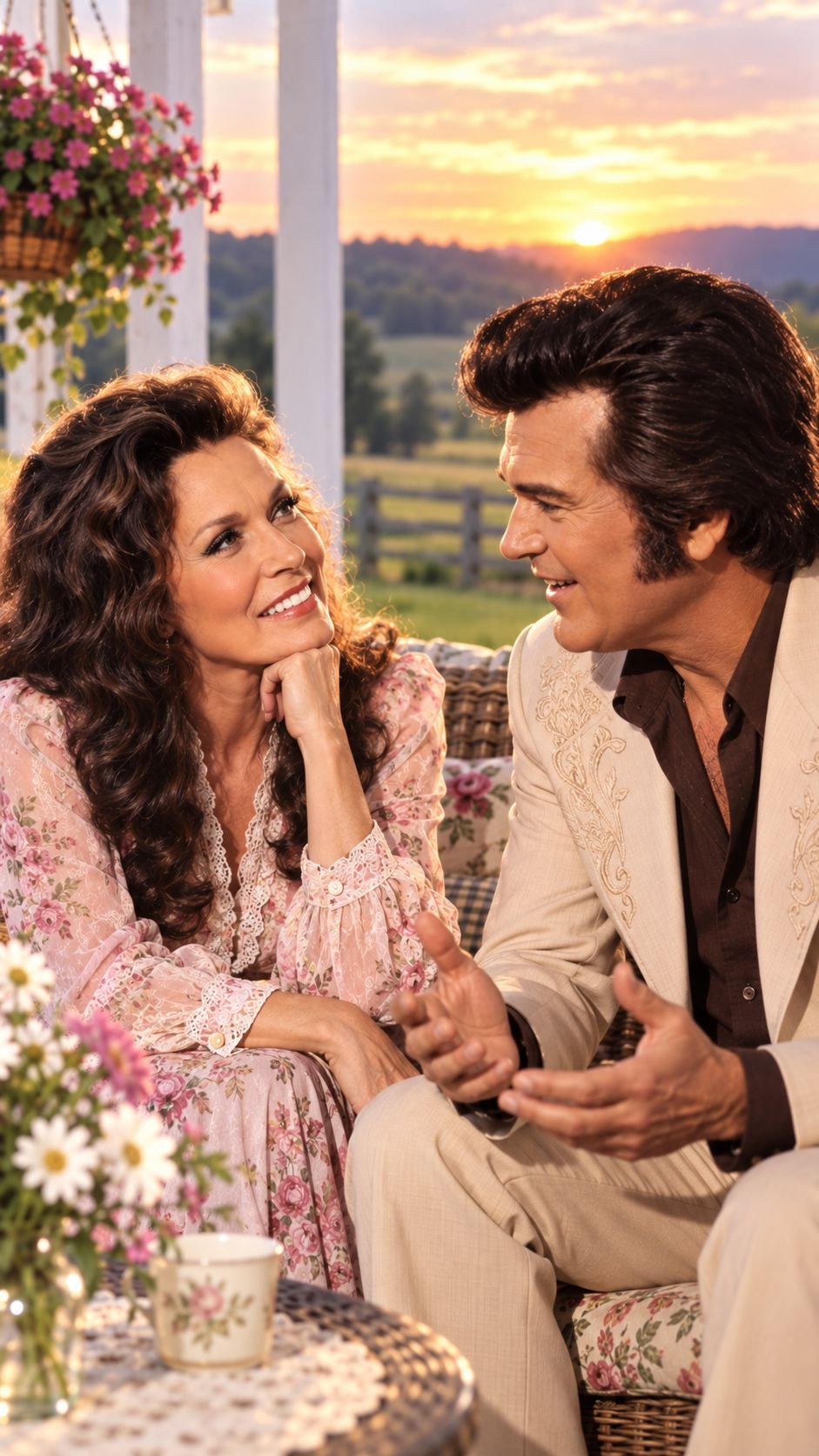
There are moments in country music history that feel almost too perfectly written to be true.
Two legendary performers. Two lifelong friends. A hospital corridor. A final visit. And a goodbye that neither of them knew would be their last.
For decades, Conway Twitty and Loretta Lynn were one of country music’s most unforgettable partnerships. Their voices seemed to understand one another instinctively, turning songs such as “After the Fire Is Gone” and “Louisiana Woman, Mississippi Man” into performances that sounded intensely personal. Their chemistry was so convincing that fans sometimes wondered whether there was something deeper between them.
But Loretta Lynn repeatedly made the distinction clear: their relationship was friendship, not romance. In a later interview, she directly said that she and Conway were friends, not lovers.
And then came June 1993.
The ending of their story was not on a stage beneath bright lights. It happened in a hospital, in the middle of an extraordinary coincidence that left Loretta caring for two people she loved at the same time.
The Night Everything Changed
On June 5, 1993, Conway Twitty died at age 59 after suffering a ruptured abdominal aneurysm. He had collapsed while traveling by bus after performing in Branson, Missouri. Doctors attempted emergency surgery, but he died the following morning.
What made the tragedy even more heartbreaking was where Loretta Lynn happened to be.
She was already at a Springfield, Missouri, hospital because her husband, Oliver “Doolittle” Lynn, was recovering from heart surgery.
Suddenly, the hospital became the place where Loretta was forced to confront the possible loss of two important men in her life.
Years later, she described the experience with remarkable emotion.
“I stayed with Dee and I stayed with the band for a while, and then I’d run up to see Doo, and then I’d run back to sit with Dee.”
Loretta was moving between rooms, trying to support Conway’s wife, Dee Henry, while also checking on her own husband.
It was an impossible situation.
And then came the moment that has remained one of the most haunting stories in country music history.
“You’re Gonna See Him for the Last Time Alive”
At some point, a chaplain approached Loretta.
The question was simple, but devastating:
Did she want to see Conway?
Loretta initially did not understand why she was being asked.
Then the meaning became clear.
She was being given one final opportunity to see her longtime friend alive.
According to Loretta’s later recollection, she immediately went to Conway with Dee. She reportedly took Dee by the hand and went with her to his bedside.
And Loretta did what friends often do when confronted with something they cannot accept.
She encouraged him to fight.
“Conway, don’t you die on me. You know you love to sing. You’re gonna be alright.”
Those words are difficult to hear decades later because they capture something profoundly human.
Loretta wasn’t delivering a farewell speech.
She wasn’t preparing for death.
She was trying to convince her friend that he wasn’t going anywhere.
The Goodbye That Didn’t Feel Like Goodbye
Dee also spoke to Conway.
According to Loretta’s later account, Dee reminded him that he had survived difficult circumstances before.
There was still hope.
Or at least, they needed hope.
Loretta eventually left Conway’s room and returned to her husband.
Then, almost immediately, someone told her the news.
Conway Twitty had died.
He was only 59.
The Washington Post’s 1993 obituary reported that Twitty had collapsed while traveling home from Branson and died after surgery for an abdominal aneurysm. At the time of his death, he had more than 50 No. 1 hits and a career that stretched across decades.
For Loretta, however, Conway’s death wasn’t a statistic.
It was personal.
“I’ve Not Only Lost a Great Singing Partner”
The public knew Conway Twitty as one of country music’s greatest male vocalists.
Loretta knew him differently.
She knew the man behind the stage.
She knew his sense of humor. She knew how easily he could become embarrassed. She knew how much fun they could have together.
And she knew the man who had become one of her closest friends in country music.
When Conway died, Loretta’s statement reflected that personal connection.
“I’ve not only lost a great singing partner but also a great friend.”
The statement was reported in the Congressional Record shortly after Twitty’s death. It also noted that Loretta’s husband was recovering at the same hospital where Conway died.
That distinction matters.
Because the story of Conway and Loretta has often been distorted by the extraordinary chemistry they displayed onstage.
But chemistry isn’t necessarily romance.
Sometimes it is trust.
Sometimes it is friendship.
Sometimes it is two performers who understand exactly how to make a song believable.
Why Fans Always Thought There Was Something More
Part of the mystery came from the songs themselves.
When Conway Twitty and Loretta Lynn sang about forbidden love, loneliness, temptation, marriage, and regret, they didn’t sound like two people merely acting out lyrics.
They sounded like they had lived the story.
Their 1971 recording of “After the Fire Is Gone” became a defining example. The song tells the story of two people whose relationships have lost their emotional warmth and who find themselves drawn toward each other. NPR’s retrospective on Loretta’s career highlighted the recording as one of the pair’s major duets.
But the intensity of the performance was part of their artistic gift.
In a Billboard feature, both artists recalled how their connection began with mutual admiration. Loretta had been a fan of Conway since hearing “It’s Only Make Believe,” while Conway said he had been a Loretta Lynn fan before they ever recorded together.
Their friendship developed naturally into one of country music’s most successful partnerships.
They won the CMA Vocal Duo of the Year award four consecutive times, from 1972 through 1975, and won a Grammy for “After the Fire Is Gone.”
Loretta’s “Confession” Wasn’t What the Rumors Suggested
That’s perhaps the most important part of this story.
The word “confession” can make people expect a shocking revelation — a secret romance, a hidden affair, or some dramatic truth that had supposedly been buried for years.
But Loretta’s later recollections tell a more complicated and, in some ways, more touching story.
She didn’t confess that she and Conway had secretly been lovers.
Instead, she repeatedly emphasized the depth of their friendship.
And when she talked about his final hours, what came through most strongly was grief.
She remembered him as a friend.
A musical partner.
A man who had been woven into her life and her family’s life.
She even remembered how her husband, Doo, had liked Conway. In a later interview, Loretta recalled that Conway was the one country artist her husband particularly cared about, and she remembered the laughter that filled their trips together.
That memory changes the emotional meaning of their relationship.
It wasn’t simply Loretta and Conway.
It was Loretta, Conway, Doo, their families, their music, their tours, and years of shared memories.
The Cruel Irony of Their Final Meeting
Perhaps the most heartbreaking detail is that Loretta didn’t know she was saying goodbye.
When she told Conway that he would be all right, she believed she was encouraging him through another difficult moment.
She couldn’t know that the next time she heard his name, it would be because he was gone.
That is what makes the story endure.
There was no grand final concert.
No dramatic final duet.
No carefully written farewell.
Just a hospital room.
A friend.
A wife.
A few words of encouragement.
And then silence.
“Don’t you die on me.”
Those words, remembered years later, reveal how impossible it was for Loretta to accept what was happening.
The Partnership That Outlived the Man
After Conway’s death, the recordings remained.
The laughter remained.
The television appearances remained.
The awards remained.
And the songs remained.
But something else remained too: the memory of two people who had created something that audiences could feel even when they couldn’t explain it.
Conway and Loretta didn’t need to be lovers to create believable love songs.
They needed musical trust.
They needed timing.
They needed personality.
And above all, they needed friendship.
Their partnership worked because they knew how to push one another, tease one another, and create tension without destroying the affection underneath it.
Billboard’s 1978 account even recalled Loretta joking at Conway’s expense because she knew exactly how easily she could embarrass her famously bashful partner.
That playful relationship helps explain why their performances felt so alive.
What Loretta Really Left Behind
Years after Conway’s death, Loretta’s recollections gave fans something more meaningful than a scandalous secret.
She gave them a glimpse into the final moments of a friendship.
She showed that behind the glamorous costumes, hit records, awards, and rumors were two human beings who genuinely cared about each other.
And perhaps that is the real tragedy.
Loretta Lynn didn’t get a final conversation with Conway in the way people might imagine.
She got a final moment.
A few words.
A desperate attempt to encourage him.
And then the terrible realization that she had just seen her friend for the last time.
Their music made millions believe in stories of forbidden love.
But their real story may have been even more powerful:
two friends who understood each other deeply, made extraordinary music together, and were separated forever by a tragedy neither could have predicted.
Conway Twitty died in 1993, but the partnership he shared with Loretta Lynn never really disappeared. Their recordings continue to preserve the sound of their voices together — voices that once made audiences wonder where the performance ended and real emotion began.
And perhaps that is why, decades later, people are still asking about Conway and Loretta.
Not because there must have been a secret romance.
But because sometimes the strongest connections in life are the ones that don’t need a romantic explanation.
They simply need to be remembered.
VIDEO: