 By admin
INTRODUCTION:
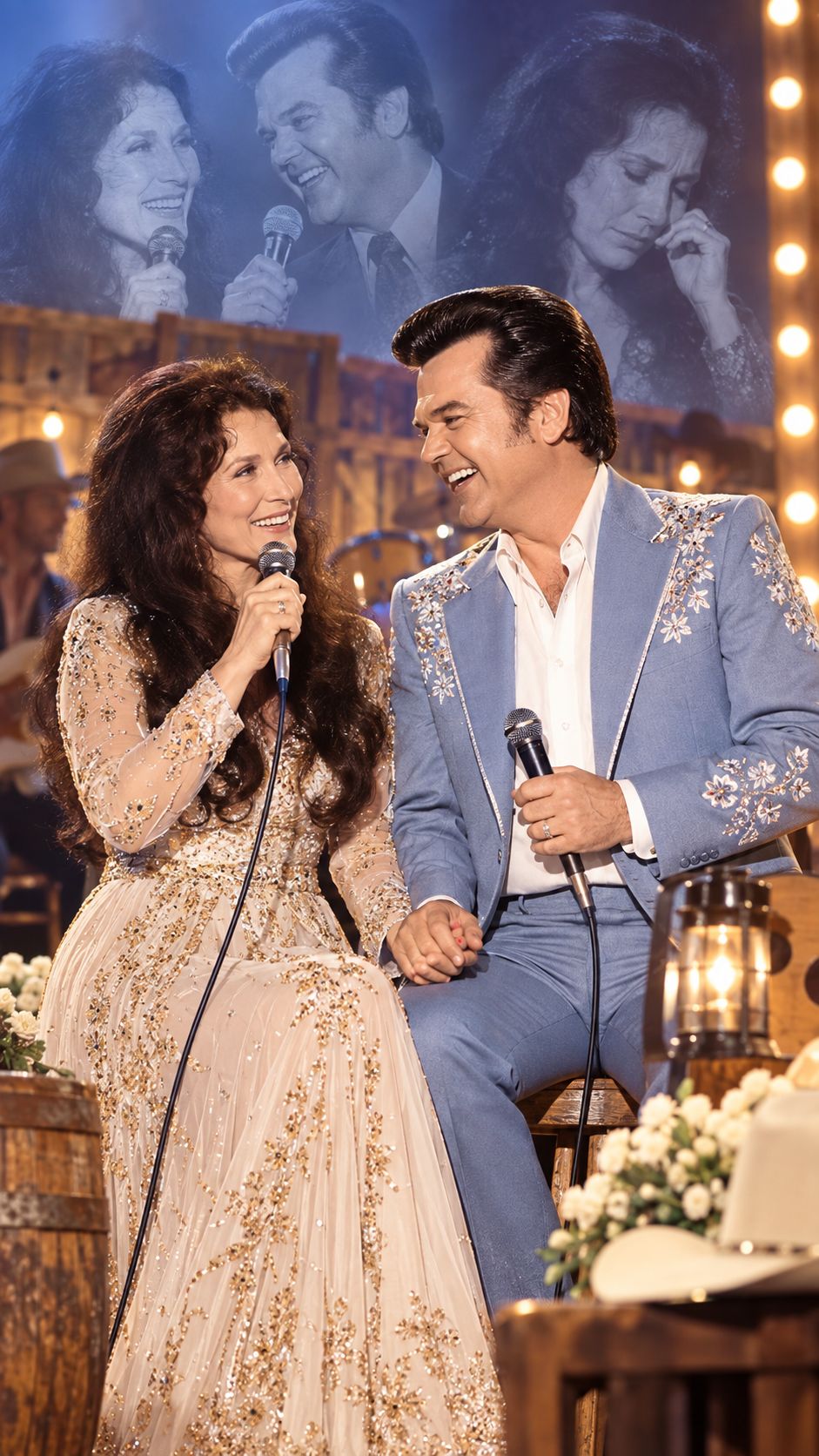
There are country music partnerships that become successful.
And then there are partnerships that become mythology.
Conway Twitty and Loretta Lynn belonged to the second category.
When their voices met in the early 1970s, something happened that neither a chart position nor a recording contract could fully explain. His deep, aching baritone seemed to pull emotion from the shadows, while her unmistakable voice answered with honesty, strength, and vulnerability.
Together, they created records that sounded less like ordinary duets and more like conversations between two people who had lived through the same heartbreak.
Their success was extraordinary. Their story was complicated. And over time, the line between what happened onstage, what happened behind the scenes, and what fans imagined became increasingly difficult to separate.
But beneath all the awards and No. 1 records was something much more human: two performers trying to turn complicated emotions into unforgettable music.
The Beginning of Something Almost Unbelievable
When Loretta Lynn and Conway Twitty began their professional partnership, neither needed the other to establish a career.
Lynn was already one of country music’s defining voices. Twitty had transformed himself from a rock-and-roll performer into one of Nashville’s most successful country artists.
By the time they recorded “After the Fire Is Gone,” both had already proven they could succeed alone.
Yet the combination was different.
The song reached No. 1 on the country chart in 1971 and became the first of five consecutive No. 1 duets for the pair. Their partnership eventually produced 11 studio albums between 1971 and 1988, while their recordings included classics such as “Lead Me On,” “Louisiana Woman, Mississippi Man,” “As Soon as I Hang Up the Phone,” and “Feelins’.”
The success wasn’t merely commercial.
From 1972 through 1975, they were named the CMA Vocal Duo of the Year four consecutive times. “After the Fire Is Gone” also earned them a Grammy.
They weren’t simply singing together. They were creating emotional tension that audiences could feel.
That tension became their secret weapon.
Why Their Duets Felt So Real
Listen closely to a Conway-and-Loretta recording and the magic becomes easier to understand.
Twitty rarely needed to overpower a song. His voice carried a controlled sadness, almost as if he were holding something back.
Lynn was different.
She could sound vulnerable in one line and fiercely defiant in the next.
That contrast created electricity.
In “After the Fire Is Gone,” the emotional center isn’t a glamorous romance. It’s the emptiness that remains when love has disappeared from a relationship.
That was daring territory for mainstream country music.
And it was precisely the kind of emotional realism that made their recordings resonate.
The Country Music Hall of Fame describes their collaboration as one of the most successful duet partnerships in country history, noting the Grammy and four CMA awards they earned together.
But there was another element that made the partnership fascinating.
They sounded believable.
So believable, in fact, that audiences sometimes assumed the chemistry they heard in the songs reflected a romantic relationship in real life.
Loretta herself pushed back against that interpretation.
In an American Masters interview, Lynn recalled that people believed she and Conway had “a thing going,” but she said that was far from the truth. She described Twitty as a friend and spoke warmly of the relationship between him and her husband, Mooney Lynn.
That distinction matters.
The intensity was real.
The romance was part of the music.
The No. 1 Machine
Once the first hit arrived, the partnership seemed almost unstoppable.
“Lead Me On” followed in 1971.
Then came “Louisiana Woman, Mississippi Man” in 1973.
Then “As Soon as I Hang Up the Phone.”
Then “Feelins’.”
Five consecutive No. 1 country singles turned the duo into a phenomenon. The Songwriters Hall of Fame records the same remarkable streak and notes that Lynn also accumulated 11 No. 1 country hits as a solo artist.
This is important because the Conway-and-Loretta story wasn’t about two stars becoming dependent on one another.
Quite the opposite.
Their individual careers remained powerful.
Twitty was piling up solo successes, ultimately earning 40 No. 1 Billboard country hits according to the Country Music Hall of Fame. Lynn was simultaneously building her own historic legacy, including “Coal Miner’s Daughter” and a series of songs that established her as one of country music’s most distinctive female voices.
Their partnership worked because neither disappeared inside the other.
Their voices remained unmistakably their own.
But Success Created Its Own Emotional Shadow
The songs often dealt with subjects that could make listeners uncomfortable.
Infidelity.
Loneliness.
Marriage without intimacy.
Temptation.
Regret.
The emotional aftermath of love disappearing.
These were not sanitized stories.
They were messy.
They were human.
And because Conway and Loretta delivered them with such convincing chemistry, some listeners naturally blurred the distinction between the characters in the songs and the performers themselves.
That became one of the most persistent myths surrounding the duo.
But the documented story is actually more interesting.
The chemistry didn’t require a secret affair.
It required trust, timing, vocal contrast, and extraordinary musical instincts.
Garth Brooks later explained that when the two voices came together, they created something that neither could create alone. Trisha Yearwood similarly discussed the special energy generated by great duet partners.
That is the real mystery.
How can two people sound so emotionally connected without actually being romantically connected?
Conway and Loretta answered that question every time they stepped behind a microphone.
The Heartbreak Was Sometimes Inside the Songs
Perhaps the saddest part of their story is that the emotional pain listeners heard didn’t have to come from one dramatic event between Conway and Loretta.
The heartbreak was already embedded in the material.
“After the Fire Is Gone” is about what happens when the emotional fire inside a relationship disappears.
“Lead Me On” carries the language of temptation and vulnerability.
“As Soon as I Hang Up the Phone” turns separation into drama.
“Feelins’” digs directly into emotional conflict.
These weren’t lightweight love songs.
They were miniature dramas.
And Conway and Loretta performed them like actors who understood every uncomfortable corner of the story.
Their greatest trick was making millions of people believe they were witnessing something private—even when they were simply witnessing two masters interpreting a song.
That is why the partnership remains so powerful decades later.
Then Came the Passage of Time
Nothing in country music lasts forever.
The partnership continued for years, with recordings stretching well beyond their initial explosion of success. Their final studio album together, Making Believe, appeared in 1988.
Then came the tragedy that changed how fans remembered everything.
Conway Twitty died unexpectedly in 1993 at the age of 59.
Suddenly, every performance became part of history.
Every photograph carried greater weight.
Every duet sounded different.
A partnership that had once seemed almost permanent had become something that could only exist in recordings and memories.
Loretta Lynn continued performing and recording for decades, building a legacy that extended far beyond her work with Twitty. But the emotional imprint of their partnership never disappeared.
Perhaps that is because their songs captured something timeless.
People fall in love.
People fall out of love.
People stay together.
People leave.
People regret.
People remember.
Country music has always understood that heartbreak doesn’t need a complicated explanation.
Sometimes the simplest truth hurts the most.
The “Unforgiven” Feeling
If there is an “unforgiven” chapter in the Conway-and-Loretta story, it isn’t necessarily a hidden scandal.
It is the feeling created by looking backward.
The realization that the voices once heard together can never again stand on a stage in quite the same way.
The realization that an era has ended.
The realization that songs once performed as entertainment have become historical documents.
And perhaps most painfully, the realization that fans can listen to the same recording for decades while knowing the people who created it are gone.
That’s the strange power of country music.
A record can freeze a moment that real life couldn’t preserve.
Conway Twitty died in 1993.
Loretta Lynn died in 2022.
But their voices remain together.
Still arguing.
Still flirting within the boundaries of a song.
Still confronting temptation.
Still finding tenderness inside sadness.
Still creating that unmistakable tension between two people who understood exactly how to make a lyric hurt.
Why Their Legacy Still Matters
Today, younger performers continue to revisit the Conway-and-Loretta repertoire. The songs have survived because the emotional situations inside them remain recognizable. The official Loretta Lynn site has even highlighted modern performers carrying songs such as “Louisiana Woman, Mississippi Man” and “After the Fire Is Gone” into new performances.
That tells us something important.
The partnership wasn’t successful merely because Conway Twitty and Loretta Lynn were famous.
It succeeded because the songs gave audiences somewhere to put their own memories.
A lonely marriage.
A forbidden feeling.
A goodbye.
A second chance.
A love that never completely disappeared.
That is why the old records still breathe.
The charts can tell us how successful Conway and Loretta were. The songs tell us why they mattered.
Their five consecutive No. 1 hits are impressive.
Their awards are historic.
Their albums are collectible.
But their greatest achievement may have been something that cannot be measured by statistics:
They made millions of listeners feel as though two people were revealing something deeply personal right in front of them.
And perhaps that is the final heartbreak.
The world heard the voices.
The world bought the records.
The world watched the performances.
But the private lives behind those voices belonged to Conway Twitty and Loretta Lynn alone.
What remains for everyone else is the music.
And decades later, that music still refuses to let the story end.
VIDEO: