 By admin
INTRODUCTION:
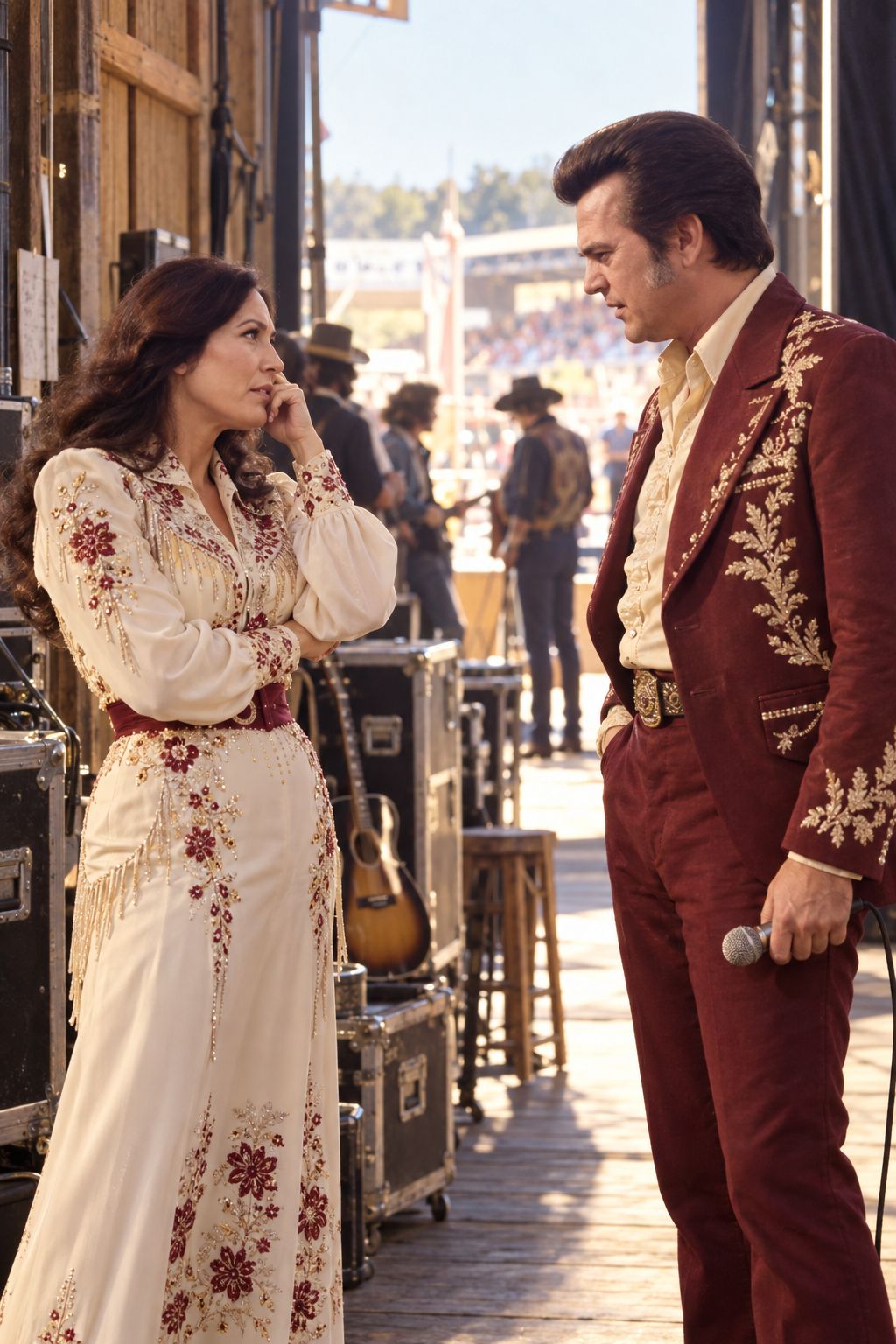
There are country duos that sound good together.
And then there are Conway Twitty and Loretta Lynn—two voices that seemed to understand exactly how much tension, tenderness, jealousy, humor, and heartbreak a three-minute song could contain.
For more than a decade, their recordings created an illusion so convincing that fans sometimes wondered whether the emotions in their songs were coming from real life. Their voices could sound like two people arguing behind a closed door, confessing secrets, or desperately trying not to fall in love.
But that raises a fascinating question:
What happened when the curtain came down?
Was the legendary chemistry between Conway Twitty and Loretta Lynn ever close to becoming a problem? Were there moments when the emotional intensity of their performances threatened the friendship behind them?
The surviving record tells a more complicated—and more human—story than the rumors suggest.
There is no reliable evidence that some secret scandal nearly destroyed their partnership. In fact, the strongest documented evidence points toward professional trust. But the mythology surrounding their duets grew so powerful that separating performance from reality became almost impossible.
And that may be the real story.
When Two Voices Became Too Convincing
The partnership officially took shape around 1970–71, when Conway Twitty and Loretta Lynn began recording together. Their first major duet, “After the Fire Is Gone,” became the beginning of an extraordinary run.
They followed it with songs including “Lead Me On,” “Louisiana Woman, Mississippi Man,” “As Soon as I Hang Up the Phone,” and “Feelins’.”
The numbers tell only part of the story.
The duo accumulated five consecutive No. 1 country singles between 1971 and 1975, while their partnership eventually produced numerous Top 10 hits and multiple major awards.
But audiences weren’t simply hearing two singers.
They were hearing characters.
A desperate husband.
A suspicious wife.
Two lovers.
Two people fighting temptation.
Two people saying things they perhaps should never say.
That emotional realism became their secret weapon.
The more believable the performance became, the more difficult it was for audiences to believe it was only a performance.
And that created the first layer of backstage tension—not necessarily between Conway and Loretta, but between their public image and their private reality.
The “Forbidden” Feeling Was Part of the Music
Some of their most famous songs deliberately lived in morally complicated territory.
“After the Fire Is Gone” dealt with the emotional emptiness of a relationship and the temptation to find comfort elsewhere.
“Lead Me On” leaned into romantic danger.
“Louisiana Woman, Mississippi Man” transformed a simple love story into a larger-than-life battle between geography, personality, and desire.
Then there was “As Soon as I Hang Up the Phone,” a dramatic recording built almost like a miniature stage play.
These weren’t innocent little love songs.
They were stories about adults making difficult choices.
That distinction matters because listeners sometimes assumed the intensity represented the singers’ own relationship.
Loretta herself pushed back against that interpretation.
In an interview preserved by PBS’s American Masters, Lynn directly addressed the long-running speculation surrounding her relationship with Twitty, saying that people assumed the two had “a thing” going on, while she described him as a friend and emphasized that her husband, Mooney, liked Conway.
That statement is important because it separates the emotional world of the records from the documented relationship between the performers.
The rumors may have been irresistible.
The evidence is different.
Behind the Studio Door
Imagine the atmosphere at Bradley’s Barn, where so much of Nashville’s classic sound was shaped.
There was no giant modern production machine.
No elaborate digital editing.
No social-media team explaining every interaction.
Instead, there were musicians, microphones, producers, songwriters, and two singers who had to make listeners believe every word.
That environment demanded concentration.
Conway was famously controlled in his public persona. The Country Music Hall of Fame notes that he was known for a minimalist performance style and, for years, avoided much of the conventional entertainment-industry chatter surrounding his career.
Loretta, meanwhile, had built her reputation around emotional directness.
Put those personalities together, and something remarkable happened.
Conway’s restraint created space for Loretta’s emotional fire.
Loretta’s emotional directness gave Conway something against which to play.
It was almost theatrical.
One pushed.
The other resisted.
One confessed.
The other answered.
One voice opened the door.
The other walked through it.
That contrast became the foundation of their sound.
Was There Really a Backstage War?
This is where the story needs to slow down.
Modern headlines often turn an intriguing partnership into a supposed secret feud. Claims about forbidden recordings, explosive arguments, hidden romances, or a partnership on the verge of collapse can make compelling social-media material.
But the documented career history tells us something else.
They kept recording together.
Not for one album.
Not for one hit.
For years.
Their discography includes a remarkable sequence of collaborative albums, from We Only Make Believe and Lead Me On through Louisiana Woman, Mississippi Man, Country Partners, Feelins’, United Talent, Dynamic Duo, Honky Tonk Heroes, Diamond Duet, and later releases.
That longevity doesn’t prove that every working relationship was effortless.
Artists can disagree.
Producers can change arrangements.
Schedules can clash.
Creative personalities can collide.
But there is an enormous difference between normal artistic tension and a documented backstage war that nearly destroyed a partnership.
The historical record strongly supports the former more than the latter.
The Real Pressure May Have Come From the Songs
Perhaps the greatest misconception about Conway Twitty and Loretta Lynn is that their chemistry needed a secret romance to explain it.
It didn’t.
They were professionals who understood storytelling.
And they understood something many performers never master:
You don’t have to experience a story personally to make an audience feel it personally.
Conway could sing a line as though he had been carrying its pain for twenty years.
Loretta could answer with a single phrase and make it sound like she had already decided whether to forgive him.
That’s acting.
That’s phrasing.
That’s trust.
And that’s musicianship.
The Country Music Hall of Fame recognizes the extraordinary impact of their collaboration, noting that Twitty and Lynn won a Grammy and four CMA awards for their classic duets.
Their success wasn’t built on scandal.
It was built on chemistry.
Yet the Rumors Tell Us Something Important
The rumors themselves are fascinating.
Why did so many people believe there was something more?
Because the records sounded intimate.
Because the lyrics were sometimes provocative.
Because Conway’s voice carried an unmistakable romantic authority.
Because Loretta could sound simultaneously vulnerable and defiant.
And because country music has always blurred the line between autobiography and storytelling.
The audience doesn’t just listen to a duet.
The audience creates a relationship between the singers in its imagination.
That imagined relationship can become stronger than reality.
Conway and Loretta didn’t need a forbidden romance to create forbidden chemistry. The songs already contained it.
That may be why their recordings still feel dangerous decades later.
The Moment That Could Have Broken Everything
Every legendary partnership eventually faces the same danger:
repetition.
Once a formula works, the industry wants more.
More albums.
More singles.
More appearances.
More tours.
More versions of the same chemistry.
But somehow, Conway and Loretta continued finding different emotional shapes inside the duet format.
Their 1977 album Dynamic Duo, for example, still reached No. 3 on the U.S. country album chart, while its single “I Can’t Love You Enough” reached No. 2 in the United States and No. 1 in Canada.
That is significant.
The partnership wasn’t merely surviving on nostalgia.
It was still commercially viable.
And by 1979, Diamond Duet celebrated another major chapter in their recording history.
If backstage tensions existed—and almost certainly, like any long professional relationship, there were moments of disagreement—the larger story is that they continued to work through them.
The Friendship Behind the Fantasy
Perhaps the most touching element of their story is that the supposed “forbidden” relationship was never necessary.
Loretta’s own recollection, preserved by PBS, emphasized friendship rather than secret romance.
That changes the entire interpretation of their music.
The tenderness wasn’t necessarily evidence of hidden desire.
It was evidence of trust.
Two performers could enter a fictional relationship for three minutes, give it everything they had, and then step back into their real lives when the microphone went silent.
That’s not less romantic.
In some ways, it’s more impressive.
Because they had to create emotional truth without allowing the fiction to destroy the friendship.
The Legacy That Refused to Die
When Conway Twitty died in 1993, one of country music’s most distinctive voices was gone.
But the partnership with Loretta Lynn continued to live through recordings, performances, documentaries, radio, and generations of listeners.
Even decades later, performers have returned to their repertoire. The official Loretta Lynn site notes that the modern duo Twitty & Lynn has performed songs such as “Louisiana Woman, Mississippi Man” and “After the Fire Is Gone,” demonstrating how enduring the original material remains.
That’s the ultimate answer to the mystery.
Not a secret scandal.
Not a confirmed forbidden romance.
Not a documented feud that nearly destroyed them.
Something far more interesting happened.
They became so convincing together that millions of people couldn’t believe the relationship was fictional.
And perhaps that is the highest compliment two country singers can receive.
The Truth Behind the “Forbidden Duets”
The mythology surrounding Conway Twitty and Loretta Lynn will probably never disappear.
Fans will continue examining old photographs.
They’ll replay the duets.
They’ll listen for pauses between lines.
They’ll wonder whether a certain glance meant something more.
That’s part of the magic.
But the historical record gives us a powerful alternative interpretation.
Their greatest secret wasn’t a hidden romance.
It was professional trust.
They trusted each other enough to sing songs about betrayal without betraying the friendship behind them.
They trusted each other enough to make fictional passion sound real.
And they trusted the audience to enter that world for three minutes at a time.
The real forbidden duet wasn’t about two people secretly falling in love. It was about two artists becoming so emotionally convincing that the entire country briefly believed they had.
That is why Conway Twitty and Loretta Lynn remain unforgettable.
The microphones stopped.
The records ended.
The stage lights eventually went dark.
But that strange, beautiful tension between their voices never really disappeared.
And perhaps it never will.
VIDEO: