 By admin
INTRODUCTION:
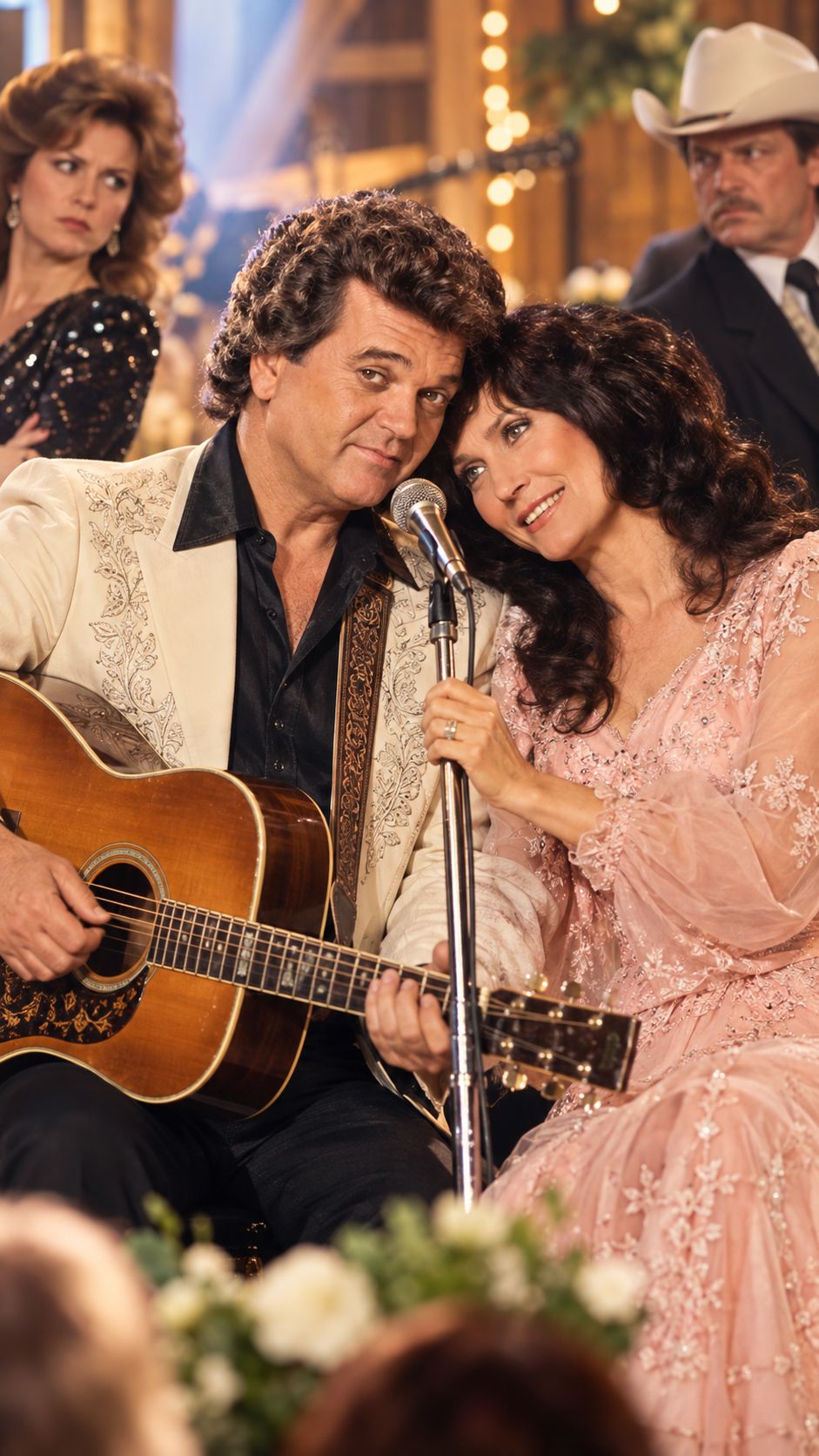
There are country-music partnerships that sound good together.
And then there are partnerships that sound too real.
When Conway Twitty and Loretta Lynn stepped onto a stage together, audiences weren’t simply hearing two singers trade verses. They were hearing a man and woman seemingly caught in the middle of a complicated relationship—arguing, teasing, longing, resisting, forgiving, and sometimes sounding as though they had secrets that nobody else was allowed to know.
That was the magic.
It was also the source of decades of speculation.
Fans repeatedly wondered whether the emotional intensity between Conway Twitty and Loretta Lynn was more than professional. Their songs were filled with forbidden love, temptation, marriage problems, regret, and desire. Their voices seemed to answer one another almost instinctively.
Yet the fascinating truth is that the available firsthand evidence points in a very different direction.
Loretta herself repeatedly denied that she and Conway were lovers. In an interview preserved by PBS, she said that people believed they “had a thing going,” but insisted that was “the farthest from the truth.” She described Conway as a friend and emphasized that her husband, Oliver “Doolittle” Lynn, loved him.
So why did their partnership feel so dangerous?
The answer may be even more interesting than an affair.
The Chemistry Was Real—But It Was Musical
The story began with mutual admiration.
Conway had been a fan of Loretta. Loretta had been a fan of Conway since before she became a country superstar. According to a Billboard-era account preserved by World Radio History, the two first became acquainted while touring Europe, where Loretta’s husband, Mooney, was also present. They eventually recorded together in 1969.
What followed became one of country music’s defining partnerships.
Their first major hit, “After the Fire Is Gone,” arrived in 1971. More hits followed, including “Lead Me On,” “Louisiana Woman, Mississippi Man,” and “Feelins’.” The Country Music Hall of Fame notes that the pair won CMA Vocal Duo of the Year four consecutive times from 1972 through 1975.
Between 1971 and 1988, they released 11 studio albums together and charted 12 singles, five of which reached No. 1 on the Billboard country chart.
That wasn’t merely commercial success.
It was emotional theater.
They didn’t just sing the story. They made listeners feel as if they were standing inside it.
That distinction explains almost everything.
Why Fans Thought Something Else Was Happening
Listen to the subjects of their biggest songs.
“After the Fire Is Gone” tells the story of two people drawn together after the passion has disappeared from their marriages.
“Lead Me On” explores temptation and emotional conflict.
“Louisiana Woman, Mississippi Man” celebrates lovers determined to overcome distance.
These weren’t harmless love songs.
They were dramatic stories about people crossing emotional boundaries.
And Conway and Loretta performed them with such convincing intimacy that audiences sometimes forgot the fundamental rule of country music: a singer can portray a character without becoming that character.
PBS’s American Masters specifically notes that the ease of their chemistry and the subject matter of their songs made the nature of their relationship a puzzle to audiences.
Another American Masters segment explains that the connection between their voices created an energy that simply wasn’t present when either artist sang alone.
That energy was real.
The romance wasn’t.
At least according to the two people who actually lived it.
And Then There Were Their Spouses
This is where the story becomes especially fascinating.
The phrase “their spouses were terrified” makes for a powerful headline, but the documented story is more complicated.
There is little reliable evidence that Doolittle Lynn or Conway’s wives were literally terrified that the two singers would have an affair.
In fact, the surviving accounts often suggest the opposite.
Loretta famously said that Doolittle loved Conway. She recalled that Conway was essentially the only artist in the music business that her husband truly cared about.
Conway himself also spoke warmly about Doolittle.
A Billboard profile quoted Conway describing Mooney as a wonderful man and saying that he loved him. The same account describes Conway and Loretta as “really good friends and business partners.”
That detail changes the entire story.
Imagine how unusual it must have been.
Two married country stars walk onto a stage and sing songs about forbidden romance.
The audience sees sparks.
The lyrics suggest temptation.
The performances feel intimate.
Yet behind the scenes, the people closest to them understood that the relationship was fundamentally built on friendship, trust, and music.
That contradiction is what made the partnership so compelling.
Conway Knew Exactly How to Create Mystery
Conway Twitty understood the power of restraint.
His stage persona was famously controlled. His official biography describes him as an entertainer who favored understatement and mystery rather than excessive stage banter.
Put that personality next to Loretta’s more outspoken, playful presence, and something extraordinary happened.
She could tease him.
He could react.
She could challenge him.
He could answer with that unmistakable voice.
Suddenly, a song about two fictional lovers sounded like an actual conversation between two people with years of history.
And because Conway rarely explained everything, the audience filled in the blanks.
That was dangerous—not necessarily to their marriages, but to the boundary between performance and reality.
Loretta Was Part of the Illusion Too
Loretta wasn’t simply standing beside Conway and singing harmony.
She knew exactly how powerful their chemistry was.
The Billboard account recalls an amusing incident in which fans repeatedly asked whether she and Conway were married. One admirer even told them they made the perfect couple.
Those moments reveal something important about their public image.
They didn’t need to manufacture a scandal.
The songs did it for them.
Their chemistry was so convincing that listeners created the scandal themselves.
The audience saw romance because the music gave them every reason to imagine it.
But Loretta continued to draw the line.
Years later, she remained clear that she and Conway were friends, not lovers. In a 2016 interview, she called Conway a good man and again spoke warmly about his relationship with her husband.
The Saddest Proof Came After Doolittle’s Death
Perhaps one of the strongest pieces of evidence about the depth of their friendship came during an incredibly painful moment.
Loretta later recalled that when Doolittle was seriously ill, Conway came to the hospital to see him. Doolittle died that night.
Loretta remembered Conway’s visit and the bond between the two men in an interview with Dan Rather.
That is difficult to reconcile with the idea of a secret romantic rivalry.
Doolittle didn’t appear to view Conway as a threat.
He viewed him as a friend.
And that may be the most revealing part of the entire story.
The “Danger” Was in the Songs
The real danger was artistic.
Conway and Loretta possessed something performers spend entire careers trying to find: absolute believability.
When they sang about forbidden love, the listener believed them.
When they sang about heartbreak, the listener believed them.
When they argued through a lyric, the listener felt like an invisible witness.
And when they looked at each other onstage, the audience couldn’t help but wonder what existed beyond the microphones.
But the available firsthand accounts tell us that the emotional electricity was largely the product of extraordinary musical chemistry.
That doesn’t make it less fascinating.
It makes it more fascinating.
Because they managed to create the illusion of forbidden love without apparently needing to live it.
A Partnership That Still Confuses Listeners
Decades later, the songs continue to create the same reaction.
Put on “After the Fire Is Gone.”
Listen to Conway’s low, controlled voice.
Then hear Loretta answer.
The tension rises.
The story unfolds.
And for a few minutes, it becomes incredibly easy to forget that you’re listening to two legendary performers interpreting a song.
That’s the legacy of their partnership.
Not a confirmed secret affair.
Not a hidden romance.
Not evidence that their spouses were secretly fighting over them.
But something much harder to achieve:
two artists who could make millions of people believe a fictional love story was real.
Their chemistry wasn’t dangerous because they crossed the line. It was dangerous because they could make everyone believe they might.
And perhaps that’s why Conway Twitty and Loretta Lynn remain one of country music’s most endlessly fascinating duos.
They didn’t need a forbidden romance to create a legendary story.
They only needed two voices, two personalities, extraordinary trust—and songs powerful enough to blur the line between acting and feeling.
That may be the most heartbreaking truth of all: the romance audiences spent decades searching for may never have existed outside the music.
But inside the music?
It was absolutely unforgettable.
VIDEO: