 By admin
INTRODUCTION:
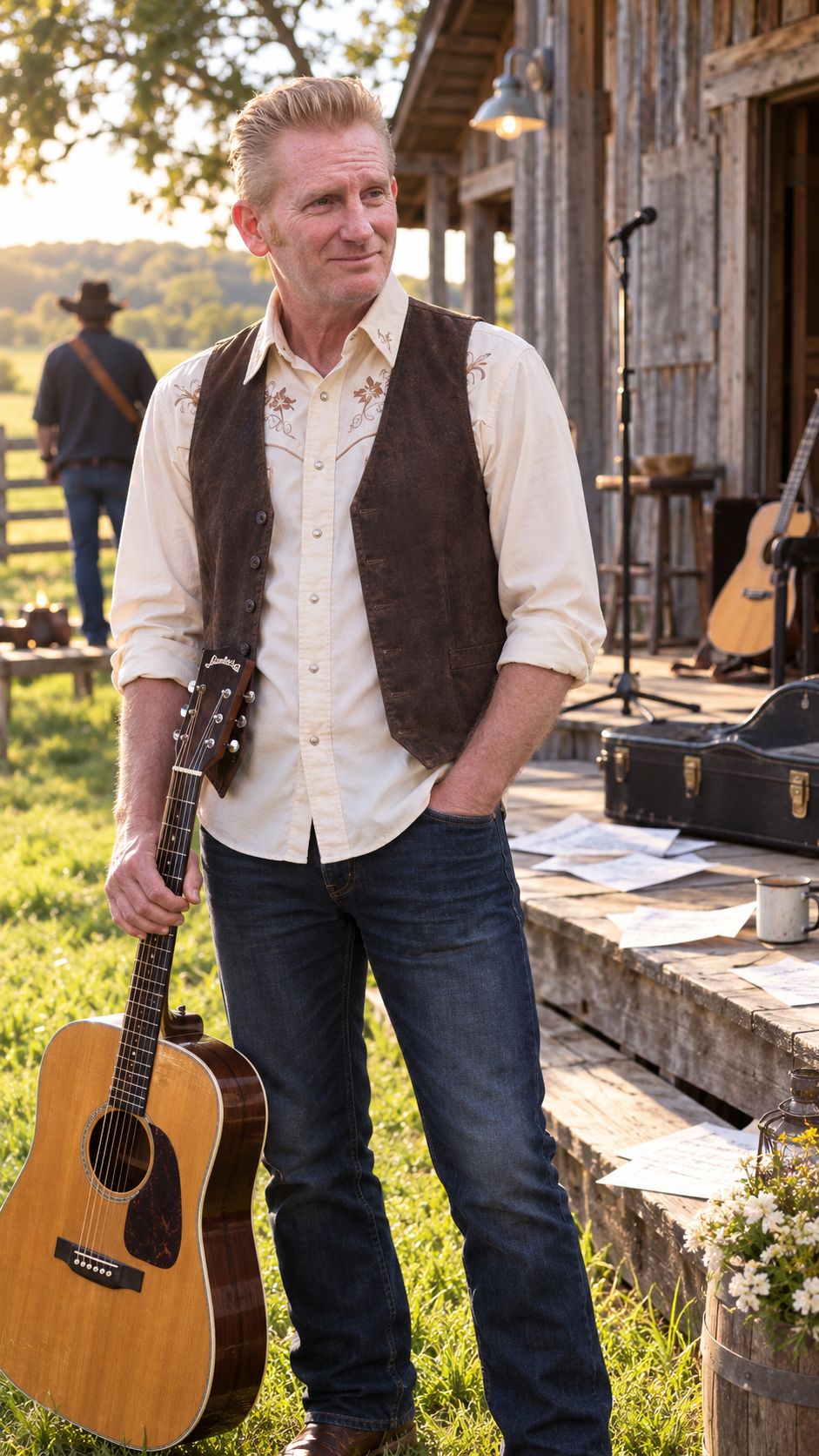
For years, Joey + Rory were presented as one of country music’s most comforting love stories.
They looked almost too perfect for Nashville: a husband and wife singing about faith, family, heartbreak, small-town life, and the simple pleasures of home. Joey Feek had the warm, unmistakable voice. Rory Feek was the songwriter, producer, storyteller, and steady presence beside her.
To millions of fans, their career seemed almost effortless.
But behind the photographs, television appearances, award ceremonies, and smiling interviews was a very different story—one involving rejected ideas, industry expectations, career compromises, exhausting schedules, and a struggle to protect their marriage from a music business that did not always understand what made them different.
The tensions were not necessarily between Joey and Rory.
In many ways, the greatest tension was between Joey + Rory and the Nashville system itself.
And once you understand that, their career looks very different.
Before There Was Joey + Rory, There Was Joey Martin
Long before the world knew her as Joey Feek, she was Joey Martin—a young singer hoping to establish herself in Nashville.
She secured a deal connected to Sony and recorded an album that was ultimately shelved. According to later accounts, the project was caught in label changes and disagreements over the direction of her career.
That forgotten chapter is crucial.
Because the conventional story of Joey + Rory often begins with two people falling in love and eventually becoming a country duo.
The deeper story begins earlier—with Joey discovering that talent alone did not guarantee artistic control.
In a later interview, Joey described a particularly painful conflict surrounding her marriage to Rory. She said people involved with her career questioned whether being married would hurt her commercial appeal and objected to her wanting Rory involved in her touring life.
Rory later recalled the situation even more bluntly, describing pressure surrounding how Joey should present herself, what music she should make, and even who should accompany her professionally.
That was not simply a disagreement about a record.
It was a disagreement about what kind of woman a country star was supposed to be.
“I only get one marriage in this lifetime.”
That sentiment became one of the defining principles behind Joey’s eventual career.
She chose the marriage.
And ironically, that decision helped lead her toward the career that ultimately made her beloved.
The Record That Disappeared
One of the most fascinating details in the Joey Feek story is that the album recorded during her early solo career essentially disappeared from public view.
The album, recorded years before Joey + Rory, was prepared for release but was shelved amid changes at Sony. Rory later described the unreleased material as having sat for years before finally receiving renewed attention.
Think about what that means.
A young singer works toward her first major-label opportunity.
She records the songs.
She prepares for the next step.
Then the machinery changes.
And suddenly the future she imagined is gone.
It is easy to look backward and see the outcome as inevitable. It was anything but.
Joey could have walked away from music.
Instead, she eventually found another path.
Then Came Rory—and an Unlikely Partnership
Rory already had a career of his own as a songwriter and producer when he met Joey.
He had moved to Nashville in 1995 and established himself as a songwriter, eventually working with artists and projects through his own Giantslayer Records.
Joey and Rory met at the Bluebird Café.
The relationship that followed eventually changed both of their careers.
But even then, becoming a duo was not some grand master plan.
When they were encouraged to audition for CMT’s Can You Duet, Rory reportedly had doubts about whether the pairing could actually become a viable career.
Yet they won.
And suddenly the couple who had not been designed by Nashville’s traditional machinery had become impossible to ignore.
Their first album, The Life of a Song, became a surprise success in 2008, and their growing popularity helped establish them as a distinctive husband-and-wife act.
But success brought another problem.
They were now expected to keep doing everything.
When “Success” Started Becoming Exhaustion
By 2012, Joey openly acknowledged that the first years had been relentless.
They had accepted almost every opportunity—radio tours, festivals, fairs, concerts and appearances—because they wanted to discover what worked and prove they were serious about their career. Eventually, however, they realized that not every opportunity was worth the cost.
That is an important detail that often disappears beneath the feel-good narrative.
The dream was real.
But so was the exhaustion.
They had music.
They had television.
They had touring.
They had songwriting.
They had family responsibilities.
They also had their own business interests and life on their Tennessee farm.
Rory explained in 2012 that juggling their television program, writing, filming, editing, touring, recording and ordinary family life had made time management one of his biggest struggles.
Behind the cheerful television image was an enormous workload.
And the more successful they became, the more complicated it became to protect the life that had made them successful in the first place.
The Television Gamble That Changed Everything
Here is where Rory’s business instincts became particularly important.
Traditional country radio was not necessarily built to reward an act like Joey + Rory.
Their music was rooted in traditional country, storytelling, faith, family and an older-fashioned aesthetic. Their songs did not always fit the dominant commercial formula.
Rory recognized that television could give them something radio could not: direct access to an audience.
In a 2012 interview, he explained that the couple’s television strategy allowed them to create their own exposure rather than depending entirely on traditional radio gatekeepers.
That decision was brilliant in one sense.
But it also revealed the underlying conflict.
They were building a career partly because they did not completely fit the industry’s preferred model.
Their song “Play the Song” captured that frustration. Rory described the song as being aimed largely at the recording industry and its tendency to favor whatever formula appeared successful at the moment.
The message was unmistakable:
Don’t tell us what country music is supposed to sound like.
The Tension Was Never Simply “Joey vs. Rory”
This is where the story needs to be handled carefully.
There is plenty of material showing that Joey and Rory faced professional pressures. There is much less evidence supporting the idea that their marriage itself was secretly falling apart during their successful years.
In fact, contemporary accounts frequently described the opposite.
In a 2009 Associated Press interview, Rory said they were close friends, shared a passion for country music, and enjoyed working together.
Their disagreements were often about career philosophy, not whether they loved one another.
That distinction matters.
The tension came from questions such as:
- How much should they tour?
- How much should they prioritize radio?
- How much control should labels have?
- How should Joey’s identity as a wife affect her career?
- How could they remain authentic while becoming commercially successful?
- How much of their private life should become part of their public image?
Those are difficult questions for any artist.
For a married couple, they become even more complicated.
And Then Everything Changed
By 2014, the couple’s professional challenges were suddenly dwarfed by something far more serious.
After the birth of their daughter, Indiana, Joey was diagnosed with cervical cancer. She underwent treatment and surgery, and the disease eventually returned.
Their final major musical chapter became Hymns That Are Important to Us.
The album was not simply another project.
Joey continued recording despite her illness, with vocals recorded wherever she was physically able—including hotel rooms and their home.
And then came the cruelest irony.
The couple who had spent years fighting to make music on their own terms finally achieved one of their greatest commercial milestones just as Joey’s life was nearing its end.
The album debuted at No. 1 on the country chart.
Joey died in March 2016 at age 40.
Suddenly, every earlier struggle looked different.
The rejected album.
The label conflicts.
The exhausting tours.
The decision to build their own audience.
The television experiment.
The insistence on authenticity.
None of it felt like a conventional country success story anymore.
It felt like a couple who had spent years trying to build a career around the life they actually wanted to live.
The Most Powerful Part Was What They Refused to Sacrifice
There is a temptation to turn the Joey + Rory story into a scandal.
To search for secret fights.
To claim that every disagreement concealed some enormous betrayal.
But the documented history points somewhere more complicated—and more human.
Their career contained real tensions.
Yet those tensions were often about control, authenticity, commercial expectations, time, and the cost of success rather than a hidden war between husband and wife.
Rory later said that he had always believed an artist should be able to succeed without sacrificing integrity or becoming something they were not.
That philosophy explains almost everything about their journey.
They didn’t simply want to become famous.
They wanted to become successful without losing the reason they started singing in the first place.
And perhaps that is why their story continues to resonate.
They weren’t trying to build the biggest country-music machine. They were trying to build a life where the music still belonged to them.
That distinction became their identity.
What the “Hidden Tensions” Really Reveal
The most revealing part of the Joey + Rory story is not a secret feud.
It is the pressure placed on artists when their personal lives, creative identities and commercial expectations collide.
Joey experienced the frustration of having her early solo career interrupted by circumstances beyond her control. Rory saw firsthand how the business could attempt to reshape an artist. Together, they created a different route—one built around television, independent thinking, traditional country values and a deliberately personal connection with their audience.
And they paid a price for that independence.
They worked constantly.
They had to make difficult decisions.
They turned down or reconsidered opportunities.
They had to learn how to say no.
And eventually, they faced a tragedy no career strategy could solve.
Joey’s death transformed their music from a living partnership into a legacy.
Rory later described struggling to perform without her, saying he did not want to be onstage without Joey.
That may be the final answer to the question of what held Joey + Rory together.
Not the television show.
Not the awards.
Not the record sales.
Not the carefully photographed image.
It was the relationship underneath all of it.
Their career was never as simple as the photographs suggested.
But perhaps it was also never as cynical as some modern retellings suggest.
The real story sits somewhere in between: two artists trying to protect love, family and authenticity while navigating an industry that constantly demanded something more from them.
And that may be why, years later, the music still feels so personal.
Because beneath every harmony was a negotiation.
Beneath every smile was a choice.
And behind the story that looked effortless was a couple who had fought—quietly, persistently, and sometimes painfully—to make sure that the career never became more important than the life.
VIDEO: