 By admin
INTRODUCTION:
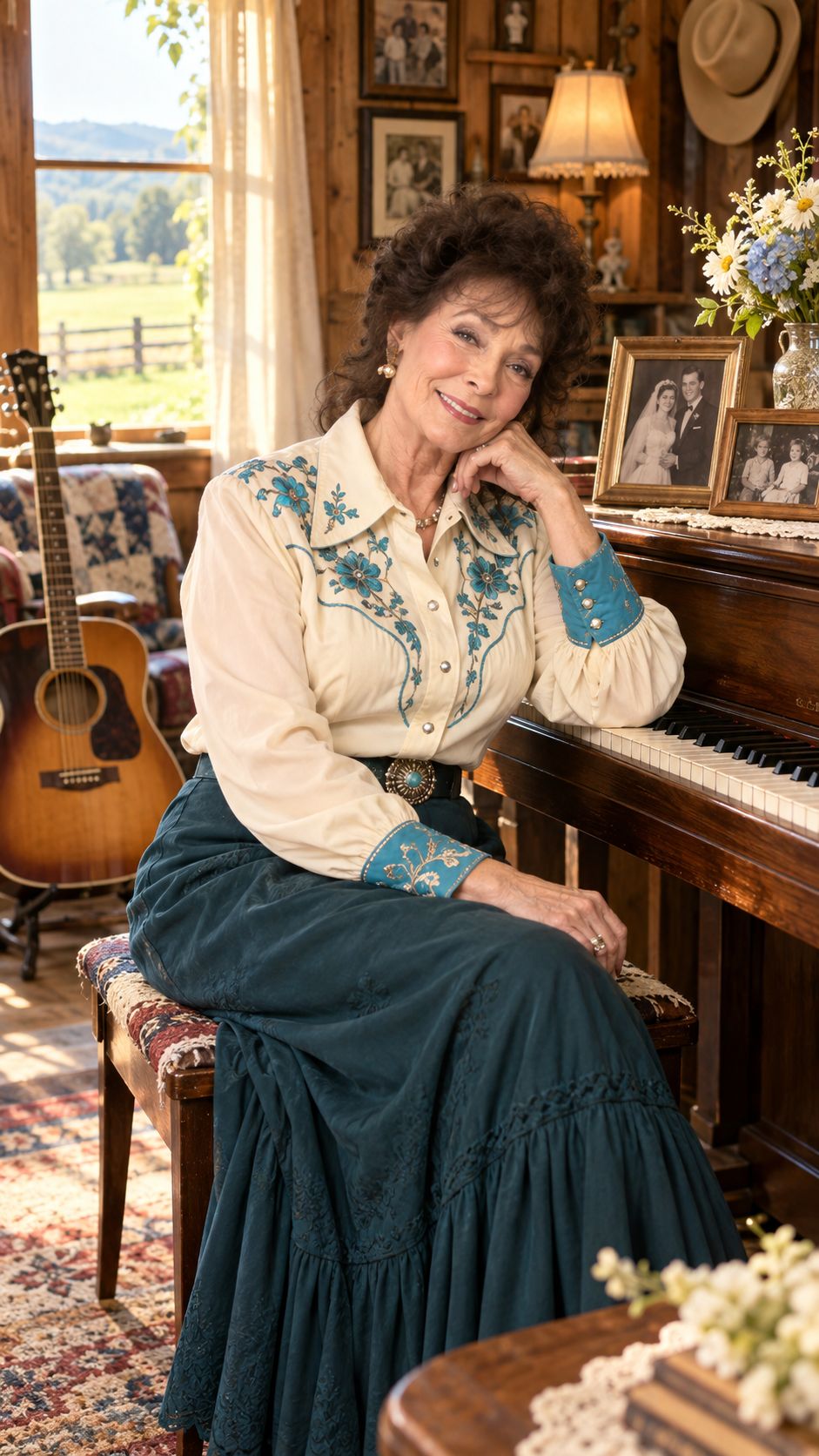
For decades, country music has romanticized the idea of the “country couple”—two people surviving poverty, fame, family tragedy, and changing times with their love still intact. But Loretta Lynn and Oliver “Mooney” Lynn were never a simple love story.
Their marriage lasted nearly half a century, from 1948 until Mooney’s death in 1996. It produced six children, countless arguments, moments of tenderness, devastating betrayals, and—most importantly for country music—some of Loretta Lynn’s most unforgettable songs.
It was a relationship filled with contradictions.
He encouraged the young woman he called Loretta to sing in public. He bought her first guitar. He helped push her toward a career that eventually made her one of the defining voices in country music.
And yet, according to Loretta Lynn’s own accounts, he was also repeatedly unfaithful, drank heavily, and their marriage could become deeply volatile.
That contradiction is exactly what makes their story so difficult—and so fascinating.
“It wasn’t a fairy tale. It was real life: complicated, painful, passionate, and impossible to reduce to one sentence.”
A Marriage That Began Before Fame
In January 1948, Loretta Webb married Oliver Vanetta “Mooney” Lynn shortly before her sixteenth birthday. Later accounts have sometimes listed her as younger, but state records confirmed that she was 15 at the time.
She was a teenager from rural Kentucky. He was six years older and had returned from military service.
Within a short time, their lives changed dramatically.
The couple moved to Washington State, where Mooney sought work. Loretta became a young wife and mother, eventually raising six children while trying to understand a world far removed from the Kentucky community where she had grown up.
The early years were not easy.
PBS’s biography of Loretta Lynn notes that Mooney temporarily left her when she became pregnant with their first child. They eventually reconciled and continued their life together.
That pattern—conflict, separation, reconciliation, and continuing forward—would become part of their story.
The Man Behind the Guitar
Perhaps the most surprising part of their relationship is that the same man who caused Loretta enormous emotional pain also helped set her musical career in motion.
Mooney bought Loretta a $17 guitar in 1953. Later, he encouraged her to perform publicly, even approaching a local bandleader and boasting about his wife’s singing ability.
Loretta was initially reluctant.
She was a mother. She was inexperienced. She had no obvious reason to believe that a woman from her background could become a national recording star.
But Mooney pushed her toward the stage.
Eventually, she began performing, recorded “I’m a Honky-Tonk Girl,” and started the journey that would take her from Washington dance halls to the Grand Ole Opry and the highest levels of country music.
Years later, Loretta herself acknowledged the importance of that early encouragement.
“If it wasn’t for Doolittle, there would be no career.”
That statement reveals something important about their marriage.
Loretta did not see Mooney as simply a villain or simply a hero.
He could be both the person who hurt her and the person who helped open the door to her future.
The Infidelity Wasn’t a Rumor—It Was Part of Her Story
The subject of Mooney’s infidelity has often been sensationalized, but the foundation for it comes directly from Loretta Lynn’s own recollections.
In her autobiography Still Woman Enough, and in interviews surrounding its publication, she described a husband who was repeatedly unfaithful. She also recalled the emotional and physical volatility of their relationship. CBS reported in 2002 that Lynn described Mooney as an alcoholic who beat her, spent her money, and repeatedly cheated.
Those details are painful precisely because Loretta did not present the marriage as a perfect romance.
She presented it as survival.
In one of the most revealing descriptions of their relationship, Loretta explained why she stayed:
“I put up with it because of six kids. And I loved him and he loved me.”
That sentence has endured because it refuses to make the story simple.
Love did not erase betrayal.
Family did not erase pain.
And staying did not mean that everything was acceptable.
It meant that, in Loretta’s telling, love and hardship existed at the same time.
Then She Turned the Pain Into Songs
This is where the marriage becomes inseparable from Loretta Lynn’s music.
Her greatest achievement was not simply surviving difficult experiences. It was transforming them into songs that millions of women recognized as their own stories.
“Don’t Come Home a-Drinkin’ (With Lovin’ on Your Mind)” confronted drinking and marital betrayal.
“Fist City” delivered a warning to another woman who threatened her marriage.
“Wine, Women and Song” tackled a cheating man’s behavior head-on.
And “You Ain’t Woman Enough” transformed jealousy and romantic competition into a declaration of confidence.
These songs were not abstract exercises.
They came from the world Loretta knew.
She once explained that Mooney never knew exactly which lines were about him.
“Half of it was about him.”
That may be the most extraordinary aspect of their marriage.
Every argument potentially became a song.
Every betrayal could become a verse.
Every heartbreak could become another record.
Instead of hiding the messiness of marriage, Loretta made it part of her artistic identity.
The Woman Behind “Fist City”
Today, it can be tempting to hear songs such as “Fist City” as simply entertaining examples of old-school country attitude.
But their emotional power came from somewhere deeper.
Loretta Lynn understood that many women listening to country radio had experienced versions of the same problems: husbands who drank too much, marriages strained by money, infidelity, loneliness, jealousy, and the pressure of raising children.
She gave those women language.
She did not sing as though marriage was always beautiful.
She sang about marriage when it was ugly.
She sang about anger.
She sang about forgiveness.
She sang about wanting a husband to come home.
And sometimes she sang about wanting another woman to stay away.
That honesty helped establish her as one of country music’s most important voices on women’s experiences.
But There Was More Than Pain
It would also be inaccurate to portray the entire 48-year relationship as nothing but misery.
Mooney helped Loretta begin her career. He traveled with her at various points. The couple built a family and eventually established the Loretta Lynn Ranch in Tennessee.
Their relationship survived enormous changes.
They went from young newlyweds with little money to a famous country-music family.
They experienced the pressures of touring and fame.
They endured the death of their son Jack Benny in 1984.
They faced serious health problems later in Mooney’s life.
And after decades together, their marriage ended not through divorce, but through death.
Mooney died in 1996 after years of health problems, including heart disease and diabetes.
Loretta was left with something almost impossible to describe: grief for a person who had been both a source of pain and one of the central figures in her entire life.
The Final Chapter Was Surprisingly Tender
As Mooney’s health deteriorated, Loretta reportedly put aspects of her career on hold to care for him.
Biography.com reports that after heart surgery in 1992, his health complications eventually included diabetes and the amputation of both legs. Loretta remained involved in his care until his death in 1996.
That final chapter adds another layer to the story.
After decades of arguments, infidelity, and heartbreak, she was still there.
Not because the past disappeared.
Not because every wound had magically healed.
But because their lives had become deeply intertwined.
Her relationship with Mooney had shaped her adulthood, her family, her career, and her music.
Why Their Story Still Matters
The biggest mistake would be to turn Loretta Lynn’s marriage into either a romantic fairy tale or a simple tragedy.
It was neither.
It was a complicated human relationship that lasted almost 50 years.
Loretta herself called it one of the hardest love stories, and that description may be more revealing than any dramatic headline.
Their marriage contained devotion and betrayal.
Encouragement and conflict.
Family and loneliness.
Music and pain.
And somehow, all of those contradictions became part of Loretta’s artistic legacy.
The heartbreak didn’t destroy her voice. She turned the heartbreak into the voice millions of women heard.
That is perhaps the rawest truth behind the legend.
Loretta Lynn did not become a country icon because her life was perfect.
She became one because she was willing to sing about the parts of life that other people were afraid to admit existed.
Her 48-year marriage to Mooney gave her some of her deepest wounds—but it also gave her stories, perspective, and emotional material that helped redefine what a woman could say in country music.
And when the final years came, after all the fighting and all the forgiveness, she remained connected to the man she had married as a teenager.
That doesn’t make their relationship a blueprint for love.
It makes it a portrait of complicated human history.
And perhaps that is why, decades later, people still listen when Loretta Lynn sings about love, betrayal, marriage, and heartbreak.
Because she never pretended those things were separate.
For her, they were all part of the same story.
The story of a woman who lived through the storm—and then turned the storm into music.
VIDEO: