 By admin
INTRODUCTION:
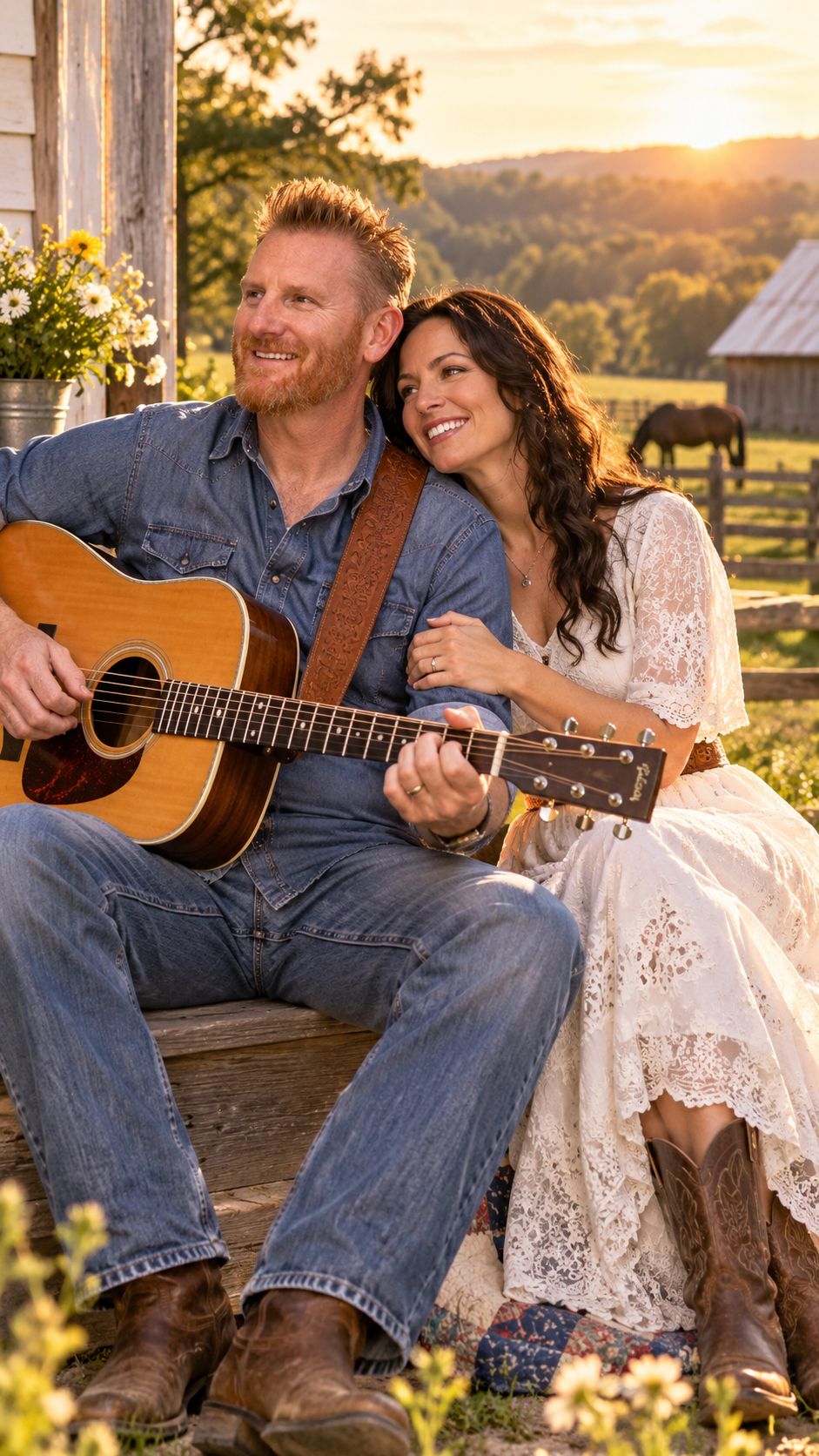
There are love stories that belong to movie screens.
And then there are love stories that unfold quietly—in old farmhouses, around kitchen tables, inside weathered barns, between unfinished songs and whispered prayers.
The story of Rory Feek and Joey Feek belongs to the second kind.
To millions of country music fans, they were Joey + Rory, the husband-and-wife duo whose voices seemed to carry something increasingly rare in modern country music: intimacy. Their harmonies sounded less like two performers trying to impress an audience and more like two people who had spent years learning how the other breathed.
But behind the records, television appearances, awards and concert stages was another story.
It was the story of a Tennessee farm.
It was the story of a marriage.
And ultimately, it became the story of how one man tried to keep loving someone even after he could no longer hear her footsteps in the house.
Before the Music, There Was a Life
The remarkable thing about Rory Feek and Joey Feek is that music was never the entire foundation of their relationship.
They met in Nashville, where Rory was already establishing himself as a songwriter and Joey was pursuing her own dreams as a singer. Their paths crossed at a songwriter’s night at the Bluebird Café, and Joey later described being immediately drawn to Rory.
They married in 2002.
Their musical partnership came later.
That distinction matters.
When audiences eventually saw Joey + Rory on television and heard their records, it was easy to assume that the music had created the romance. In reality, the romance came first, and the music eventually became one of its languages.
The couple lived together on Rory’s farm in Pottsville, Tennessee, creating a life that often seemed deliberately removed from the machinery of Nashville.
As Rory later explained, they genuinely enjoyed being home. The farm wasn’t simply a backdrop for their public image. It was where they cooked, worked, raised a family, welcomed friends and eventually performed for audiences.
Their barn even became a concert venue.
That transformation captured something essential about their philosophy: they didn’t necessarily want to abandon country music’s traditional world of front porches, barns and rural communities in order to become famous.
They brought the music home.
When Two Names Became One Musical Identity
In 2008, a friend encouraged the couple to audition for CMT’s Can You Duet?
Rory had reservations. He was an established songwriter and was not naturally drawn toward becoming a performer in the conventional sense. Joey, however, had a voice that demanded to be heard.
They auditioned.
They finished third.
And somehow, the result mattered less than what happened next.
The couple became Joey + Rory.
Their debut album, The Life of a Song, arrived in 2008, and their music quickly developed a following among listeners who appreciated its rootsy, traditional character. Their career continued with albums, television and touring, and in 2010 they received the ACM Award for Top New Vocal Duo.
But the most revealing part of their story may not have happened on an awards stage.
It happened at home.
As the Country Music Hall of Fame and Museum has documented, Rory eventually moved from writing primarily for other artists toward writing and performing music specifically connected to his life with Joey.
That distinction transformed the meaning of his songwriting.
He wasn’t simply writing songs anymore.
He was documenting a marriage.
“The songs became another way of telling the story of who we were.”
That is why so much of their music feels unusually personal.
The songs weren’t detached observations.
They sounded lived-in.
The Farm Became Part of the Love Story
For Joey + Rory, Tennessee wasn’t merely where they happened to live.
It became part of their identity.
Their television program, The Joey + Rory Show, gave audiences an intimate look at their rural lifestyle, with much of the show filmed on their farm. The couple cooked, talked, performed and shared pieces of everyday life with viewers.
According to contemporary accounts, the farm’s barn was transformed into a performance space, allowing the couple to bring music directly into the world they loved.
That image remains powerful because it contradicts the traditional idea of celebrity.
They didn’t need every moment to happen under bright stage lights.
Sometimes the stage was a barn.
Sometimes the audience was standing across a parking lot.
Sometimes the most important performance was simply being together at home.
And that simplicity became part of their appeal.
“We just like our life a lot.”
Rory said words to that effect when discussing their desire to remain connected to home rather than allowing the music business to define everything about them.
For fans, it became increasingly difficult to separate the songs from the life that inspired them.
Then Their Story Changed Forever
In 2014, Rory and Joey were preparing for the birth of their daughter, Indiana.
They stepped away from some of their regular professional activity because they wanted to focus on their growing family.
But the story they imagined would not be the story they received.
Their daughter was born with Down syndrome.
Then Joey was diagnosed with cervical cancer.
The family’s life became a battle against circumstances they could not control.
Rory later wrote that his original blog had been created to document the family’s journey, but the writing gradually became something deeper. It became a way to understand what was happening.
His own description of those years is among the most revealing pieces of evidence about the emotional world behind the public story. He recalled writing some posts through laughter and others while tears fell onto the keyboard.
That detail explains why Rory’s later work feels so different from ordinary celebrity memoir.
He wasn’t simply preserving memories.
He was trying to understand them.
When the Songs Became Prayers
Joey’s final years changed the emotional meaning of everything the couple had recorded.
Their album Hymns That Are Important to Us was released in 2016, during Joey’s illness, and it ultimately reached No. 1 on the country album chart and later won the Grammy for Best Roots Gospel Album.
The songs became inseparable from the reality surrounding them.
There was no longer a comfortable distance between performance and life.
The hymns were being sung by a woman confronting mortality.
And beside her was a husband trying to absorb the possibility of losing the person who had become his creative partner, closest companion and family.
Joey died in March 2016 at age 40.
Rory was left to continue a life that had been built around the word “we.”
Suddenly, there was only “I.”
And that may have been the most painful song of all.
What Happens When the Other Voice Goes Silent?
After Joey’s death, Rory’s relationship with music changed.
He wrote.
He remembered.
He documented.
He created To Joey, With Love, a documentary built around their relationship and final years.
CBS News reported that Rory described making the film as an experience that allowed him to see Joey every day through the footage they had captured together.
That idea is devastatingly beautiful.
He couldn’t bring her back.
But he could still see her.
He could still hear her.
He could still preserve the moments that existed before illness became the center of their story.
And perhaps most importantly, he could continue telling the story they had started together.
He Kept Writing Her Into the Future
One of the most heartbreaking details came when Rory was asked to sign something after Joey’s death.
For years, the signature had been Joey + Rory.
Now, suddenly, he was expected to sign his own name.
Rory later described being overwhelmed by what that meant. Instead of simply signing his name, he continued signing with both names for a period of time, adding words that acknowledged their shared love.
It was a small gesture.
But sometimes grief lives inside small gestures.
A signature.
An empty chair.
A familiar song.
A barn without the same voice coming from its stage.
A kitchen that still remembers someone’s favorite recipe.
Those are the places where loss becomes real.
The Tennessee Farm After Joey
The farm continued.
Life continued.
Indiana grew.
Rory continued writing books, making music and sharing stories.
But the physical landscape remained connected to the emotional landscape of the past.
In Rory’s own writing, the farm repeatedly appears as a place where memory and everyday life coexist. Years after Joey’s death, he described continuing to live there with Indiana—walking her to the schoolhouse and sharing ordinary meals with family.
That may be the real untold chapter.
Not that Rory simply “moved on.”
But that he learned to move forward while carrying the past.
There is a profound difference.
Moving on can sound like forgetting.
Moving forward can mean remembering while continuing to live.
A Love Story That Refused to End at the Funeral
Country music has always understood heartbreak.
From Hank Williams to George Jones, from Merle Haggard to Willie Nelson, the genre has repeatedly turned private pain into public song.
But Rory and Joey’s story added another dimension.
Their greatest heartbreak became part of their artistic legacy without erasing the joy that came before it.
Their story was not only about cancer.
It was not only about death.
It was not only about grief.
It was also about first meeting.
About marriage.
About raising children.
About homemade meals.
About music in a barn.
About laughter.
About faith.
About choosing a quieter life when the world was telling them to chase something bigger.
And that is why the Tennessee farm matters.
It wasn’t simply where Rory and Joey lived.
It was where their ordinary life became extraordinary to the people watching.
The Songs Still Carry the Conversation
Today, Rory continues to release music and tell stories. His catalog includes projects such as The Life of a Song, Gentle Man, A Farmhouse Christmas, Inspired, Country Classics, Hymns That Are Important to Us, His and Hers and To Joey, with Love – Soundtrack.
The titles themselves almost read like chapters in a biography.
Songs.
Faith.
Family.
Memory.
Love.
Loss.
And ultimately, continuation.
Perhaps that is what makes the story of Rory Feek and Joey Feek endure.
Their love wasn’t perfect because it escaped suffering.
It was meaningful because it passed through suffering without becoming meaningless.
“Some love stories end. Others become part of the life that follows.”
For Rory, the Tennessee farm became that second kind of place.
The porch, the barn, the songs, the photographs and the memories could never recreate the life he once shared with Joey.
But they could preserve its meaning.
And maybe that is the deepest truth hidden inside the music.
The greatest love songs are not always about finding someone.
Sometimes they are about remembering someone.
Sometimes they are about learning how to wake up the next morning.
Sometimes they are about raising a child, walking across a farm and continuing to write when the person who inspired half the words is no longer there to hear them.
And sometimes, the most powerful country song is not the one playing through a speaker.
It is the quiet melody of a life that keeps going.
On a Tennessee farm, surrounded by memories, Rory Feek continues to tell that story—one song, one page and one ordinary day at a time.
Because some love stories are never really finished.
They simply change verses.
VIDEO: