 By admin
INTRODUCTION:
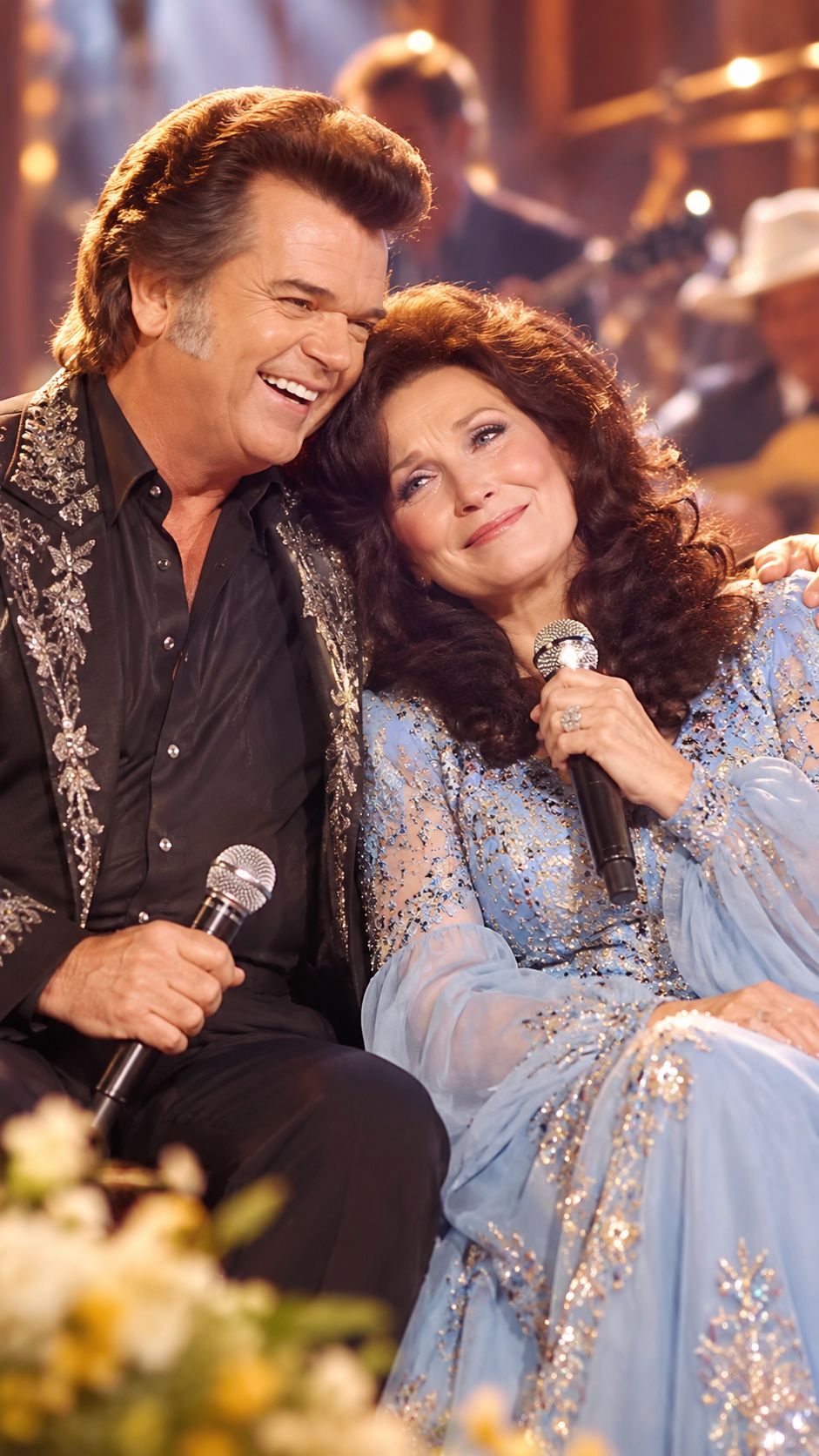
There are country duos that sound good together—and then there are Conway Twitty and Loretta Lynn.
When their voices met, something seemed to happen that neither singer could quite create alone. His deep, controlled baritone carried the weight of experience, while her unmistakable voice could sound tender, fiery, wounded, or defiant within a single verse. Put them together, and even a simple exchange of lyrics could feel like an entire relationship unfolding in real time.
Their partnership officially began with “After the Fire Is Gone” in 1971. The song became a No. 1 country hit and established the foundation for one of the most successful male-female partnerships in country music history. Over the following years, they recorded eleven studio albums and collected four consecutive CMA Vocal Duo of the Year awards from 1972 through 1975.
But awards only tell part of the story.
The deeper mystery is why they sounded so believable together.
Why did millions of listeners hear tension, affection, frustration, temptation, humor, and heartbreak whenever Conway and Loretta stood beside each other?
The answer lies in three remarkable secrets.
Secret #1: They Didn’t Try to Sound Alike—They Sounded Completely Different
One of the most important reasons Conway Twitty and Loretta Lynn worked so beautifully together was the contrast between their voices.
Conway possessed a rich, low, intensely emotional delivery. His style often relied on restraint. He didn’t need to shout to communicate pain. A slight change in tone could make a line sound like a confession.
Loretta was different.
Her voice carried the character of someone who had lived the stories she sang. The Country Music Hall of Fame describes her music as drawing deeply from her own experiences and her ability to tell difficult truths with a distinctive perspective.
That contrast created musical electricity.
Think about the structure of “Louisiana Woman, Mississippi Man.”
The song doesn’t work because Conway and Loretta sound identical. It works because they sound like two different people having a conversation.
He represents one side.
She answers from the other.
He pushes.
She responds.
He makes a claim.
She challenges it.
And suddenly the listener isn’t merely hearing two singers—they’re eavesdropping on a relationship.
“Their voices didn’t erase each other. They gave each other something to react to.”
That distinction is crucial.
Many vocal partnerships become predictable because both singers occupy the same emotional space. Conway and Loretta rarely had that problem. Their differences gave their songs movement.
And that movement made their performances feel alive.
Secret #2: They Understood That a Great Duet Is Really a Conversation
The second secret was storytelling.
Conway and Loretta didn’t simply sing songs together. They acted out emotional situations through music.
This became particularly powerful with songs built around complicated relationships.
Consider “After the Fire Is Gone.”
The song explores two people confronting the emptiness of relationships after passion has disappeared. Rather than treating the subject as a simple romantic fantasy, the performance creates tension between desire, loneliness, guilt, and emotional escape.
That complexity gave both singers something to play.
PBS’s American Masters highlighted how powerful the combination was, with Garth Brooks and Trisha Yearwood discussing the distinctive impact created when Lynn and Twitty’s voices joined together.
The magic wasn’t simply in the melody.
It was in the interaction.
Listen closely to their classic recordings and you’ll notice that they frequently leave emotional space for one another. One singer delivers a thought, and the other responds. Instead of competing for attention, they build the drama together.
That’s why songs like “Lead Me On,” “Louisiana Woman, Mississippi Man,” and “Feelins’” remain so recognizable.
Each one feels like a scene.
Each one has characters.
And each one gives the audience a reason to keep listening until the final line.
The Country Music Hall of Fame notes that their first duet, “After the Fire Is Gone,” topped the charts in 1971 and launched one of the most successful duet teams in country music history. Their later hits included “Lead Me On,” “Louisiana Woman, Mississippi Man,” and “Feelins’.”
That wasn’t an accident.
They understood one of country music’s oldest strengths:
Tell the truth of a complicated human moment, and let the listener decide how they feel about it.
Secret #3: The Chemistry Was Built on Trust—Not Romance
Perhaps the biggest misunderstanding surrounding Conway Twitty and Loretta Lynn was the assumption that their extraordinary chemistry must have reflected a real-life romance.
It didn’t.
Loretta herself directly rejected that idea.
In an interview featured by PBS’s American Masters, Lynn explained that people assumed she and Conway had something romantic going on, but she described him as a friend and emphasized the respect between Conway and her husband, Mooney.
That makes their musical chemistry even more fascinating.
They didn’t need a real-life romance to manufacture emotional intensity.
They needed trust.
Trust allowed Loretta to sound vulnerable without losing her strength.
Trust allowed Conway to reveal tenderness without losing his masculine presence.
And trust allowed both singers to enter fictional stories completely while keeping their personal lives separate from the characters they portrayed.
That distinction is part of what made them so convincing.
“They didn’t have to live the story to make you believe it. They only had to understand the story.”
And they clearly understood the emotional language of country music.
Both artists had already established major solo careers before their partnership became a defining chapter of their legacies. Conway had transformed himself from a rock-and-roll star into one of country’s biggest hitmakers, eventually earning forty No. 1 Billboard country hits according to the Country Music Hall of Fame. Loretta had already become one of country’s most important female voices.
They weren’t dependent on each other.
They chose to work together.
That difference matters.
When Two Country Legends Became Something Bigger
By the early 1970s, something extraordinary had happened.
Conway Twitty and Loretta Lynn had stopped being simply two successful solo artists making duets.
They had become a musical identity of their own.
Their albums repeatedly found audiences, their songs became country standards, and their awards continued to accumulate. PBS reports that they released eleven studio albums together between 1971 and 1988, with five No. 1 songs coming from five different albums.
The Country Music Hall of Fame records that they won CMA Vocal Duo of the Year four years in a row, from 1972 through 1975.
And the Grammy record tells another part of the story: “After the Fire Is Gone,” “Lead Me On,” “Louisiana Woman, Mississippi Man,” and “Feelins’” all received Grammy recognition.
But statistics cannot fully explain the emotional reaction their performances still create.
Because ultimately, their legacy wasn’t built on numbers.
It was built on believability.
When Loretta sang toward Conway, you believed she was talking to him.
When Conway answered, you believed he had something to say.
When their voices merged, you believed the two characters in the song had finally reached the same emotional place.
That’s the rare quality every great duet hopes to achieve.
The Real Legacy of Conway and Loretta
There is a reason later generations of country singers continue to revisit their songs.
Their music doesn’t require the listener to know every detail of their lives.
You don’t have to understand the entire history of Nashville.
You don’t even have to be alive when the records were released.
The emotions remain recognizable.
Love.
Regret.
Jealousy.
Longing.
Temptation.
Humor.
Heartbreak.
Those feelings don’t belong to one generation.
That’s why Conway Twitty and Loretta Lynn remain such an enduring musical pairing.
Their greatest secret may actually be the simplest one:
They knew how to listen to each other.
In a great duet, one voice isn’t supposed to overpower the other. One voice gives the other somewhere to go.
Conway gave Loretta room to challenge him.
Loretta gave Conway room to reveal another side of himself.
Together, they transformed ordinary lyrics into miniature dramas.
And somewhere between the first verse and the final harmony, listeners stopped hearing two stars.
They heard two people.
“That was the magic of Conway and Loretta: the voices were legendary, but the emotions felt human.”
Perhaps that’s why decades later, their recordings still sound less like museum pieces and more like conversations caught in time.
Conway Twitty and Loretta Lynn didn’t simply become country royalty because they made hit records. They became country royalty because, together, they made listeners believe every word.
And that is a kind of chemistry that numbers alone can never measure.
VIDEO: