 By admin
INTRODUCTION:
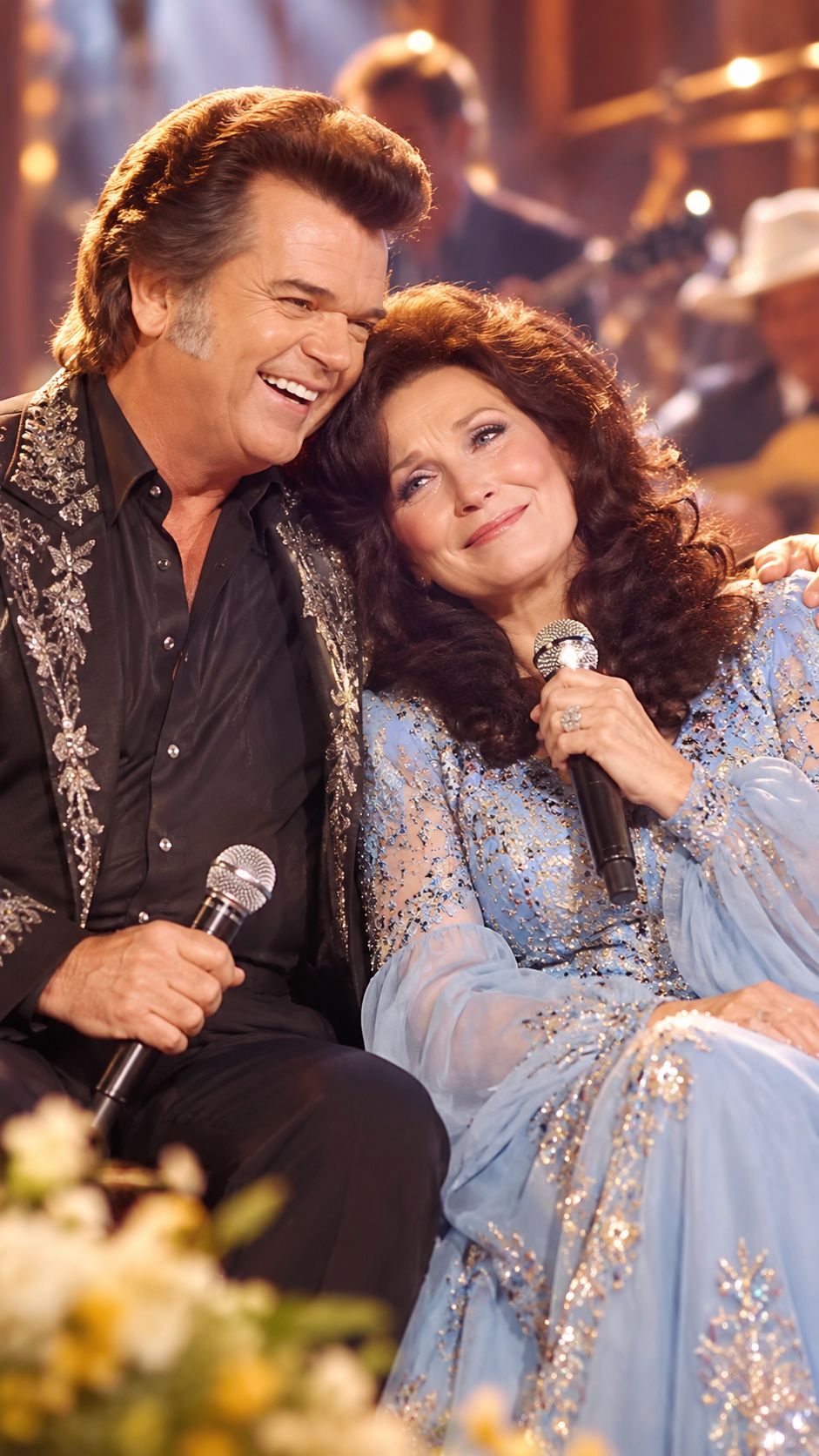
There are some friendships in country music that feel larger than the songs that made them famous. Loretta Lynn and Conway Twitty had one of those rare bonds.
For more than a decade, their voices seemed almost inseparable. They recorded hit after hit, toured together, traded playful lines onstage, and created a kind of musical chemistry that made audiences believe they were witnessing something deeper than a professional partnership. Yet Loretta repeatedly described Conway as a friend rather than a romantic partner, emphasizing the genuine affection and respect that existed between them.
And then, in June 1993, that friendship was suddenly confronted with the unimaginable.
Conway was only 59.
What followed became one of the most heartbreaking chapters in the history of country music—and years later, Loretta’s words about him revealed just how deeply the loss had stayed with her.
“What I wouldn’t give to sing with him one more time.”
That sentence may be one of the simplest tributes ever spoken about a musical partner.
It also says almost everything.
The Partnership That Country Music Couldn’t Recreate
When Loretta Lynn and Conway Twitty began recording together in the early 1970s, neither could have known how enduring their partnership would become.
They recorded together from 1971 through 1981, producing ten albums and a remarkable series of successful duets. Loretta later recalled that Conway was her “singin’ partner” and described the extraordinary amount of music they created together.
Their appeal wasn’t simply that both were famous.
It was the contrast.
Conway’s deep, smooth voice could sound confident, mischievous, wounded, or romantic. Loretta brought a sharper emotional edge—sometimes playful, sometimes fiery, sometimes vulnerable.
Put them together, and something happened that neither voice could create alone.
PBS’s documentary on Loretta described their musical connection as an energy created specifically by the two voices together.
That is why songs such as “Louisiana Woman, Mississippi Man,” “After the Fire Is Gone,” and “You’re the Reason Our Kids Are Ugly” remain so recognizable decades later.
They didn’t simply sing at each other.
They sounded as though they were living inside the songs.
And that distinction mattered.
Loretta Always Insisted Their Bond Was About Friendship
Over the years, fans naturally wondered whether the chemistry between Loretta Lynn and Conway Twitty reflected something romantic.
Loretta pushed back against that interpretation.
In the PBS documentary Loretta Lynn: Still a Mountain Girl, she explained that she loved Conway as a friend and emphasized that her husband, Oliver “Doolittle” Lynn, also cared deeply about him. She recalled that Conway was one of the few people in the music business her husband genuinely enjoyed talking with.
That detail makes their story even more poignant.
Because their connection didn’t need a romance to be extraordinary.
It was something perhaps more difficult to explain: trust, musical instinct, friendship, shared history, and an almost effortless understanding of how to make a song come alive.
Loretta later remembered Conway in similarly affectionate terms, calling him one of the best men she had known and praising his devotion to his family and music.
For fans who had spent years watching them perform together, those words carried enormous weight.
Then Came the Night Nobody Expected
Conway Twitty’s death was sudden.
On June 5, 1993, after performing in Branson, Missouri, Conway became seriously ill while traveling back toward Nashville. He was taken to a hospital in Springfield, where he was suffering from an abdominal aortic aneurysm.
And in one of those extraordinary coincidences that seem almost impossible in real life, Loretta Lynn was at the same hospital.
She wasn’t there because Conway was dying.
She was there because her husband was seriously ill.
Suddenly, Loretta found herself moving between two hospital rooms, concerned about two men who had played enormous roles in her life.
In an interview with Dan Rather, Loretta remembered seeing Conway arrive at the hospital. She initially thought he had simply come to visit Doolittle.
Then she realized something was terribly wrong.
“I never thought anything was wrong with him…” Loretta recalled.
The situation deteriorated quickly.
And eventually, Loretta was told she might be seeing her longtime singing partner for the final time.
The Words She Said Beside His Bed
This is where the story becomes almost unbearably sad.
According to Loretta’s recollection, a chaplain asked whether she wanted to see Conway because he might not survive.
She went to him.
Loretta later remembered telling Conway:
“Conway, don’t you die on me.”
She reminded him of his love of singing and encouraged him to keep fighting.
She wasn’t delivering a farewell speech.
She was refusing to believe that the man she had shared so many stages with was about to disappear.
She wanted him to get better.
She wanted another song.
Another performance.
Another joke backstage.
Another moment when their voices could meet again.
But shortly afterward, while Loretta was with Doolittle, she received the devastating news.
Conway had died.
He was only 59.
Imagine the emotional collision of that moment: Loretta was already watching her husband fight for his life, while simultaneously losing one of her closest musical companions.
Country music had changed forever in a matter of hours.
The Tragedy Wasn’t Just Losing Conway
It would be easy to describe Conway’s death simply as the end of a legendary career.
But for Loretta, it was more personal.
She hadn’t merely lost another country star.
She had lost the person whose voice had become part of her own musical identity.
Their partnership had lasted years. Their recordings had become part of country music’s collective memory. Their families remained connected. And even decades later, Conway’s absence continued to surface whenever Loretta reflected on the music they made together.
That is what makes her later tribute so powerful.
Nearly three decades after Conway’s death, Loretta still wrote about him with affection.
In 2020, she marked the anniversary of his passing by remembering him as one of the best men she had known. She praised his family values, his love of music, his extraordinary career, and even his talent as a baseball player.
And in 2022, another tribute carried an even more painful sentiment:
“What I wouldn’t give to sing with him one more time.”
There it was.
The ache beneath all the memories.
Not I wish we had recorded more albums.
Not I wish we had performed more shows.
Just:
I wish I could sing with him again.
Why Those Words Still Hurt
Music creates a strange kind of memory.
A photograph freezes someone’s face.
A song can bring their voice back.
That’s why the recordings of Loretta Lynn and Conway Twitty remain so powerful. When their voices appear together, listeners don’t simply hear two legendary singers.
They hear an era.
They hear two friends who spent years standing beside each other beneath stage lights.
They hear laughter, teasing, tension, tenderness, and the unmistakable confidence of performers who knew exactly how to respond to one another.
And because Conway died so unexpectedly, every surviving recording carries another layer of meaning.
There is no final tour that slowly faded into retirement.
No carefully planned goodbye.
No final concert where everyone knew it was the last.
There was simply a life interrupted.
A voice suddenly silenced.
And a musical partner left behind to remember what they had created.
The Legacy That Refused to Die
Perhaps the most beautiful part of the story is that Conway and Loretta’s music never truly disappeared.
Their grandchildren later helped carry the story forward through Twitty & Lynn, a tribute act featuring Conway’s grandson Tre Twitty and Loretta’s granddaughter Tayla Lynn. Their official account describes their mission as celebrating the grandparents’ music and preserving the legacy of their unique duet partnership.
Tayla has also recalled how strongly Loretta responded to the performances, saying the shows brought back memories of Conway and the years when they were building their careers.
That detail feels almost poetic.
The songs that once belonged to Loretta and Conway became memories.
Those memories became stories.
And those stories became songs again.
The circle continued.
The Final Meaning Behind Loretta’s Words
When Loretta Lynn spoke about Conway Twitty during the final years of her life, she wasn’t trying to manufacture nostalgia.
She was remembering someone she had genuinely loved as a friend, collaborator, and musical partner.
Her words reveal something important about legendary partnerships: sometimes the deepest bonds are not the ones that fit neatly into a label.
They don’t have to be romantic.
They don’t have to be explained.
Sometimes two people simply discover that their voices, personalities, humor, and instincts fit together in a way that can never be duplicated.
That was Loretta Lynn and Conway Twitty.
And perhaps that is why her most heartbreaking sentiment wasn’t really about death at all.
It was about music.
It was about wanting one more chance.
One more stage.
One more microphone.
One more song.
“What I wouldn’t give to sing with him one more time.”
For millions of country fans, that sentence feels like the perfect final chapter to their story.
Because Conway may have left the stage in 1993.
But whenever those old recordings begin to play, Loretta and Conway are together again—trading lines, answering each other’s voices, and creating that unmistakable magic that made country music history.
And perhaps that is the greatest gift their musical partnership ever left behind:
The song ended. The friendship didn’t. And the memory never will.
VIDEO: