 By admin
INTRODUCTION:
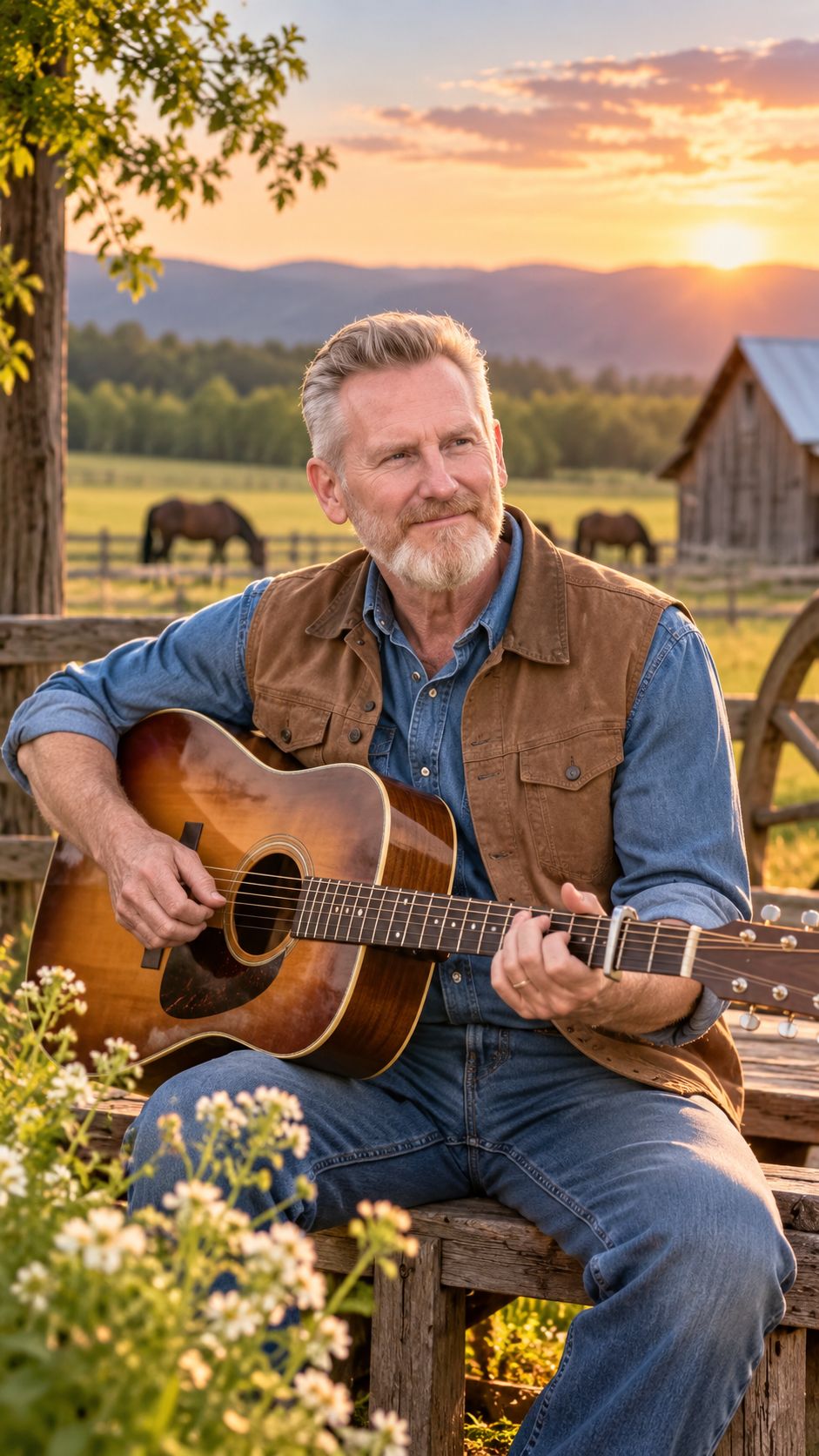
There was a time when Rory Feek could have measured his success the way Nashville traditionally does: by hit records, awards, chart positions, packed venues, and the number of people who knew his name.
He had already experienced much of that world.
As one half of Joey + Rory, Rory became part of a country music story that connected deeply with listeners who wanted something more authentic than polished celebrity. The duo gained national attention after appearing on Can You Duet?, released multiple albums, earned recognition from the Academy of Country Music, and built a devoted audience around songs that sounded like real life rather than manufactured entertainment.
But somewhere along the way, Rory began asking a question that has nothing to do with record sales:
What if success isn’t about how many people know you — but about what kind of life you build when nobody is watching?
That question would eventually change everything.
THE DREAM NASHVILLE TAUGHT HIM TO CHASE
For a songwriter, Nashville can be intoxicating.
There are stages to conquer, songs to write, artists to impress, publishers to satisfy and audiences waiting for the next emotional chorus.
Rory understood that world.
Before becoming widely known as Joey + Rory, he had already established himself as a songwriter. His career was built around music, storytelling and the craft of turning ordinary experiences into songs that could reach extraordinary numbers of people.
Then came Joey Feek.
Together, Rory and Joey created something that felt different. Their music was rooted in traditional country values, family, faith, humor and vulnerability. Their chemistry wasn’t simply a marketing concept. Their personal life became inseparable from the story their audience followed.
And then, in 2014, the couple made a decision that says almost everything about how Rory’s definition of success was changing.
They stepped away from the demands of their music career for a year to stay home, prepare for the arrival of their daughter Indiana, and learn how to live more simply on their Tennessee farm. Rory began documenting their everyday life through This Life I Live.
It sounds simple.
But for people in the entertainment business, choosing less can be remarkably difficult.
Sometimes the bravest career decision isn’t chasing the next opportunity. It’s deciding that the life you already have matters more.
THE FARM BECAME MORE THAN A BACKDROP
At first glance, Rory’s farm might look like a peaceful setting for photographs and country songs.
But it gradually became something much deeper.
The farm became a classroom.
It became a home.
It became a place where Rory could raise Indiana, grow food, tell stories, make music and create memories away from the machinery of the entertainment industry.
His own account of that period is revealing. Rory describes how he and Joey wanted to simplify their lives, become more self-sufficient and discover what could come from “seeking more from less.”
That philosophy eventually became part of his identity.
Instead of constantly asking, “What’s next?”, Rory began asking, “What matters now?”
And those are two very different questions.
One can lead to another stage.
The other can lead home.
THEN LIFE TOOK EVERYTHING HE HAD PLANNED AWAY
In 2016, Rory’s definition of success was tested in the most painful way imaginable.
Joey Feek died from cancer on March 4, 2016, leaving Rory to raise their young daughter Indiana.
Suddenly, there was no longer a future that could be planned exactly as they had imagined.
There was an empty chair.
A little girl who still needed her father.
A house filled with memories.
And a career that could no longer simply be separated from grief.
Rory later described the painful adjustment of returning home with Indiana without Joey. The reality was not an inspirational slogan. It was an ordinary house suddenly made painfully incomplete.
This is where the story of Rory Feek becomes larger than country music.
Because he could have responded by running back toward the noise.
Instead, much of his work continued moving in the opposite direction.
He wrote.
He filmed.
He raised his daughter.
He preserved memories.
He told stories.
He continued living on the farm.
And eventually, he returned to music on his own terms.
HE DIDN’T ABANDON MUSIC — HE CHANGED WHAT MUSIC MEANT
One of the biggest misunderstandings about Rory’s journey is that choosing a quieter life meant abandoning his identity as an artist.
It didn’t.
It transformed it.
His solo album Gentle Man, released in 2021, became a new chapter after Joey’s death. The album was his first solo record and featured collaborations with artists including Dolly Parton, Vince Gill, Trisha Yearwood, Alison Krauss, Lee Ann Womack and others.
The significance wasn’t simply that Rory returned to recording.
It was why he returned.
His music had become connected to everything he had lived through: love, loss, faith, fatherhood, memory and the uncomfortable beauty of continuing after heartbreak.
The songs no longer needed to prove that Rory belonged in Nashville.
They simply needed to tell the truth.
The goal wasn’t necessarily to become bigger. The goal was to become more honest.
And that may be the central theme of Rory Feek’s second act.
HIS GREATEST “STAGE” MAY HAVE BECOME HIS OWN BACKYARD
Perhaps nowhere is Rory’s new definition of success more visible than in the Homestead Festival.
What began as an idea for a gathering on the farm developed into a major event centered on homesteading, farming, sustainability, family life, education, music and community. Rory himself wrote in 2026 that the festival grew from a dream in late 2021 into an event that has drawn tens of thousands of people to the farm.
The official festival describes its purpose in strikingly simple terms: not merely learning how to grow food, but learning how to grow a life filled with meaning and purpose.
Think about how different that is from the traditional definition of celebrity success.
A conventional music career asks:
How big can the audience become?
Rory’s life increasingly asks:
How meaningful can the gathering become?
That distinction explains much of his journey.
THE COUNTRY ARTIST WHO FOUND SUCCESS IN ORDINARY THINGS
There is something deeply country about Rory’s philosophy.
Country music has always had a complicated relationship with fame.
Its greatest songs frequently celebrate things that fame cannot buy:
A front porch.
A family dinner.
An old truck.
A church pew.
A field at sunset.
A handwritten letter.
A child growing up.
A love that survives difficult years.
And Rory Feek’s life increasingly resembles the very stories country music has always celebrated.
His Tennessee homestead is now a place where he performs intimate concerts, hosts gatherings and continues sharing stories. His official concert schedule describes home concerts as evenings of songs and stories at his 100-acre homestead south of Nashville.
The irony is beautiful.
The songwriter who once traveled to bring his music to audiences eventually created a place where audiences could come to him.
The stage became smaller.
The meaning became larger.
SUCCESS WITHOUT THE SPOTLIGHT
Rory’s current philosophy is perhaps best understood through his own description of the story he wants to tell.
On his current This Life I Live page, Rory says that among all the songs, books, blogs and films he has created, the story that means the most to him is the one told through the life he is living and the choices he makes.
That sentence is incredibly revealing.
Because it places life above career.
Not because career is meaningless.
But because career is only one chapter.
Awards eventually gather dust.
Charts move on.
Concert lights go dark.
But the way someone loves their family, remembers the people they’ve lost, raises their children and uses their gifts can continue long after the applause disappears.
That is the kind of success Rory seems to have chosen.
THE MOST POWERFUL PART OF HIS STORY IS WHAT HE DIDN’T CHASE
In today’s entertainment culture, success often comes packaged as more.
More followers.
More money.
More publicity.
More visibility.
More opportunities.
More attention.
But Rory’s story offers another possibility:
What if success can also mean knowing when “more” isn’t what you need?
His journey from country songwriter to husband, father, widower, storyteller, farmer, author and solo artist has not followed a straight line.
It has been marked by extraordinary highs and devastating losses.
Yet the thread connecting those chapters is remarkably consistent.
Story. Family. Faith. Home. Meaning.
And perhaps that’s why so many people continue to connect with him.
Because Rory doesn’t represent a fantasy of a perfect life.
He represents something much more recognizable:
A person trying to make something meaningful out of the life he has been given.
A DIFFERENT KIND OF LEGACY
Years from now, people may remember Rory Feek’s songs.
They may remember Joey + Rory.
They may remember the albums, performances and awards.
But his most enduring legacy may be something less measurable.
A daughter growing up on a Tennessee farm.
A field filled with people learning how to live more intentionally.
A collection of stories preserved for future generations.
A guitar still being played.
A home where music and ordinary life exist side by side.
And a man who discovered that sometimes the greatest success isn’t standing beneath brighter lights.
Sometimes it’s standing beneath the same sunset you have watched for years — with the people you love — and realizing you don’t need to be anywhere else.
Rory Feek didn’t necessarily walk away from success. He redefined it.
And maybe that is the most country thing about his entire story.
Because when the applause fades, what remains isn’t the size of the stage.
It’s the life you built after you stepped off it.
And for Rory Feek, that life — imperfect, deeply personal, sometimes heartbreaking and often beautiful — became the story worth telling.
VIDEO: