 By admin
INTRODUCTION:
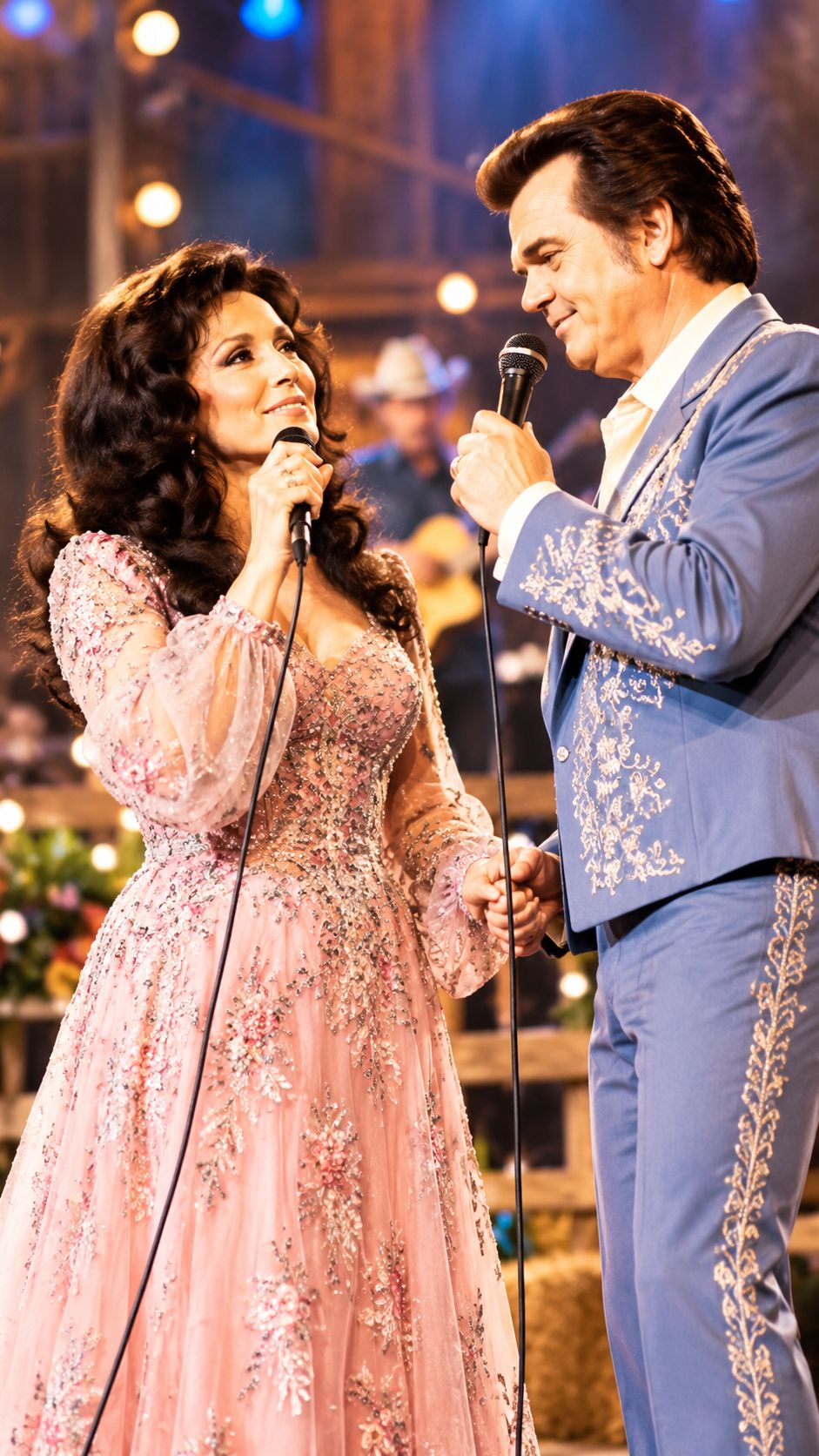
There are country songs that become hits, and then there are songs that seem to create an entire musical relationship.
For Conway Twitty and Loretta Lynn, that song was “After the Fire Is Gone.”
Released in 1971, the duet did far more than place two legendary voices on the same record. It became their first No. 1 country hit together, won the 1972 Grammy Award for Best Country Vocal Performance by a Duo or Group, and opened the door to one of the most celebrated male-female partnerships in country music history.
But statistics only tell part of the story.
The real reason the song still resonates is buried inside the way Twitty and Lynn sang it.
They didn’t sound like two stars trying to impress each other.
They sounded like two people who understood exactly what the other voice needed.
“After the Fire Is Gone” wasn’t simply a duet. It was a conversation between two voices, two characters, and two different kinds of country storytelling.
the beginning of something neither voice could create alone
Before Conway Twitty and Loretta Lynn became one of country music’s defining duet teams, each had already built a powerful identity.
Loretta Lynn had transformed personal experience into country storytelling. Her songs could be funny, confrontational, vulnerable, and brutally honest. The Country Music Hall of Fame describes her music as rooted in the truth of her own life and notes that her partnership with Twitty began after her earlier duet work with Ernest Tubb.
Conway Twitty, meanwhile, had already established himself as one of the most successful and emotionally distinctive singers in country music. His career eventually produced 40 No. 1 Billboard country hits, and his dramatic vocal style became one of his defining trademarks.
On paper, putting them together made sense.
But country music history is full of pairings that looked good on paper and never developed into something magical.
This one did.
And “After the Fire Is Gone” was the spark.
a song about what happens when love loses its fire
The brilliance of the song lies in its emotional gray area.
It isn’t a simple love song.
It isn’t a triumphant declaration.
It isn’t even really about romance in the traditional sense.
Instead, it explores the painful realization that something once powerful has faded.
That emotional uncertainty gave Twitty and Lynn enormous room to act through their voices.
Neither singer had to overdo it.
Neither needed dramatic vocal acrobatics.
They simply had to make the listener believe the story.
And they did.
The song was written by L.E. White and became the first No. 1 country hit for Twitty and Lynn as a duo. It spent two weeks at the top of the country chart and remained on the chart for 14 weeks.
But its importance went far beyond the chart.
The record established the emotional formula that would define the pair.
Conway brought the tension. Loretta brought the confrontation.
Together, they created something neither could have achieved in quite the same way alone.
why their voices worked so perfectly together
Listen closely to the contrast.
Conway Twitty’s voice often carried a deep, almost conversational sadness. He could make a lyric sound like something he had been carrying around for years.
Loretta Lynn had a completely different emotional color. Her voice could sound tender one moment and fiercely direct the next.
That difference created electricity.
When one singer delivered a line, the other didn’t merely repeat the emotion.
The response changed it.
That is one of the secrets behind great duet singing.
The two voices shouldn’t sound identical.
They should sound like two sides of the same story.
And that became the defining characteristic of Twitty and Lynn.
PBS’s American Masters notes that the pair eventually made 11 studio albums between 1971 and 1988, produced five No. 1 songs from five different albums, and won the CMA Vocal Duo of the Year award every year from 1972 through 1975.
That incredible run began with the chemistry established by “After the Fire Is Gone.”
the moment everything changed
There is a reason the song is often remembered as the beginning of something much bigger.
Once listeners heard Conway and Loretta together, the pairing suddenly felt inevitable.
The success of “After the Fire Is Gone” led to more recordings and eventually more country classics, including “Lead Me On,” “Louisiana Woman, Mississippi Man,” and “Feelins’.”
Their collaboration became so successful that the duo earned four consecutive CMA Vocal Duo of the Year awards from 1972 through 1975.
And their Grammy success confirmed that this wasn’t merely a commercial novelty.
The Recording Academy lists “After the Fire Is Gone” as the winner of the 1972 Grammy for Best Country Vocal Performance by a Duo or Group.
That achievement mattered because it demonstrated something important:
The emotional power of their partnership could stand beside the biggest recordings in country music.
why fans still feel something when they hear it
More than five decades later, what makes the recording interesting isn’t simply nostalgia.
It’s honesty.
Country music has always understood that life rarely fits neatly into happy endings and sad endings.
Sometimes love simply changes.
Sometimes two people remain together emotionally long after the relationship itself has begun to disappear.
Sometimes the hardest thing to admit is that the feeling isn’t what it used to be.
“After the Fire Is Gone” lives inside that uncomfortable space.
And that’s precisely why it remains powerful.
The song doesn’t ask the listener to choose a side. It asks the listener to recognize a feeling.
That is a much harder thing for a song to accomplish.
the chemistry became bigger than the song
The most fascinating part of the story is that “After the Fire Is Gone” was only the beginning.
The duo went on to create a catalog that became inseparable from the golden era of country duets.
“Louisiana Woman, Mississippi Man” showed their playful, larger-than-life side.
“Lead Me On” leaned into emotional vulnerability.
“Feelins’” demonstrated that their chemistry could work across different shades of romantic storytelling.
And their albums continued to build the mythology of the pair.
The official Conway Twitty site describes Twitty’s partnership with Lynn as a landmark duet relationship and highlights songs including “After the Fire Is Gone,” “Lead Me On,” and “Louisiana Woman, Mississippi Man.”
Yet none of those later achievements erase the importance of the first major breakthrough.
Everything had to start somewhere.
And it started with a song about love after the flame had disappeared.
a legacy that refuses to disappear
Perhaps the greatest proof of the song’s endurance is what happened after Conway Twitty and Loretta Lynn were gone.
Artists continued performing their songs.
New generations discovered the recordings.
Their duet catalog remained part of the country music conversation.
The official Loretta Lynn site notes that the modern performing duo Twitty & Lynn continues to perform songs from Conway and Loretta’s repertoire, including “After the Fire Is Gone” and “Louisiana Woman, Mississippi Man.”
That says something about the songwriting.
Great country music doesn’t belong only to the decade in which it was recorded.
It belongs to anyone who has ever recognized themselves in the story.
And perhaps that’s why “After the Fire Is Gone” still hits differently.
It isn’t trying to recreate the past.
It captures something timeless.
the real reason this duet still matters
When Conway Twitty and Loretta Lynn stepped into the recording booth for “After the Fire Is Gone,” they could not have known exactly what the song would become.
They were two established artists making a duet.
But something happened.
Their voices locked together.
Their personalities became characters.
Their differences became the source of their chemistry.
And suddenly country music had discovered one of its most enduring partnerships.
The song reached No. 1.
The Grammy followed.
Then came more No. 1s, more albums, more awards, and years of unforgettable performances.
But underneath all those achievements was something much simpler.
Two voices telling the truth about a relationship that had lost its fire.
That is why the song still hurts. That is why it still feels intimate. And that is why, after all these years, Conway Twitty and Loretta Lynn can sing a story from 1971 and somehow make it feel like it happened yesterday.
For longtime country fans, “After the Fire Is Gone” isn’t just an old duet.
It is the moment when Conway Twitty and Loretta Lynn became something larger than two solo stars.
It was the beginning of a partnership that helped define country music’s golden age of duets—and a reminder that sometimes the most unforgettable songs aren’t about love at its happiest.
They’re about what happens after the fire is gone.
VIDEO: