 By admin
INTRODUCTION:
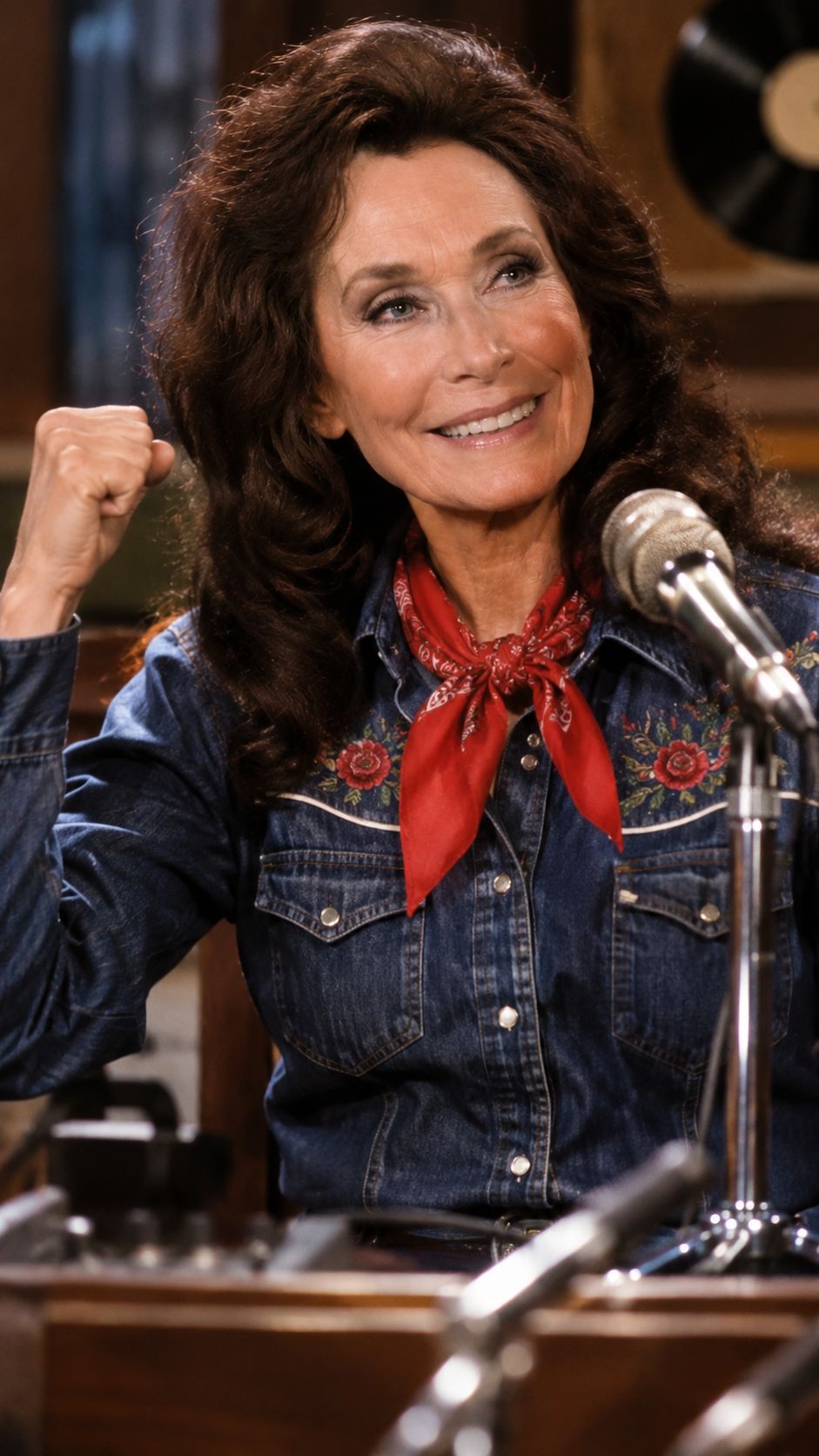
There are voices that entertain, voices that inspire, and then there are voices that change the way an entire generation thinks. Loretta Lynn belonged to that rare third category. She was never simply a country singer standing beneath the stage lights, delivering songs about love, heartbreak, and everyday life. She was a woman who dared to put uncomfortable truths into music, even when those truths made powerful people nervous.
At a time when women in country music were often expected to remain polite, traditional, and carefully within the boundaries of acceptable conversation, Loretta Lynn chose a different path. She sang about subjects that many people preferred to whisper about behind closed doors. Marriage, women’s independence, birth control, divorce, double standards, and the complicated realities of being a woman became the foundation of some of her most unforgettable recordings.
Her songs did more than entertain audiences. They challenged expectations, provoked arguments, and occasionally collided with the unwritten rules of American radio. Some broadcasters hesitated. Some stations refused to play particular recordings. Some listeners were outraged, while others felt that someone had finally given their experiences a voice.
But Loretta never built her career around pleasing everyone. She built it around telling stories honestly. And that courage would become one of the defining characteristics of her extraordinary legacy.
THE SONGS THAT MADE RADIO STATIONS NERVOUS: INSIDE LORETTA LYNN’S MOST CONTROVERSIAL RECORDINGS
1. A coal miner’s daughter who refused to stay silent
To understand why Loretta Lynn became such a controversial figure, it is important to understand where she came from.
Born in Butcher Hollow, Kentucky, in 1932, Loretta grew up in a working-class family where money was scarce and life demanded resilience. Her childhood was far removed from the glamorous world of Nashville entertainment. She understood poverty, family responsibilities, marriage, motherhood, and the struggles faced by ordinary women.
After marrying Oliver Lynn, known as Doolittle, at a young age, she experienced the responsibilities of adulthood long before most people her age. She became a mother, managed a household, and eventually pursued a music career that would transform her life.
But her greatest advantage as a songwriter was not simply her ability to sing.
It was her willingness to speak.
When she began recording professionally in the early 1960s, country music had plenty of songs about romance, heartbreak, loyalty, and marriage. However, female performers were often expected to present those subjects from a familiar perspective: the patient wife, the devoted sweetheart, or the heartbroken woman waiting for her husband to return.
Loretta understood those stories, but she also knew there were other sides to them.
What happened when a husband drank too much? What happened when a woman became tired of being betrayed? Why were divorced women judged more harshly than divorced men? And why was a woman expected to remain quiet about decisions affecting her own family?
These were not abstract questions to Loretta.
They were the realities she wanted to explore through music.
Her songwriting challenged the comfortable image of country womanhood, and she did it without abandoning the traditional country sound that made audiences fall in love with her.
That combination made her dangerous to conventional thinking.
2. Don’t Come Home A-Drinkin’: The song that challenged the traditional husband
One of the earliest examples of Loretta’s fearless attitude arrived with Don’t Come Home A-Drinkin’ (With Lovin’ on Your Mind) in 1966.
The subject was remarkably straightforward: a woman who had endured too much from a husband who spent his evenings drinking and enjoying himself while leaving her alone with the responsibilities of home.
But the song’s message was anything but ordinary.
Instead of welcoming her husband home with unquestioning affection, the woman in the song establishes a boundary. She is tired of being ignored, tired of being treated as though her feelings do not matter, and unwilling to pretend everything is fine simply because her husband has returned.
For many traditional radio programmers, that attitude was uncomfortable.
The controversy surrounding the recording was particularly revealing because Loretta was not singing about an imaginary scandal or an outrageous lifestyle. She was describing a familiar domestic problem that many married women understood.
In interviews, Loretta recalled that some stations considered the song inappropriate, with Chicago station WJJD among those that refused to play it.
The irony was extraordinary.
A song about a married woman demanding respect was considered too controversial for the airwaves, even though its central message was rooted in everyday married life.
Yet the public responded enthusiastically.
The recording reached No. 1 on the country charts and helped establish Loretta Lynn as a powerful voice for women who wanted to be heard.
She had discovered something important: sometimes the subjects that make radio programmers uncomfortable are precisely the subjects audiences want to hear.
3. Fist City: When Loretta turned confrontation into a country anthem
If Don’t Come Home A-Drinkin’ demonstrated Loretta’s determination, Fist City showed that she could be downright intimidating when she wanted to be.
Released in 1968, the song presented a woman confronting another woman who was showing romantic interest in her husband.
There was no delicate language of reconciliation or polite suggestion that everyone should simply get along.
Instead, Loretta delivered a warning with unmistakable confidence.
The recording was bold, humorous, confrontational, and unmistakably country. It also challenged the expectation that female singers should always appear gentle and agreeable.
Some radio stations objected to its aggressive message, but the controversy did not prevent the song from reaching No. 1 on the country charts.
What made the song especially interesting was its attitude.
Loretta was not attempting to portray herself as a perfect woman. She was presenting a character with jealousy, anger, pride, and a fierce determination to defend her marriage.
That honesty was part of her appeal.
Her audience did not necessarily need to agree with every decision made by the woman in the song. They simply recognized the emotions.
Fist City also demonstrated something that would become a recurring theme throughout her career: Loretta was willing to give female characters the freedom to be imperfect.
They could be angry. They could be jealous. They could make threats. They could stand their ground.
They did not have to behave like carefully written fictional heroines.
And that was a refreshing departure from the expectations placed on many female country performers.
4. Wings Upon Your Horns: A subject many singers avoided
Released in 1969, Wings Upon Your Horns explored another deeply personal and sensitive subject: innocence, sexuality, and the emotional consequences of growing up.
The recording approached themes that were particularly delicate within conservative American culture.
Its religious imagery and discussion of lost innocence made some listeners uncomfortable. For a female country singer to address such subjects openly was especially unusual.
The significance of this song goes beyond its controversy.
Loretta understood that women experienced complicated emotional lives that could not always be expressed through conventional love songs.
There were expectations surrounding purity, reputation, and morality. Women were frequently judged according to standards that were not applied equally to men.
By exploring these ideas, Loretta was challenging the silence surrounding female experience.
She was not trying to shock audiences simply for attention. She was expanding the subjects that country music could discuss.
And she was doing it through a genre that had traditionally been associated with family values, religious traditions, and small-town conservatism.
That contrast made her work even more powerful.
5. One’s on the Way: Motherhood, domestic pressure, and unexpected humor
One of the most fascinating aspects of Loretta Lynn’s songwriting was her ability to discuss serious subjects without making every recording sound like a lecture.
One’s on the Way, released in 1971, is an excellent example.
Written by Shel Silverstein, the song follows a pregnant woman in Topeka, Kansas, who listens to the glamorous lives of celebrities while dealing with the ordinary pressures of motherhood.
The contrast is both funny and revealing.
While famous women appear to enjoy exciting lifestyles, the narrator is dealing with domestic responsibilities and another pregnancy.
Beneath the humor lies a meaningful observation about the unequal burdens placed on women.
The song questions the distance between the glamorous image of womanhood presented by popular culture and the exhausting reality experienced by many mothers.
Loretta was particularly well suited to deliver that message because audiences already associated her with the realities of family life.
Her performance gave the song warmth, personality, and a sense of authenticity.
It also demonstrated that controversial subjects did not always require angry performances.
Sometimes humor could expose social expectations more effectively than confrontation.
The recording became another major country hit and remains an important example of her ability to combine entertainment with social commentary.
6. Rated X: The divorced woman who refused to accept society’s judgment
Perhaps one of Loretta’s most important recordings was Rated X, released in 1972.
The song confronted a deeply rooted double standard.
In many communities, divorced women were judged harshly. Their reputations could become the subject of gossip, and people frequently assumed that a woman who had experienced divorce was somehow less respectable.
Men, meanwhile, often escaped the same level of scrutiny.
Loretta brought that inequality into the center of a country song.
The title itself was provocative, borrowing from the language of movie ratings to suggest that a divorced woman was being socially classified as someone unsuitable for respectable company.
What made the recording particularly powerful was its perspective.
Rather than treating the divorced woman as someone who deserved sympathy or condemnation, Loretta gave her a voice.
She exposed the unfairness of a society that could turn a woman’s personal circumstances into a permanent judgment of her character.
The song was controversial enough that some disc jockeys reportedly banned it before listening to the actual recording.
In an interview, Loretta recalled that certain broadcasters reacted to the title alone.
But once the song became successful, some of those same stations reconsidered their decisions.
The recording eventually reached No. 1 on the country charts.
That achievement was significant because Rated X was not merely another successful single. It demonstrated that listeners were willing to embrace a message that traditional radio gatekeepers had initially considered inappropriate.
Loretta was once again proving that her audience could handle conversations that the industry was hesitant to have.
7. The Pill: The recording that brought the controversy to another level
Then came the song that would become the defining symbol of Loretta Lynn’s rebellious reputation.
The Pill, released in 1975, was arguably her boldest statement about women’s independence.
The recording had actually been made in 1972, but her record label delayed its release for approximately two years because of concerns about the subject matter.
The reason was obvious.
The song celebrated birth control and the freedom it could offer women who had spent years managing pregnancies and raising children.
Its narrator is a married woman who has reached a turning point. She has spent years taking care of her family while her husband enjoyed a different kind of freedom.
Now, she believes circumstances are about to change.
The song was playful, energetic, and full of humor, but its message was unmistakable: women should have greater control over their reproductive choices.
For conservative broadcasters in the 1970s, that was a difficult subject.
Birth control was still surrounded by religious, cultural, and political controversy. A woman openly celebrating access to contraception was particularly provocative.
When The Pill finally reached radio in 1975, approximately 60 stations reportedly refused to play it.
The controversy extended beyond radio.
Newspapers discussed it. Religious figures criticized it. The subject became a national conversation about what country music should be allowed to say.
Even the Grand Ole Opry reportedly discussed the controversy surrounding the recording, although it did not permanently ban Loretta.
But something extraordinary happened.
The song became a major commercial success, reaching No. 5 on the Billboard country chart.
It demonstrated that a recording could face considerable resistance from broadcasters and still connect with millions of listeners.
The historical importance of The Pill cannot be measured by its chart position alone.
It gave country music a conversation that had rarely been presented so openly from a woman’s perspective.
For many listeners, Loretta was not being outrageous.
She was expressing something they had wanted to say for years.
8. Why did radio stations fear Loretta Lynn’s voice?
The answer was more complicated than simply saying that her songs were too controversial.
Loretta Lynn represented a challenge to the traditional relationship between country music, gender expectations, and cultural authority.
During the 1960s and 1970s, radio programmers played an important role in determining which artists and recordings reached mainstream audiences.
A controversial song could face significant obstacles before listeners ever had the opportunity to hear it.
And Loretta repeatedly presented material that challenged established expectations.
Consider the subjects she explored:
-
Marriage: Women could demand respect rather than silently tolerate mistreatment.
-
Infidelity: Female characters could express anger and defend themselves.
-
Divorce: A woman’s reputation should not be determined by her marital status.
-
Motherhood: Raising children could be exhausting, complicated, and emotionally demanding.
-
Birth control: Women deserved a voice in decisions about their own families.
-
Sexuality: Female experiences could be discussed honestly rather than hidden behind polite language.
These subjects were not necessarily unfamiliar to American society.
What was different was hearing them delivered by one of country’s biggest female stars.
Loretta was not an underground performer trying to attract attention through rebellion. She was a commercially successful artist with a devoted audience and a growing influence over the genre.
That made her message difficult to dismiss.
Her songs also exposed an uncomfortable contradiction within the industry.
Country music had always told stories about broken marriages, drinking, jealousy, infidelity, and family struggles. Yet when a woman discussed those subjects from her own perspective, some broadcasters suddenly considered the material inappropriate.
That double standard is central to understanding her legacy.
The issue was not simply what Loretta sang.
It was who was singing it.
9. The remarkable irony: The songs they rejected became hits
There is an extraordinary irony running through Loretta’s career.
Several recordings that attracted radio resistance also became some of her biggest country successes.
Don’t Come Home A-Drinkin’, Fist City, and Rated X all reached No. 1 on the country charts.
The Pill, despite widespread resistance from radio stations, reached the Top Five.
Loretta herself often joked about the relationship between controversy and commercial success, suggesting that a ban could sometimes be a sign that a record was doing something right.
However, it is important to distinguish between individual station bans and a nationwide prohibition. There was no single official list of every banned Loretta Lynn recording, and the number of affected songs varies depending on the historical account.
Still, the larger pattern is unmistakable.
Her controversial material repeatedly found an audience.
And that audience included people who did not necessarily share her exact circumstances but recognized the emotions behind her songs.
A woman who had never experienced divorce could understand the unfairness described in Rated X.
A young listener could appreciate the humor of One’s on the Way.
A married woman could recognize the frustration in Don’t Come Home A-Drinkin’.
And a mother could understand the complicated feelings expressed in The Pill.
Loretta’s greatest achievement was making deeply personal subjects feel universal.
10. The legacy she left for generations of female country singers
The influence of Loretta Lynn did not disappear when the 1970s ended.
Her willingness to confront uncomfortable subjects helped expand the possibilities for women in country music.
Artists such as Dolly Parton, Reba McEntire, Miranda Lambert, The Chicks, and Maren Morris have all operated in a musical landscape where women can address subjects that earlier generations might have struggled to discuss openly.
Each artist has her own identity, musical style, and approach to controversial material. Nevertheless, Loretta helped establish an important precedent: a female country singer did not have to remain within the boundaries of a carefully constructed image.
She could be funny, angry, outspoken, vulnerable, independent, and unapologetic.
Her influence also extended beyond the lyrics themselves.
She demonstrated that authenticity could become a commercial strength. Audiences did not necessarily want perfect characters or polished stories about idealized relationships.
They wanted recognizable people.
They wanted songs that sounded as though someone had actually lived through the experiences being described.
That was Loretta’s extraordinary gift.
Her voice carried the unmistakable character of a woman who understood the world she was singing about.
And even when the industry disagreed with her, she continued to make records that reflected her perspective.
Her induction into the Country Music Hall of Fame in 1988 and her extraordinary career recognition confirmed what generations of listeners had already understood: she was one of the defining artists in country music history.
11. The song that country radio still struggles to embrace
Perhaps the most surprising part of this story is that the controversy surrounding The Pill did not completely disappear with the passing of time.
Even decades after its release, the song remained relatively uncommon on country radio.
A 2022 examination of airplay found that the recording had received very little exposure on U.S. country-format stations compared with Coal Miner’s Daughter.
That difference is revealing.
One song celebrates Loretta’s childhood, family roots, and journey from poverty to musical greatness. The other openly discusses reproductive freedom and women’s independence.
Both are essential parts of her artistic identity.
Yet they have not received the same treatment from the radio landscape.
This raises an interesting question about how music history is remembered.
Are controversial songs sometimes excluded from the story of an artist because they challenge the image audiences have been taught to associate with that performer?
In Loretta’s case, it would be impossible to tell her complete story without discussing the recordings that made broadcasters uncomfortable.
Her music was never exclusively about nostalgia, romance, or Appalachian traditions.
It was also about the complicated experiences of ordinary women living in a rapidly changing America.
And The Pill remains one of the clearest examples of that artistic courage.
12. Loretta Lynn was never afraid of being misunderstood
Looking back at her extraordinary career, it becomes clear that Loretta Lynn was not simply trying to become the most controversial woman in country music.
She was trying to tell stories that mattered to her.
She understood that some subjects would provoke criticism. She knew that certain radio stations might refuse to play her recordings. And she recognized that speaking openly about marriage, sexuality, and women’s independence could create disagreements.
But she continued.
That determination was especially remarkable because she was working in an industry where success depended heavily on radio exposure, professional relationships, and public acceptance.
She could have chosen safer material.
She could have avoided the subjects that generated controversy.
She could have presented herself as a more conventional country star.
Instead, she built a career around a voice that sounded unmistakably like her own.
And that is why her legacy remains so important.
Loretta Lynn helped prove that country music could be traditional without being silent, honest without being disrespectful, and entertaining without avoiding difficult realities.
Her songs challenged audiences, irritated gatekeepers, and opened doors for conversations that would continue long after their original release.
The woman from Butcher Hollow became a country music legend not because everyone agreed with her, but because she had the courage to sing what many people were afraid to say.
Some artists become legends because they make beautiful music. Others become legends because they change what music is allowed to say. Loretta Lynn managed to do both.
FINAL THOUGHT: THE VOICE THEY COULD NOT SILENCE
The story of Loretta Lynn is ultimately a story about courage.
Her songs were sometimes banned, criticized, misunderstood, and questioned. Yet the woman behind them continued to stand firmly behind her musical identity.
She did not need every radio station to approve of her.
She needed listeners who understood her.
And she found millions of them.
Today, when country music fans revisit The Pill, Rated X, Fist City, and Don’t Come Home A-Drinkin’, they are hearing more than memorable recordings from a legendary career.
They are hearing the voice of a woman who refused to let society decide which stories women were allowed to tell.
That is why Loretta Lynn remains unforgettable.
The radio stations could turn down the volume, but they could never erase the message.
A QUESTION FOR COUNTRY MUSIC FANS:
Which Loretta Lynn song do you believe was the bravest of them all — The Pill, Rated X, Fist City, or Don’t Come Home A-Drinkin’? And do you think today’s country radio would have the courage to embrace these songs if they were released for the first time today?
VIDEO: