 By admin
INTRODUCTION:
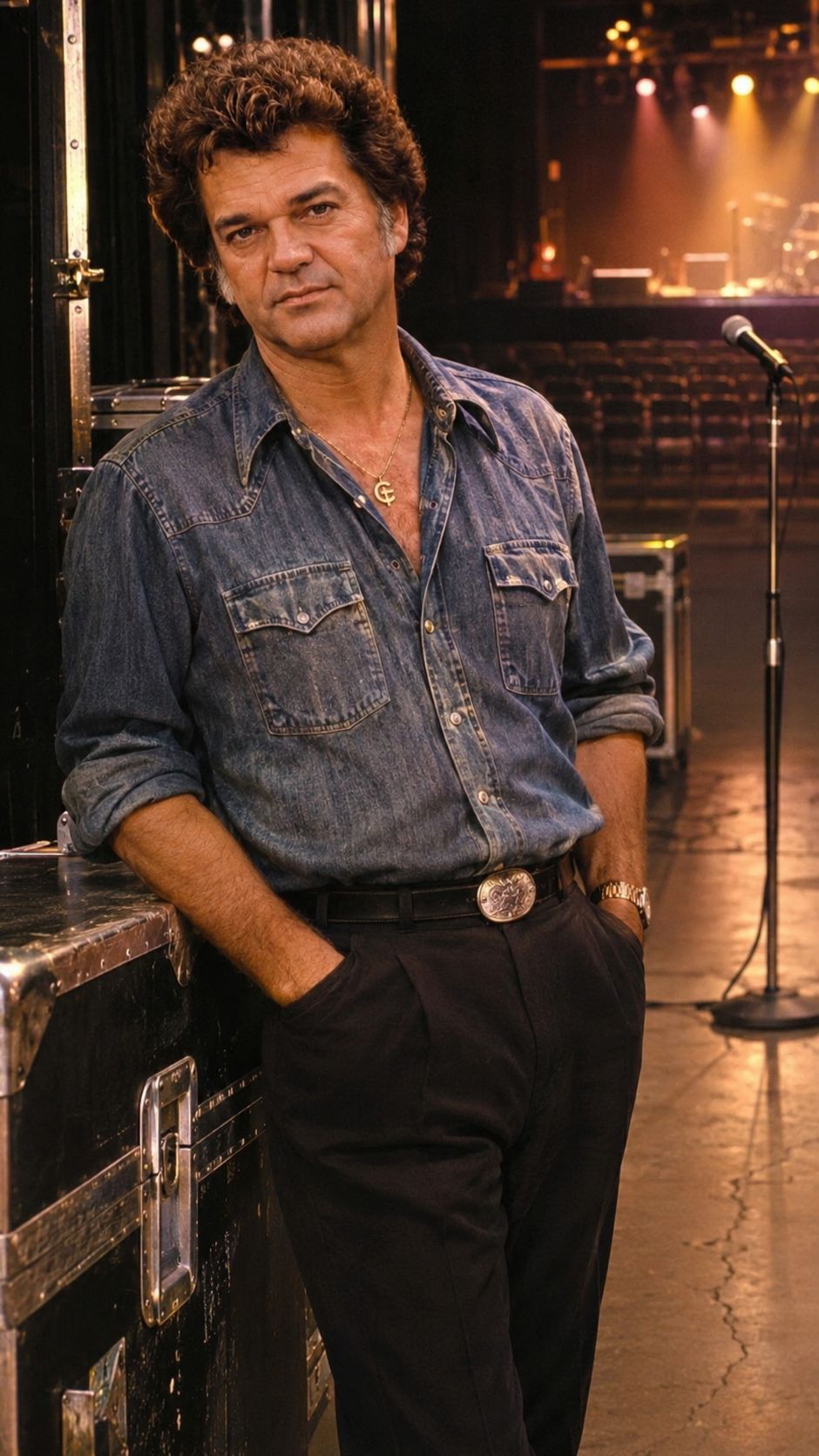
There are moments in country music history when the world seems to stop, when a familiar voice disappears and generations of listeners suddenly realize that something irreplaceable has been lost. For millions of fans, that moment came on June 5, 1993, when Conway Twitty, one of the most beloved voices in American country music, passed away unexpectedly at just 59 years old.
It was difficult to imagine a country music world without him. For decades, Conway had been a constant presence on radio stations, concert stages, record players, and in the hearts of people who found comfort in his songs. His warm, unmistakable voice could turn a simple love story into an unforgettable emotional experience. Whether singing about devotion, heartbreak, loneliness, or the complicated realities of relationships, he possessed a rare ability to make listeners feel as though he were singing directly to them.
But behind the familiar smile and remarkable career was a final chapter that unfolded far too quickly. His sudden illness shocked those around him, leaving family members, fellow musicians, and devoted fans struggling to comprehend the news.
The story of Conway Twitty’s final days is not simply about the death of a legendary performer. It is about a remarkable life, an extraordinary musical legacy, and the painful reminder that even the strongest voices can fall silent without warning.
THE NIGHT EVERYTHING CHANGED: A SUDDEN MEDICAL EMERGENCY
The events surrounding June 4, 1993, remain among the most heartbreaking moments in the history of country music.
Earlier that day, Conway Twitty had been performing in Branson, Missouri. Despite experiencing stomach discomfort, he continued with his professional commitments. It was Fan Fair weekend in Nashville, one of the most important gatherings on the country music calendar, and Conway was traveling home with his wife, Dee Henry, and members of his band.
Nobody could have imagined that the journey would end in tragedy.
During the trip, the tour bus stopped near Springfield, Missouri. While members of the group stepped away briefly, Conway collapsed. When they returned, they discovered that something was seriously wrong.
He was rushed to a hospital in Springfield, where doctors discovered that he had suffered a ruptured abdominal aneurysm.
It was a devastating medical emergency requiring immediate surgery.
An abdominal aneurysm involves a weakened section of a major blood vessel in the abdomen. When it ruptures, severe internal bleeding can occur, creating a life-threatening situation that demands urgent treatment.
For those waiting anxiously at the hospital, every passing minute must have felt unbearable.
Surgeons worked desperately to save the country star. Reports from the time described serious complications during the operation, including repeated cardiac arrests.
His family was summoned.
The man who had spent decades commanding concert stages and captivating audiences was now fighting for his life in a hospital room.
Tragically, the doctors could not save him.
On the morning of June 5, 1993, Conway Twitty died at the age of 59.
The news spread quickly, leaving the country music community stunned. A performer who had remained active, recording and touring, had disappeared from the world in a matter of hours.
What made the tragedy especially difficult to accept was its suddenness. There had been no long public farewell, no final concert announcement, and no opportunity for fans to prepare themselves for the loss.
One day, his voice was still filling theaters. The next, an entire musical generation was mourning his absence.
A CAREER THAT REFUSED TO FOLLOW THE RULES
To understand why Conway’s death affected so many people, it is necessary to understand the extraordinary journey that brought him to the top.
Born Harold Lloyd Jenkins on September 1, 1933, in Friars Point, Mississippi, Conway grew up surrounded by the musical traditions of the American South.
His father introduced him to the guitar, while gospel, blues, and country music helped shape his developing musical identity.
He demonstrated an interest in performing at an early age. Before becoming a nationally recognized entertainer, he had already formed a band and gained experience performing on local radio.
However, his first major success did not come from country music.
In 1958, he released It’s Only Make Believe, a song that became an enormous international hit. The recording reached the top of the American pop charts and established him as a major rock-and-roll star.
For a young performer, it was an extraordinary achievement.
Yet Conway eventually realized that his musical ambitions extended beyond the rock-and-roll world.
During the 1960s, he made a difficult transition into country music. It was not necessarily an easy decision. He was already associated with a different musical identity, and some industry professionals questioned whether audiences would accept him as a country singer.
But Conway trusted his instincts.
He embraced the traditional storytelling, emotional honesty, and expressive vocal delivery that defined country music.
The decision transformed his career.
Songs such as Hello Darlin’, Fifteen Years Ago, Linda on My Mind, and You’ve Never Been This Far Before established him as one of the genre’s most successful performers.
His ability to communicate complicated emotions became his greatest strength.
He did not simply sing about heartbreak. He made listeners feel the loneliness, regret, desire, and vulnerability behind every lyric.
By the time of his death, he had accumulated an extraordinary collection of chart successes, including 40 Billboard country number-one hits.
His journey from rock-and-roll idol to country music superstar remains one of the most remarkable career transformations in American popular music.
THE SPECIAL BOND BETWEEN CONWAY TWITTY AND LORETTA LYNN
Among the many chapters of Conway’s career, perhaps none remains as beloved as his musical partnership with Loretta Lynn.
Together, they created something that went far beyond an ordinary collaboration.
Their voices complemented each other beautifully. Conway possessed a smooth, intimate vocal style, while Loretta brought strength, personality, and emotional conviction.
When they performed together, their contrasting qualities created an unmistakable musical chemistry.
Their partnership produced several enduring recordings, including:
-
After the Fire Is Gone
-
Lead Me On
-
Louisiana Woman, Mississippi Man
-
As Soon as I Hang Up the Phone
-
Feelins’
Their success was not simply the result of two famous artists sharing a microphone. They understood how to tell a story together.
Their songs explored love, temptation, misunderstandings, commitment, and the complicated emotions that often exist between two people.
The audience could believe every word.
Their achievements included four consecutive Country Music Association Vocal Duo of the Year awards from 1972 through 1975, along with a Grammy Award for After the Fire Is Gone.
For many fans, Conway and Loretta became one of the defining partnerships of classic country music.
That is why Conway’s sudden passing was particularly heartbreaking for admirers of their music.
An essential musical partnership had been permanently changed.
Although Loretta continued performing and building her own extraordinary legacy, the distinctive combination of their voices could never be recreated in quite the same way.
Their recordings became more than entertainment. They became reminders of a musical era when storytelling, vocal chemistry, and emotional sincerity could create something timeless.
THE FAMILY LEFT BEHIND: THE PERSONAL COST OF A SUDDEN GOODBYE
Behind every famous performer is a family whose relationship with that person has little to do with record sales, awards, or public recognition.
For Conway Twitty, the people closest to him were part of a world that existed beyond the concert stage.
His wife, Dee Henry, and his four children, Joni, Jimmy, Kathy, and Michael, were among those left behind after his death.
The suddenness of the tragedy made the loss even more difficult.
Unlike a prolonged illness, an unexpected medical emergency can leave families with almost no time to process what is happening.
A routine journey home can suddenly become a life-changing emergency.
Plans for the following day become irrelevant. Ordinary conversations become precious memories. The future that everyone assumed would arrive is suddenly gone.
Conway had spent much of his life traveling, recording, performing, and maintaining a demanding schedule.
His family knew the realities of life with a successful touring musician. But nothing could make them fully prepared for the events of that June morning.
It is also important to remember that the public sees only a small part of a performer’s life.
Fans remember the songs, the television appearances, the concerts, and the familiar stage personality. Family members remember the person who existed away from the spotlight.
The loss of a father and husband is different from the loss experienced by an audience.
For his family, Conway was not simply a country music legend.
He was someone whose presence had been part of their everyday lives.
HIS FINAL RECORDING AND THE UNEXPECTED MEANING OF FINAL TOUCHES
One of the most remarkable details surrounding Conway’s death involves an album that would take on an entirely different meaning after he was gone.
The album was Final Touches.
Released in 1993, following his death, the record became an unexpected reminder of how actively Conway had continued working until the final chapter of his life.
The title itself carries an emotional weight that listeners could hardly have anticipated.
For an artist whose career had spanned decades, it was another opportunity to demonstrate his ability to interpret songs and connect with an audience.
But history gave the album a significance that nobody could have planned.
It became associated with the final chapter of a career that ended much too soon.
There is something particularly moving about listening to an artist’s final recordings after learning that they would never again enter the studio to create something new.
Every vocal performance becomes a reminder of what was lost.
Every lyric feels more personal.
Every familiar note seems to carry a little more meaning.
Final Touches was not intended to be a farewell message to millions of listeners. Yet, in retrospect, it became part of Conway’s musical farewell.
Another important detail is that his final recording session included a duet with Sam Moore, formerly of the legendary soul duo Sam & Dave. Their interpretation of Rainy Night in Georgia appeared on the 1994 collection Rhythm, Country & Blues.
That recording demonstrated that Conway’s musical curiosity and creative ambitions remained alive even as his career approached its final chapter.
COUNTRY MUSIC LOST MORE THAN A SINGER
When an influential performer dies, the immediate reaction is often measured through chart positions, record sales, awards, and public tributes.
But the true impact of Conway Twitty cannot be measured by statistics alone.
He was a musician who understood the emotional power of a song.
His recordings spoke to people experiencing ordinary but deeply personal moments: falling in love, losing someone, regretting a decision, missing a partner, or trying to understand a relationship that had become complicated.
He knew that country music did not always need dramatic arrangements or complicated production.
Sometimes, a powerful voice and an honest lyric were enough.
His influence also extended to other performers.
He supported songwriters, recognized promising talent, and helped create opportunities for artists who were still finding their place in the industry.
The Country Music Hall of Fame would later recognize his extraordinary achievements by inducting him in 1999.
His contributions also received recognition from the Nashville Songwriters Hall of Fame, which inducted him in 1993.
These honors reflected something important: Conway was not simply a successful entertainer. He was a significant contributor to the musical traditions that shaped country music.
His death left a void, but his recordings ensured that his influence would continue reaching new generations.
WHY CONWAY TWITTY’S FINAL DAYS STILL BREAK OUR HEARTS
More than three decades have passed since June 5, 1993.
Country music has changed enormously. New artists have emerged, musical styles have evolved, and the industry has entered an entirely different technological era.
Yet Conway Twitty remains a familiar name to listeners who cherish traditional country music.
His story continues to resonate because his final days represent something larger than the loss of a celebrity.
They remind us how fragile life can be.
A performer can stand before thousands of people, receive applause, travel to the next destination, and make plans for another performance without knowing that the ordinary journey home may become the final chapter.
There was no grand farewell concert.
There was no carefully planned retirement.
There was simply a sudden medical emergency, a desperate effort to save a life, and a heartbreaking announcement that changed the lives of his family and disappointed millions of admirers.
Perhaps that is why songs like Hello Darlin’ and Goodbye Time feel especially emotional when heard today.
They were created as musical expressions of human relationships, but history has given them another layer of meaning.
Listeners now hear the voice of a man who is no longer here to sing them.
And yet, his voice remains.
That is the extraordinary power of recorded music. It allows a performer to continue reaching people long after the final curtain has fallen.
A LEGACY THAT WILL NEVER BE SILENCED
The final days of Conway Twitty were tragically short, but his influence was built over an entire lifetime.
From his early beginnings as Harold Jenkins in Mississippi to his success as a rock-and-roll sensation, and eventually his rise as one of country music’s greatest voices, his journey was filled with determination, reinvention, and remarkable musical achievements.
His partnership with Loretta Lynn gave country music some of its most unforgettable duets.
His solo recordings became part of the emotional soundtrack of countless lives.
His performances demonstrated the extraordinary connection that can exist between a singer and an audience.
And his unexpected death on June 5, 1993, reminded the world that even the brightest musical careers can end without warning.
But perhaps the most beautiful part of his story is that the silence of his final day never became the silence of his music.
His songs still play in homes, on classic country radio stations, in cars traveling down American highways, and in the hearts of people who grew up listening to him.
For longtime fans, hearing Conway sing is like meeting an old friend again.
Some voices belong to a generation. Others become part of every generation that follows. Conway Twitty left behind a voice that time could never take away.
He may have taken his final breath in 1993, but his music continues to speak.
And perhaps that is the greatest tribute any artist could ever receive.
CONWAY TWITTY MAY BE GONE, BUT HIS VOICE WILL NEVER BE FORGOTTEN.
VIDEO: