 By admin
INTRODUCTION:
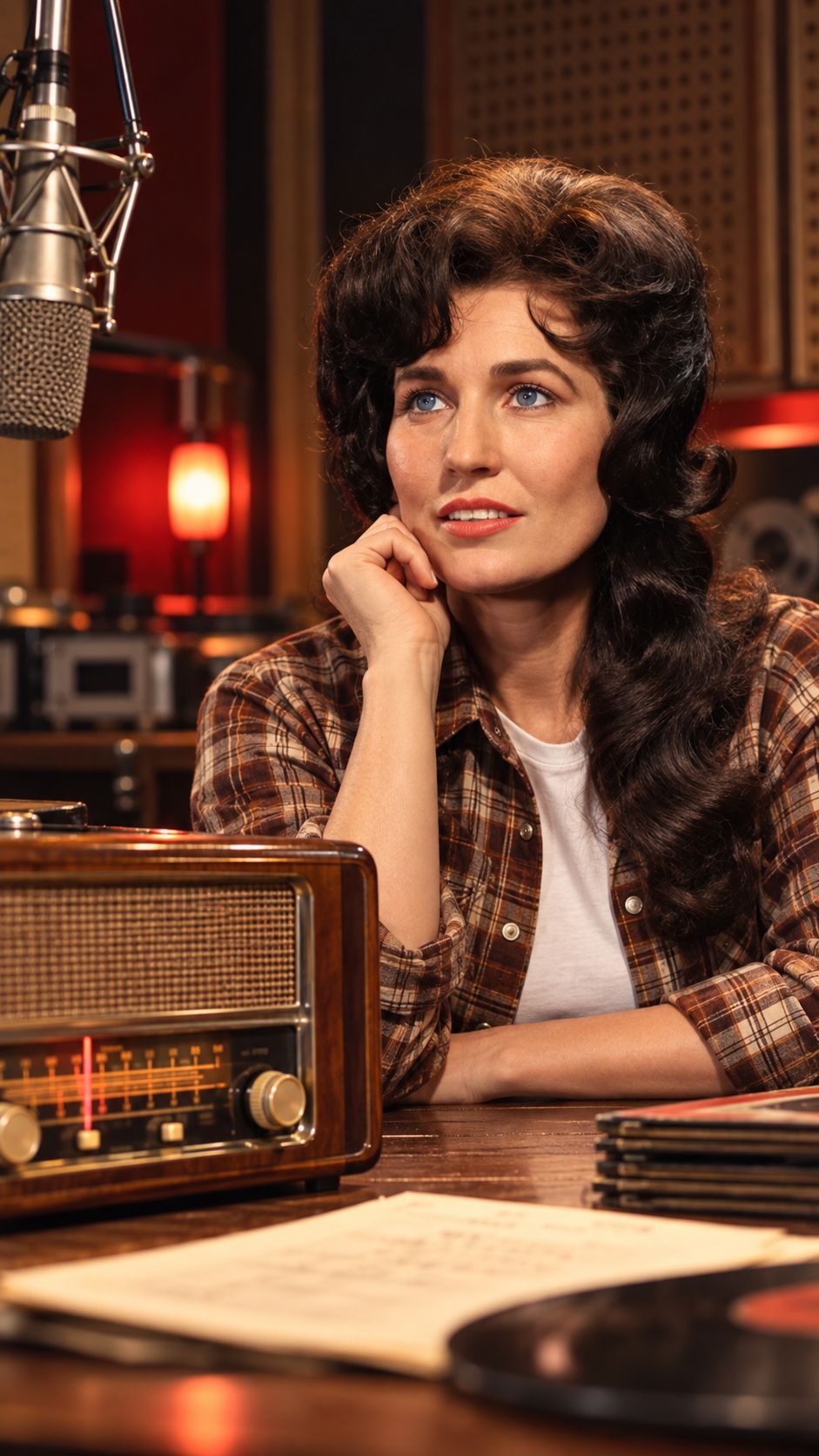
There are moments in country music history when a single song becomes far more than a melody. It becomes a confession, a challenge, and sometimes a battle between an artist’s courage and a society that is not yet ready to listen. Few country singers understood that power quite like Loretta Lynn, the coal miner’s daughter whose unmistakable voice carried the struggles, dreams, heartbreaks, and hard-won independence of ordinary American women into living rooms across the nation.
During an era when women in country music were often expected to sing about devotion, sacrifice, and the quiet virtues of marriage, Loretta Lynn dared to tell stories that made people uncomfortable. She sang about birth control, marital conflict, women’s rights, and the complicated realities of life behind closed doors. Her lyrics were direct, sometimes startling, and frequently controversial. To some listeners, she was a fearless truth-teller. To others, she crossed lines that a woman in country music was never supposed to approach.
The controversy surrounding her music helped transform her from a talented singer into one of the most influential voices in American country music. Songs that provoked outrage also sparked conversations that many people had avoided for generations.
The claim that she was banned from radio nine times has become a dramatic way to describe the resistance her music encountered. The exact number, however, should not be treated as an established historical fact without reliable documentation. What is undeniable is that Loretta Lynn repeatedly challenged the boundaries of what country music could say—and who was allowed to say it.
1. The Pill: The Song That Made America Uncomfortable
The 1975 controversy that defined Loretta Lynn’s fearless reputation

If one song best explains why Loretta Lynn became a lightning rod for controversy, it is undoubtedly The Pill.
Recorded in 1972 and released in 1975, the song arrived at a moment when discussions about contraception, marriage, and women’s independence remained deeply divisive. Its premise was deceptively simple: a wife who has endured repeated pregnancies finally celebrates having greater control over her reproductive future.
Yet the subject was anything but simple for country radio.
At the time, women singing about motherhood were generally expected to celebrate family life, not openly express frustration with the physical and emotional demands of repeated pregnancies. Lynn turned that expectation upside down. With humor, sharp phrasing, and a lively country arrangement, she gave voice to a woman who had reached her limit.
The song was not a rejection of children or family. Rather, it explored something many women understood privately but rarely heard discussed so candidly in popular music: the desire to make decisions about their own bodies and futures.
The Pill was refused airplay by numerous country radio stations. Contemporary accounts commonly report that more than 60 stations declined to play it, although the precise total varies across retellings.
The backlash did not destroy the record. Instead, the controversy helped draw attention to it. The song reached No. 5 on the Billboard Hot Country Singles chart and became one of Lynn’s most recognizable recordings.
That achievement reveals the central contradiction of her career. The same honesty that made some gatekeepers uncomfortable made countless listeners feel understood.
Sometimes, the song people are told not to hear becomes the song they most need to hear.
Lynn had experienced motherhood at a young age and understood that family life was not simply a collection of sentimental photographs. It involved responsibility, exhaustion, sacrifice, and difficult decisions.
She did not need to present herself as a political theorist to make a powerful statement. She only needed to tell a story that felt real.
And that was precisely what made The Pill so difficult for its critics to dismiss.
2. Rated X: When Divorce Became a Public Scandal

Before The Pill became the defining controversy of her career, Loretta Lynn had already challenged another deeply rooted social expectation with Rated X, released in 1972.
The song examines the double standard confronting divorced women. In the world Lynn describes, a divorced woman can be judged harshly by other women while simultaneously being viewed as sexually available by men.
Her character is trapped between conflicting expectations. She is no longer considered respectable in the same way as a married woman, yet she is still expected to navigate a society that measures her worth through male approval.
What made Rated X so striking was that Lynn did not portray divorce as a simple happy ending or a personal failure. She examined the stigma that followed women after a marriage ended.
In conservative communities, divorce could carry consequences far beyond the courtroom. It could affect friendships, church relationships, family standing, and a woman’s prospects for a new relationship.
Lynn understood the power of these social judgments. Her songwriting frequently focused on working-class women who had little control over how society interpreted their choices.
The title alone was enough to make some disc jockeys suspicious. In later interviews, Lynn recalled that certain DJs rejected the record before listening to it. Once the song climbed the charts, some changed their minds.
That detail reveals something important about the era: sometimes, a title could provoke more fear than the actual story contained.
Rated X eventually reached No. 1 on the country chart, demonstrating that controversial subject matter did not automatically alienate audiences.
Its deeper significance lies in its refusal to treat divorced women as cautionary tales. Lynn gave her character a voice, a perspective, and a dignity that social conventions often denied her.
She was not asking listeners to agree with every decision her character made. She was asking them to consider the unfairness of the judgment she faced.
That distinction remains central to understanding Lynn’s artistry.
3. Don’t Come Home A-Drinkin’ (With Lovin’ on Your Mind): The Wife Who Finally Says No

Long before the debate over contraception reached its peak, Lynn had already begun challenging the expectations placed on wives through Don’t Come Home A-Drinkin’ (With Lovin’ on Your Mind), released in 1966.
The premise is direct: a woman is tired of her husband returning home after drinking and expecting affection as though his behavior has no consequences.
There is no elaborate philosophical argument. The woman has simply had enough.
That straightforwardness is precisely what makes the song powerful. Lynn’s narrator refuses to pretend that marriage automatically erases resentment or that a wife’s responsibilities include silently accepting every demand placed upon her.
Country music had long explored drinking, infidelity, and marital trouble. What distinguished Lynn was the position from which she told the story.
She was not merely singing about a troubled relationship from a distance. She placed the frustrated wife at the center of the narrative and allowed her to set a boundary.
The song became a major country hit, reaching No. 1 on the Billboard country chart in 1967. It helped establish Lynn as an artist who could combine commercial appeal with unusually direct storytelling.
Its importance becomes clearer when considered alongside her later controversies.
Don’t Come Home A-Drinkin’ challenged the assumption that a woman should always accommodate her husband. Rated X questioned the stigma attached to divorced women. The Pill explored reproductive choice.
Together, these songs reveal a consistent artistic vision: women were entitled to describe their own experiences, even when those experiences contradicted traditional expectations.
Lynn’s approach was particularly effective because she did not deliver her message through abstract slogans. She used recognizable characters, familiar domestic situations, humor, anger, and memorable melodies.
Listeners could disagree with the woman in a song and still recognize her situation.
That ability to make difficult subjects feel personal was one of Lynn’s greatest strengths.
4. Wings Upon Your Horns: The Price of Innocence

Another revealing example is Wings Upon Your Horns, released in 1969.
The song explores a young woman’s sexual awakening, innocence, and disappointment. Its use of religious imagery gives the story an additional layer of emotional tension, connecting personal experience with the moral expectations surrounding it.
For a female country singer working in the late 1960s, openly addressing such themes was a significant artistic risk.
The cultural expectations of the period frequently demanded that women present themselves as morally respectable while leaving many of the realities of romantic relationships unspoken. Lynn was willing to explore the consequences of those expectations.
Her songs did not always offer tidy resolutions. Sometimes, a character made a mistake. Sometimes, she trusted the wrong person. Sometimes, she discovered that the world was far less forgiving than she had imagined.
That willingness to portray vulnerability made Lynn’s storytelling more human than a simple narrative of good behavior rewarded and bad behavior punished.
The controversy surrounding songs like Wings Upon Your Horns also demonstrates how differently audiences can interpret the same material. Some listeners hear an uncomfortable challenge to traditional morality. Others hear a warning about manipulation, trust, and the consequences of unequal relationships.
The song’s lasting value lies in that emotional complexity.
Lynn did not need every listener to reach the same conclusion. She needed the story to feel sufficiently real that people would keep discussing it after the music ended.
And she understood that a song could be provocative without being empty provocation.
5. One’s on the Way: The Exhaustion Behind the Perfect Family Picture

Released in 1971, One’s on the Way offered another sharp observation about the gap between domestic expectations and everyday reality.
Written by Shel Silverstein, the song follows an overwhelmed mother in Kansas City who is surrounded by household responsibilities, children, and the demands of family life while the wider world continues moving around her.
The narrator is pregnant again. Her life is busy, repetitive, and exhausting, yet the song presents her situation with a wonderfully dry sense of humor.
Its brilliance lies in what it refuses to romanticize.
Motherhood can be deeply meaningful, but that does not mean every moment is peaceful. Raising children requires work. A household does not maintain itself. A mother’s personal ambitions and needs do not disappear simply because she has a family.
The song’s humor makes its social commentary easier to absorb. Instead of delivering a lecture about gender roles, it allows listeners to recognize the absurdity of a woman being expected to manage everything while the rest of the world barely notices her workload.
For Lynn, this was familiar territory.
Her repertoire repeatedly returned to women whose lives were shaped by marriage, money, children, and responsibilities that rarely attracted public recognition. She understood that the most revealing social criticism could emerge from an ordinary domestic scene.
One’s on the Way became another major country hit, reaching No. 1 on the country chart in 1971.
Its success illustrates a crucial point: not every controversial or socially observant song was banned from radio. Some reached enormous audiences precisely because their humor and familiarity made them accessible.
It would therefore be misleading to describe every challenging Lynn recording as a censored song. The response varied from record to record, station to station, and audience to audience.
What connects these songs is not a uniform history of prohibition. It is Lynn’s willingness to portray women’s lives without smoothing away their contradictions.
6. Dear Uncle Sam: When Country Music Turned Toward War

Not all of Lynn’s controversial material centered on relationships or women’s independence.
In Dear Uncle Sam, released in 1966, she addressed the human consequences of the Vietnam War through the perspective of a woman whose loved one has been sent away to serve.
The song transforms a major national conflict into an intimate personal experience. Instead of focusing on military strategy or political speeches, it asks listeners to consider the people waiting at home.
Its emotional power comes from the distance between public language and private reality. Governments discuss duty and sacrifice, but families experience absence, uncertainty, and fear.
Lynn’s approach was consistent with her broader songwriting philosophy: major historical events become more understandable when viewed through the lives of ordinary people.
The song was not simply a slogan for or against a political position. Its focus was the emotional cost of war, a subject that resonated with families who had direct experience of military service.
This recording also complicates the popular image of Lynn as a singer concerned exclusively with domestic relationships. She could move from a household argument to a national tragedy without abandoning her central interest in human experience.
Her characters were often people who lacked power over the larger forces shaping their lives. Whether those forces involved marriage, social judgment, economic circumstances, or war, she gave their feelings room to be heard.
That perspective helped distinguish her from performers who treated country music primarily as entertainment.
For Lynn, a song could also be a way of making private suffering visible.
7. Was Loretta Lynn Really Banned From the Radio Nine Times?
The headline claim deserves a closer look because the distinction between a documented radio ban and a memorable story about censorship matters.
There is strong historical evidence that The Pill was rejected by numerous radio stations and that Rated X faced resistance from some disc jockeys. Lynn herself discussed these experiences in interviews.
However, the specific claim that she was banned nine separate times should not be presented as an established fact without a clearly documented list of nine incidents.
There was no single, universal decision that removed all of Lynn’s controversial songs from every American radio station. Radio programmers made individual decisions, and different stations responded differently to particular recordings.
A song could be refused by one station, played by another, and still become a national hit.
This distinction makes Lynn’s story more interesting, not less.
The real struggle was not necessarily a series of nine identical bans. It was the recurring tension between an artist determined to tell uncomfortable stories and an industry that sometimes preferred familiar, less challenging material.
The Pill provides the clearest example. The recording was controversial, but it also achieved substantial commercial success. Its reception demonstrates that radio resistance could coexist with enthusiastic demand from listeners.
The same complexity applies to Rated X, which ultimately topped the country chart despite the objections Lynn recalled.
There is another important consideration: controversy can create publicity. When a song becomes the subject of debate, people who might otherwise overlook it may become curious enough to seek it out.
That does not mean every ban was a calculated publicity strategy or that every controversial record benefited financially. It means that censorship and commercial success are not always opposites.
Lynn’s career repeatedly demonstrated that audiences could be more receptive to difficult subjects than certain gatekeepers assumed.
The most defensible conclusion is this: Loretta Lynn faced documented resistance over specific songs, but the exact nine-ban figure remains unverified.
Her legacy does not depend on that number. It rests on the recordings themselves and the conversations they helped bring into public life.
8. Why Loretta Lynn’s Controversial Songs Still Matter Today

Decades after their release, Loretta Lynn’s most challenging songs continue to attract attention because the questions they raise have not disappeared.
Women still negotiate expectations surrounding marriage, motherhood, independence, and respectability. Families still experience the consequences of war. People who leave relationships still encounter judgment. And artists still face decisions about whether to challenge audiences or provide the familiar comfort they expect.
Lynn’s work offers a valuable reminder that popular music can entertain while also examining social realities.
Her influence can be heard in generations of country artists who have written about complicated relationships, imperfect families, and women’s autonomy. Performers such as Miranda Lambert and The Chicks have continued exploring difficult subjects in ways that reflect, in different forms, the tradition Lynn helped strengthen.
That does not mean every later artist shares her exact politics or artistic approach. Rather, her career helped establish that a woman in country music could tell an uncomfortable story without surrendering her place in the genre.
Her achievement was especially remarkable because she communicated through the language of traditional country music. She used familiar melodies, plainspoken lyrics, humor, and characters that felt recognizable to working families.
She did not have to abandon country music’s traditions to challenge its assumptions.
Instead, she demonstrated that the genre’s greatest strength was its capacity to tell the truth about people who were rarely perfect.
And perhaps that is why the controversies remain so compelling. The songs were never simply about shocking radio programmers. They were about women whose experiences had been reduced to stereotypes, men who failed to understand their partners, families living through uncertainty, and individuals struggling to make sense of circumstances beyond their control.
Loretta Lynn gave those people a voice that was unmistakably hers.
9. The Final Truth: She Was More Than a Controversial Country Singer
It would be easy to remember Loretta Lynn only as the woman who sang about subjects other country stars avoided. But doing so would overlook the musical skill, emotional intelligence, and storytelling ability that made those songs endure.
She was a songwriter and performer who understood that a compelling character could communicate more than a dozen abstract arguments.
She could make listeners laugh at domestic exhaustion, recognize the cruelty of social judgment, feel the loneliness of a family touched by war, and confront the difficult realities of reproductive choice.
Her songs could be playful and angry, compassionate and confrontational, traditional in sound and radical in implication.
That combination helped her become one of country music’s most important voices. Her achievements extended far beyond controversy, including her historic recognition as the first woman to win the Country Music Association’s Entertainer of the Year award in 1972.
Her place in music history was earned not because every station rejected her songs, but because she continued to create work that connected with audiences even when some gatekeepers objected.
And that is the lasting lesson behind the stories of her supposedly forbidden recordings.
A controversial headline may attract attention for a moment. A truthful song can remain meaningful for generations.
Loretta Lynn understood the difference.
She sang about the lives people lived, the feelings they concealed, and the questions they were sometimes afraid to ask. She did so in a voice that was direct, unmistakable, and deeply rooted in the traditions of country music.
Whether the disputed number was nine or something else entirely, the historical record points to a larger truth: she repeatedly tested the boundaries of what country music was willing to say.
And she helped make those boundaries wider.
The legacy that outlasted the controversy
Perhaps the most remarkable thing about Loretta Lynn is that her most provocative songs did not erase her traditional country roots. They revealed how much those roots could hold.
She could sing about heartbreak and independence, family and frustration, patriotism and personal sacrifice. She could challenge a cultural expectation without losing her connection to the people who had grown up listening to country music.
Her story reminds us that the history of American music is not only a history of hit records and award ceremonies. It is also a history of the subjects artists dared to bring into the open.
And sometimes, the most enduring country songs are the ones that make us reconsider what we thought we knew.
What do you think was Loretta Lynn’s boldest song—The Pill, Rated X, or another recording that challenged the rules of its time? Her music still gives fans plenty to discuss, and that may be the strongest evidence of all that her voice continues to matter.
VIDEO: