 By admin
 INTRODUCTION:
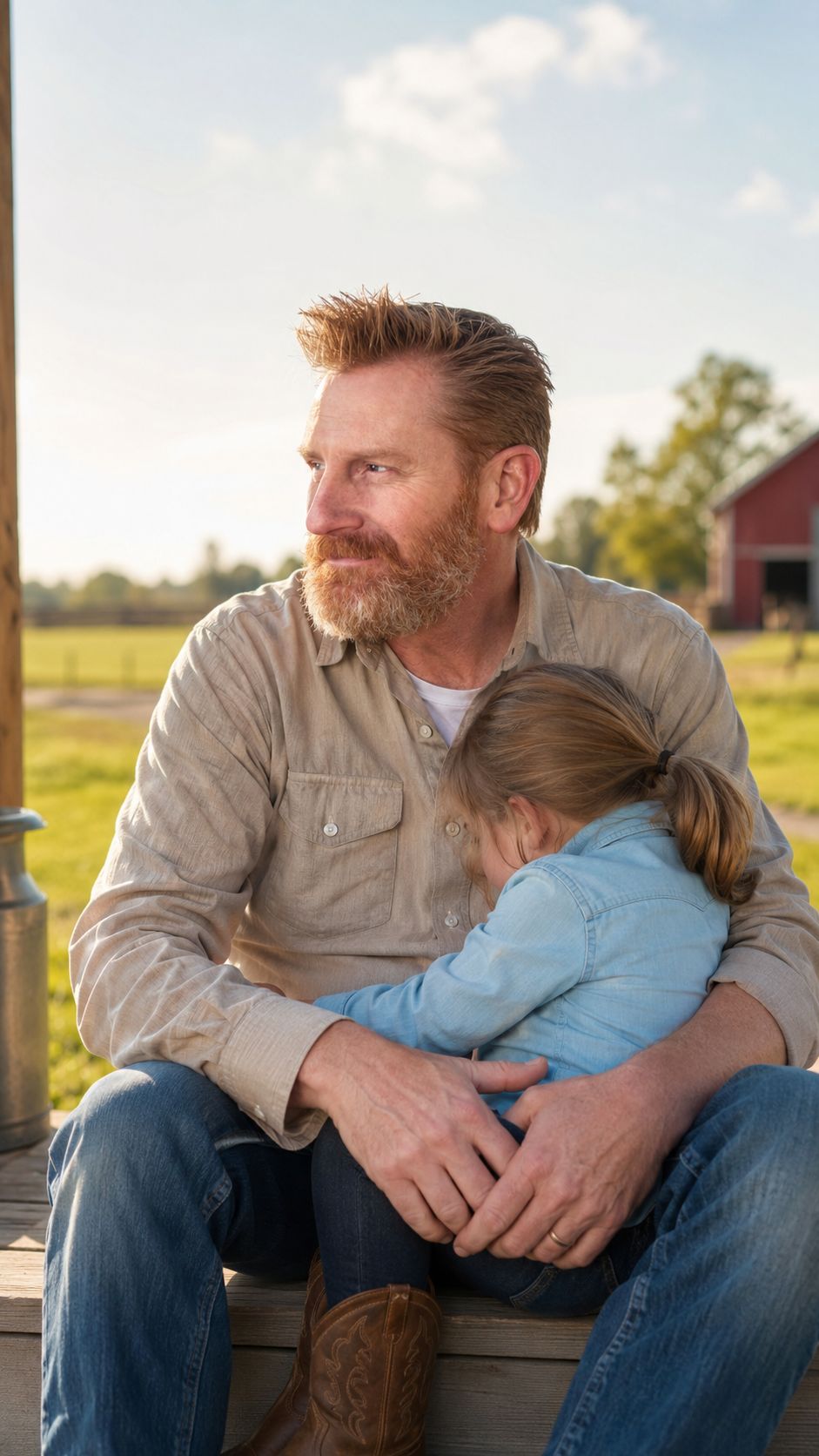
There is something almost disarming about Rory Feek.
He doesn’t look like a man who has spent years carrying grief.
In photographs, he is often seen in a worn hat, boots, jeans, standing somewhere on his Tennessee farm. Sometimes he is beside a barn. Sometimes he is sitting on a porch. Sometimes he is simply walking through the property with his daughter.
And often, there is that quiet smile.
It is not the loud smile of a celebrity enjoying the spotlight.
It is the smile of someone who has learned that happiness can exist alongside heartbreak.
For Rory Feek, the simple life has never really been simple.
Behind the farm, the schoolhouse, the music, the stories and the quiet mornings is a man who experienced extraordinary success—and extraordinary loss. He became half of the beloved country duo Joey + Rory, built a life around family, watched his wife Joey battle cancer, and ultimately faced the devastating reality of raising their young daughter without her mother.
Yet somehow, Rory chose not to run from ordinary life.
He leaned into it.
And that decision may be the most revealing part of his story.
He Had Fame—But He Chose Home
Before the farm became the center of his world, Rory Feek was already an accomplished songwriter and performer.
Together with Joey, he became part of one of country music’s most recognizable husband-and-wife duos. Their music was rooted in traditional country values, while their public story was built around something even more powerful: marriage, family, faith and authenticity.
But in 2014, Rory and Joey made a decision that said more about their priorities than any award ever could.
They stepped away from the machinery of entertainment as they prepared for the birth of their daughter, Indiana.
Rory later explained that they had planned to spend time at home, simplify their lives and document the experience of raising their new baby.
Then life changed in ways they could never have anticipated.
Indiana was born with Down syndrome.
And shortly afterward, Joey was diagnosed with cervical cancer.
Their dream of a peaceful year on the farm became something entirely different.
As Rory himself wrote on his long-running blog, the story they had imagined was replaced by one involving “a little girl with Down syndrome, a new mother with cancer,” and eventually the unbearable loss of his wife.
That is the part of Rory’s story that is easy to overlook.
People see the farm.
But the farm was never merely an escape from Nashville.
It became the place where Rory learned how to live after his entire definition of family had changed.
The Farm Became a Place of Memory
After Joey died in 2016 at the age of 40, Rory found himself raising Indiana, who was only two years old.
Their Tennessee property became both home and sanctuary.
A schoolhouse was built on the farm. The barn became a gathering place. The land became part of Indiana’s childhood.
And surrounding all of it were reminders of Joey.
One particularly powerful image came to define Rory’s post-Joey life: from the farmhouse, he could see both the cross marking Joey’s resting place and the schoolhouse created for Indiana.
It was almost as though the landscape itself represented the two forces shaping his life—loss behind him and fatherhood in front of him.
That is why Rory’s farm life can look deceptively peaceful.
The quiet is real.
But so is the history underneath it.
Every garden path, every barn door and every morning routine carries memories of a life that Rory once expected to share with Joey.
He didn’t erase those memories.
He built them into the life that came afterward.
Joey’s Absence Became Part of His Fatherhood
Perhaps the most heartbreaking part of Rory’s story is that Indiana was so young when her mother died.
She would grow up knowing Joey largely through memories, photographs, recordings, stories and the people who loved her.
Rory therefore faced a responsibility larger than simply raising a daughter.
He had to help preserve a mother.
That meant telling Indiana who Joey was.
It meant keeping her music alive.
It meant allowing Joey’s presence to remain part of their home instead of pretending that grief had to disappear for life to continue.
Rory once described how Indiana would sometimes ask to hear her mother’s singing.
That detail says everything.
A little girl could not fully understand death.
But she could recognize a voice.
And for Rory, that voice remained a bridge between the mother Indiana lost and the daughter he was raising.
“I just had the best seat in the house, to watch the world discover my wife.”
That line reveals something profound about Rory.
He wasn’t simply Joey’s husband.
He was her witness.
He understood her talent, her joy and her love of performing. And after she was gone, he continued telling her story.
Not because he wanted to live in the past.
But because he understood that love does not automatically end when someone’s life does.
Fatherhood Changed Him
Rory has also spoken openly about how fatherhood evolved for him.
He was already a father to older daughters, Heidi and Hopie, before Indiana was born. But the experience of raising Indiana after Joey’s death forced him to reconsider what being a father truly meant.
In one interview, Rory reflected that when he was younger, he had been present for his children but had not always fully understood how precious those moments were.
Later, he became more intentional about simply being there.
“I am more present than I was then.”
That may be one of the quietest but most important statements Rory has ever made.
Because fatherhood is often portrayed as sacrifice in dramatic terms.
But sometimes the greatest sacrifice is much quieter.
It is choosing not to rush.
Choosing the school run over another opportunity.
Choosing dinner at home.
Choosing a conversation on the porch.
Choosing to be available when a child needs you.
Rory’s life increasingly became an argument for the importance of presence.
He Didn’t Stop Grieving—He Learned to Carry It
One of the biggest misconceptions about grief is that moving forward means leaving the person behind.
Rory’s story suggests something different.
He moved forward while carrying Joey with him.
His blog, This Life I Live, became one of the ways he processed what had happened. Rory has described storytelling as something that helped him understand his own life.
That is important because he was not simply writing for an audience.
He was trying to make sense of an experience that could not be easily explained.
The farm became part of that process.
Working the land.
Growing food.
Taking care of animals.
Raising a child.
Building a schoolhouse.
Writing.
Remembering.
Those ordinary acts became a form of reconstruction.
After tragedy takes away the life you expected, you sometimes have to build a new life from small pieces.
For Rory, those pieces were often remarkably ordinary.
And perhaps that was exactly the point.
The Quiet Smile Means Something Different Now
When Rory Feek smiles today, it is tempting to see only peace.
But knowing his story changes the image.
That smile is not evidence that he forgot.
It is evidence that he kept living.
He lost a wife he deeply loved.
He watched a young family become a single-parent household.
He had to help his daughter grow up with memories of a mother she lost far too young.
And yet he continued to create.
He continued to tell stories.
He continued to work the farm.
He continued to make room for family.
That is not a fairy-tale ending.
It is something more honest.
A life that continued after the ending Rory never wanted.
Perhaps This Is Rory Feek’s Greatest Country Song
Country music has always understood something that other genres sometimes miss:
The most powerful stories are not always about winning.
Sometimes they are about enduring.
A broken heart.
An empty chair.
A child growing up.
A photograph on the wall.
A song playing on the radio.
A pair of boots by the door.
A cup of coffee beside an empty seat.
These are the details that make grief real.
And Rory Feek has spent years turning those details into a different kind of country story.
Not one about celebrity.
Not one about wealth.
Not even one primarily about music.
It is a story about what happens when a man loses the future he thought he was going to have—and chooses to build another one anyway.
His farm may look quiet.
His life may appear simple.
His smile may seem effortless.
But behind that smile is a history of love, loss, sacrifice and fatherhood.
And perhaps that is why Rory’s story continues to resonate so deeply.
Because eventually, most people discover that life does not give us the ending we planned.
The question is what we do next.
Rory Feek chose to keep showing up.
For his daughter.
For the memories of his wife.
For the land.
For the stories.
For the ordinary mornings that somehow became extraordinary simply because they were still there.
And maybe that is the real lesson hidden beneath his simple farm life:
Sometimes courage doesn’t look like standing on a stage.
Sometimes it looks like walking home.
Sometimes it looks like raising your child.
Sometimes it looks like planting another garden after the person who taught you how to grow one is gone.
And sometimes, after everything you’ve lost, courage looks exactly like a quiet smile.
Not because the pain disappeared.
But because love stayed.
VIDEO: