 By admin
 INTRODUCTION:
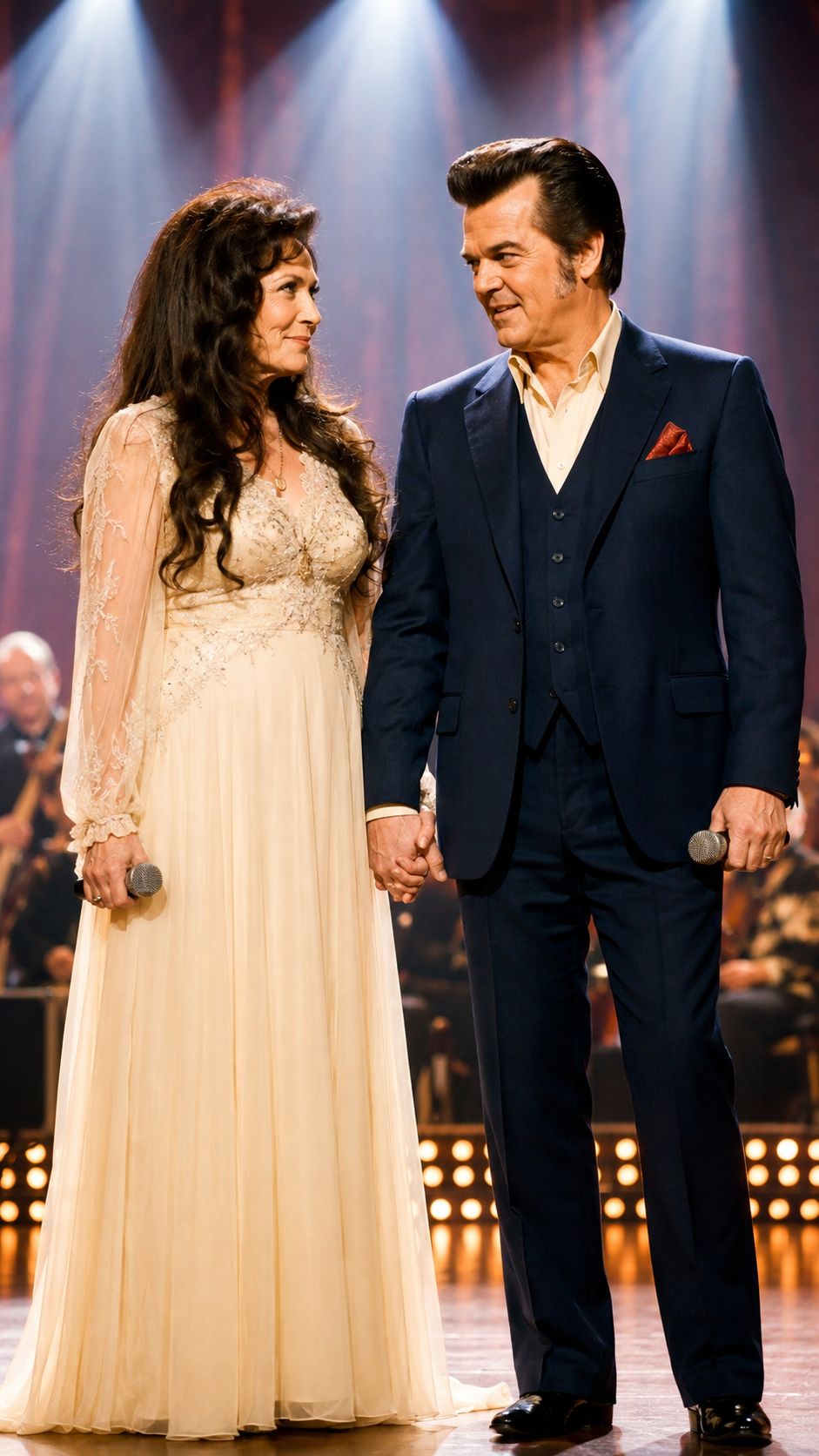
There are some stories in country music that seem almost too perfect to be true.
Two superstars. Two unmistakable voices. Two very different personalities. Years of unforgettable duets, teasing banter, emotional performances—and a friendship that audiences constantly misunderstood.
Then, decades later, one final encounter changed the way fans remembered everything.
Conway Twitty and Loretta Lynn were never simply another country duet. From the moment their voices collided, there was something magnetic about them. They could sound playful one minute, wounded the next, and completely believable throughout. Their chemistry was so convincing that fans spent years wondering whether something more complicated existed behind the scenes.
Loretta herself rejected that idea.
As she explained to American Masters, people assumed she and Conway were romantically involved, but she insisted that their relationship was friendship and music.
And yet, there was another emotion beneath their partnership that is easier to understand: competition.
Not necessarily hatred. Not betrayal. Not the kind of rivalry that destroys friendships.
Something subtler.
The pressure of standing beside another superstar and trying to make sure your own voice was never swallowed by theirs.
TWO GIANTS WALK INTO THE SAME ROOM
When Conway and Loretta began working together, neither needed the other to become famous.
Loretta had already established herself as one of country music’s most formidable women. Conway, meanwhile, had transformed himself from a rock-and-roll star into one of country music’s biggest hitmakers.
Their partnership officially took shape in the early 1970s, after producer Owen Bradley helped bring them together. Initially, there was resistance from people around them who questioned whether combining two major solo careers made sense.
The answer came through the records.
Their first No. 1 duet, “After the Fire Is Gone,” reached the top of the country chart in 1971 and helped launch an extraordinary run.
Then came “Lead Me On,” “Louisiana Woman, Mississippi Man,” “As Soon as I Hang Up the Phone,” and “Feelins’.”
Five consecutive No. 1 country singles.
They eventually accumulated 12 Top 10 hits together and four consecutive CMA Vocal Duo of the Year awards from 1972 through 1975.
That success created a strange problem.
The better they became together, the more people wanted to know what happened when the microphones were turned off.
THE “RIVALRY” FANS COULDN’T STOP TALKING ABOUT
The supposed rivalry between Conway and Loretta should be understood carefully.
There is no strong evidence that they were enemies or secretly plotting against one another.
But they were competitive professionals.
And that mattered.
Conway had a polished, confident stage persona. Loretta brought something different: toughness, humor, vulnerability, and a voice that could sound like it had lived through every lyric.
When they shared a stage, neither disappeared.
They pushed back against each other.
That tension became part of the magic.
Conway could deliver a line with effortless confidence, and Loretta could answer him with a look—or a vocal phrase—that seemed to say, You aren’t getting the last word.
That wasn’t necessarily hostility.
It was theater.
It was chemistry.
And it was one reason audiences couldn’t look away.
They didn’t sound like two singers trying to blend into one voice. They sounded like two personalities refusing to surrender their identity.
That distinction helped make their records timeless.
WHEN THE PARTNERSHIP STARTED TO CHANGE
But even legendary partnerships have limits.
Conway and Loretta’s full-time touring partnership largely wound down by 1981 as their individual careers demanded more of their time. They remained friends and occasionally reunited professionally.
That is important because it changes the meaning of their later appearances.
They weren’t a permanently inseparable duo waiting for one dramatic breakup.
They had already become two independent legends.
And perhaps that is why their later reunions carried such emotional weight.
There was history in every glance.
History in every harmony.
History in every joke.
THE NIGHT THAT WASN’T SUPPOSED TO BE A GOODBYE
This is where the story becomes almost unbearably sad.
Online retellings sometimes describe a specific “final night” as though Conway and Loretta knew they were standing together for the very last time and deliberately staged a dramatic farewell.
The historical record is more complicated.
Their final appearances together are not as cleanly documented as the viral versions suggest, and some stories circulating online appear to blend different performances and later memories.
But something far more extraordinary—and fully documented—happened in June 1993.
And it wasn’t on a concert stage.
It was in a hospital.
Conway was traveling through Missouri when he suddenly became critically ill. He was taken to Cox Medical Center in Springfield after suffering an abdominal aortic aneurysm.
By an extraordinary twist of fate, Loretta Lynn was already in that same hospital, where her husband, Oliver “Doolittle” Lynn, was seriously ill.
Think about that for a moment.
After years of touring together.
After years of making audiences laugh and cry.
After years of people speculating about their relationship.
Their paths crossed one final time—not beneath stage lights, but beneath hospital lights.
THE SHOCKING MOMENT
Loretta later recalled the moment she learned Conway was there.
She was moving between Conway’s wife Dee and her own husband Doolittle, trying to be present for both families.
Then a chaplain told her that Conway might not have long.
Loretta went to see him.
She reportedly encouraged him not to give up, telling him that he loved singing and would be all right. Conway’s wife also spoke to him.
Then Loretta left to return to Doolittle.
And moments later, the news came.
Conway Twitty had died.
He was only 59.
The man who had spent years singing about love, heartbreak, temptation, and goodbye had suddenly become the story behind one of country music’s most heartbreaking goodbyes.
There was no grand final duet.
No carefully planned farewell.
No curtain falling while the audience stood and applauded.
Instead, fate placed Loretta in the same hospital where her longtime musical partner was fighting for his life.
And then it took him away.
THE MOMENT THAT CHANGED HOW FANS HEARD THEIR SONGS
After Conway’s death, their music inevitably sounded different.
Songs that once seemed playful suddenly carried another layer.
“After the Fire Is Gone” wasn’t just a story about fading passion anymore.
“Lead Me On” wasn’t simply theatrical chemistry.
“Louisiana Woman, Mississippi Man” became a snapshot of a musical world that could never be recreated in exactly the same way.
Their voices had become historical artifacts.
The laughter between lines.
The teasing.
The arguments inside the lyrics.
The way Conway would lean into a phrase.
The way Loretta could answer him with equal force.
All of it suddenly belonged to the past.
And perhaps that is the real “shocking moment” behind their story.
It wasn’t a secret fight.
It wasn’t proof that they hated each other.
It was the realization that the partnership everyone assumed would always be there was suddenly gone.
THE TRUTH BEHIND THE UNFINISHED STORY
The temptation is to turn Conway and Loretta’s relationship into a scandal.
Country music history is full of rumors, and their performances certainly encouraged them. Their chemistry was so believable that some listeners assumed they were having an affair.
Loretta repeatedly denied it.
She described Conway as a friend and emphasized that her husband loved and respected him.
That makes their story more powerful—not less.
Because their connection didn’t need a secret romance to become legendary.
It survived on something more durable:
trust, musical instinct, friendship, and mutual respect.
Their supposed rivalry was really the tension between two enormous personalities trying to create something greater than either could create alone.
And they succeeded.
WHY THEIR FINAL CHAPTER STILL HURTS
More than 30 years after Conway’s death, fans continue returning to those recordings.
That alone tells us something.
The music didn’t disappear when the partnership ended.
It became history.
Loretta Lynn continued carrying her own legacy for decades, while Conway’s catalog remained a monument to one of the most prolific careers in country music.
And every time their voices meet on an old recording, the same strange feeling returns.
They sound alive.
They sound competitive.
They sound amused.
They sound as though they’re about to walk offstage together and do it all again tomorrow.
But tomorrow never came.
That may be the saddest part of Conway and Loretta’s story: the music makes it feel as though they are still together, even though history knows they are not.
The legend of their “final night” should therefore not be reduced to an invented feud or a perfectly scripted goodbye.
The truth is more human.
Two people who had shared one of country music’s greatest musical partnerships eventually went their separate professional ways. They remained friends. And when fate brought them together one final time, it happened under circumstances neither could have imagined.
No spotlight.
No applause.
No encore.
Just Loretta, Conway, their families, and the unbearable silence that followed.
That is the part of the story worth remembering.
Not a rivalry that destroyed them.
But a friendship that survived the rumors.
Not a dramatic farewell written for television.
But a final encounter that happened when nobody was watching.
And perhaps that’s why, decades later, Conway Twitty and Loretta Lynn still sound like they are arguing, flirting, laughing, and breaking each other’s hearts every time the record spins.
Because great country music doesn’t simply preserve a voice.
Sometimes, it preserves a relationship.
And sometimes, long after the people are gone, the song is the only place where they can still meet.
VIDEO: