 By admin
INTRODUCTION:
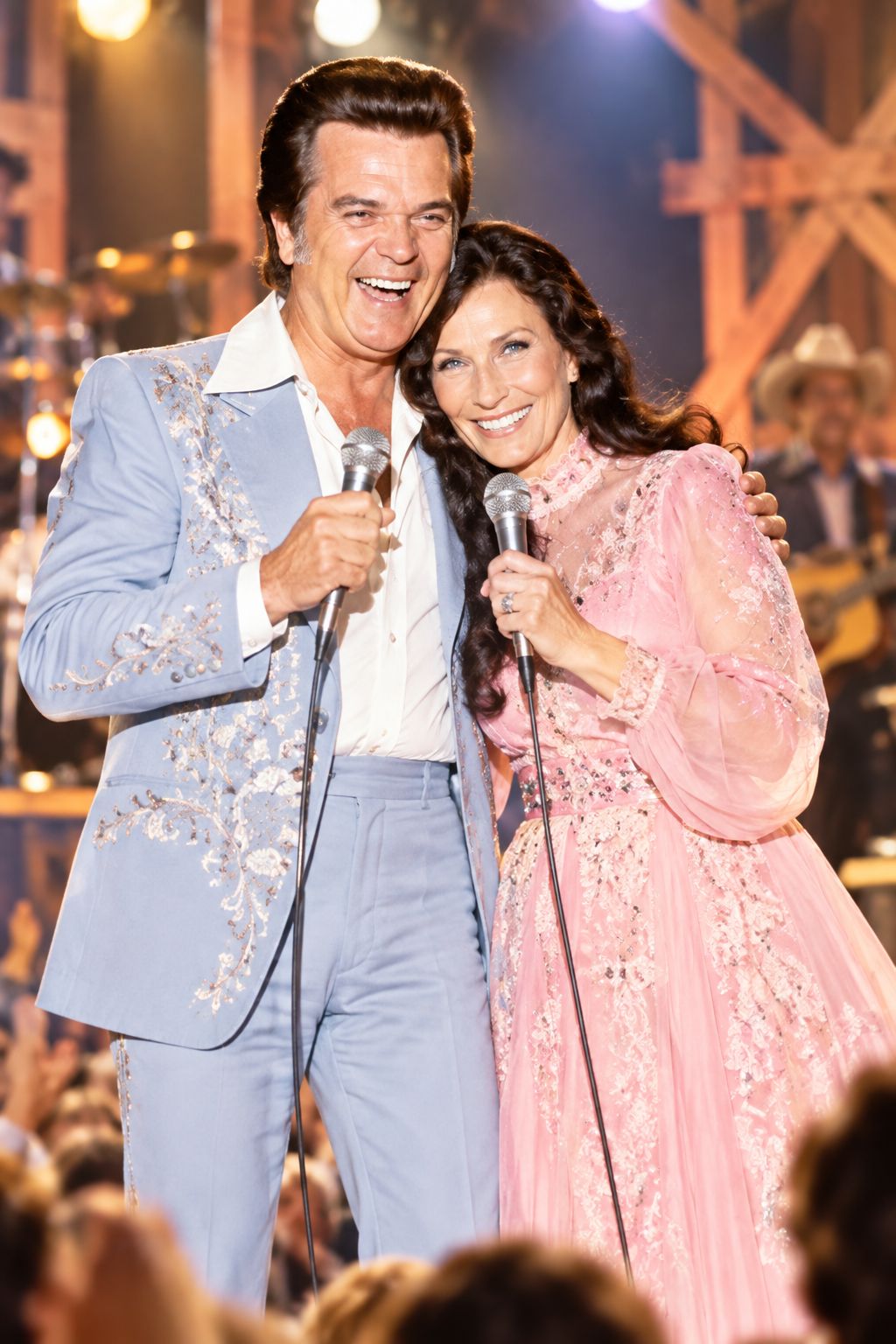
There are musical partnerships that become successful.
And then there are partnerships that seem to change the rules of the game.
In the 1970s, Conway Twitty and Loretta Lynn created one of country music’s most unforgettable creative partnerships. Their voices were different. Their personalities were different. Their backgrounds were different. Yet when they stood behind a microphone together, something extraordinary happened.
They didn’t simply record duets.
They created a new emotional language for country music.
At a time when country duets could easily become predictable—two singers trading lines, harmonizing on a familiar melody—Twitty and Lynn brought something far more dramatic to the format. Their recordings often sounded like conversations between two people caught in complicated relationships: lovers, spouses, people fighting, forgiving, regretting, and trying desperately to understand one another.
That emotional realism helped make their music feel less like a performance and more like a private moment accidentally captured on tape.
And decades later, that is exactly why their partnership still matters.
“When Conway and Loretta sang together, it never felt like two stars simply sharing a song. It felt like two characters living inside the same story.”
The Unlikely Partnership
By the time their partnership became a major force in country music, both artists had already established identities of their own.
Loretta Lynn had become one of the most important women in country music. Her songs frequently explored marriage, family, heartbreak, independence, motherhood, and the complicated realities of being a woman in a changing America.
Conway Twitty, meanwhile, had traveled a remarkably unusual road to country superstardom. He had initially achieved major success in rock and roll before reinventing himself as a country artist.
That history mattered.
Twitty understood pop audiences. Lynn understood the emotional traditions of country music. Together, they occupied a fascinating space between old Nashville and a rapidly changing musical world.
Their voices were not conventionally identical.
That was the point.
Lynn’s delivery could sound vulnerable, direct, stubborn, or wounded. Twitty’s voice carried a darker, smoother quality that could make even a simple lyric sound intimate.
Put them together, and the contrast became part of the magic.
Why Their Duets Felt So Different
The secret wasn’t simply vocal chemistry.
It was dramatic chemistry.
Their most memorable recordings frequently gave each singer a distinct emotional position. One might sound hopeful while the other sounded doubtful. One would make an accusation while the other responded. Rather than merely harmonizing, they often sounded as if they were actually talking to each other.
That transformed the duet.
Suddenly, the listener wasn’t just hearing a song.
They were eavesdropping on a relationship.
This was particularly powerful because country music has always been fascinated with storytelling. The genre thrives on characters, consequences, and emotional truth. Twitty and Lynn understood that instinctively.
“Their greatest achievement wasn’t proving that two voices could blend. It was proving that two personalities could collide inside a song.”
That distinction is crucial.
Many successful duets are beautiful because the singers sound alike.
Twitty and Lynn were compelling because they didn’t.
Their differences created tension, and tension created drama.
A Seismic Shift in the Country Duet
The phrase “seismic shift” may sound dramatic, but their influence deserves dramatic language.
During the 1970s, country music was becoming increasingly sophisticated in its production while still holding tightly to its storytelling roots. Radio audiences were changing. Television was becoming increasingly important. Country artists were reaching listeners who might never have walked into a traditional honky-tonk.
Twitty and Lynn were perfectly positioned for that moment.
Their partnership demonstrated that a duet could be commercially powerful without sacrificing emotional complexity.
Their recordings could be catchy enough for radio but dramatic enough to make listeners feel personally invested.
And their success helped reinforce an important idea:
Country music could tell complicated stories without losing its identity.
Their work also demonstrated the commercial power of recurring artistic partnerships. Instead of being a one-off collaboration, Twitty and Lynn became a recognizable musical team. Audiences knew what emotional world they were entering when the two voices appeared together.
That familiarity created anticipation.
And anticipation became part of their appeal.
The Songs Became Conversations
One reason their recordings remain so memorable is that they often feel cinematic.
Imagine the scene.
Two people are standing in a kitchen after an argument.
One has already said something they regret.
The other isn’t ready to forgive.
Silence fills the room.
Then one person begins to sing.
The other answers.
That is the emotional architecture of the classic Twitty-Lynn duet.
They understood that country music doesn’t need elaborate storytelling devices. A few carefully delivered lines can create an entire world.
A glance.
A hesitation.
A change in vocal tone.
A single phrase answered by another voice.
Suddenly, the listener understands the relationship.
This is where their artistry becomes particularly impressive. They didn’t need to explain every detail. They trusted the audience to fill in the emotional gaps.
And audiences did.
The Chemistry Was About Performance—Not Just Personality
Over the years, listeners have sometimes become fascinated by the chemistry between Twitty and Lynn and wondered whether there was something deeper behind it.
That fascination is understandable.
Their performances could feel extraordinarily intimate.
But the most useful way to understand their connection is through their professional artistry and performance chemistry, rather than turning every emotional lyric into evidence of a private relationship.
They were actors as much as singers when they performed together.
They inhabited the emotional world of the songs.
That’s what made the performances convincing.
Country music has always blurred the line between performer and character. A great country singer doesn’t simply sing about heartbreak—they make you believe they’ve stood in the doorway at midnight and watched someone leave.
Twitty and Lynn mastered that illusion together.
“The intimacy was real in the performance, even when the story belonged to the song.”
That is a powerful distinction.
And it explains why their work could move millions of listeners without requiring the audience to know every detail of their personal lives.
Loretta Lynn’s Strength Met Conway Twitty’s Vulnerability
There was another reason the partnership worked so well.
Lynn rarely sounded passive.
Even when her character was heartbroken, there was usually a sense of strength underneath the vulnerability.
Twitty brought a different emotional texture. His voice could sound confident and masculine, but there was often vulnerability hiding beneath that smooth delivery.
Together, those qualities created balance.
Lynn could challenge.
Twitty could soften.
Lynn could accuse.
Twitty could plead.
Lynn could sound wounded.
Twitty could sound regretful.
The emotional possibilities multiplied because neither singer completely dominated the other.
This made their duets feel like genuine exchanges rather than showcases for one superstar.
The Legacy Goes Beyond the 1970s
The greatest test of a musical partnership isn’t how successful it was during its peak.
It’s whether people still care decades later.
Twitty and Lynn passed that test.
Their influence can be felt in the continuing popularity of country duets, especially songs built around romantic tension and conversational storytelling.
Modern country artists continue to use the formula they helped popularize: contrasting voices, alternating perspectives, emotional conflict, and lyrics that allow listeners to imagine an entire relationship from a few minutes of music.
The technology changed.
The production changed.
The fashion changed.
But the emotional formula survived.
Why?
Because people never stop arguing.
They never stop falling in love.
They never stop breaking up.
They never stop wondering whether they should forgive someone.
That’s the timeless territory Twitty and Lynn explored.
Why Their Music Still Hurts
Perhaps the most remarkable thing about their recordings is how little emotional distance they create between the listener and the story.
You can listen to one of their classic performances today and still recognize yourself.
Maybe you’ve loved someone who couldn’t give you what you needed.
Maybe you’ve said something you wished you could take back.
Maybe you’ve stayed when leaving would have been easier.
Maybe you’ve watched two people you love fight and wished you could make peace between them.
That’s the power of great country music.
It doesn’t require your life to match the singer’s life.
It only needs to make you recognize an emotion you’ve felt.
Twitty and Lynn understood that better than most.
“The songs may belong to another generation, but the emotions never went out of style.”
A Partnership That Became History
Conway Twitty and Loretta Lynn didn’t merely contribute another chapter to the history of country duets.
They helped redefine what a country duet could accomplish.
They showed that two singers could create an entire dramatic world in a few minutes.
They proved that contrasting voices could be more powerful than matching ones.
They demonstrated that romance in country music didn’t have to be simple, clean, or predictable.
And most importantly, they reminded listeners that the greatest country songs aren’t really about perfect love.
They’re about imperfect people trying to navigate it.
That may be the true reason their music continues to resonate.
The 1970s are gone. The recording studios have changed. The country charts have evolved. New generations of singers have taken the stage.
But put on a Twitty-Lynn duet, close your eyes, and something remarkable happens.
For a few minutes, time disappears.
Two voices meet.
Two sides of a story collide.
And suddenly, you’re no longer listening to a piece of country music history.
You’re listening to two human beings trying to make sense of love.
And perhaps that’s why their partnership remains so unforgettable.
Because the seismic shift they created wasn’t ultimately about fame, charts, or awards.
It was about making a duet feel alive.
And once country music discovered just how powerful that could be, it was never quite the same again.
VIDEO: