 By admin
 INTRODUCTION:
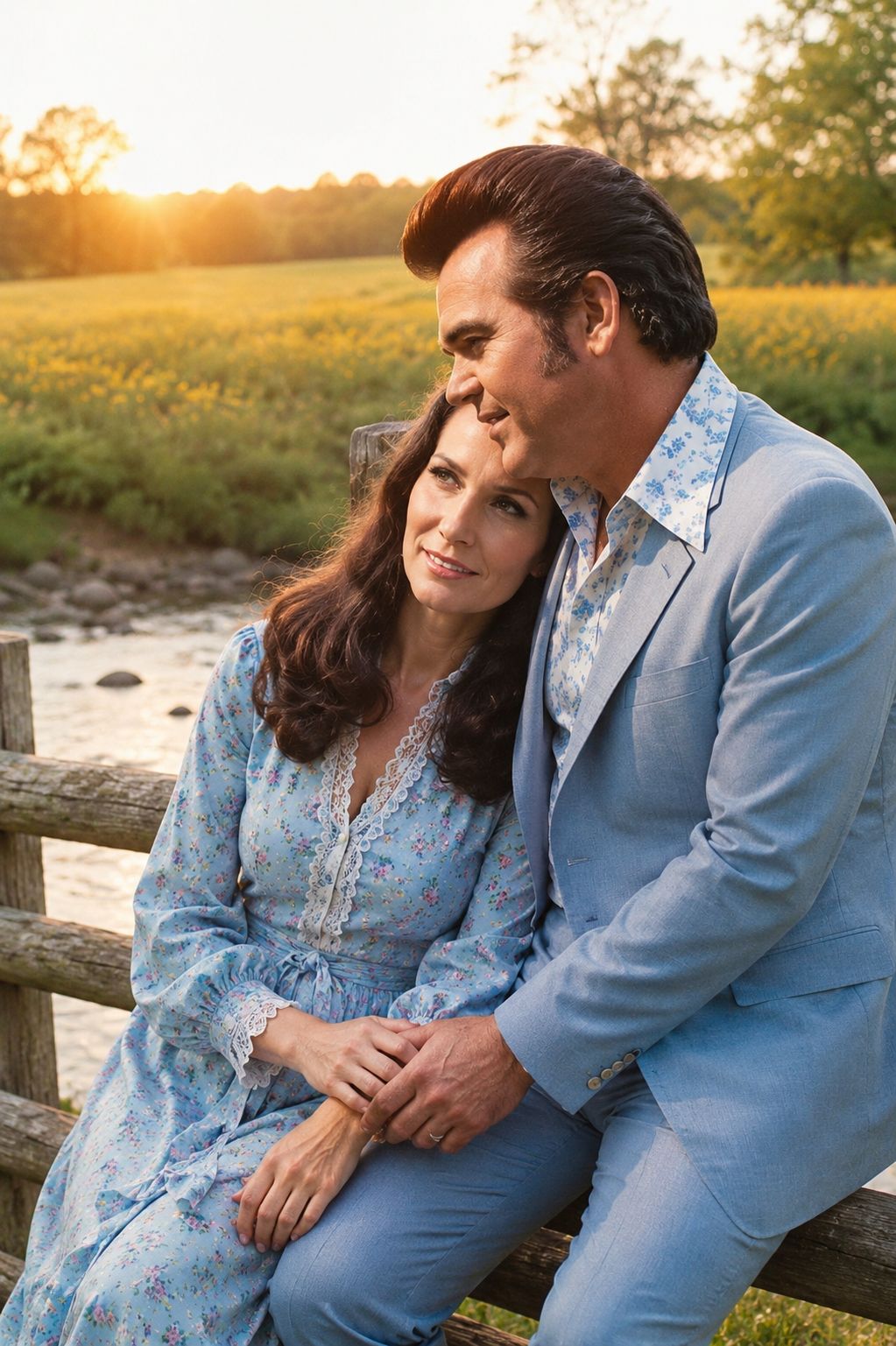
There are country music partnerships that sound good together. And then there are partnerships that make millions of listeners wonder whether they are hearing music—or witnessing something far more personal.
Conway Twitty and Loretta Lynn belonged to that second category.
From the moment their voices collided on songs such as “After the Fire Is Gone,” “Lead Me On,” “Louisiana Woman, Mississippi Man,” and “Feelins’,” audiences heard something almost impossible to explain. Their voices did not simply harmonize. They seemed to argue, tease, confess, challenge, and sometimes surrender to one another.
That chemistry created one of the most successful male-female partnerships in country music history. Between 1971 and 1988, they released 11 studio albums together, produced five No. 1 singles, and won the CMA Vocal Duo of the Year award four consecutive times from 1972 through 1975.
But behind those statistics was a question that refused to disappear:
Were Conway Twitty and Loretta Lynn simply extraordinary friends—or was there ever something more?
The answer, according to Lynn herself and statements attributed to Twitty, is remarkably clear.
But the mystery survives because their music made the opposite case.
The Chemistry That Started the Rumors
To understand why people suspected forbidden love, you have to listen to the songs.
“After the Fire Is Gone” was not a harmless love song. It dealt with emotional emptiness inside a relationship and the temptation to seek affection elsewhere. “Lead Me On” played with the tension between desire and restraint. “Louisiana Woman, Mississippi Man” turned geographical distance into romantic drama.
These were songs about complicated adults making complicated choices.
And Conway and Loretta performed them with such conviction that audiences could easily forget they were watching two professionals interpreting a story.
PBS’s American Masters specifically notes that the pair’s easy chemistry and romantic lyrics caused audiences to puzzle over the nature of their relationship. Lynn, however, rejected the idea that they were lovers, explaining that she loved Conway as a friend and that her husband, Oliver “Doolittle” Lynn, also cared deeply about him.
That distinction matters.
Because the greatest illusion Conway and Loretta created was not that they were secretly in love.
It was that they could make listeners believe they were.
Their secret was not necessarily a hidden romance. Their secret was the extraordinary ability to make a song feel like a private conversation.
They Were Already Stars Before They Became “Conway & Loretta”
The partnership worked partly because neither artist needed the other to become famous.
Loretta Lynn had already established herself as one of country music’s defining female voices. Conway Twitty had traveled an unusual road from rock and pop success into country superstardom.
Twitty’s official biography describes his country career as a remarkable run that eventually produced 50 consecutive No. 1 hits, while also noting his celebrated duet partnership with Lynn.
Their first professional spark came before their famous studio partnership. Lynn later recalled that she and Conway began singing together in dressing rooms while touring overseas. They liked what they heard and decided to try the idea with producer Owen Bradley when they returned home. Bradley loved the combination and put them in the studio.
That origin story is revealing.
It wasn’t some carefully manufactured romantic pairing.
It began with two seasoned performers discovering that their voices simply worked.
And once the microphones were turned on, something extraordinary happened.
The Friendship Behind the Fantasy
There is an important difference between intimacy and romance.
Country music has always depended on emotional intimacy. A great singer has to make an audience believe the words are coming directly from the heart, even when the story belongs to someone else.
Conway and Loretta were masters of that art.
Twitty reportedly described Lynn as one of his best friends in the music business and explicitly denied that there had been a romantic relationship between them.
Lynn gave essentially the same explanation years later.
In an interview preserved by Fresh Air, she was asked directly about the rumors surrounding her and Conway. Her answer was straightforward: they were friends, not lovers.
That should settle the historical question.
But emotionally?
It doesn’t.
Because sometimes the most fascinating relationships are not the ones that become romances.
They are the ones that could have been imagined as romances because the connection was so strong.
And Then There Was Doolittle Lynn
One of the most interesting pieces of the story is that Loretta’s husband was not necessarily threatened by Conway.
In fact, the evidence suggests something quite different.
Doolittle Lynn became an important supporter of the Conway-Loretta partnership. In 1973, he found the song “Louisiana Woman, Mississippi Man,” which became one of their signature recordings. American Songwriter recently revisited the story, noting that Doolittle’s opinion carried increasing weight with both performers.
That detail changes the entire emotional landscape.
Imagine the rumor from the outside:
A married country superstar and a charismatic male singer perform passionate songs together.
Fans see sparks.
But behind the curtain, her husband is helping them find songs.
The supposed “forbidden love” becomes something much more interesting: trust.
Doolittle apparently understood something that audiences sometimes missed.
Conway was not trying to take Loretta away from him.
Conway and Loretta were building something musically rare.
Why Their Songs Felt So Dangerous
The real danger was inside the lyrics.
The duo routinely explored subjects that were uncomfortable for their era: temptation, loneliness, marital dissatisfaction, forbidden attraction, emotional betrayal, and desire.
They did not sing about romance as something clean and perfect.
They sang about romance when it was messy.
That made their performances feel unusually adult.
Their voices were also perfectly contrasting.
Conway’s deep, smooth delivery could sound almost conversational. Loretta’s voice carried vulnerability, strength, humor, and an unmistakable Appalachian honesty.
Put those voices together and the emotional effect was explosive.
He could sound like the man trying to persuade.
She could sound like the woman resisting.
Then, sometimes, they switched roles.
That musical tension created the illusion of a relationship even when there was no evidence of one.
Five No. 1s—and a Legacy That Outlived the Rumors
The numbers tell only part of the story.
Their partnership produced five No. 1 country singles, including “After the Fire Is Gone,” “Lead Me On,” “Louisiana Woman, Mississippi Man,” “As Soon as I Hang Up the Phone,” and “Feelins’.” They also earned multiple other Top 10 hits.
Their first No. 1, “After the Fire Is Gone,” became the doorway into everything that followed.
The Country Music Hall of Fame describes the song as the beginning of one of country music’s most successful duet teams.
But success did not destroy their individuality.
They remained major solo stars.
That was part of the reason the partnership lasted.
They didn’t need to possess each other.
They needed to complement each other.
And perhaps that is why the relationship remained so fascinating.
When the Music Ended, the Friendship Didn’t
Their full-time touring partnership eventually wound down, with the pair stopping regular touring together in 1981, although they continued recording and appearing together afterward. Their final recording partnership extended into 1988.
The end of the regular Conway-and-Loretta era could easily have become a sad footnote.
Instead, it became part of their mythology.
Then came one of the most poignant coincidences in the entire story.
In 1993, Conway Twitty became seriously ill and was taken to a hospital in Springfield, Missouri. Loretta Lynn happened to be at that same hospital because her husband, Doolittle, was receiving treatment.
Their paths crossed again at the end of Conway’s life.
The coincidence has become one of the haunting final chapters of their story.
By then, decades of rumors mattered less than the friendship itself.
So, Was It Forbidden Love?
If we’re talking about the historical record, there is no solid evidence that Conway Twitty and Loretta Lynn had a secret romantic affair.
The strongest firsthand statements point in the opposite direction.
Lynn repeatedly described Conway as a friend.
Twitty reportedly described her in similar terms.
And the role of Doolittle Lynn in their musical partnership further complicates the idea of a secret affair.
But there is another kind of love that country music rarely gets enough credit for portraying.
Friendship can be profound.
Two people can know each other’s rhythms, anticipate each other’s voices, laugh together, trust one another professionally, and create something unforgettable without becoming lovers.
Maybe that is what made Conway and Loretta special.
They didn’t need a forbidden romance to create a love story. The love was in the music, the friendship, the trust, and the years they spent making each other sound better.
The Mystery May Never Completely Disappear
And perhaps that’s exactly how it should be.
Country music thrives on unanswered questions.
What if?
What happened behind the curtain?
What did they say when the microphones were off?
Did they ever wonder what audiences imagined?
We may never know every private thought that passed between Conway Twitty and Loretta Lynn.
But we know what they left behind.
Eleven studio albums.
Five No. 1 singles.
Four consecutive CMA Vocal Duo awards.
Decades of performances.
And a catalog of songs that still makes listeners lean closer to the speaker.
That is the paradox of Conway and Loretta.
The rumors survived because the music was convincing.
The friendship survived because it was real.
And the legacy survived because, together, they created something that country music almost never produces twice.
A musical relationship so emotionally believable that generations of listeners still wonder whether they were hearing acting—or witnessing something deeper.
Perhaps the final answer is simpler than the mystery.
Conway Twitty and Loretta Lynn did not need to be forbidden lovers.
They were something rarer:
two extraordinary country artists who trusted each other enough to sing the truth—even when the truth belonged to somebody else’s story.
And every time their voices meet on an old recording, that mystery comes alive again.
VIDEO: