 By admin
INTRODUCTION:
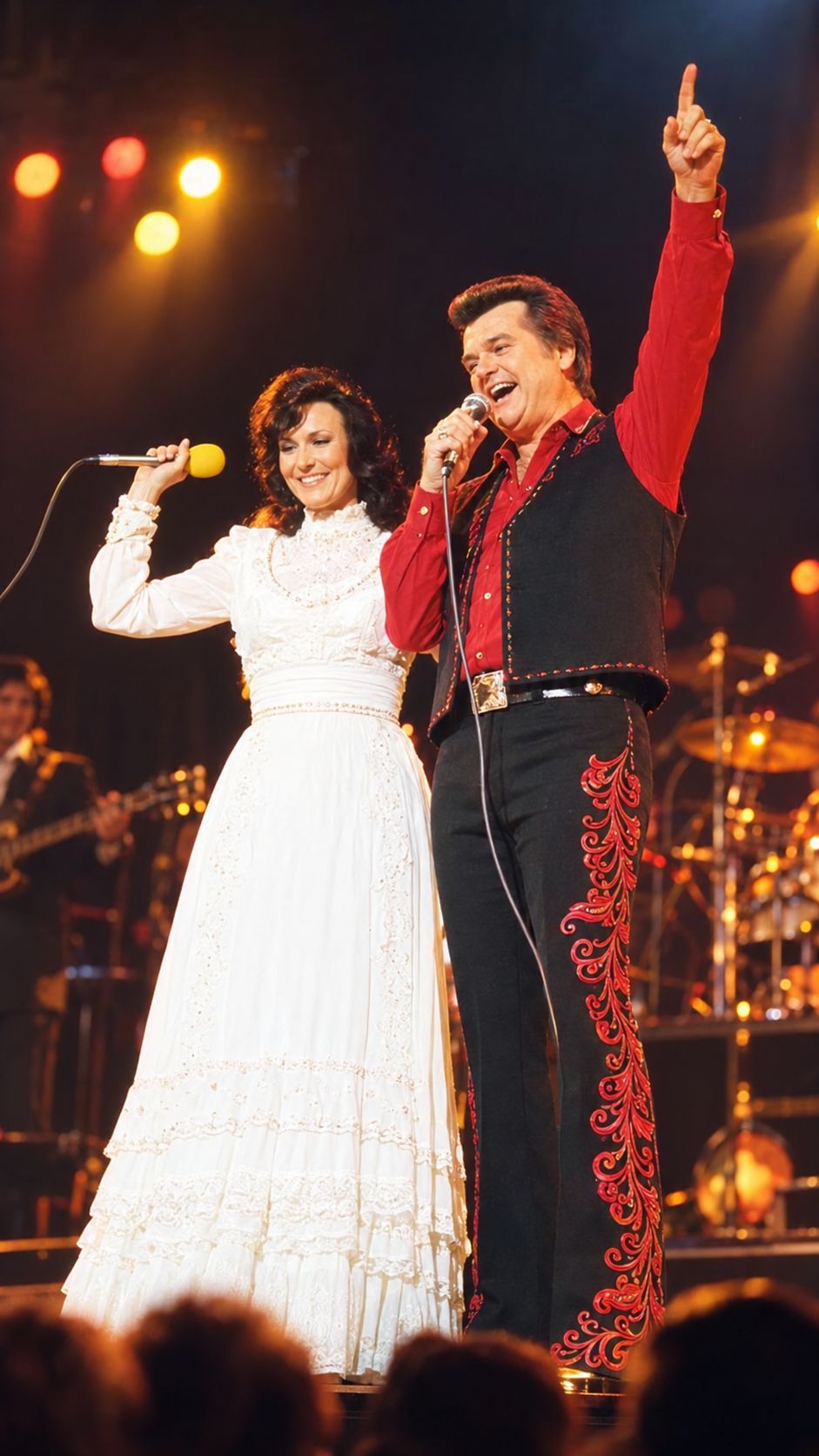
Few partnerships in country music history have captured the imagination of audiences quite like Conway Twitty and Loretta Lynn. When their voices came together, something extraordinary happened. His smooth, deeply expressive baritone blended with her unmistakable country twang, creating performances filled with tenderness, tension, heartbreak, and a kind of emotional honesty that seemed to reach beyond the boundaries of a recording studio. Their songs told stories of love tested by temptation, relationships strained by distance, and hearts caught between desire and responsibility.
Yet behind the unforgettable melodies and dazzling performances, their partnership has long inspired curiosity. Their convincing chemistry onstage led fans to wonder how much of their emotional connection extended beyond the music. In an industry fascinated by celebrity relationships, rumors, speculation, and public scrutiny could easily become part of the story surrounding two artists who made complicated love songs sound almost painfully real.
But there is an important distinction between the drama portrayed in a song, the chemistry witnessed by an audience, and the private truth of two people’s lives. The public fascination surrounding Conway Twitty and Loretta Lynn reveals as much about the power of country music storytelling as it does about the pressures faced by famous performers.
Their legacy, therefore, deserves more than sensational rumors. It deserves a closer look at their remarkable musical partnership, the speculation surrounding their connection, the challenges of maintaining public reputations, and the enduring songs that ultimately secured their place among country music’s most beloved duos.
THE SPARK THAT FUELED THE SPECULATION: WHEN MUSIC SOUNDED ALMOST TOO REAL
The story of Conway Twitty and Loretta Lynn began with two artists who had already established themselves as formidable talents. Twitty possessed a remarkable ability to communicate longing and vulnerability through his rich baritone, while Lynn had built her reputation on fearless storytelling, independence, and an unmistakable voice grounded in working-class life.
Their musical partnership emerged in the early 1970s, and their first major duet hit, After the Fire Is Gone, immediately demonstrated the extraordinary potential of their combined talents. Released in 1971, the song portrayed two people caught in an extramarital relationship, confronting the complicated emotions that arise when passion and commitment collide.
The performance was powerful precisely because neither singer softened the story’s uncomfortable edges. Twitty sounded like a man wrestling with desire, while Lynn delivered her lines with a mixture of conviction and vulnerability. Together, they created a musical conversation that felt almost private.
For listeners, the effect was captivating. For some observers, however, the emotional realism raised questions.
How could two performers communicate such convincing romantic tension without sharing a deeper personal connection?
That question became a recurring source of public fascination. The more convincingly they portrayed complicated relationships, the easier it became for audiences to blur the line between their artistic roles and their real lives.
Yet this is where the distinction matters most: a believable performance is not proof of a real-life affair. The speculation surrounding Twitty and Lynn grew largely from the emotional intensity of their music, not from established evidence that the two were romantically involved.
THE RUMORS AND INFIDELITY ALLEGATIONS THAT FOLLOWED THEIR SUCCESS
Country music has always thrived on stories of forbidden love, jealousy, betrayal, reconciliation, and the difficult choices people make when their hearts pull them in opposing directions. In the case of Conway Twitty and Loretta Lynn, those themes became inseparable from their public image as a duet partnership.
Their recordings frequently explored subjects that many listeners recognized from real life. The songs were not always comfortable or morally straightforward. They often presented characters who made mistakes, struggled with temptation, or discovered that love could survive even when trust had been damaged.
Because their voices blended so naturally, listeners sometimes wondered whether the emotions were more than theatrical.
The rumors surrounding their relationship became particularly intriguing because Loretta Lynn was married to Oliver “Doolittle” Lynn, widely known as Doo, throughout her career with Twitty. Her marriage had its own complicated history, much of which Lynn discussed candidly in her autobiographical writing and interviews. Meanwhile, Twitty maintained his own family life and professional commitments.
These circumstances made the romantic themes of their duets even more compelling to audiences who followed their careers.
However, responsible storytelling requires a clear distinction between speculation and documented history. There is no established evidence that proves the two singers carried on the affair that some listeners imagined. Indeed, Lynn publicly rejected that interpretation of their relationship, explaining that she loved Twitty as a friend and that her husband loved him as well.
This context changes how their story should be understood.
Rather than treating rumors as hidden confessions, it is more revealing to examine why audiences were so eager to believe them. Their performances invited listeners to imagine entire relationships within a few minutes of music. When the curtain fell, the emotional connection remained vivid in the audience’s memory.
In an age before social media, fan magazines, television appearances, and celebrity coverage helped shape public opinion. Today, a short performance clip can circulate online and generate thousands of theories about two artists’ private lives. Decades ago, the same fascination developed through radio, live shows, record sleeves, and conversations between devoted fans.
The technology changed, but the human instinct to search for a story behind a compelling performance remained remarkably consistent.
THE ROLE OF MARRIAGE, TRUST, AND PUBLIC SCRUTINY
To understand the atmosphere surrounding the partnership, it is important to consider the personal circumstances of both artists without inventing private confrontations or presenting unverified allegations as fact.
Loretta Lynn’s marriage to Doo Lynn was a significant part of her life story. She married young, raised a family, and pursued a demanding musical career while navigating the challenges of a long and often difficult relationship. Her willingness to discuss marriage honestly helped distinguish her from performers who preferred to maintain a carefully polished public image.
Her songs frequently challenged conventional expectations of women, addressing independence, fidelity, family pressures, and the realities of romantic relationships.
Against that background, her duets with Twitty could be interpreted in several ways. Some listeners heard pure romantic fantasy. Others recognized the emotional conflicts that had always made Lynn’s own songwriting so distinctive.
Twitty, meanwhile, brought a different kind of stage presence. His restrained delivery and smooth voice allowed the lyrics to carry the emotional weight. He rarely needed exaggerated gestures to make a song persuasive. A pause, a change in vocal intensity, or a carefully delivered line could suggest an entire history between two fictional characters.
Together, they created performances that were easy to misinterpret precisely because they were so effective.
Public scrutiny can place artists in an impossible position. If performers demonstrate little emotion, audiences may call them cold or unconvincing. If they portray romantic tension exceptionally well, some observers may assume that their characters reveal their private desires.
For Twitty and Lynn, the second possibility became part of the mythology surrounding their partnership.
But their lasting professional relationship is better understood through the qualities that made their collaboration successful: musical compatibility, complementary personalities, strong song selection, and a shared understanding of how to tell a story.
Their success also reminds us that friendship and artistic intimacy are not the same as romantic involvement. Two people can understand each other’s creative instincts, trust one another onstage, and produce deeply moving work without their relationship needing to conform to the audience’s assumptions.
THE SONGS THAT MADE THEIR CHEMISTRY IMPOSSIBLE TO IGNORE
<escape>1. “After the Fire Is Gone” — The Duet That Changed Everything</escape>
The 1971 recording remains one of the defining moments in the history of Conway Twitty and Loretta Lynn. Its portrayal of an extramarital relationship immediately established the emotional territory in which their partnership would flourish.
The song earned the duo a Grammy Award for Best Country Performance by a Duo or Group with Vocal, helping establish them as a major force in country music.
Its success also demonstrated a central truth about their appeal: audiences were willing to engage with morally complicated characters when the performances conveyed genuine emotional depth.
The song did not need a real-life scandal to become convincing. The writing, arrangement, and vocal interpretation were powerful enough on their own.
<escape>2. “Lead Me On” — The Tension Between Desire and Restraint</escape>
With Lead Me On, the pair continued exploring the uncertainty that can emerge when attraction collides with personal boundaries.
Their voices created a sense of conversation rather than a conventional duet in which each singer simply took a turn. Twitty’s smooth phrasing and Lynn’s direct delivery made the characters feel distinct, allowing the emotional tension to develop naturally.
The result was a performance that rewarded repeated listening, revealing different shades of vulnerability and hesitation with each encounter.
<escape>3. “Louisiana Woman, Mississippi Man” — A Celebration of Irresistible Chemistry</escape>
Not every memorable collaboration centered on infidelity or heartbreak.
Their 1973 hit Louisiana Woman, Mississippi Man offered a more playful and energetic picture of romance. The song’s geographical imagery, lively rhythm, and spirited exchanges transformed their partnership into an exuberant celebration of two people determined to overcome the distance between them.
The recording reached the top of the country charts and became one of their signature songs.
Its success showed that their appeal extended far beyond controversial subject matter. They could deliver humor, warmth, determination, and joy with the same ease that they brought to emotional ballads.
<escape>4. “As Soon as I Hang Up the Phone” — A Story Told Through Conversation</escape>
This memorable recording demonstrated another dimension of their storytelling ability.
Built around a telephone conversation, the song allowed the performers to create dramatic tension through spoken exchanges and sung passages. Instead of relying solely on melody, it used timing, pauses, and changing emotions to move the story forward.
The format highlighted their complementary strengths. Lynn could convey hurt and determination with remarkable clarity, while Twitty’s voice supplied a contrasting emotional perspective.
It was a reminder that their greatest asset was not simply romantic chemistry but the ability to make listeners feel as though they were witnessing a scene unfold.
<escape>5. “You’re the Reason Our Kids Are Ugly” — The Humor That Balanced the Drama</escape>
A discussion of their legacy would be incomplete without acknowledging their comic side.
You’re the Reason Our Kids Are Ugly showcased a playful exchange built around affectionate insults and domestic humor. The song challenged the assumption that a successful male-female duet needed to sound romantic or sentimental.
Instead, it allowed the singers to poke fun at each other and at the imperfections of everyday relationships.
This versatility was essential to their longevity. They were not confined to one emotional register, and their ability to shift between serious drama and lighthearted comedy made their partnership feel fresh across different recordings.
HOW TWO SOLO SUPERSTARS BUILT A LASTING LEGACY
The achievements of Conway Twitty and Loretta Lynn provide a more substantial measure of their success than any rumor ever could.
According to accounts of their careers, the pair recorded eleven studio albums together between 1971 and 1988. Their collaborations produced five No. 1 country singles, and they won the Country Music Association’s Vocal Duo of the Year award four consecutive times, from 1972 through 1975.
These accomplishments were not the product of public curiosity alone. They reflected a partnership that consistently delivered commercially successful recordings while preserving the individuality of both artists.
Loretta Lynn remained a major country music figure in her own right, celebrated for songs that spoke directly to women’s experiences and challenged social expectations. Her career demonstrated that a woman could be commercially successful while singing about subjects that others might consider uncomfortable.
Conway Twitty built an equally formidable reputation as a solo performer. His smooth vocal style, instinct for memorable melodies, and ability to communicate romantic vulnerability helped him become one of country music’s most successful recording artists.
Their collaboration strengthened rather than erased their individual identities.
That distinction is crucial. Some duos become famous because their members seem inseparable, but the most enduring partnerships allow both artists to retain their own creative strengths. Twitty and Lynn could stand together onstage without either voice losing its character.
Their professional success also depended on practical decisions. Both artists maintained solo careers, and their collaborative recordings complemented rather than replaced their individual work. The arrangement gave audiences something special without requiring either performer to abandon the career that had brought them to prominence.
Behind the apparent spontaneity of their performances was the discipline of experienced professionals who understood the demands of recording, touring, and sustaining a musical reputation.
WHAT THEIR STORY REVEALS ABOUT FAME AND THE POWER OF RUMORS
The enduring fascination with Conway Twitty and Loretta Lynn illustrates a recurring challenge for public figures: audiences often want access not only to the art but also to the private lives they imagine behind it.
A romantic duet can inspire listeners to remember their first love. A song about betrayal can bring back a painful relationship. A performance filled with longing can make an audience wonder whether the singers have experienced the same emotions themselves.
Those reactions are part of music’s extraordinary power. Problems arise when an emotional response becomes an assumption about real people.
In the case of Twitty and Lynn, their songs created a convincing illusion of intimacy. That illusion became a central part of the public mythology surrounding them, even though Lynn explicitly described their connection as friendship.
Their story therefore offers an important lesson for modern entertainment culture. Public fascination is not proof, chemistry is not confirmation, and a compelling story is not necessarily a documented fact.
Sensational headlines may attract attention, but the truth of their achievement is already remarkable. Two highly accomplished artists found a way to combine distinct voices, interpret complicated songs, and maintain a successful partnership over many years.
They did so in an industry that constantly demanded new hits, fresh performances, and the ability to connect with changing audiences.
The most meaningful response to the rumors is not to invent a secret romance or an unverified confrontation. It is to appreciate how their music made people care so deeply about the characters they portrayed.
THE FINAL VERDICT: A PARTNERSHIP THAT OUTLIVED THE SPECULATION
The legacy of Conway Twitty and Loretta Lynn cannot be reduced to questions about whether their onstage chemistry concealed something more.
Their partnership was built on musical intelligence, professional respect, contrasting vocal styles, and an extraordinary ability to tell stories about love in all its complicated forms. Their recordings could be tender, provocative, humorous, heartbreaking, or hopeful, sometimes within the same collection of songs.
The rumors followed them because the performances were convincing. Yet the documented achievements of their careers offer a far more enduring explanation for their place in country music history.
Twitty died in 1993, while Lynn died in 2022. Although neither artist is still here to perform their celebrated duets, their recordings continue to introduce new listeners to a partnership that helped define an era.
For longtime fans, those songs remain a connection to a time when country music could tell difficult stories without pretending that every relationship had a simple answer. For younger listeners, they offer a reminder that extraordinary musical chemistry does not depend on manufactured scandal.
Perhaps that is the most beautiful part of their story.
Conway Twitty and Loretta Lynn did not need a proven secret romance to make their duets unforgettable. Their voices, their songs, and their shared artistic legacy were more than enough.
And decades later, when the opening notes of After the Fire Is Gone or Louisiana Woman, Mississippi Man begin to play, listeners can still hear the magic that made their partnership legendary.
The rumors may remain part of the conversation, but the music is what endures.
Their greatest achievement was not convincing the world that their fictional love stories were real. It was making those stories feel real enough to touch millions of hearts.
VIDEO: