 By admin
 INTRODUCTION:
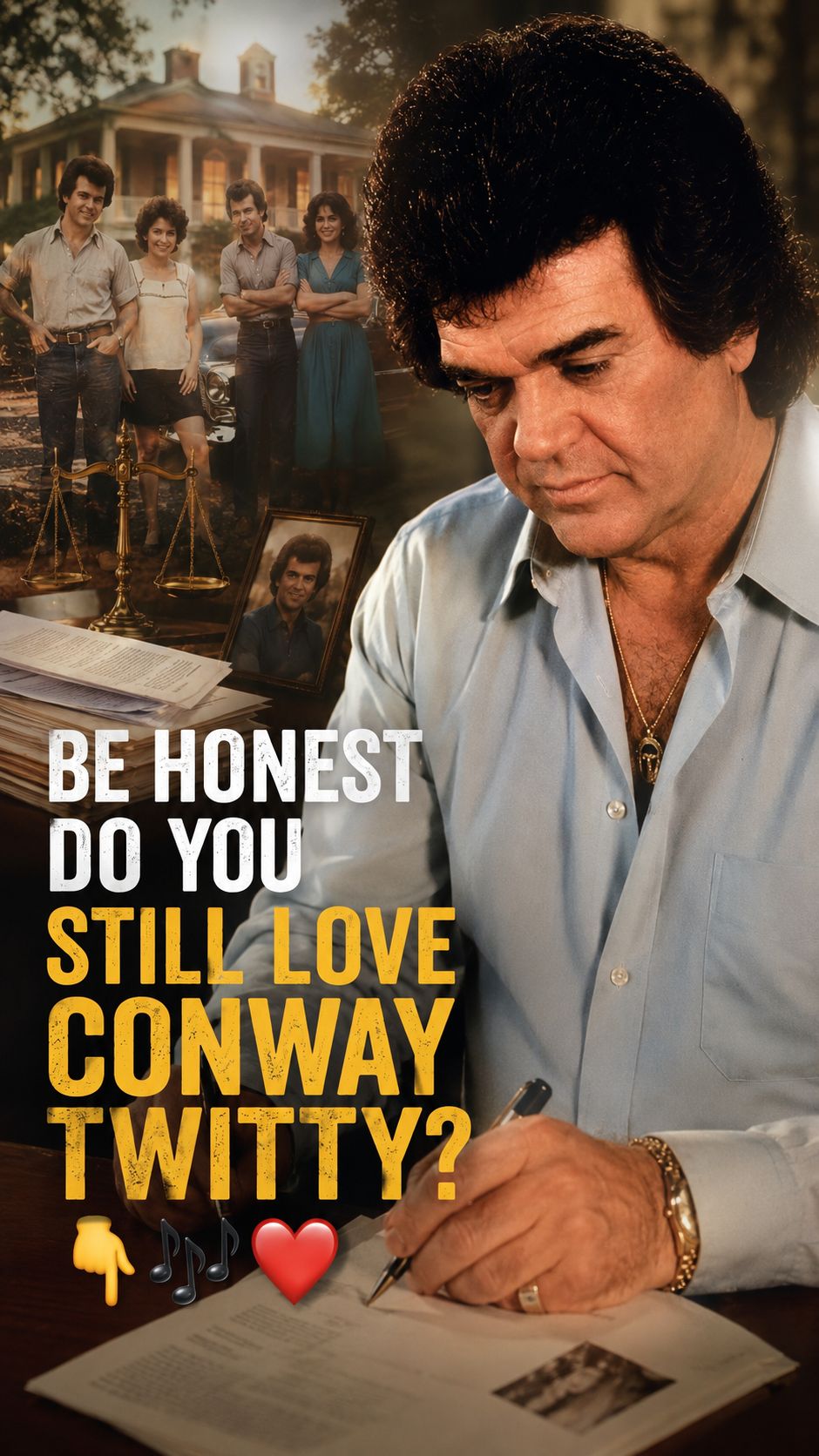
For decades, Conway Twitty sang about love, heartbreak, regret, loyalty, and the complicated spaces between people who once promised to stay together forever.
But after his death in 1993, the country superstar’s own family would find themselves living through a story that sounded almost like one of his songs.
There was money.
There was property.
There was music.
There was a famous name worth protecting.
And, at the center of it all, there was a family trying to determine what Conway Twitty himself had wanted.
The estate was commonly reported in the range of $12 million to $15 million, depending on the valuation and source. But the dollar figure only tells part of the story. The real battle was over something far more emotional: who had the right to carry Conway’s legacy into the future.
What followed became one of the most complicated estate fights in country music history, involving Twitty’s widow, his four adult children, business associates, lawyers, accountants, property, royalties, memorabilia, and ultimately the control of his name and music.
And it would last for years.
THE DAY THE MUSIC STOPPED
Conway Twitty died on June 5, 1993, at the age of 59.
Born Harold Lloyd Jenkins, he had reinvented himself several times during his career. He first became a major pop and rock-and-roll success with “It’s Only Make Believe” before establishing himself as one of country music’s most recognizable voices.
By the 1970s and 1980s, songs such as “Hello Darlin’” had transformed him into a country institution. His career produced an extraordinary run of hits, and his business empire eventually extended well beyond recording and touring.
But when Conway died, the question wasn’t simply how much money he had accumulated.
It was: What happened to everything he had built?
His 1982 will, with later codicils, named his four adult children—Michael, Joni, Kathy, and Jimmy Jenkins—as the principal beneficiaries, while also providing $50,000 to his mother. The problem was that the will had been created before his 1987 marriage to Delores “Dee” Henry Jenkins.
That single detail would become enormously important.
Because Conway had married Dee years after the will was written, Tennessee law gave his widow a statutory claim to a portion of the estate despite her absence from the document.
The family suddenly had a legal problem that could not be solved with a handshake.
THE WILL THAT HAD NEVER BEEN UPDATED
According to contemporary reporting, Conway and Dee had been working toward an updated estate plan during the years before his death, but the new documents were never completed and signed.
That omission would become the foundation of the conflict.
Contemporary reports said Tennessee law entitled Dee to one-third of Conway’s estate even though she was not named in the old will.
On paper, it was a legal issue.
Inside the family, however, it was much more personal.
Conway’s children believed their father had clearly expressed his wishes.
Dee, meanwhile, was Conway’s wife and had been deeply involved in his life and business during their marriage.
Both sides had reasons to believe they were protecting something important.
And that is often where inheritance disputes become most painful.
Because when family members enter a courtroom, they aren’t merely arguing about numbers.
They are arguing about memories.
About promises.
About who was closest to the person who died.
About what that person would have wanted.
And sometimes, about who gets to tell the story afterward.
TWITTY CITY BECAME A SYMBOL OF THE WAR
Perhaps nothing represented Conway Twitty’s empire more vividly than Twitty City in Hendersonville, Tennessee.
It wasn’t simply a residence.
It was part home, part business complex, part family world, and part monument to Conway’s success.
His children had lived and worked around the property. It represented a time when the Twitty family existed together inside the enormous world Conway had built.
After his death, however, Twitty City became another battlefield.
The dispute over the estate eventually led to efforts to liquidate major portions of Conway’s property and possessions. Later accounts describe the sale of Twitty City and the auctioning of memorabilia, instruments, trophies, photographs, and other personal belongings.
Imagine the emotional weight of that.
The trophies that once celebrated a career.
The photographs that captured childhood.
The objects that had surrounded Conway during the years when his children were growing up.
Suddenly, they weren’t simply family possessions.
They were estate assets.
And estate assets can be assigned a price.
That is one of the cruelest realities of death inside a wealthy family.
Something that has enormous sentimental value to one person may appear on a balance sheet as nothing more than property.
THE COURTROOM BATTLE GOT UGLIER
The legal fight wasn’t limited to the widow’s share.
Conway’s children also challenged the role of the estate’s executors and became involved in disputes over financial records and transactions.
One particularly important Tennessee appellate case involved claims concerning alleged debts owed by Conway’s daughters Kathy and Joni.
The court record reveals how complicated the family’s financial arrangements had become.
The children had lived in condominiums associated with Twitty Enterprises, worked for their father’s business, received salaries and bonuses, and had personal expenses recorded through accounts maintained by the company.
The estate later sought repayment of certain amounts.
The daughters disputed aspects of those claims.
The case demonstrates something that is easy to overlook when looking at a celebrity estate from the outside:
Conway’s family and business lives were deeply intertwined.
That may have worked while Conway was alive.
After he died, it created an accounting nightmare.
What had once been a father’s generosity could suddenly look like a loan.
What had once been a family arrangement could become a legal obligation.
And what had once been informal could become evidence.
“THIS WAS A WAR WE HAD TO FIGHT”
The emotional intensity of the dispute was evident in statements attributed to Conway’s daughters.
Following a major appellate decision in 1999, Joni described the fight in extraordinarily personal terms:
“This was a war we had to fight.”
She and her sister Kathy argued that they were fighting to preserve their father’s wishes and protect the legacy he intended to pass down to his children and future generations.
That statement reveals why the battle became so much bigger than money.
For Conway’s children, the issue wasn’t simply whether they would inherit millions.
They believed they were fighting for their father’s final voice.
And there was another priceless asset at stake:
Conway Twitty’s identity.
His name.
His image.
His music.
His intellectual property.
His legacy.
THE 1999 APPEALS COURT DECISION
After years of litigation, the Tennessee Court of Appeals issued a significant ruling in June 1999.
The court’s opinion confirmed that Conway’s four children were the beneficiaries under his will, while also addressing Dee Jenkins’ statutory rights as the surviving spouse. The decision dealt with multiple issues surrounding the administration and division of the estate.
The result was not a simple victory for one side.
Dee retained important legal rights.
The children retained important rights of their own.
And the estate remained extraordinarily complicated.
Contemporary reporting described the fortune as having remained unresolved for nearly seven years by 1999, with the widow ultimately entitled to a one-third share under Tennessee law.
The children, however, ultimately obtained control of Conway’s name, image, and music-related intellectual property through the complicated legal proceedings.
That distinction mattered enormously.
Because the estate was not just a house and bank account.
It was Conway Twitty.
THE MUSIC WAS WORTH MORE THAN THE MEMORABILIA
A country star’s estate can contain two very different kinds of wealth.
There is the physical wealth: homes, cars, instruments, furniture, awards, photographs, clothing, and personal possessions.
Then there is the invisible wealth.
The songs.
The publishing.
The royalties.
The name.
The image.
The right to license the legacy.
The second category can continue producing money long after the artist is gone.
That is why control over Conway Twitty’s intellectual property became such a critical part of the dispute.
Years after his death, the family would face another controversy involving a 1990 agreement with Sony/ATV Music Publishing. In 2008, Conway’s four children sued over the arrangement, arguing that its terms and their understanding of the rights involved were problematic.
So although the original estate fight had begun in the aftermath of Conway’s death, questions about his musical legacy continued to echo well beyond the first courtroom battles.
THE TRAGEDY OF A FAMILY LEGACY
There is an uncomfortable irony in the entire story.
Conway Twitty built his career by understanding emotion.
His greatest songs worked because listeners recognized themselves in them.
He understood that love could turn into loneliness.
That devotion could become heartbreak.
That people could care deeply about one another and still find themselves separated by circumstances they couldn’t control.
After his death, his own family lived through precisely that kind of contradiction.
People who had once gathered around the same man were now on opposite sides of legal arguments.
A family that had shared the extraordinary experience of growing up around a country superstar was suddenly divided over the meaning of his final wishes.
And the longer the fight continued, the more expensive—and emotionally exhausting—it became.
By the late 1990s, the legal battle had already consumed years.
Some later accounts characterize the broader estate saga as lasting roughly 15 years, particularly when subsequent disputes over Conway’s business and intellectual property are included.
WHAT CONWAY LEFT BEHIND
Conway Twitty died before he could see the full consequences of his unfinished estate planning.
That may be the saddest part of the story.
He left behind a remarkable catalog.
He left behind millions of fans.
He left behind four children.
He left behind a wife.
He left behind businesses, properties, recordings, memories, and a name that had become synonymous with country music.
But he also left behind an estate plan that had not fully caught up with the life he was living when he died.
And that gap created years of conflict.
“We took more than just flowers to our father’s grave this Father’s Day,” Kathy Jenkins said after the 1999 appellate victory. “We took him justice.”
Whether one views the dispute through the eyes of the children, the widow, or the courts, the emotional lesson is difficult to escape.
Money did not create the memories.
Conway created those.
But money, property, contracts, copyrights, and legal rights determined who could control what remained after he was gone.
THE LEGACY THAT SURVIVED THE WAR
Today, decades after Conway Twitty’s death, the courtroom documents are only one chapter of his story.
Fans still hear “Hello Darlin’”.
They still remember his unmistakable voice.
They still revisit his recordings with Loretta Lynn.
They still talk about the man behind the rhinestone suits, the deep voice, and the endless string of country hits.
And perhaps that is the final twist.
The estate dispute was enormous.
The legal bills were real.
The family wounds were real.
Properties disappeared.
Memorabilia was sold.
Years passed.
But the music survived.
The name survived.
The voice survived.
And the story of Conway Twitty continues to fascinate country fans precisely because it reminds us that behind every legendary performer is a human life—with family relationships, unfinished plans, complicated emotions, and decisions that can echo for generations.
Conway Twitty spent his life singing about the things people could lose.
In the end, his own estate became a painful demonstration of exactly that.
The $15 million fortune may have started the headlines.
But the real battle was never only about money.
It was about who had the right to decide what Conway Twitty wanted—and who would carry his name after the final curtain fell.
And perhaps that is why this extraordinary estate battle remains one of the most haunting chapters in the history of country music.
VIDEO: