 By admin
INTRODUCTION:
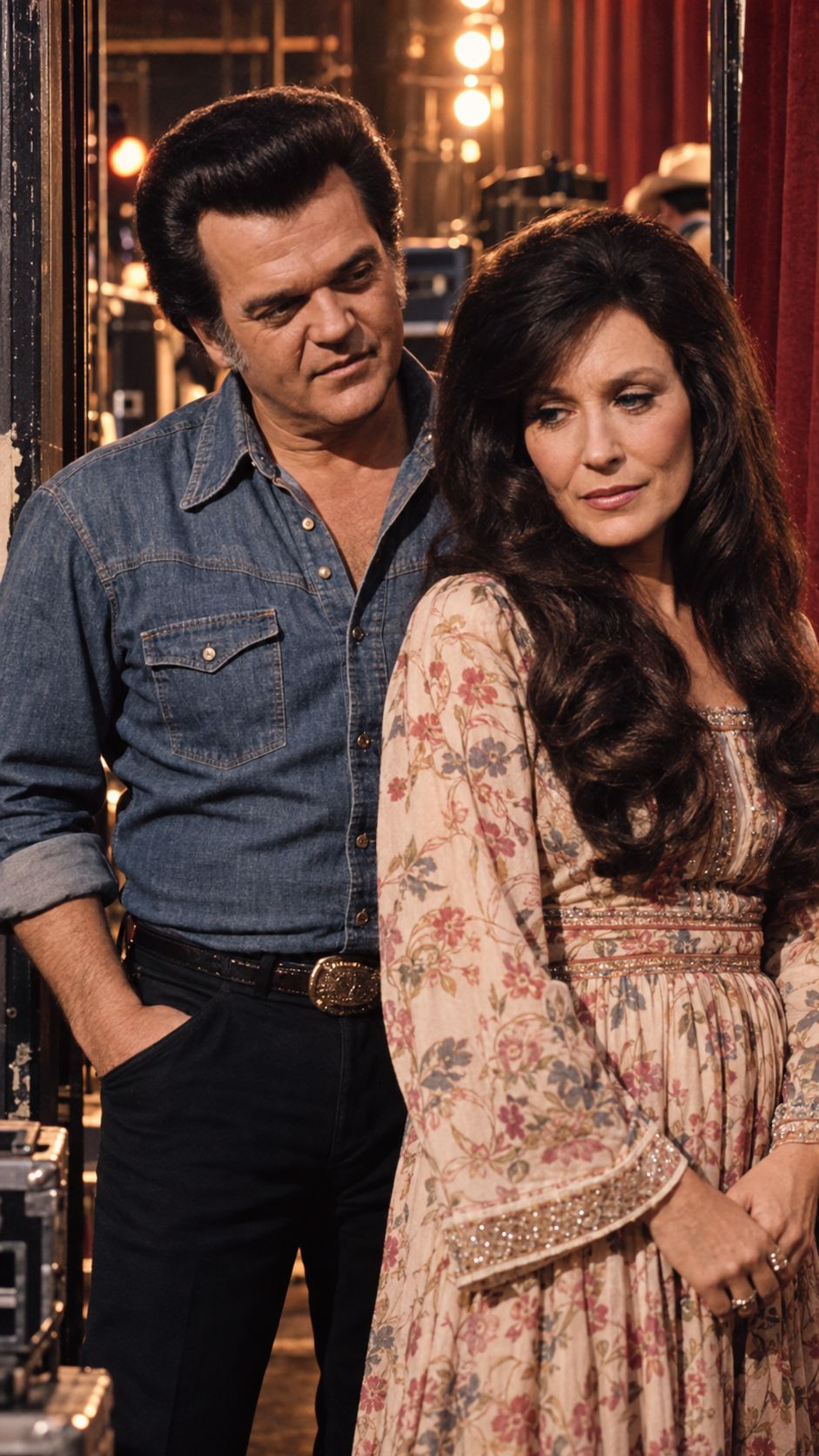
There are musical partnerships that entertain us, and then there are those that make us feel as though we have been invited into someone else’s most private moments. When Conway Twitty and Loretta Lynn stood together to sing, something extraordinary happened. Their voices blended with a tenderness that felt almost too personal, their expressions seemed to tell stories beyond the lyrics, and their performances carried an emotional intensity that made millions of country music fans wonder what truly existed between them.
For decades, their unforgettable duets have inspired questions about love, loyalty, temptation, and the delicate line between performance and reality. Songs such as After the Fire Is Gone and As Soon as I Hang Up the Phone did more than showcase two remarkable singers. They transformed ordinary stories of heartbreak and forbidden affection into dramatic musical experiences that listeners could feel deep in their hearts.
But here is the question that continues to fascinate fans: could the extraordinary chemistry between these two country legends have created tension in their private lives? Did the people closest to them ever struggle with the powerful connection audiences witnessed onstage?
The truth is more complicated than the rumors. Behind the speculation lies a story about two professionals, two established family lives, the pressures of public attention, and the remarkable ability of music to make an imagined romance feel startlingly real. To understand their legacy, we must look beyond the whispers and discover why their partnership became so convincing that generations of listeners still wonder whether the magic was ever entirely an act.
1. When Two Voices Created a Romance That Felt Almost Too Real
The story began not with a scandal, but with an artistic discovery.
Loretta Lynn and Conway Twitty were already accomplished performers when their musical partnership took shape in the early 1970s. Lynn had established herself as a fearless storyteller whose songs explored marriage, heartbreak, loyalty, and the complicated realities of women’s lives. Twitty, meanwhile, possessed a smooth, expressive voice that could make even a simple lyric sound like a private confession.
According to Lynn, the idea for their collaboration developed after the two singers performed together informally in dressing rooms while traveling overseas. When they returned home, they sang for their producer, Owen Bradley, who recognized the potential and encouraged them to record together.
That moment would change country music history.
What made the partnership so compelling was not simply the beauty of their voices. It was the contrast between them. Twitty often sounded calm, confident, and emotionally restrained, while Lynn brought a directness that could make a conversation between two fictional lovers feel painfully authentic.
Neither singer needed to overpower the other. They understood how to leave space for a pause, how to answer a line with a subtle change in tone, and how to make a shared chorus feel like the inevitable conclusion of a deeply personal conversation.
To listeners, it sounded intimate.
To music lovers who had spent years watching country singers perform predictable duets, it felt different. These were not two artists merely taking turns singing verses. They were building a story together.
And when the story involved forbidden love, emotional dissatisfaction, or the temptation to betray a marriage, the effect could be extraordinary.
The audience did not just hear the characters. It began to believe in them.
2. The Song That Started the Whispers: After the Fire Is Gone

If one recording helped turn speculation about Conway Twitty and Loretta Lynn into a lasting part of country music folklore, it was After the Fire Is Gone.
Released in 1971, the song tells the story of two people who seek comfort in one another because the love in their respective homes has faded. Their attraction is complicated by guilt, secrecy, and the knowledge that their choices may hurt others.
It is an uncomfortable subject, even by the standards of a genre that has always been willing to explore the darker corners of relationships.
But the song’s power comes from its refusal to make the situation simple.
There is longing in the performance, but there is also regret. There is tenderness, but there is an unmistakable awareness that the characters are crossing a line. Rather than presenting romance as a perfect escape, the song captures the emotional consequences of looking for love outside a failing relationship.
Twitty delivers his lines with a quiet intensity. Lynn responds with the emotional clarity that made her one of country music’s most distinctive voices. Together, they create the impression of two people who understand one another all too well.
The recording became their first No. 1 country hit as a duo and won them a Grammy Award.
Yet its success brought an unexpected complication: audiences began wondering whether the performers were singing from personal experience.
Lynn later acknowledged that people assumed she and Twitty were romantically involved because of the songs they recorded. She firmly rejected that interpretation, explaining that they were friends, not lovers. She also recalled that her husband, Oliver “Doolittle” Lynn, liked Twitty and had a friendly relationship with him.
That distinction is crucial.
A convincing performance can make listeners feel that they are witnessing a real romance, but emotional authenticity is not proof of an affair.
In fact, the duo’s ability to make complicated fictional situations feel believable may be the strongest evidence of their talent.
3. Were Their Spouses Really Jealous?

This is where the story becomes especially interesting, because the popular version of their history can be much more dramatic than the documented facts.
The headline practically writes itself: a jealous husband, a seductive singing partner, a forbidden song, and a marriage supposedly threatened by the chemistry between two stars.
But was that really what happened?
There is no solid, widely established evidence that jealous spouses nearly destroyed the partnership between Twitty and Lynn. Their romantic repertoire inspired rumors, but those rumors should not be confused with proof of marital ultimatums, secret affairs, or attempts to end their musical collaboration.
Lynn’s own account offers a different perspective. She described Twitty as a friend and indicated that her husband liked him. The available historical accounts therefore do not support the sweeping claim that her marriage was nearly destroyed by the duet partnership.
Still, the question of jealousy is worth examining from a broader perspective.
Imagine being the spouse of a performer whose work requires them to sing about desire, heartbreak, and longing with another person night after night. Imagine watching an audience cheer when those two performers exchange knowing glances or lean into a shared lyric.
Even when everyone understands that the performance is theatrical, the emotions can look remarkably convincing.
That situation could create uncomfortable questions in any relationship. Where does artistic expression end? How should a spouse respond when millions of strangers romanticize their partner’s professional relationship? And what happens when a fictional love story becomes more famous than the real people performing it?
These are reasonable questions about the pressures of public life. They are not evidence that a particular spouse acted jealously.
In Lynn and Twitty’s case, the distinction matters because their partnership was too important to reduce to an unverified domestic scandal.
The more revealing story is that their performances were so convincing that even listeners who knew better could find themselves wondering what happened when the music stopped.
4. Oliver Lynn: The Husband Behind the Headlines
To understand the speculation surrounding Loretta Lynn, it helps to understand the place her husband occupied in her life and career.
Oliver “Doolittle” Lynn, commonly known as Doo, was her husband and manager. Their relationship was complicated, and Lynn spoke openly throughout her life about the difficulties they experienced together. Her music frequently explored the realities of marriage without pretending that love automatically made every problem disappear.
That history matters because audiences sometimes project the emotional conflicts in a singer’s songs onto the singer’s private life.
When Lynn sang about betrayal, listeners wondered whether she had experienced it. When she sang about a woman confronting a difficult husband, people searched for parallels in her marriage. And when she performed a passionate duet with Twitty, some listeners interpreted the chemistry as evidence of a hidden personal connection.
But these interpretations do not automatically establish facts.
Indeed, Doo Lynn reportedly helped find the song Louisiana Woman, Mississippi Man for the duo, demonstrating that his involvement in Loretta’s career was not simply a matter of standing outside the musical partnership.
That detail complicates the familiar image of a husband watching helplessly as his wife develops a musical bond with another man.
Rather than assuming that the partnership was a battle between a husband and a duet partner, it is more accurate to recognize that country music careers often involve entire networks of spouses, managers, musicians, producers, and collaborators.
The private dynamics of those relationships are not always visible to the public.
What is clear is that Lynn continued to work with Twitty, and their partnership produced a remarkable body of recordings. The historical record gives us much stronger reasons to celebrate their professional achievement than to declare that a jealous spouse nearly brought it to an end.
5. The Magic of As Soon as I Hang Up the Phone

If After the Fire Is Gone introduced listeners to the emotional complexity of the duo, As Soon as I Hang Up the Phone demonstrated just how inventive their storytelling could become.
The song, associated with their 1974 album Country Partners, unfolds like a miniature radio drama. Rather than relying exclusively on conventional duet harmonies, it uses spoken dialogue and singing to create the feeling of an intimate telephone conversation.
The format places listeners in the middle of a relationship at a moment of emotional uncertainty. One voice reveals a painful truth, while the other attempts to respond. The result feels less like a polished studio performance and more like an overheard exchange between two people who are struggling to say what they really mean.
That approach reveals an important part of Twitty and Lynn’s genius: they understood that the most compelling romantic songs are often built around what remains unsaid.
A hesitation can communicate doubt. A quiet response can suggest hurt. A familiar phrase can become devastating when delivered at precisely the wrong moment.
Their performances invited listeners to imagine the characters’ lives beyond the recording. Who were these people before the conversation began? What had happened between them? Would their relationship survive the truth?
That sense of narrative intimacy also helps explain why fans continued to speculate about the singers themselves.
When artists convincingly portray emotional vulnerability, audiences can begin to confuse the feelings of the characters with the feelings of the performers.
But acting through song is an art. The ability to communicate heartbreak does not require a singer to be experiencing that exact heartbreak in real life.
Twitty and Lynn knew how to turn a few minutes of music into an entire emotional universe. That achievement deserves more attention than any unsupported claim about a secret romance.
6. Louisiana Woman, Mississippi Man: When Chemistry Became Joy

Not every great Conway Twitty and Loretta Lynn duet depended on sadness or forbidden desire.
Their 1973 hit Louisiana Woman, Mississippi Man revealed another side of their partnership: playful competition, spirited flirtation, and the excitement of two strong personalities pushing against each other.
The song builds its appeal around a geographical divide between its characters. Rather than allowing that distance to become a source of tragedy, it turns the obstacle into a lively exchange of challenges and declarations.
The energy is different from the weary longing of After the Fire Is Gone.
Here, the singers sound animated and mischievous. Their voices bounce between one another, creating a musical conversation that feels spontaneous even within a carefully crafted arrangement.
The song also demonstrates why the duo could appeal to such a wide audience. They were not trapped in one emotional register. They could perform sorrow, temptation, humor, affection, and determination with equal conviction.
Their 1973 album of the same name reached No. 1 on the country album chart, further cementing their status as one of the genre’s defining partnerships.
This success also challenges the notion that their relationship depended on scandal.
If their appeal had rested entirely on rumors of a forbidden romance, the partnership might have struggled to sustain itself across so many different kinds of songs.
Instead, their catalog offered variety, consistency, and a recognizable musical identity.
The chemistry was real in the sense that mattered most: two accomplished performers understood how to bring out the best in one another.
7. Eleven Albums, Award-Winning Success, and a Partnership That Endured
The scale of the achievement is easy to overlook when attention is focused on personal rumors.
Conway Twitty and Loretta Lynn recorded 11 studio albums together between 1971 and 1988. Their partnership produced five No. 1 country singles, and they won the Country Music Association’s Vocal Duo of the Year award four consecutive times, from 1972 through 1975.
Those accomplishments were not the result of a single sensational song.
They reflected a sustained creative relationship in which both artists repeatedly found material that suited their combined strengths.
Twitty’s smooth delivery offered a sense of restraint and assurance. Lynn’s voice brought personality, conviction, and a direct emotional presence. The contrast made their performances distinctive, while their shared instincts allowed them to sound unified.
Their partnership also benefited from a deep understanding of country music’s narrative traditions.
Country songs frequently examine the tension between what people want and what they believe they should do. They explore the difference between public appearances and private pain, the promises people make and the mistakes they regret, and the ways ordinary lives can be transformed by extraordinary emotions.
Twitty and Lynn understood that territory.
They did not need to convince listeners that they were secretly in love. They needed to convince listeners that the characters in their songs were in love, unhappy, tempted, or afraid.
And they succeeded so consistently that their performances became part of country music’s collective memory.
The awards and recordings provide a more substantial explanation for their enduring legacy than any dramatic story about spouses attempting to end their collaboration.
Their achievement was artistic, professional, and deeply human.
8. Why the Jealous-Spouse Story Refuses to Disappear
There is a reason the question continues to attract attention decades later.
Stories about great music partnerships are rarely told through recordings alone. Audiences want to know what happened backstage, what the performers thought of one another, whether their families approved, and whether the feelings expressed in their songs ever crossed into their private lives.
The more convincing the music, the more irresistible these questions become.
With Conway Twitty and Loretta Lynn, several ingredients combined to create an enduring mythology: romantic lyrics, intimate performances, two singers with contrasting vocal personalities, and a partnership that lasted for years.
Their best-known songs gave listeners plenty of material for speculation.
After the Fire Is Gone explored a relationship outside marriage. As Soon as I Hang Up the Phone turned a telephone conversation into a dramatic emotional encounter. Louisiana Woman, Mississippi Man presented romantic attraction through playful conflict.
Together, these recordings offered a wide range of fictional relationships, each rendered with unusual conviction.
It was almost inevitable that some listeners would begin to ask whether the singers’ personal relationship mirrored the stories they performed.
Sensational retellings can then turn those questions into supposed revelations, adding jealous spouses, secret confrontations, or forbidden romances without establishing that those events actually happened.
That is how a compelling question can gradually become an exaggerated narrative.
The more responsible approach is to preserve the mystery that genuinely exists without inventing private events. We can acknowledge that the chemistry was extraordinary, that the songs explored emotionally charged subjects, and that fans speculated about the singers.
We can also respect Lynn’s own account that she and Twitty were friends rather than lovers.
Their legacy does not become less fascinating when the rumors are examined carefully. In many ways, it becomes more impressive.
They created performances so persuasive that audiences continued discussing them long after the final notes faded.
9. What Really Made Their Partnership Almost Impossible to Replace?
The deepest secret behind Conway Twitty and Loretta Lynn’s success may have been the balance between individuality and connection.
Neither artist disappeared into the partnership.
Lynn remained the candid, independent voice who had built a career on telling stories that other performers might have avoided. Twitty retained the smooth, emotionally controlled style that made him one of country music’s most recognizable male singers.
Together, they created something neither could have achieved in quite the same way alone.
Their voices did not simply blend. They reacted to one another.
One singer could introduce a thought, and the other could transform its meaning with a single response. A lyric that sounded straightforward in isolation could acquire new emotional weight when placed in conversation with the other performer.
This is the essential art of a great duet: the relationship between the voices becomes part of the story.
It also explains why the partnership has continued to inspire musicians and listeners across generations. Later performers have returned to their repertoire because the songs offer more than memorable melodies. They provide lessons in timing, phrasing, dramatic structure, and the emotional possibilities of singing with another person.
Their influence is visible in the continued celebration of their music, including modern performances that revisit classics such as Louisiana Woman, Mississippi Man and After the Fire Is Gone.
The partnership’s enduring appeal was not dependent on whether the singers shared a secret romance.
It depended on something much more difficult to manufacture: trust between performers, a shared understanding of the material, and the ability to make a fictional story feel emotionally true.
That is why their recordings remain compelling even to listeners who know the rumors and understand the distinction between a performance and a private relationship.
10. The Final Truth: Did Jealous Spouses Almost Ruin Country Music’s Greatest Duet?
The question makes for a dramatic headline, but the most responsible answer is more nuanced than the rumor suggests.
There is no well-established evidence that jealous spouses nearly destroyed the partnership between Conway Twitty and Loretta Lynn. Their romantic songs certainly encouraged speculation, but Lynn publicly described their relationship as a friendship and recalled that her husband liked Twitty. The documented history points toward a successful musical collaboration rather than a partnership demonstrably on the brink of collapse because of jealousy.
That does not mean the story lacks drama.
The real drama lies in the extraordinary contrast between the songs’ fictional relationships and the performers’ lives outside the recording studio. It lies in the challenge of portraying temptation without being mistaken for the character, and in the strange experience of watching millions of listeners invest in a romance that exists primarily through music.
For Loretta Lynn, the partnership brought another dimension to a career already defined by fearless storytelling. For Conway Twitty, it created an opportunity to demonstrate the expressive power of his voice alongside one of country music’s most distinctive female performers.
For their audiences, it provided decades of unforgettable songs.
And perhaps that is the most remarkable part of the entire story.
The rumors have survived because the music was convincing. The music has survived because the performers were exceptional.
Their greatest duets did not need a real-life scandal to make them meaningful. They needed honest storytelling, contrasting voices, and the courage to explore emotions that people often struggle to discuss openly.
More than half a century after After the Fire Is Gone first captivated country music audiences, the partnership still invites listeners to ask questions about love, loyalty, and the mysteries of human connection.
But the enduring truth is not that a jealous spouse almost destroyed a great musical partnership.
It is that Conway Twitty and Loretta Lynn created something so emotionally powerful that listeners still want to believe there must have been a secret behind it.
Sometimes, the greatest mystery in music is not what happened behind closed doors.
It is how two people can stand on a stage, sing a story that belongs to someone else, and make millions of listeners feel as though they are hearing their own hearts speak.
And that is a kind of magic that jealousy, gossip, and time have never managed to erase
VIDEO: